Occitanie Travel Guide: Where to Stay, Eat & Explore in Luxury
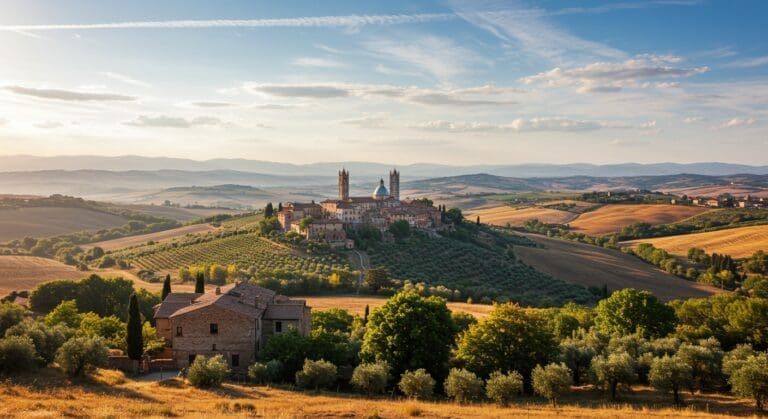
Sometime around six in the evening, when the heat has finally lost its argument with the day, the air in Occitanie does something quite specific. It carries lavender and hot stone and the faint ghost of a wood fire, all at once, as if the landscape is exhaling. The cicadas are still going – they always are, with the commitment of tiny musicians on a deadline – and somewhere nearby someone is opening wine. This is not a metaphor. This is just Tuesday in southern France.
Occitanie is, to put it plainly, one of the great overlooked luxury destinations in Europe. Not overlooked by the French, obviously – they have always known – but overlooked in the sense that it hasn’t been overrun, overpriced, or reduced to a mood board aesthetic the way certain other regions have. It rewards the traveller who does a little homework. Families seeking genuine privacy rather than a hotel corridor find it here, in estates where the children can run and the adults can breathe without managing the distance between the two. Couples marking a milestone – an anniversary, a significant birthday, that trip you’ve been promising yourselves for years – find that the combination of serious gastronomy, ancient landscapes and a particular quality of afternoon light does something rather good for a relationship. Groups of friends, the kind who have stopped pretending they want to share rooms, discover that a large villa in the Languedoc countryside solves almost every logistical and diplomatic problem at once. And the growing tribe of remote workers who have realised that fibre broadband and a private pool are not mutually exclusive find in Occitanie a setting that makes answering emails feel, if not exactly pleasurable, then at least considerably less grim. Wellness travellers, too – the serious ones who want thermal waters, long cycling routes and meals built around vegetables grown in actual soil – are increasingly choosing Occitanie over the more predictable spa destinations. It is, in other words, a region for people who know what they want.
Getting Here Without the Indignity of a Four-Hour Transfer
Occitanie stretches from the Mediterranean coast to the edge of the Pyrenees, which means the question of how to arrive depends very much on where you’re going. The region’s two major airports are Toulouse-Blagnac and Montpellier Méditerranée, both well served by direct flights from across Europe. From London – indeed from most of the United Kingdom – you’re looking at two hours in the air, which still feels like a small miracle when you emerge into sunshine that means business.
Carcassonne Airport handles seasonal routes from several UK and northern European cities and puts you within striking distance of the Aude vineyards, the Corbières hills and the Canal du Midi without ever going near a motorway interchange that tests your faith in signage. Béziers Cap d’Agde Airport is another useful entry point for the Hérault coast and the wine country of the Languedoc. For the Pyrenees end of the region – the Ariège, the Hautes-Pyrénées, the ski resorts above Cauterets and Font Romeu – Tarbes-Lourdes-Pyrénées Airport is the pragmatic choice, though Toulouse remains accessible enough for most western Pyrenean destinations with a pleasant drive through increasingly dramatic scenery.
The train network deserves mention. The TGV connects Paris to Montpellier in just over three hours and to Toulouse in about the same time, and there is something undeniably civilised about arriving by high-speed rail, glass of something cold in hand, watching the landscape shift from the grey-green of the north to the bone-white light of the south. Within the region, a hire car is essentially non-negotiable unless you’re based in a city. The beauty of Occitanie – those limestone plateaux, those vine-wrapped hillsides, those villages that appear to have been assembled by someone who prioritised views over accessibility – is not accessible by bus. Nor should it be.
Where to Eat: A Region That Takes This Seriously
Fine Dining
The case for Occitanie as a serious gastronomic destination rests, at its apex, on a single address in a village that most people have never heard of. Fontjoncouse, in the wild limestone scrubland of the Aude, is not the sort of place you stumble across. You go there deliberately, with a reservation that took planning, because Gilles Goujon’s Auberge du Vieux Puits holds three Michelin stars and was named by Tripadvisor in 2020 as the best gastronomic restaurant in the world. That is not a small claim, and Goujon backs it up without apparent effort. Now working alongside his sons Enzo on savoury and Axel on sweet, the cooking here is about restraint and honesty – about stepping back and letting the ingredients of the Corbières speak without interruption. It is the kind of meal that rearranges your understanding of what food can be. The journey to get there is part of the ritual.
In Laguiole, high in the Aveyron on the Aubrac plateau where the wind has opinions, the Maison Bras tells a different story – one of land, of memory, of a family that has spent decades listening to a single extraordinary landscape. Michel Bras, who gave the world the molten chocolate fondant (you are welcome) and the legendary gargouillou – that elaborate, deeply personal assemblage of vegetables, herbs, leaves and flowers that has influenced more chefs than most care to admit – founded a restaurant that has sat among the world’s best for decades. His son Sébastien now holds two Michelin stars in the 2025 guide, and the cooking remains true to the original philosophy: faithful to place, faithful to season, faithful to the idea that emotion has a legitimate seat at the table.
In Toulouse, Michel Sarran’s one-starred restaurant operates on the principle that a restaurant should feel like a house. The single set menus celebrate the produce of the south with genuine affection – sun-soaked, spice-touched, occasionally drawn toward influences from the Maghreb, Asia and the Caribbean in ways that feel earned rather than borrowed. With a Tripadvisor rating of 4.7 from over 1,600 reviews, it earns its reputation quietly and consistently.
In Montpellier, La Réserve Rimbaud brings its single Michelin star to a setting of considerable charm: an old building draped in greenery, a terrace over the river Lez, and cooking that celebrates the historical produce of Occitania with the kind of creative intelligence that makes you glad you booked the extra night. This is one of those restaurants where the setting and the food conspire to make you feel that you have, for once, made exactly the right decision.
Where the Locals Eat
Beyond the starred addresses, the daily food culture of Occitanie is excellent in the unremarkable, taken-for-granted way that French provincial food so often is. The morning market in Montpellier’s Place de la Comédie and the vast covered market of Les Halles de la Bocquerie are not experiences designed for tourists – they are where people actually shop, which is precisely why they’re worth visiting. The oysters from the Étang de Thau near Sète are eaten standing up at stalls along the waterfront, with white wine that costs less than the bus fare home from most European airports. In Toulouse, the cassoulet debate – the slow-cooked white bean and meat dish that defines the culinary soul of the Languedoc – is conducted with the kind of earnestness other cultures reserve for matters of national importance. It deserves it. Find a bistro with a handwritten menu, order the cassoulet, and clear your afternoon.
Wine bars are increasingly excellent across the region, particularly in Montpellier and Perpignan, where the natural wine movement has found a home among bars that take their lists seriously without taking themselves too seriously. The cave à vins attached to smaller domaines in the Corbières, Minervois and Roussillon are among the most pleasurable places to spend an hour – particularly if you arrive with the genuine intention of learning something rather than the performance of it.
Hidden Gems Worth Seeking Out
The Canal du Midi villages – Capestang, Homps, Argens-Minervois – have restaurants that exist primarily because the canal-boat crowd discovered them, and the canal-boat crowd, it turns out, has good taste. Look for the smaller auberges in the Haut-Languedoc natural park, particularly around Olargues and Saint-Pons-de-Thomières, where the cooking draws on chestnut, wild boar and mushroom in autumn in ways that feel entirely removed from any trend. The mountain villages of the Aveyron – Conques, Najac, Belcastel – have adopted the farm-to-table philosophy not as a marketing position but as a simple fact of geography: the nearest supermarket is an hour away, so you cook what you have.
The Geography of the Place: More Than One Region Wearing the Same Name
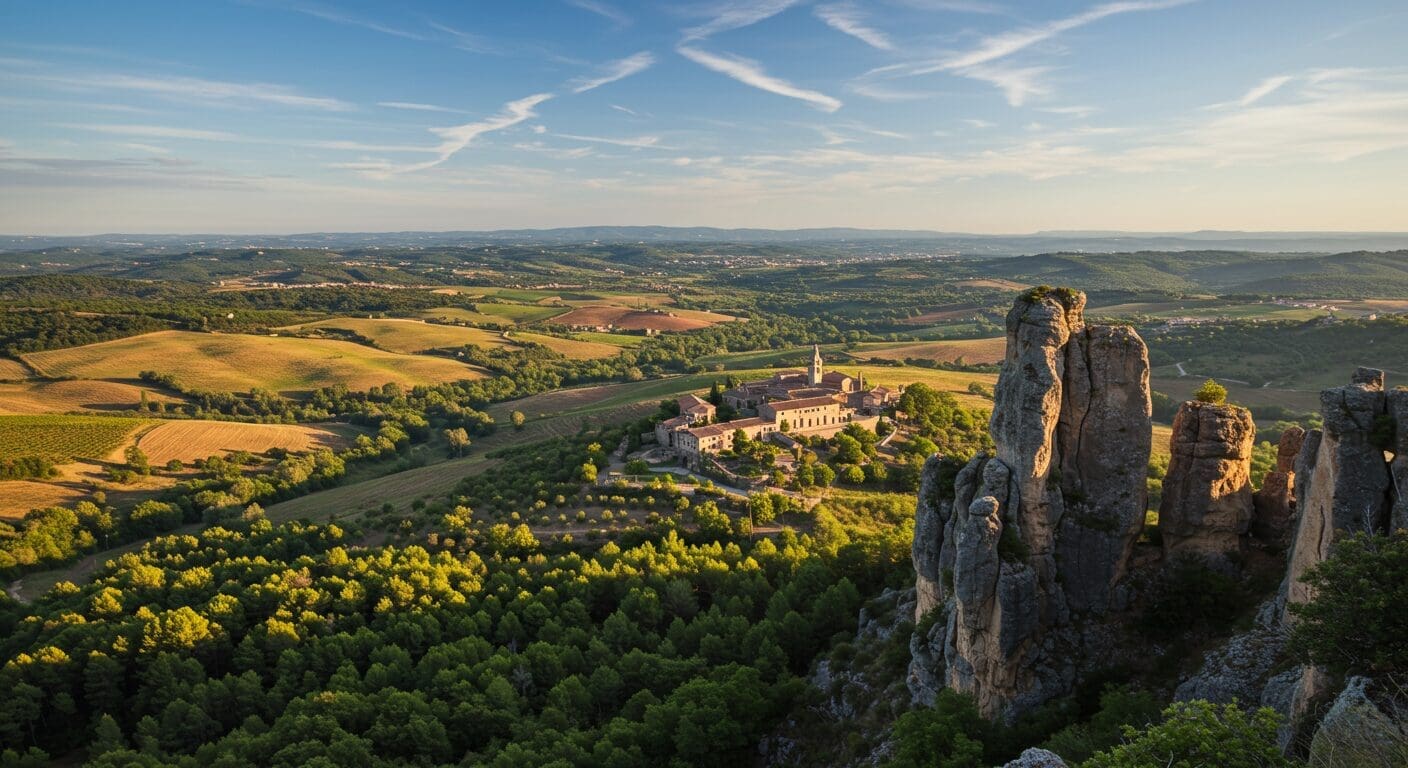
Occitanie is France’s largest administrative region by area, which is something that sounds bureaucratic until you look at a map and appreciate what it actually means in practice. This is a place of genuinely radical landscape variety – so varied, in fact, that visitors who assume they know what to expect consistently arrive somewhere else entirely.
The Mediterranean coast stretches from the Camargue – that wild, salt-flat, flamingo-and-horse territory at the edge of the Rhône delta – through the étangs and sandy shores of the Hérault and into the Roussillon, where the coastline turns rocky and the light takes on the particular intensity that explains why Matisse ended up in Collioure and basically never left. Inland from the coast, the vine-covered plains of the Languedoc give way to the limestone plateaux of the Garrigues, fragrant with wild thyme and cistus, before rising into the dramatic Massif Central country of the Aveyron and the Lozère, where the Millau Viaduct floats above the Tarn gorge in a way that seems architecturally improbable even when you’re standing underneath it.
To the south, the Pyrenees form a border with Spain that is dramatic and frequently snow-capped and provides the region with skiing, serious hiking, and a Catalan cultural identity in the east that feels distinct from anything north of it. The Canal du Midi bisects the middle of all this – a UNESCO World Heritage waterway that runs from Toulouse to the Mediterranean through plane-tree avenues of impractical beauty, connecting the Atlantic coast to the Mediterranean via 240 kilometres of engineered serenity. It was built in the seventeenth century by a visionary called Pierre-Paul Riquet, who staked his personal fortune on the project. He died seven months before it opened. France has always had a gift for irony.
Things to Do: The List Is Not Short
The activities available across Occitanie span a range that is almost unfair in its breadth. The question is usually not what to do, but which version of yourself you feel like being on any given day.
The Pont du Gard, the Roman aqueduct that crosses the Gardon river in three tiers of limestone precision, is one of those rare monuments that justifies the word “extraordinary” without the word feeling tired. Go early, before the tour groups, and walk across the top level if you can. The Cité de Carcassonne – the medieval fortified city that rises from the plain of the Aude like something from a more dramatic century – is rightly famous and deeply atmospheric, best experienced in the early morning or at dusk when the tour buses have departed and the ramparts catch the last of the light. It is also, in the height of summer at noon, an education in the relationship between ancient stone and radiant heat. Bring water.
The Gorges du Tarn offer some of the finest gorge scenery in France, best navigated by canoe or kayak along a river that threads between walls of limestone and dolomite up to 600 metres high. The Gorges de l’Hérault, less well known, are similarly beautiful and considerably less crowded – a theme that applies to much of inland Occitanie. The Cirque de Navacelles, carved by a river that abandoned its loop and left behind a natural amphitheatre of vertiginous beauty, is the kind of geological formation that makes you feel your own scale very clearly.
Wine tourism – vineyard visits, cellar tastings, domaine stays – is among the most pleasurable activities in the region, and in areas like Saint-Chinian, Pic Saint-Loup, Maury and the Roussillon appellations, the winemakers are independent-minded, often organic or biodynamic, and genuinely interested in conversation. This is not the Loire Valley experience of polished tasting rooms and a gift shop. It is closer to a kitchen table, a bottle opened without ceremony, and an hour that stretches pleasantly into two.
For Those Who Need More Than a Sunlounger
The adventure credentials of Occitanie are, in the most genuine sense, considerable. The Pyrenees offer serious hiking: the GR10 long-distance trail runs along the French side of the mountains from the Atlantic to the Mediterranean, while the Pyrenean crossing on the HRP (Haute Randonnée Pyrénéenne) is for those who consider altitude a recreational parameter. The national park of the Pyrénées encompasses peaks above 3,000 metres, mountain lakes of glacial clarity, and wildlife that includes brown bears – a fact that tends to sharpen the attention during a morning walk.
Cycling is exceptional. The Canal du Midi towpath is a flat, shaded, 240-kilometre invitation to slow down, while the Voie Verte routes across the Languedoc and Roussillon have been developed with genuine seriousness. For road cyclists, the Pyrenean climbs – the Col du Tourmalet, the Col d’Aubisque – carry the weight of Tour de France legend and reward those prepared to earn their views. Mountain biking in the Haut-Languedoc and around the Caroux massif is technically demanding and scenically extravagant.
The Mediterranean coast offers kitesurfing and windsurfing around Leucate and Cap d’Agde, where the Tramontane wind blows with consistent purpose and the conditions are considered among the finest in Europe. Diving around the Cap Creus marine reserve and the rocky headlands near Collioure reveals clear water and healthy marine life. The Gorges du Tarn and Gorges de l’Ardèche are established canyoning and via ferrata destinations for those who enjoy their geology at close range and at speed. In winter, the Pyrenean ski resorts – Font Romeu, Cauterets, Ax-les-Thermes – offer skiing without the Alpine price tag and with considerably shorter lift queues. It is a trade-off that many discover they are entirely comfortable with.
Occitanie with Children: Genuinely Good, Not Just Theoretically
The honest answer to whether Occitanie works for families is: extremely well, provided you approach it correctly. The correct approach involves a private villa rather than a hotel, a pool that is yours and not shared with twelve strangers, and an understanding that the best family holiday is one where the adults are also, quietly, having a good time.
The practical pleasures for children are numerous and varied. The beaches of the Languedoc coast – the shallow, sandy, warm-watered étang shores rather than the more exposed Mediterranean beaches – are excellent for young children, safe and spacious in ways that Mediterranean resorts in more fashionable territories are not. The Camargue, with its white horses, pink flamingos and the specific, primal satisfaction of a landscape that looks like it belongs to a different age, has a way of working on children that no screen-based equivalent can replicate.
The medieval citadels – Carcassonne, Aigues-Mortes, the Cathar castles strung along the Corbières ridgelines like something from a game – are exactly as exciting as children imagine them to be. The Gouffre de Padirac, a vast underground river system with boat tours through cavernous chambers, is genuinely dramatic for all ages. Water parks, canyoning for older children, horse riding on Camargue trails, kayaking on the gentle stretches of the Hérault – the range of physical activity available means that the challenge is not finding things to do, but choosing between them. Having a villa as your base – space, routine, a kitchen for early dinners – makes managing all of this considerably more civilised.
The Weight of History in a Region That Carries It Well
Occitanie is where the Cathars made their last stand, where the Romans built their most ambitious provincial infrastructure, where troubadour poetry was invented, where the Inquisition arrived with particular thoroughness, and where Catalan, Occitan and French cultural identities still coexist with the mild tension of people who have been sharing a kitchen for centuries and have come to a workable arrangement.
The Cathar history is perhaps the most dramatically compelling thread. In the early thirteenth century, the papacy launched a crusade against the Cathar heresy – a dualist Christian movement that had taken hold across the Languedoc – and what followed was the systematic reduction of a civilisation. The ruined castles of Peyrepertuse, Quéribus, Montségur and Puilaurens sit on limestone ridges and summits with a stark dignity that the centuries have not diminished. Montségur in particular – where two hundred Cathar faithful were burned alive in 1244 rather than renounce their beliefs – has a quality of atmosphere that the most resolute sceptic tends to notice.
The Roman presence is everywhere: in the Pont du Gard, in the amphitheatre of Nîmes (one of the best-preserved in the world, and still in use for concerts and bullfights), in the Maison Carrée temple that prompted Thomas Jefferson to stand in front of it for hours, “gazing whole hours like a lover at his mistress.” He said that himself. Jefferson understood a good building. The medieval abbeys of Fontfroide and Lagrasse in the Aude, the cloisters of Saint-Guilhem-le-Désert in the Hérault, the pilgrimage route to Santiago de Compostela that runs through Saint-Gilles and Montpellier – the cultural and historical density of this region is such that you could spend a week doing nothing else and barely scratch the surface.
The festival calendar is distinguished. Montpellier’s Festival de Radio France in July is a serious classical music event. The Feria de Nîmes – bullfighting, flamenco, all-night celebration – is not for everyone but is emphatically an experience. The Festival de Carcassonne, held against the backdrop of the medieval city, is one of those outdoor performance settings that reminds you that a good venue is doing half the work.
What to Buy and Where to Find It
Occitanie produces things worth taking home, in the most literal sense. The cutlery made in Laguiole – the Aveyron village that is also home to the Maison Bras restaurant – is among the finest produced anywhere. The distinctive bee-topped folding knife is a genuine design object with a genuine use, though the proliferation of cheaper imitations means it’s worth visiting an actual Laguiole workshop rather than a souvenir shop. The difference is immediately apparent to the hand.
The ceramic and pottery tradition of the region – particularly in the studios around the Hérault and the Catalan towns of the Roussillon – yields work that is modern in sensibility and locally rooted in material. The markets of Pézenas (a town of improbable charm that was once the winter residence of Molière, who set up as a barber for a season and observed the locals with the attention of someone who intended to use them later) are excellent for antiques, fabric and objets with genuine provenance.
Wine, obviously. The appellations of the Languedoc – Picpoul de Pinet, Faugères, Saint-Chinian, Terrasses du Larzac, Roussillon cru wines from Maury, Banyuls and the Côtes du Roussillon Villages – offer extraordinary quality at prices that remain, for now, entirely reasonable by comparison with better-known French wine regions. Buy directly from domaines where possible; most are open for visits and will let you taste before you commit a case to the boot of a hire car. Olive oil from the mills around the Gard and Hérault, honey from the Cévennes, chestnut flour, local cheeses – Pélardon, Roquefort from the Combalou caves in the Aveyron, the buttery Laguiole itself – all make the kind of gifts that arrive home smelling of somewhere specific and specific somewhere good.
Practical Things Worth Knowing Before You Arrive
The currency is the euro. French is the language, though in the Roussillon you will encounter Catalan signs, Catalan pride, and a quietly insistent cultural identity that has been here considerably longer than the French administrative region that contains it. Occitan – the language of the troubadours that gives the region its name – is experiencing something of a cultural revival and appears on roadsigns and in school programmes, though daily conversation in Occitan is limited to older rural communities and enthusiastic academics.
Tipping in France remains discretionary rather than expected, though rounding up in restaurants and leaving a few euros for exceptional service is appreciated and not considered extravagant. The service in formal restaurants is professional and unhurried in the way that French service tends to be – which is to say, the meal will take as long as it should and rushing it is not an available option.
The best time to visit depends heavily on what you intend to do. July and August deliver the heat and the crowds and the particular magic of a summer evening in the south of France that justifies both. June and September are, for most purposes, better months: the temperatures are more manageable, the roads are quieter, and the light in September is something that painters have been trying to capture for centuries. Spring – April through June – brings wildflowers to the Garrigues, snow to the higher Pyrenean passes and an openness to the landscape that summer closes down. Autumn in the wine country, when the harvest is underway and the vines are turning, is outstanding. Winter in the mountains is for skiers. Winter on the coast is for those who like a landscape to themselves and don’t mind a jumper.
Safety is not a significant concern in rural Occitanie. Cities follow the standard urban precautions. The sun in July and August is a more immediate practical matter than crime: the UV index at Mediterranean latitudes is considerably higher than visitors from northern Europe tend to expect, and the combination of altitude and reflective limestone in the Causses and Pyrenees compounds this. Drink more water than seems necessary. It will prove necessary.
Why a Private Villa Changes the Entire Experience
There is a particular pleasure in returning to a property that is entirely your own after a day of medieval fortresses, three-star restaurants and gorge scenery that made you genuinely gasp. Not a hotel lobby. Not a shared pool where someone else has already arranged the good sunloungers. Your own terrace, your own kitchen, your own unhurried morning in a landscape that seems, for the duration of your stay, to belong to you. This is what a luxury villa in Occitanie actually delivers – and it is, once experienced, rather difficult to go back.
For families, the logic is especially clear. A private villa with a pool, generous indoor-outdoor living space, a kitchen for early dinners and bedtimes that don’t require negotiation with a hotel restaurant’s seating plan – these are not luxuries in the frivolous sense. They are the functional conditions for a holiday that actually works. Children have space to be energetic without performing that energy in a corridor. Adults have evenings that feel like evenings rather than logistics.
For groups of friends or multi-generational families – the grandparents, the siblings, the various configurations of people who love each other and also need their own bathroom – a villa of the right size transforms the whole dynamic. There is privacy within community. You share the pool and the dinner table; you retreat to your own wing when you need to. It is the social structure that hotels were not designed to provide.
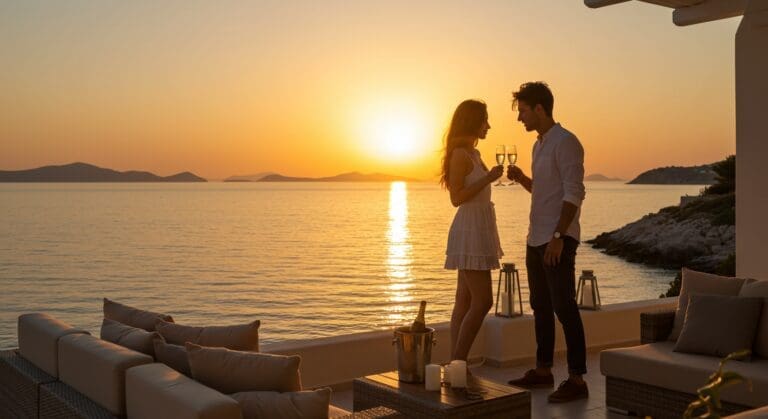
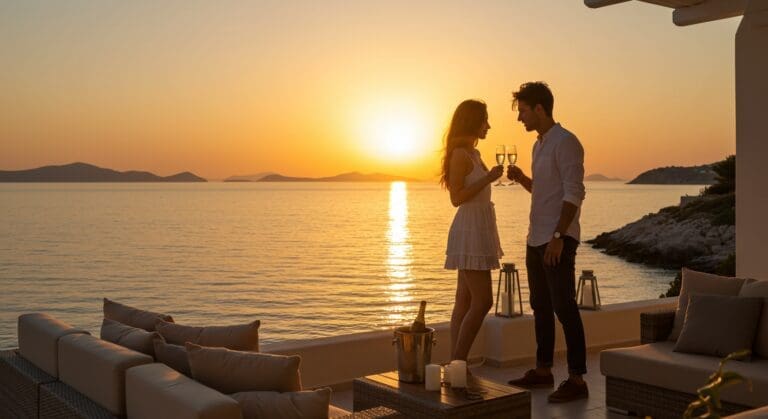
For couples, a luxury villa in the Languedoc countryside or the Pyrenean foothills or above a Mediterranean bay offers something that even the finest hotel cannot entirely replicate: the sense of having found something that is, for now, just yours. The private pool at dusk. The dinner on the terrace. The particular quality of silence that only arrives when the cicadas have finally, briefly, stopped.
Remote workers – and they are a real and growing constituency, not a marketing category – find that the combination of reliable high-speed internet (fibre broadband is increasingly standard in premium villa rentals; Starlink has resolved the connectivity question in more rural properties) and a private pool represents a working environment of quite startling quality. The afternoon swim is not a distraction from work. It is what makes the work sustainable. This is not a philosophy that requires much defence when you are floating on your back in the Languedoc sunshine.
Wellness amenities – heated pools, outdoor gyms, yoga terraces, hot tubs positioned for the kind of view that tends to appear in your mind unbidden for years afterwards – are increasingly standard in the premium villa market, and Occitanie’s combination of clean air, abundant outdoor activity and a food culture built around genuinely good produce makes it a natural context for the kind of restorative holiday that actually restores rather than simply relocates the usual pressures to a warmer setting.
Excellence Luxury Villas offers an extensive collection of private villa rentals in Occitanie – from intimate stone-built farmhouses in the Aude to large contemporary estates above the Mediterranean coast, staffed properties in the Languedoc wine country, and mountain retreats in the Pyrenean foothills. Each is selected for the quality of its accommodation, its location, and its capacity to deliver the specific kind of holiday that only a private villa can provide.
More Occitanie Travel Guides
- Best Restaurants in Occitanie: Fine Dining, Local Gems & Where to Eat
- Occitanie Food & Wine Guide: Local Cuisine, Markets & Wine Estates
- Occitanie with Kids: The Ultimate Family Holiday Guide
- Best Time to Visit Occitanie: Month by Month Weather, Crowds & Tips
- Occitanie Luxury Itinerary: The Perfect 7-Day Guide
- Romantic Occitanie: The Ultimate Couples & Honeymoon Guide
What is the best time to visit Occitanie?
For most visitors, June and September offer the best combination of warm weather, manageable crowds and good light. July and August deliver peak summer conditions – hot, bright, busy – which suit those who want beach time and evening culture in equal measure. Autumn is exceptional for wine country and foliage; spring brings wildflowers and cooler temperatures ideal for hiking and cycling. Winter is the right choice for Pyrenean skiing and for those who want the medieval villages and gorge landscapes entirely to themselves.
How do I get to Occitanie?
The main airports are Toulouse-Blagnac and Montpellier Méditerranée, both with direct flights from across Europe, including multiple UK departure points. Carcassonne Airport handles seasonal routes that are useful for the Aude and Languedoc. Béziers Cap d’Agde Airport serves the Hérault coast. For the Pyrenees, Tarbes-Lourdes-Pyrénées Airport is the most practical option. The TGV from Paris reaches both Toulouse and Montpellier in around three hours. A hire car is strongly recommended for anywhere outside the major cities.
Is Occitanie good for families?
Yes, and genuinely rather than theoretically. The range of activities – beaches, medieval castles, underground river systems, horse riding in the Camargue, kayaking, cycling trails – means children of most ages are well catered for. The shallow, warm coastal lagoons are particularly good for young children. A private villa with a pool is by far the most practical base for families, offering flexible meal times, outdoor space and the kind of routine that makes travelling with children considerably more enjoyable for everyone involved.
Why rent a luxury villa in Occitanie?
A private villa gives you something no hotel can: complete autonomy over your time, your space and your experience. In Occitanie, that means your own pool in a landscape of considerable beauty, your own terrace for evening meals, a kitchen for informal dinners and early breakfasts, and the privacy to inhabit a holiday rather than simply attend one. For families, it removes the logistical friction of hotel life. For couples, it delivers genuine seclusion. For groups, it creates the right social conditions – shared space with private retreat. The staff and concierge options available through premium villa rentals – private chefs, housekeeping, local expertise – add a layer of ease that elevates the experience further.
Are there private villas in Occitanie suitable for large groups or multi-generational families?
Yes. The Occitanie villa market includes properties ranging from intimate two-bedroom farmhouses to large estates sleeping twelve or more, with private pools, separate guest wings, multiple living areas and outdoor spaces designed for group living. Multi-generational families particularly benefit from the layout of traditional Languedoc and Roussillon properties, which tend toward generous ground floor accommodation suitable for older guests alongside separate sleeping wings for younger family members. Staffed properties with private chefs and housekeeping make the logistics of larger group stays effortless.
Can I find a luxury villa in Occitanie with good internet for remote working?
Increasingly, yes. Fibre broadband is standard in most premium villa rentals in the larger towns and well-connected rural areas of the Languedoc and Roussillon. For more remote properties in the Aveyron, Lozère or the higher Pyrenean foothills, Starlink satellite connectivity has resolved what was previously a significant gap