Puglia Travel Guide: Where to Stay, Eat & Explore in Luxury
What if the most quietly extraordinary region in Europe had been hiding in plain sight all along, just below the ankle of Italy’s boot, waiting for everyone else to catch up? Puglia has been that place for decades – a region of ancient olive trees, limestone cities, whitewashed hill towns, and some of the most unapologetically delicious food on the planet, quietly getting on with things while the crowds queued for Venice and fought over sun loungers in Positano. The secret is largely out now, and yet somehow Puglia still manages to feel like it belongs to you. That is a rare thing. This guide explains exactly why – and exactly how to make the most of it.
It helps to know who Puglia is actually for. Families seeking genuine privacy – the kind that a private villa with its own pool and walled garden provides, where children can run and adults can drink wine in peace – will find it close to ideal. Couples on milestone trips, whether honeymoons or landmark anniversaries, discover that the landscape has a cinematic quality that does a great deal of the romantic heavy lifting for them. Groups of friends, particularly those who have tired of the predictability of Ibiza or the Spain costas, find in Puglia an adult alternative with real culture and extraordinary food. Remote workers needing reliable connectivity are increasingly well-served here – fibre broadband and even Starlink have reached many premium villas, making it possible to take a call overlooking an olive grove without the WiFi dying at a critical moment. And wellness-focused guests will find the slow pace, clean air, morning swims, and farm-to-table eating do more for them in a week than a month of expensive supplements at home.
Getting to the Heel of Italy – and Why the Journey Is Worth Every Minute
Puglia’s two main airports are Bari Karol Wojtyła Airport and Brindisi Airport. Both receive direct flights from major European cities, including London, Amsterdam, Paris, and Frankfurt. From the United Kingdom, Ryanair and easyJet both fly direct to Bari and Brindisi from several airports, with flight times hovering around two and a half hours. Which airport to use largely depends on where you are staying. Bari makes more sense for the northern parts of the region – the Valle d’Itria, Alberobello, and the Gargano Peninsula. Brindisi is the better choice for Lecce, the Salento peninsula, and the southern coast.
Transfers by private car or minivan are the most practical option, and they are easily arranged in advance. Taxis exist but can be expensive and unreliable over longer distances. Car hire is genuinely recommended for anyone planning to explore beyond one fixed base – Puglia’s pleasures are spread across a wide region, and much of the best of it sits on roads that a sat nav will describe as “roads” with some optimism. The trains between Bari, Lecce, Brindisi, and Taranto are functional and often more pleasant than expected. For the Valle d’Itria – the trulli zone in the heart of the region – having your own car is essentially non-negotiable unless you enjoy standing at unmarked crossroads with a warm bottle of water.
At the Table: How Puglia Became One of Europe’s Great Food Destinations
Fine Dining
The anchor of any serious food itinerary in Puglia should be Masseria Moroseta, just outside Ostuni. Chef Giorgia Eugenia Goggi has built something genuinely remarkable here: a tasting menu at around 90 euros that centres almost entirely on vegetables – many of them grown in the masseria’s own organic gardens – and yet never feels like an act of restraint. The dining room, set within a beautifully kept historic farmhouse, is exactly the kind of place where you order wine and somehow forget to look at your phone for three hours. TripAdvisor reviewers, not always the most lyrical judges, have called it “the very best of the region.” Book well in advance. This one fills up.
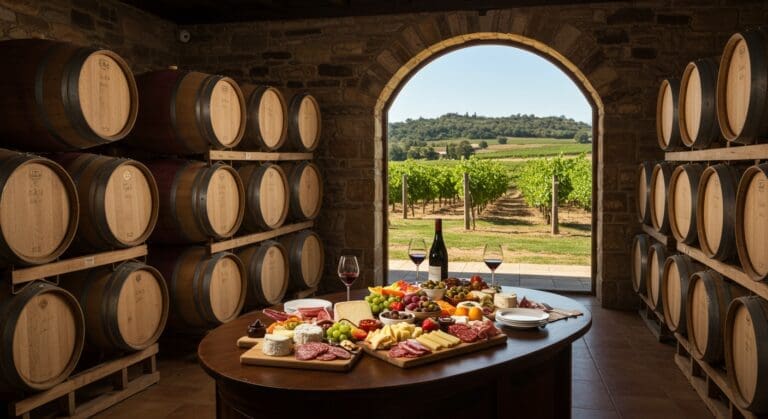
The broader fine dining scene in Puglia is less flashy than in, say, Sicily or the Amalfi Coast, and this is entirely to its credit. The focus is on ingredient quality, seasonality, and technique rather than theatre. You will find beautifully executed burrata, hand-rolled orecchiette with a ragù that has been going since Tuesday, grilled sea bream that arrived on shore that morning. The luxury is in the produce. The region produces more olive oil than any other in Italy – which is saying something considerable – and it shows in everything.
Where the Locals Eat
Lecce has two institutions that any honest Puglia food guide must acknowledge. Alle Due Corti is the place to eat ciceri e tria – Lecce’s defining dish of chickpeas and fried pasta, a combination that sounds unlikely and tastes inevitable. It was Bourdain-approved, Anthony himself having visited in 2017, and it has been consistently delivering on that endorsement ever since. Authentic, unfussy, and quietly proud of its traditions. The burrata is also exceptional. Trattoria Le Zie on Via Costadura 19 operates on a similarly honest brief: traditional Puglian dishes in generous portions, prices that feel almost apologetic, and a room full of Italian families who clearly know exactly what they are doing. Booking is essential at both.
In Bari’s old town, Carletto Cucina offers a four-course lunch for around 25 euros that is one of the most satisfying meals you can have in the region. Ten tables outside on the cobbles, house wine that does the job perfectly, and the kind of abundance – generous sides, excellent fresh pasta, proper dessert – that makes it feel more like eight courses than four. The Bari Vecchia food scene in general rewards wandering: keep your eyes open for street food stalls selling panzerotti (fried dough pockets stuffed with tomato and mozzarella), which locals eat from paper bags while walking, with a level of conviction that makes you feel you’ve been eating them wrong your whole life.
Hidden Gems Worth Seeking Out
Osteria del Tempo Perso in Ostuni is one of those restaurants that tends to appear on “best of” lists and then quietly continues to justify the mention. Set in a winding alleyway in the old town, lit at night with the kind of warm, twinkling lights that make everything seem like a film set, it delivers on food, wine, service, and atmosphere simultaneously – which is harder than it sounds. Locals love it. Visitors who find it tend to come back. It has the feel of a place that has been there forever and intends to stay. In the Valle d’Itria, any agriturismo attached to a working olive or wine estate is worth investigating for lunch – many are not listed anywhere discoverable online and require the sort of local knowledge that a good villa concierge earns their keep providing.
Understanding the Landscape: A Region of Surprising Variety
Puglia is a long, thin region – it stretches roughly 400 kilometres from the spur of the Gargano Peninsula in the north to the very tip of the Salento heel in the south – and it would be a mistake to assume it is uniform. The north is defined by the Gargano, a dramatic limestone promontory rising from the Adriatic coast, forested and cliff-edged, with a slightly wild quality that feels entirely different from the sun-bleached flatlands further south. The Tremiti Islands sit offshore and are accessible by ferry in summer.
Moving south, the Valle d’Itria is the region’s most distinctive landscape: a gently rolling limestone plateau dotted with trulli – those conical-roofed white stone buildings that appear on every piece of Puglia marketing ever produced, and which are, despite the familiarity of the image, genuinely extraordinary in person. Alberobello has the highest concentration and is a UNESCO World Heritage Site, which means it also has the highest concentration of tourists. The smarter approach is to stay in a trullo property in the surrounding countryside, where the landscape does its work at a gentler pace.
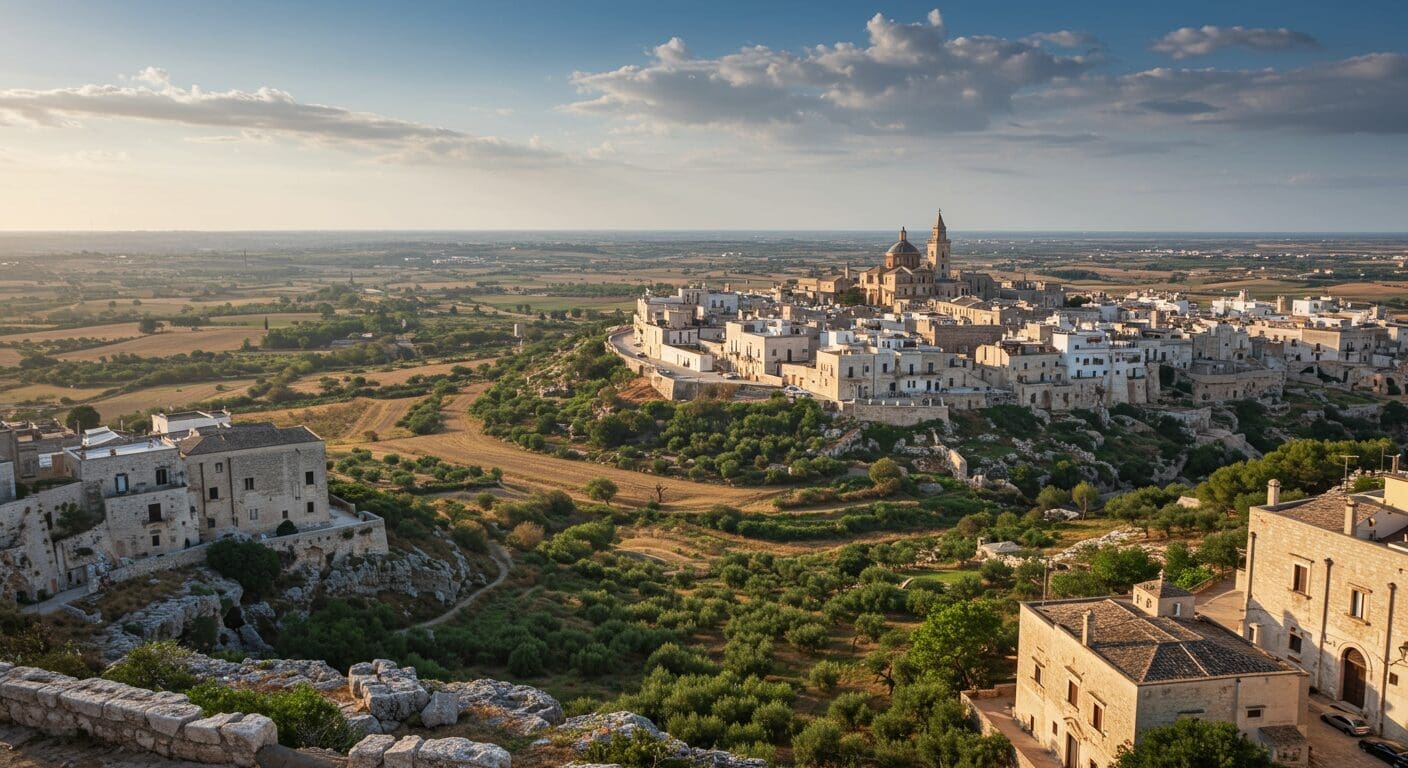
Ostuni – the White City – sits on a hilltop and earns its nickname convincingly. Its old town is a labyrinth of whitewashed lanes, churches, and viewpoints overlooking olive groves that roll to the coast. Further south still, Lecce is the great Baroque surprise: a city of extravagant golden stone architecture, laid out with a confidence that suggests it knows exactly how good-looking it is. The Salento peninsula below Lecce is wilder and flatter, with a coastline of remarkable clarity on both the Adriatic and Ionian sides.
What to Actually Do: From Morning Swims to Baroque Architecture
The rhythm of a Puglia holiday tends to settle into something deeply civilised: a morning swim in the villa pool or from a rock platform on the coast, a late breakfast of local bread, ricotta, and figs, then a leisurely expedition to a town or masseria in the cooler part of the afternoon. This is not laziness. This is wisdom.
Lecce deserves at least a full day – preferably two – for its architecture alone. The Basilica di Santa Croce is the defining example of the local Baroque style, an eruption of carved stone that took nearly 150 years to complete and shows. The city is also genuinely lively at street level, with a university population that keeps the café culture and aperitivo scene in excellent condition. Alberobello and the trulli landscape is a half-day trip from most central Puglia bases. Ostuni’s old town rewards an evening visit when the day-trippers have left and the residents reclaim the streets. Matera – technically in Basilicata but easily reached in an hour from central Puglia – is one of the most extraordinary places in southern Italy, an ancient cave city of arresting beauty that more than justifies crossing a regional border.
Taranto has been underrated for years and is beginning to correct this injustice. Its National Archaeological Museum holds one of the most significant collections of Magna Graecia art and artefacts in the world. The Salento coast – particularly the stretch around Torre dell’Orso, Otranto, and Santa Maria di Leuca – offers some of the most translucent water in the Mediterranean. Otranto itself, with its cathedral containing a Byzantine floor mosaic of operatic ambition covering the entire nave, is not to be missed.
Getting Active: The Region’s Best Adventures on Land and Sea
Puglia’s coastline makes it a natural base for water-based adventure. Sea kayaking along the rocky Gargano coast or the cave-punctuated Salento shoreline is excellent – guided tours operate throughout the season and access sea caves that are unreachable on foot. Snorkelling and scuba diving are well-established, particularly around the Tremiti Islands, where the underwater visibility is outstanding and the marine life properly impressive. Sailing along the Adriatic coast, with day stops at small ports and overnight anchorages, is one of the more civilised ways to see the region – charter companies operate out of Bari, Brindisi, and Otranto.
On land, cycling has become increasingly popular and increasingly well-organised. The Valle d’Itria and the plateau landscapes of the Murge are particularly suited to it – the gradients are gentle, the roads quiet, and the scenery rewards a slower pace. E-bike hire has made this accessible to a much wider range of fitness levels, which is either a wonderful democratisation of active travel or a slight cheat, depending on who you ask. Hiking in the Gargano – through the Foresta Umbra, a remarkable ancient beech forest sitting incongruously on a Mediterranean headland – offers a completely different face of the region. Horse riding through olive groves and farmland is available through several agriturismo properties and is as charming as it sounds. Kitesurfing is popular along the Salento coast, particularly around Torre Lapillo and Porto Cesareo, where the conditions are consistently favourable.
Puglia with Children: Why Families Come Back Year After Year
Puglia is, without much debate, one of the best family holiday destinations in southern Italy. The beaches on both coasts range from wide sandy bays to shallow, calm inlets where small children can wade for what feels like half a mile before the water reaches their waists. The Ionian coast in particular – around Gallipoli, Santa Caterina, and Porto Cesareo – offers stretches of fine sand in calm, warm water that make supervision considerably less stressful than rockier alternatives.
A private villa with pool transforms the family holiday dynamic in ways that are difficult to overstate. Children have space to play without constant management. Adults have the pool terrace, the outdoor dining area, and the ability to put the children to bed and then sit outside with a glass of local Primitivo without negotiating with a hotel lift. Puglian cuisine – fresh pasta, pizza, grilled fish, good bread – is broadly child-friendly without requiring any special pleading. Italians are openly delighted by children in restaurants, which is a generosity not to be taken for granted. The trulli of the Valle d’Itria are inherently fascinating to younger visitors who see them immediately as something from a fairy tale, which they essentially are. A trullo villa makes a memorable family base – architecturally distinctive enough to be exciting, and comfortable enough for everyone to actually sleep.
History Carved in Stone: Puglia’s Extraordinary Cultural Depth
This is a region that has been fought over, settled, built upon, and inhabited continuously for millennia. Greeks, Romans, Byzantines, Normans, Swabians, Angevins, Aragonese – each wave left something behind, and the accumulated result is a cultural landscape of unusual richness. The Greek colonists who arrived in the 8th century BC left temples and artefacts that ended up in Taranto’s museum. The Normans built Castel del Monte, a perfectly octagonal 13th-century fortress in the middle of the Murge plateau with no clear military function and a symmetry so exact it has obsessed historians for centuries. Frederick II of Hohenstaufen, Holy Roman Emperor, was particularly fond of Puglia, and his shadow falls across the region in castle after castle.
Lecce’s Baroque architecture is a 17th and 18th-century explosion of confidence in the local golden limestone – pietra leccese – a material soft enough to carve with extraordinary detail and warm enough to glow in evening light. The craft traditions of the region – terracotta pottery in Grottaglie, papier-mâché figurines in Lecce (a tradition going back centuries and considerably more sophisticated than it sounds), hand-woven fabrics in the Salento – are living continuations of very old stories. The festivals calendar is full of genuine local celebration: the Festa di Sant’Oronzo in Lecce in August, the Festival della Valle d’Itria in Martina Franca (a serious opera festival with an outdoor setting that would be impossible to invent), and the Notte della Taranta, an enormous folk music celebration centred on the traditional pizzica dance, held every August in Melpignano. It is loud, joyful, and absolutely not to be missed.
What to Bring Home: Shopping the Markets and Ateliers
Puglia is not a luxury shopping destination in the way that Milan or Florence might be, and this is more a feature than a flaw. The shopping here is about craft, food, and things made by hand by people who have been making them for a long time. Lecce is the best place to start: the old town has excellent shops selling papier-mâché work in the local tradition, ranging from small nativity figures to genuinely ambitious decorative pieces. The craft is peculiar to Lecce and the surrounding area, and the quality from the better workshops is high enough to constitute real folk art.
Grottaglie, a town near Taranto, is the pottery capital of Puglia and has been producing ceramics since the medieval period. The entire historic quarter functions essentially as an open workshop district – you can walk from studio to studio, watch potters at work, and buy directly. The characteristic local style uses a cream and blue-green palette that is immediately recognisable and travels well. Olive oil is perhaps the single best edible souvenir – the extra-virgin oils from the region’s great estates, particularly those made from the Coratina variety, are of exceptional quality and represent genuine value compared to equivalent product at home. Local markets, particularly in Bari and Lecce, are worth a morning for cheeses, preserved vegetables, local wines, and the various small foods that will taste slightly less extraordinary once you are back in the United Kingdom but are worth buying anyway.
The Practical Bit: What You Actually Need to Know Before You Go
Puglia uses the euro. English is spoken in most tourist-facing businesses in the major towns, less reliably in smaller villages and rural areas, where a phrasebook and some patience go a long way. Tipping is not the compulsory performance it has become in the United States – rounding up the bill or leaving a few euros is appreciated and entirely adequate. Do not tip with a card. Italians find this baffling.
The best time to visit is May, June, early July, and September. August is peak season – hot, crowded, and expensive, though still good if you are based in a private villa with a pool and have no particular need to go anywhere during the hours between noon and four. October is underrated: warm enough to swim, empty beaches, soft light, and the olive harvest adding a particular quality to the landscape and the atmosphere. Safety is not a significant concern in tourist areas – the usual urban precautions apply in Bari’s city centre as in any large Italian city, but Puglia is broadly relaxed and welcoming. The local driving style takes a certain amount of adaptation. Treat lane markings as advisory. You will be fine.
Local etiquette is largely standard Italian: dress modestly when entering churches, greet shopkeepers when entering a shop, do not order a cappuccino after 11am unless you want a gentle look of concern from the barista. The pace of life is slower than northern Italy and considerably slower than northern Europe. Allow for this. It is, in fact, the point.
Why a Private Luxury Villa in Puglia Is the Only Sensible Choice
There are hotels in Puglia. Some of them are excellent. And yet the private villa consistently wins for anyone with even a passing interest in actually enjoying themselves on their own terms. The mathematics are straightforward: a large villa shared between eight or ten people often costs less per person than a decent hotel room, and provides infinitely more – a private pool, outdoor dining, a fully-equipped kitchen for those mornings when you want nothing more than local bread and good coffee on a terrace in the sun, bedrooms with actual separation between generations and temperaments.
For families, the advantages are structural. Children sleep where they sleep, adults eat when they eat, and the pool is always available without the resort-level competition for sun loungers that turns adults into their worst selves. For groups of friends, the shared villa is the whole point – the communal dinners, the late-night conversations, the collective morning coffee – all of it happens at your pace, in your space, without a hotel schedule imposing itself.
Many of the finest luxury villas in Puglia are converted masserie – the great fortified farmhouses of the region, with thick limestone walls, cool interior courtyards, and grounds planted with ancient olive trees. They have been sympathetically restored to provide all the comforts of high-end hospitality while retaining the architecture that makes the setting genuinely extraordinary. Private chef services, concierge support, in-villa massage and wellness treatments, wine cellars stocked with local bottles – all of this can be arranged, and in many cases comes as standard.
For remote workers, the combination of reliable connectivity and an environment this restorative makes it possible to work efficiently for a few hours in the morning and spend the rest of the day living well. This is not a compromise. It is, arguably, the ideal working arrangement. Wellness guests find that the clean air, the unhurried pace, the quality of the food, and the ability to swim and walk and rest according to your own rhythm does more for mind and body than any structured programme. Puglia has a way of operating on you slowly and then all at once.
Browse our full collection of luxury villas in Puglia with private pool and find the property that fits your version of the perfect Puglia holiday.
More Puglia Travel Guides
- Best Restaurants in Puglia: Fine Dining, Local Gems & Where to Eat
- Puglia Food & Wine Guide: Local Cuisine, Markets & Wine Estates
- Puglia with Kids: The Ultimate Family Holiday Guide
- Best Time to Visit Puglia: Month by Month Weather, Crowds & Tips
- Puglia Luxury Itinerary: The Perfect 7-Day Guide
- Romantic Puglia: The Ultimate Couples & Honeymoon Guide
What is the best time to visit Puglia?
May, June, and September are the sweet spots – warm enough for swimming and outdoor dining, without the intense heat and crowds of August. Early July is also excellent. October is a quietly brilliant option: the sea is still warm from the summer, the beaches are largely clear, the olive harvest is underway, and the light is extraordinary. If you do visit in August, a private villa with pool makes the midday heat a non-issue rather than a problem.
How do I get to Puglia?
Puglia has two main airports: Bari Karol Wojtyła Airport and Brindisi Airport. Both receive direct flights from major European cities, including several UK airports via Ryanair and easyJet, with flight times of around two to two and a half hours from London. Bari is the better gateway for the northern half of the region – the Valle d’Itria, Alberobello, and the Gargano Peninsula. Brindisi is more convenient for Lecce, the Salento coast, and southern Puglia. A private transfer or hired car is recommended for most villa guests, as the best properties tend to sit in the countryside rather than in city centres.
Is Puglia good for families?
Genuinely, yes. The beaches – particularly on the Ionian coast around Gallipoli and Porto Cesareo – are shallow, calm, and warm, making them ideal for younger children. Puglian food is broadly family-friendly, and Italian hospitality toward children in restaurants is sincere and consistent. A private villa with pool is the ideal family base: children have space, adults have privacy, and no one is negotiating with a hotel for a second room key. The Valle d’Itria’s trulli landscape has an inherent fairytale quality that younger visitors find immediately compelling.
Why rent a luxury villa in Puglia?
The private villa experience in Puglia offers something hotels cannot replicate at any price: genuine space, genuine privacy, and the freedom to live entirely on your own schedule. A large villa shared between a group often costs less per head than a boutique hotel room, while providing a private pool, outdoor dining, a fully-equipped kitchen, and the kind of separation between adults and children that makes everyone significantly happier. Many of Puglia’s finest villas are historic masserie – converted fortified farmhouses – that offer architectural authenticity alongside every modern comfort. Private chef services, concierge support, and in-villa wellness treatments are widely available.
Are there private villas in Puglia suitable for large groups or multi-generational families?
Yes – Puglia has an excellent range of large properties suited to groups of ten, twelve, or more guests. Many of the historic masseria conversions include multiple sleeping wings or separate guest annexes, making it possible for different generations or family units to have their own private space within a shared property. Private pools – often substantial – are standard at the luxury level. Dedicated staff including housekeepers and sometimes a private chef or villa manager come with many larger properties, significantly reducing the organisational burden on the group.
Can I find a luxury villa in Puglia with good internet for remote working?
Increasingly, yes. Fibre broadband is available in many Puglian towns and increasingly in rural areas, and a growing number of premium villa properties have installed Starlink satellite connectivity as a reliable backup or primary solution. When booking, it is worth confirming connection speeds directly – a good villa agent will be able to advise. Many villa layouts also include a study or quiet indoor workspace separate from the main living areas, which makes morning working hours genuinely productive before the pool and the afternoon take over.
What makes Puglia a good destination for a wellness retreat?
Puglia offers an environment that supports wellbeing without demanding it. The pace of life is slow by design. The food is Mediterranean at its best – fresh, vegetable-forward, olive oil-rich, genuinely seasonal. The sea is clean and warm for a long season, making daily swimming straightforward. The air quality, particularly in the countryside and coastal areas, is excellent. Many luxury villas include private pools, outdoor yoga terraces, and the option to arrange in-villa massage or wellness treatments. Several of the region’s masserias operate spa facilities. And the general unhurriedness of Pugliese life – meals that take two hours, evenings that start late and end when they end – has a restorative quality that a structured wellness programme would struggle to improve on.