Southern Spain Travel Guide: Where to Stay, Eat & Explore in Luxury
It is half past ten in the morning and you have done almost nothing. You have drunk a coffee so good it made you briefly reconsider your life choices. You have watched a cat cross a sunlit plaza with the slow authority of someone who owns it. The orange trees are flowering somewhere nearby – you can smell them but not quite locate them – and the light, already warm on the back of your neck, has the particular quality that makes even shadows look golden. This is the entry-level experience of Spain‘s deep south. It goes up considerably from here.
Southern Spain – Andalucía, to give it the name it has earned – is one of those places that rewards almost every kind of traveller, provided they arrive willing to slow down. Families who want privacy without sacrificing culture find it here: the long-lunching rhythms, the private villas with pools big enough to keep children occupied until the sun drops behind the hills, the ease with which a perfectly good afternoon can become a perfectly good evening. Couples marking milestone anniversaries – a significant birthday, a decade together, a honeymoon that got postponed and upgraded – find the region almost unreasonably romantic, all candlelit courtyards and flamenco heard through an open window from somewhere you can never quite find. Groups of friends who have spent too long planning and not enough time doing discover that Andalucía removes the friction from nearly everything. And then there are the quiet converts: the remote workers who arrived for two weeks with a laptop and left three months later, surprised by the reliability of the connectivity and the unreliability of their desire to leave. Wellness travellers, too – the ones who want yoga at sunrise and something exceptional for dinner – find that southern Spain’s pace, its light, its emphasis on pleasure approached unhurriedly, does more for them than any retreat programme ever managed.
Arriving in Andalucía: The Airports Worth Knowing and the Drives Worth Taking
There are several ways into Southern Spain and the right one depends entirely on where you are going and how much you enjoy driving through scenery that makes you pull over repeatedly for no good reason. Málaga Airport (AGP) is the region’s main international hub, well connected to most of Europe and served by both full-service carriers and budget airlines. It puts you within striking distance of the Costa del Sol, the Serrania de Ronda, the white villages of the interior and, with a little more time behind the wheel, Granada and Córdoba. Seville Airport (SVQ) is the better choice for those heading to the Cádiz coast, the sherry triangle around Jerez, or the city itself – which is absolutely worth it. Jerez de la Frontera Airport (XRY) is the quietly useful third option for western Andalucía, and Granada Airport (GRX) handles the eastern reaches with admirable directness.
From the United Kingdom, flights from London, Manchester and several regional airports run year-round, with journey times of approximately two and a half hours to Málaga. Direct flights also operate from the United States into Madrid, from where connecting services or a high-speed AVE train gets you to Seville in two and a half hours – a journey that is, it should be said, considerably more enjoyable than it sounds.
For getting around the region, a hire car is the honest answer. Public transport in the cities is efficient and the intercity trains between Seville, Córdoba, Málaga and Granada are excellent. But Andalucía’s magic lives along the back roads: the mountain passes, the cortijo country, the villages that appear suddenly and improbably on hilltops. You will want the freedom. Pack sunglasses, not a sat-nav – the Google Maps signal in certain mountain villages has opinions that do not always correspond to reality.
The Table Is the Point: Eating and Drinking in Southern Spain
Fine Dining
Andalucía has, somewhat quietly and without making a great fuss about it, become one of the most extraordinary fine dining regions on the planet. The numbers are arresting: the region now holds multiple three-Michelin-starred restaurants, each with a philosophy as distinct as the landscape that produced it.
The one you will have heard of, and rightly, is Aponiente in El Puerto de Santa María, Cádiz. Chef Ángel León has turned a beautifully restored 19th-century sandstone tide mill – one that straddles a tidal tributary of the Guadalete river – into what might fairly be described as the most intellectually serious seafood restaurant on the continent. León holds three Michelin stars and a Green Star for sustainability, and his obsession is with the ocean in its entirety: plankton converted into edible form, discarded fish species elevated into centrepieces, bioluminescence used as both ingredient and theatre. A meal at Aponiente is not dinner. It is an argument, politely delivered, about what we think food can be.
In Córdoba, Noor – newly awarded its third Michelin star in the 2026 guide – offers something equally distinctive. Chef Paco Morales has constructed an entire culinary philosophy around what he calls cocina andalusí: the forgotten cuisine of Al-Andalus, the medieval Moorish civilisation that shaped everything from the region’s architecture to its spice routes. His dishes are simultaneously archaeological and visionary. A booking here is not easily obtained. Try anyway.
Seville’s finest table is Abantal, where chef Julio Fernández Quintero – the only Michelin-starred chef in the city, a distinction he has held for more than a decade – applies precision and genuine creativity to Andalusian classics inflected with Moorish-Arab influences. The dining room is sleek and calm; the plates are anything but predictable. And in Jerez de la Frontera, LÚ Cocina y Alma brings two Michelin stars to the sherry capital, where chef Juanlu Fernández deploys French culinary technique with exemplary Andalusian ingredients in an oval dining room that makes the whole experience feel slightly cinematic.
Then there is Bagá in Jaén – worth the detour into what guidebooks used to dismiss as olive oil country and nothing else. Chef Pedro Sánchez runs one of the smallest, most focused Michelin-starred restaurants in Spain, single-handedly rewriting Jaén’s gastronomic reputation one meticulously composed plate at a time. Book early and allow yourself to be surprised.
Where the Locals Eat
The daily rhythm of eating in Andalucía is its own form of pleasure and it costs almost nothing to get it right. Breakfast is tostada – a slab of bread, grilled to order, rubbed with tomato and good olive oil, occasionally topped with jamón ibérico if you are having a particularly good morning. This is eaten standing at a bar counter, which feels wrong until it doesn’t. Lunch is the serious meal, taken late and at length, typically from 2pm onwards. Dinner rarely begins before 10pm. Adjusting to this schedule is the single most important thing you can do for your holiday, and it takes approximately one day.
In Seville, the Triana neighbourhood across the river from the old town is where people actually live, and its tapas bars – many of them unchanged since the 1960s except in price – serve the kind of food that makes you understand why Andalusians are not interested in eating quickly. In Cádiz, the Mercado Central is an excellent morning destination: a covered market with fresh seafood counters that transition seamlessly into bars as the clock approaches midday. Order whatever has just come off the boat and sit somewhere in the middle of the noise.
Sherry – cold, dry, in a proper copita – is the drink of the region and is dramatically underrated by people who have only ever encountered it as a dusty bottle at someone’s grandmother’s house. A chilled fino with a plate of jamón is one of the cleaner pleasures available in southern Spain and should be pursued accordingly.
Hidden Gems Worth Seeking Out
The white villages of the Alpujarras, on the southern flanks of the Sierra Nevada, have long sustained a tradition of simple, mountain cooking quite unlike anything on the coast. Thick stews, air-cured meats, local cheeses – the food of altitude and patience. The village of Bubión has a restaurant or two that will not appear in any guide of significance and will produce a plate of pork with chestnuts that stays with you longer than several things costing ten times as much. The rule in Andalucía’s interior is: follow the old men. They have been eating well here their entire lives. They know things.
The Shape of the Land: Understanding Andalucía’s Regions
Andalucía is not small. Larger than Portugal, it stretches from the Atlantic coast of Huelva in the west to the Mediterranean shores of Almería in the east – a distance of roughly 800 kilometres that encompasses terrain of startling variety. Understanding its geography, even loosely, saves you from making the classic mistake of assuming that everything is close to everything else. It is not. Plan accordingly, and treat the distances as opportunities rather than obstacles.
The Costa del Sol – the stretch of Mediterranean coast running east and west of Málaga – is the region’s best-known face: developed, yes, occasionally brashly so, but interspersed with genuinely lovely pockets. Marbella still has its old town, which is charming when you find it behind the boutiques. Further east, the Axarquía coast and the beaches around Nerja and Frigiliana run considerably quieter. West of Málaga, the white-washed town of Mijas perches above the coast with views that justify the drive entirely.
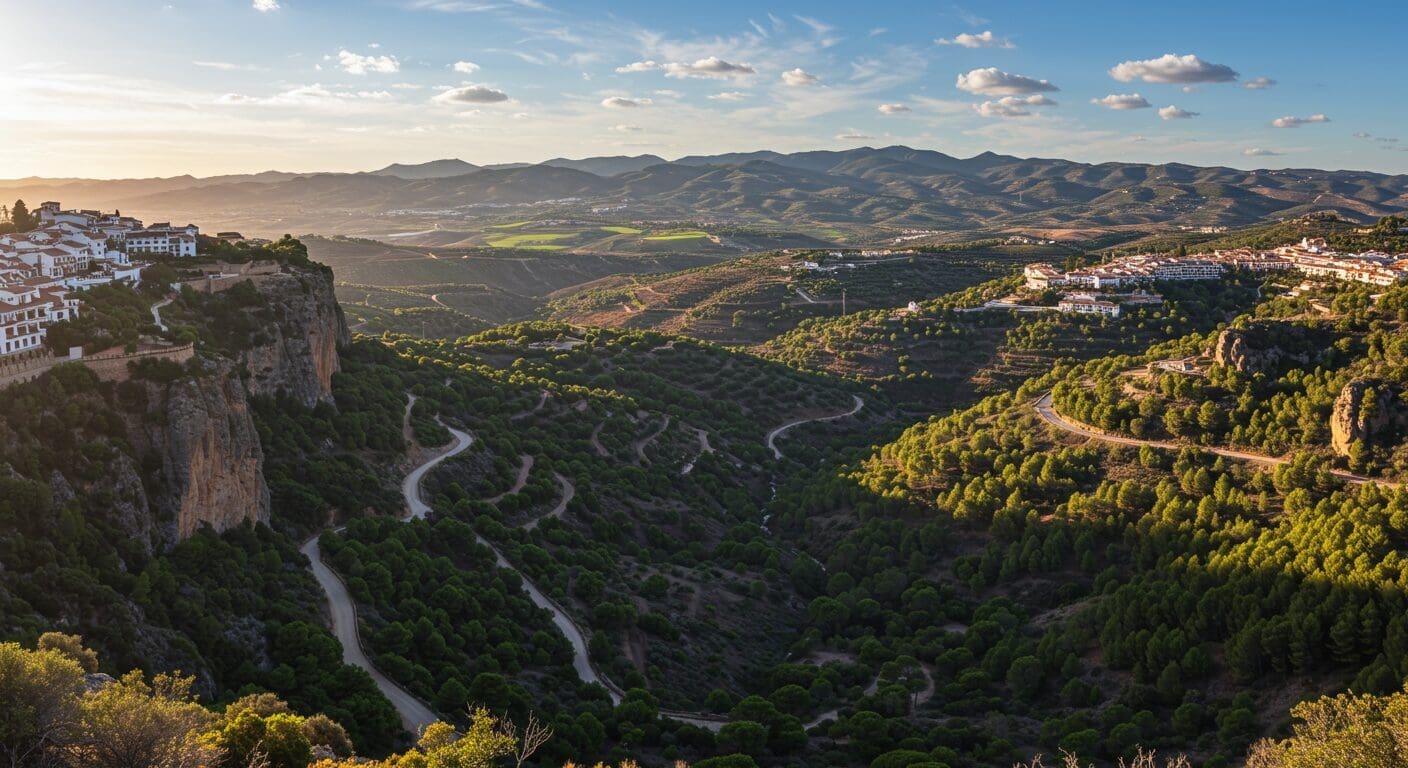
Inland, the drama intensifies. The city of Ronda – built on a plateau split by a deep gorge, connected by an 18th-century stone bridge that makes an immediate impression – is one of the most architecturally arresting places in Spain. The Sierra Nevada, which rises to over 3,400 metres, dominates the landscape around Granada and provides skiing in winter and hiking in summer from the same mountain range. The Coto Doñana – one of Europe’s great wetland reserves, at the mouth of the Guadalquivir – is where flamingos gather in genuinely improbable numbers.
The Cádiz coast – the stretch from El Puerto de Santa María down to Tarifa and the Strait of Gibraltar – is where the Atlantic arrives with proper force. The light here is different: brighter, more windswept, bleached rather than golden. The beaches are long and largely empty outside summer. Tarifa, at the continent’s southernmost tip, looks across to the Moroccan coast on a clear day with the kind of view that makes geography feel suddenly intimate.
What to Do: From Ancient Cities to Atlantic Breezes
The honest answer to what there is to do in Southern Spain is: almost anything, and ideally with several hours set aside for doing nothing in particular. But for those who prefer their leisure structured, the region provides with impressive generosity.
The Alhambra in Granada is the non-negotiable. The 14th-century Nasrid palace complex above the city is, without inflation, one of the most extraordinary buildings ever constructed by human beings. The geometry of the tilework, the sound of the water channels running through the Court of the Myrtles, the view from the Generalife gardens across the city to the Sierra Nevada – it is the kind of place that makes you feel simultaneously humbled and grateful. Book tickets weeks in advance. The queues for walk-ins are not part of anyone’s luxury holiday.
Seville’s Cathedral – the largest Gothic cathedral in the world and the third largest church overall – contains, among other things, the tomb of Christopher Columbus, which is carried on the shoulders of four enormous stone kings and manages to be simultaneously magnificent and faintly bizarre. Córdoba’s Mezquita, the great mosque-cathedral whose forest of red-and-white striped arches is one of the defining images of Moorish Spain, requires an entire morning and repays it entirely.
Away from the monuments, the region offers horse riding through the Doñana marshes, flamenco lessons in Seville that range from the excellent to the theatrical (your guide can advise), day trips to Gibraltar for reasons that are either sentimental or tax-related, wine tours through the sherry bodegas of Jerez, and cooking classes in Granada’s Albaicín neighbourhood where the Moorish tradition of spicing has been more or less continuously maintained since the 15th century.
Wind, Water and Altitude: Adventure in Andalucía
Tarifa has been called the wind capital of Europe, which is either a selling point or a warning depending on your relationship with gusts. For kitesurfers and windsurfers, it is a pilgrimage destination of the highest order: the Levante and Poniente winds funnel through the Strait of Gibraltar with consistency and force, creating conditions that attract serious practitioners from across the continent. Schools along the Playa de los Lances cater to everyone from complete beginners to those who treat the sport with the seriousness of a competitive discipline. The beach is magnificent. The wind is real.
The Sierra Nevada offers a different altitude of adventure. In winter, the ski resort – Europe’s southernmost – runs a surprisingly credible season from December through April, with the added surrealism of being able to ski in the morning and walk on a Mediterranean beach in the afternoon. In summer, the high peaks provide multi-day trekking routes that are genuinely challenging and genuinely beautiful, with hut-to-hut itineraries that take walkers through landscapes that feel remote in the best possible way.
Along the Costa de la Luz and the coast around Nerja, diving reveals underwater geology of considerable drama: sea caves, volcanic rock formations and, in the waters around Cabo de Gata in Almería, marine life that benefits from the protected status of the natural park above. Sailing charters out of Marbella, Puerto Banús and Almería offer everything from day sails to week-long coastal passages. Road cycling through the interior – particularly the climbs around Antequera and into the Sierra de Grazalema – has developed a serious following among riders who want gradient without crowds.
Southern Spain with Children: Space, Sun and the Art of the Long Lunch
Andalucía is, with very few caveats, one of the best family destinations in Europe. The Spanish attitude to children in public places is one of warm and total inclusion – small people are welcome in restaurants at 10pm, at cafés in the morning, at plazas where the evening paseo is essentially a community event with a swing set. Nobody is going to ask you to keep your children quiet. This is, depending on the children, either a relief or an invitation.
The logistics of a family luxury holiday in southern Spain are made considerably easier by the private villa model. A hotel pool is a shared resource requiring strategy; a villa pool is yours, at whatever time and in whatever state of chaos suits the family. Young children benefit enormously from a base with a garden, somewhere to leave sandy shoes without causing a scene, and a kitchen that can produce dinner at 6:30pm when the youngest has officially run out of patience with authentic dining hours. Older children tend to be rather taken with the Alhambra, with the cave houses of the Sacromonte in Granada, and with the fact that Spanish ice cream shops (heladerías) take their product with the same seriousness as any other part of the culinary tradition.
The beaches along the Costa de la Luz – wide, Atlantic-facing and considerably less crowded than the Mediterranean resorts – are excellent for families. The waters around Nerja and Almería are calm and clear enough for snorkelling that produces actual fish. And the region’s many water parks, while not precisely a luxury experience, are the kind of thing that buys you significant goodwill that can be reinvested in a longer dinner.
History in Every Wall: The Cultural Depth of Andalucía
Southern Spain sits on one of the great fault lines of Western history. For nearly eight centuries, the Iberian Peninsula was governed, transformed and in many ways defined by Moorish civilisation – a period that left its most concentrated legacy in Andalucía. The great cities of Córdoba, Seville and Granada were, at various points between the 8th and 15th centuries, among the largest and most sophisticated cities in Europe. The architecture that remains is not decorative heritage. It is evidence of a civilisation that understood mathematics, astronomy, medicine and poetry at a level that contemporary European culture had not yet reached.
This history is present everywhere, and it is more than the obvious monuments. It is in the urban planning of the old medina quarters, in the word alcázar (palace-fortress) that recurs across the region, in the irrigation systems that still water the Vega of Granada, in the azulejo tilework that covers walls from Seville to Almería. Chef Paco Morales at Noor in Córdoba has spent years reconstructing the cuisine of Al-Andalus from historical texts. The Moorish legacy in Andalucía is not something that ended in 1492. It is structural.
The flamenco tradition, born in the marginalia of Andalusian history – in the Romani communities, the Jewish quarters and the Moorish enclaves of the south – is a living art form of genuine complexity. The best places to encounter it are in the small tablaos of Seville’s Santa Cruz and Triana neighbourhoods, in the peñas (private flamenco clubs) of Jerez that occasionally admit visitors, and – if you are lucky with timing – at the numerous festivals that run through spring and early summer. Seville’s Feria de Abril, two weeks after Easter, is the region’s great popular festival: a week of flamenco dress, dancing, sherry and casetas (private marquees) that is simultaneously spectacular and largely incomprehensible to anyone who wasn’t born into it.
What to Buy and Where to Find It: Shopping in Andalucía
The shopping in southern Spain is not about brands. Those exist, particularly in Marbella and Seville, in the expected luxury retail format. But the more interesting purchases are local and specific: things that exist here and more or less nowhere else.
Córdoba has been producing leather goods – particularly decorative leather work known as guadamecí – since the Moorish period. The workshops around the old medina quarter produce belts, bags, wallets and decorative pieces of genuine quality, made by hand and not particularly interested in being cheap. Seville’s Triana neighbourhood, historically the centre of the city’s ceramic tradition, is the place to buy azulejo tiles: individual pieces, decorative panels, the kind of thing that looks magnificent on a terrace wall and is extremely difficult to pack without incident. Granada’s artisan market in the Albaicín produces marquetry wood goods in the Nasrid tradition – small boxes, frames, chess boards – inlaid with extraordinary geometric precision.
For food and wine, the purchases are obvious but worth stating: a good bottle of manzanilla sherry (get it cold and drink it that evening, or pack it well and bring it home), a tin of best-grade aceite de oliva virgen extra from Jaén, where the olive oil is as serious as the wine is elsewhere, and jamón ibérico de bellota if your budget and your luggage allowance both permit. The difference between good jamón and excellent jamón is not small. The difference in price is also not small. It is worth it.
The Practicalities: What to Know Before You Go
Spain uses the euro. Tipping is welcome but not mandatory in the way it is in, say, the United States – rounding up the bill or leaving a few coins is the norm in casual settings; 10% is generous at a restaurant and will be received warmly. Credit cards are widely accepted, though some of the smaller village bars still operate on a cash-and-trust basis that is not strictly modern.
Spanish is the language and basic Spanish is genuinely appreciated, though English is widely spoken in tourist areas. In smaller villages and more rural settings, making the effort in Spanish – even badly – tends to produce a warmth that a confident request in English does not. The regional language of Andalusia is Spanish, with a regional accent that drops consonants with considerable freedom. If a Sevillano sounds different from the Spanish you studied, this is why.
The best time to visit depends on what you are after. Spring – April and May – is the luxury holiday sweet spot: the wildflowers are extraordinary, the temperatures are warm without being aggressive, the crowds haven’t arrived and the light has the quality that photographers travel specifically to find. September and October offer similar conditions after the August peak. July and August are hot – genuinely, consequentially hot in the interior, reaching 40°C in Seville and Córdoba – which is why the private villa with pool, ideally with some shade and a functioning ice maker, transitions from a nice idea into a practical necessity. Winter in Andalucía is mild on the coast and cool in the mountains, with clear skies that make sightseeing in the cities a genuine pleasure.
Safety in the region is not a significant concern. Petty theft exists in the cities, as it does everywhere, and the usual precautions apply: don’t leave things on café tables, be aware in crowded tourist areas. The broader region is politically stable, socially relaxed and, by European standards, extremely good value for what it offers.
Why a Private Luxury Villa Is the Only Sensible Way to Do This
There is a version of a Southern Spain holiday that involves a hotel on the Costa del Sol with a lobby bar that plays music nobody chose and a pool that requires a reserved sunlounger strategy beginning at seven in the morning. It is a version that exists and presumably has its adherents. This guide is not for them.
A private luxury villa in southern Spain is a fundamentally different proposition. It is the difference between experiencing Andalucía as a performance put on for tourists and inhabiting it, however briefly, as something closer to the real thing. A villa means waking up to your own garden, your own pool, your own terrace where breakfast can take as long as it takes. It means a kitchen where local market produce can be turned into something that doesn’t require a reservation. It means space – proper, generous space – for families to spread out across, for groups of friends to occupy different corners of without negotiation, for couples to find privacy in a place that has the proportions of a home rather than a room.
For families, the private pool is the structural fact around which the entire holiday organises itself. Children swim; adults observe with varying degrees of attention from the shade. Nobody is waiting for a lifeguard to blow a whistle. For groups – the milestone birthday, the reunion of people who went to university together and are now, improbably, in their forties – a villa provides the communal space that makes an event feel like an event rather than a logistical exercise in adjoining rooms.
For remote workers – and southern Spain has become a genuinely credible remote working destination, with reliable fibre broadband in most well-appointed villas and Starlink available in more rural properties – the calculation is simple: you can work from an office in an unremarkable building in a grey month, or you can work from a terrace with a view of the Sierra Nevada with a coffee that cost 1.20 euros and took four minutes to arrive. The productivity research probably supports the terrace.
Wellness travellers find that a luxury villa in southern Spain provides a framework that no retreat centre quite replicates: the agency to design your own routine, to swim at dawn if that is your thing, to have a private yoga session on the terrace, to eat exactly what you want when you want it, and then – crucially – to walk to a Michelin-starred restaurant in the evening because wellness, in Andalucía, does not preclude pleasure. Some of the finest villa properties in the region offer gyms, hammam-style spa facilities, tennis courts and concierge teams who can arrange everything from a private chef to a flamenco class in the courtyard. These are not small differentiators.
Excellence Luxury Villas offers more than 27,000 properties worldwide, including an exceptional portfolio of luxury villas in Southern Spain with private pool – from converted fincas in the Ronda hills to contemporary estates on the Cádiz coast. Browse the full collection and find the Andalucía that suits you precisely.
More Southern Spain Travel Guides
- Best Restaurants in Southern Spain: Fine Dining, Local Gems & Where to Eat
- Southern Spain Food & Wine Guide: Local Cuisine, Markets & Wine Estates
- Southern Spain with Kids: The Ultimate Family Holiday Guide
- Best Time to Visit Southern Spain: Month by Month Weather, Crowds & Tips
- Southern Spain Luxury Itinerary: The Perfect 7-Day Guide
- Romantic Southern Spain: The Ultimate Couples & Honeymoon Guide
What is the best time to visit Southern Spain?
Spring (April and May) and early autumn (September and October) are the most rewarding months for a luxury holiday in southern Spain. Temperatures are warm and consistently pleasant, the landscape is at its most vivid, and the major sights are accessible without the pressure of peak summer crowds. July and August are the hottest months – Seville and Córdoba regularly exceed 40°C – which makes a private villa with pool essentially non-negotiable during that period. The coast remains popular in summer but is best enjoyed from the shade of a well-appointed terrace. Winter is mild and clear on the coast, with temperatures rarely dropping below 12°C, making it an excellent time for city sightseeing in Granada, Córdoba and Seville.
How do I get to Southern Spain?
Málaga Airport (AGP) is the principal gateway for most visitors and is well connected to airports across the UK, Europe and beyond. It serves the Costa del Sol, Ronda, Granada and the wider region. Seville Airport (SVQ) is the best option for western Andalucía, including the Cádiz coast, Jerez de la Frontera and Huelva. Jerez Airport (XRY) is a smaller but convenient alternative for the Atlantic coast. Granada Airport (GRX) handles the eastern part of the region. From the UK, direct flights to Málaga take approximately two and a half hours. High-speed AVE trains connect Madrid with Seville in under three hours and with Málaga in a little over two – a genuinely comfortable option for those arriving via Madrid. Car hire is recommended for exploring beyond the cities.
Is Southern Spain good for families?
Extremely. Southern Spain combines long-established child-friendly cultural attitudes – children are genuinely welcome almost everywhere at almost any hour – with practical family holiday infrastructure that is hard to match. The beaches along the Costa de la Luz and around Nerja are safe, clean and spacious. The region’s history is genuinely engaging for older children, particularly the Alhambra in Granada and the Alcázar in Seville. A private luxury villa with pool removes most of the friction from a family holiday: there is no queue for sunloungers, no negotiating restaurant timings around tired children, and no shortage of space for different generations to coexist comfortably. Families with very young children tend to find the laid-back rhythm of Andalucía considerably more accommodating than northern European alternatives.
Why rent a luxury villa in Southern Spain?
A private luxury villa in southern Spain offers a quality of experience that no hotel can replicate at equivalent spend. The private pool means complete flexibility – no reserved sunloungers, no shared facilities, no schedule. The space – typically across multiple bedrooms, terraces, gardens and living areas – means that a family or group can spread out naturally rather than occupying adjoining rooms off a corridor. Many premium properties include private staff: a chef who can cook with market produce to your preferences, a concierge who handles restaurant reservations, spa bookings and excursions, and housekeeping that maintains the property without interrupting your routine. The ratio of staff attention to guests at a luxury villa typically far exceeds what any hotel provides. And the privacy – particularly valued by couples on milestone trips and high-profile guests – is absolute.
Are there private villas in Southern Spain suitable for large groups or multi-generational families?
Yes, and in considerable variety. The luxury villa portfolio in southern Spain includes properties sleeping from six to twenty-plus guests, with configurations suited to large friendship groups, multi-generational family gatherings and milestone celebrations. The best large-group villas offer multiple bedroom wings with en-suite facilities for privacy, generous communal living and dining space, expansive pool terraces, outdoor kitchens and, in many cases, additional staff quarters for live-in teams. Some properties include separate guesthouse annexes that give different family groups their own autonomous space within a shared estate. Excellence Luxury Villas can match group requirements to specific properties – size, location, facilities and budget – to ensure the configuration works for everyone, including the person who always wants the quietest room.
Can I find a luxury villa in Southern Spain with good internet for remote working?
Increasingly, yes – and with more reliability than the reputation of rural Spain might suggest. Most premium villa properties in well-populated areas now offer fibre broadband with speeds sufficient for video calls, large file transfers and comfortable multi-device working. In more rural locations – mountain cortijos, remote finca estates in the Ronda hills or the Alpujarras – Starlink satellite connectivity has become an increasingly common provision, addressing the gap that previously made remote working from off-grid properties unreliable. When booking through Excellence Luxury Villas, connectivity specifications can be confirmed in advance and matched to your working requirements. Properties with dedicated workspace – a study, a quiet terrace with a table, a garden office – can also be identified on request. The combination of reliable connectivity and an Andalusian work environment is, it has to be said, not an easy thing to argue against.
What makes Southern Spain a good destination for a wellness retreat?
Several things work in its favour simultaneously. The climate – particularly in spring and autumn – provides consistent warmth and light that supports outdoor activity without the oppression of summer heat. The pace of Andalusian life, its emphasis on unhurried meals and long afternoons, creates a natural decompression that structured retreat programmes attempt to engineer artificially. Many luxury villa properties in the region offer private gym facilities, outdoor yoga decks