Best Restaurants in Turkey: Fine Dining, Local Gems & Where to Eat
Here is something almost no guidebook will tell you: the most transformative meal you will eat in Turkey will probably not be in a restaurant at all. It will be at someone’s kitchen table, or from a man with a cart at six in the morning, or at a communal table in Gaziantep where the waiter looks mildly offended that you needed a menu. Turkey’s food culture runs so deep, so confidently regional, and so entirely indifferent to outside validation that it took the rest of the world an embarrassingly long time to catch up. Now, finally, it has. Istanbul holds Michelin stars. Chefs are rethinking Anatolian heritage with serious intellectual rigour. And yet the woman ladling lentil soup at the market stall still has a queue longer than any fine dining reservation list. This guide covers the best restaurants in Turkey – fine dining, local gems and where to eat – from tasting menus at world-class addresses to the charcoal grills of Turkey’s unofficial gastronomic capital. Bring appetite. Bring patience. Bring more appetite.
The Fine Dining Scene: Istanbul’s Michelin Moment
For a very long time, serious food lovers treated Istanbul as a city of extraordinary ingredients squandered by an industry more interested in views than vision. That era is decisively over. Istanbul now has genuine fine dining that holds its own against any European capital – and in some cases, surpasses it.
The most significant address in the country is Turk Fatih Tutak, located in the Bomonti neighbourhood inside the Now Bomonti building. This is not just Istanbul’s best restaurant. It is the world’s first two Michelin Star Turkish restaurant, the only establishment in Turkey to hold that distinction, and a World’s 50 Best Discovery restaurant to boot. Chef Fatih Tutak’s tasting menu is, quite simply, a complete argument for why Turkish cuisine deserves to be spoken about in the same breath as French, Japanese, or Peruvian. The dishes are deeply rooted in Anatolian tradition but presented with a precision and creativity that makes the experience feel entirely contemporary. Book the Chef’s Table tasting menu if it is available. It is the sort of evening you will describe in detail to people who did not ask.
Mikla, perched high above the city, has spent years as Istanbul’s most reliable fine dining benchmark, and it remains one of the best places to understand what refined Anatolian cuisine looks like when given the attention it deserves. The views across the old city are considerable. The food is better than the views, which is saying something.
Then there is Neolokal, inside the architecturally magnificent Salt Galata building, looking out across the Golden Horn through floor-to-ceiling windows. Neolokal holds a Michelin Star and – uniquely in Turkey – a Michelin Green Star, awarded for its commitment to sustainable sourcing: working with small producers and farmers using clean, traditional methods, collaborating with a kitchen garden, and putting kitchen waste back into the soil as fertiliser. It is also a World’s 50 Best Discovery restaurant. The cooking honours forgotten ingredients and overlooked regional techniques. The view, incidentally, is the kind that makes you momentarily forget what you ordered.
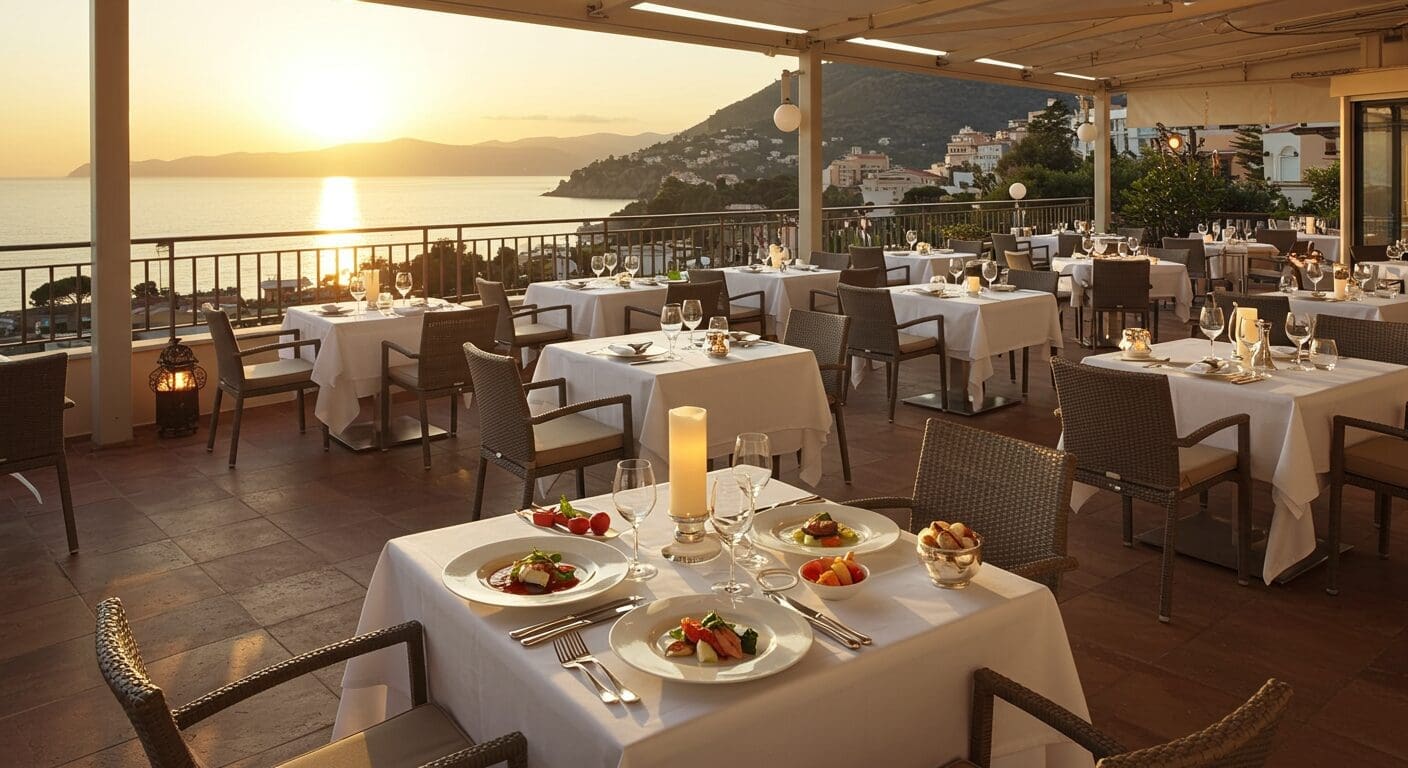
For fine dining with a different register – more theatrical, more international in its sweep – Sunset Grill & Bar in Ulus Park sits above the Bosphorus with a view that genuinely earns the name. This is one of Istanbul’s most iconic dining experiences: award-winning cuisine, a wine list of serious ambition, and an atmosphere that has made it a long-standing favourite among celebrities, discerning locals, and well-travelled international visitors. It knows what it is, and it does it extremely well.
Local Gems and Regional Tables Worth Travelling For
Outside Istanbul, Turkish food becomes even more interesting, because it becomes more specific. Every region has its own culinary logic – its own spice palette, its own way with meat, its own bread, its own claim to have invented something everyone else is doing wrong.
Gaziantep is the city that food-obsessed travellers have been quietly recommending to each other for years, and for good reason. It is a UNESCO Creative City of Gastronomy – a designation it wears with absolutely no self-consciousness whatsoever – and the food there is extraordinary in its depth and complexity. Halil Usta, founded in 1972, is the kind of institution that could only exist in a city where everyone takes eating this seriously. The restaurant is known throughout Turkey for its traditional Gaziantep kebabs – specifically the yarım simit kebabı and the rare küşleme, made from fatless lamb neck cuts, grilled over charcoal with an almost alarming level of skill. Portions are generous. Service is fast. The meat quality is exceptional. They also serve baklava made locally with natural ingredients, which bears about as much resemblance to the supermarket version as a genuine Neapolitan pizza bears to a frozen one. Prices, for the quality on offer, are extremely reasonable. Do not expect a long wine list. Do expect to leave considerably happier than when you arrived.
Along the Aegean and Mediterranean coasts, the local meyhane – Turkey’s version of a taverna, a convivial restaurant built around meze and raki – is the format that rewards slow evenings. Fresh octopus, cold white bean salads, stuffed mussels, fried courgette with yoghurt, grilled sea bass that came out of the water that morning. The cooking is not complicated. It does not need to be. The protocol is to order too many meze and eat them slowly over several hours. This is not laziness. It is the point.
Beach Clubs and Casual Coastal Dining
Turkey’s coastline has developed a beach club culture that is, depending on your perspective, either a sign of sophisticated leisure infrastructure or evidence that the Turquoise Coast has discovered what Ibiza had in 1995. Either way, the food has improved significantly.
Along the Bodrum Peninsula, a cluster of high-design beach clubs serve genuinely good food alongside their elaborate sunbed arrangements and sunset DJ sets. Expect wood-fired fish, mezze platters assembled with care, good Turkish rosé, and the sort of atmosphere where everyone appears to have arrived by boat. (Some have.)
Ölüdeniz and the wider Fethiye region, better known for the paragliding launches from Babadağ Mountain and the otherworldly Blue Lagoon, also has a growing number of waterside restaurants where the catch of the day is not a figure of speech. The informal fish restaurants along the harbour at Fethiye town – the ones with plastic chairs and tablecloths held down by condiment bottles – often outperform their smarter-looking neighbours by a considerable margin. This is a rule that applies throughout Turkey and one that will serve you well.
In Cappadocia, the culinary scene has historically lagged behind the extraordinary landscape (you are, after all, primarily there to float over fairy chimneys at dawn, not to eat). But cave restaurants carved into the volcanic rock, serving slow-cooked lamb testi – a clay pot dish broken at the table – have become a genuinely enjoyable experience, if occasionally performed with slightly too much theatrical enthusiasm.
Food Markets and Where to Eat Like a Local
Istanbul’s Kapalıçarşı – the Grand Bazaar – is an experience primarily in crowds and carpets, not cuisine. For food, head to the Mısır Çarşısı, the Spice Bazaar, in the Eminönü district, where sacks of sumac, dried fruit, Turkish delight, and more varieties of dried chilli than you thought existed press up against cheese stalls and tea sellers. It smells exceptional. Buy spices here and carry them home.
For a more working-class, completely untouristy market experience, the weekly neighbourhood bazaars – pazar – in residential Istanbul districts such as Kadıköy on the Asian side offer exactly what you want: seasonal produce, olives in more varieties than you can count, fresh herbs, and street food eaten standing up. The balık ekmek – grilled mackerel in a bread roll from the boats along the waterfront – is the sort of thing you will think about for years at random moments.
In Gaziantep, the covered bazaar district around the copper market is where the city’s real food shopping happens: shops selling pistachios grown in the surrounding region (which are, emphatically, the best pistachios in the world – Gaziantep will tell you this without provocation and they are not wrong), tahini, pomegranate molasses, and small shops selling nothing but different types of baklava. Restraint is not recommended.
What to Order: Essential Turkish Dishes
A quick orientation, because the menu can be disorienting if you arrive without a map. Meze are the small dishes that begin a meal and frequently constitute it – do not make the beginner’s error of ordering a main course while still working through six rounds of meze. Kebabs in Turkey are nothing like the late-night versions you may be familiar with from other contexts. They are serious, regionally specific preparations: Adana kebab (spiced minced lamb on a flat skewer), İskender (lamb over bread with tomato sauce and browned butter), and the Gaziantep versions already mentioned.
Pide – a boat-shaped flatbread with various fillings – is one of the country’s great casual foods and is wildly underrated abroad. Menemen is a breakfast dish of eggs scrambled with tomatoes and peppers that will make you question all other breakfasts. Lahmacun is a thin, crisp flatbread topped with spiced minced meat, squeezed with lemon, rolled up, and eaten fast. Börek – pastry filled with cheese or meat – appears everywhere and in every format and is never wrong.
For dessert: baklava in Gaziantep, künefe (a warm pastry soaked in syrup with melted cheese) anywhere it appears, and sütlaç (a cold rice pudding with a scorched top) which is considerably more interesting than it sounds.
Wine, Raki and What to Drink
Turkey has been making wine for longer than almost anywhere else on earth, and the domestic wine industry has, in the last two decades, produced some genuinely impressive bottles. Look for wines made from indigenous varietals: Öküzgözü and Boğazkere for reds (structured, dark-fruited, worth exploring seriously), and Emir and Narince for whites. The Cappadocia region produces elegant whites from Emir grapes grown in volcanic soil at altitude – they are crisp, mineral, and pair with almost everything on the Anatolian table.
Raki is the national spirit: an anise-flavoured drink diluted with water and ice, which turns cloudy – giving it the nickname Aslan Sütü, or Lion’s Milk. It is the traditional companion to meze and seafood, and drinking it properly involves a certain unhurried pace that the Turks have elevated to something close to philosophy. Turkish tea – çay – comes in a tulip-shaped glass and arrives constantly, everywhere, without being asked for. It is the social fabric of the country in liquid form.
Reservation Tips and Practical Advice
For Istanbul’s fine dining restaurants – particularly Turk Fatih Tutak and Neolokal – reservations are essential and should be made well in advance, ideally weeks rather than days. Both restaurants have international followings and fill quickly. The Chef’s Table at Turk Fatih Tutak in particular requires forward planning.
Mikla and Sunset Grill & Bar, while more accessible, also benefit from early booking, particularly for tables with the best views – which, at these addresses, matters quite a lot. Most upscale restaurants in Istanbul have English-speaking staff and online reservation systems. Outside Istanbul, things are more informal, and in places like Gaziantep, simply arriving and waiting is often the local custom and frequently the faster option.
Lunch is a serious meal in Turkey – not a quick affair – and many of the best-value eating experiences happen at midday. Dinner service typically begins later than northern Europeans expect. Arriving at 7pm in Bodrum will sometimes put you in a restaurant entirely alone, which is fine but slightly melancholy. By 9pm, things are as they should be.
A note on tipping: it is customary to leave around 10 percent in sit-down restaurants. In more casual settings, rounding up generously is well-received. At Halil Usta in Gaziantep, the appropriate response is to tell everyone you know that it exists.
Staying in a Villa with a Private Chef: The Complete Picture
For travellers who want to bring Turkey’s extraordinary food culture closer still – who want to eat a slow Aegean breakfast on a private terrace, or have a local chef prepare a full meze spread for a private group dinner without having to find a table for twelve – a luxury villa in Turkey with a private chef option makes a compelling case for itself. The best villas along the Bodrum Peninsula, the Fethiye coast, and in Cappadocia can be arranged with talented local chefs who shop the morning market and cook to the rhythms of the regional kitchen. It is, in many ways, the version of Turkish food culture that most closely resembles how the locals themselves would eat – at home, with time, with excellent ingredients, and with absolutely no need for a reservation. For the broader context on planning a trip – from getting around to what to do beyond the table – the Turkey Travel Guide covers everything you need before you arrive.