
Tuscany Travel Guide: Best Villages, Restaurants & Luxury Villas
Here is a mild confession: Tuscany almost put me off Italy. Not the place itself – the idea of it. The sheer, relentless, postcard perfection of it. The cypress trees lined up like green exclamation marks, the honey-coloured hilltowns, the rolling vineyards that look suspiciously like someone arranged them for a shoot. You’ve seen it all before you’ve even booked the flights, and that’s the problem. Tuscany arrives pre-loved, pre-romanticised, pre-Frances Mayes’d to within an inch of its life. And then you actually get there – into the countryside, past the coach parks and the queues for the Uffizi – and something embarrassing happens. You fall for it completely. Not despite the clichés, but somewhere beneath them, where the real Tuscany is quietly and magnificently going about its business. The food is better than you remember food being. The light in the afternoon does something to stone that ought to be illegal. A glass of Brunello di Montalcino in the shadow of a farmhouse wall turns out to be, without exaggeration, one of the finer things you’ve done with a Tuesday. Tuscany, it transpires, earned every cliché it owns. Luxury villas in Tuscany have become the considered traveller’s preferred way to experience it – not because they offer an escape from the region, but because they place you directly inside it, with a pool, a view, and no itinerary imposed on you by anyone.
Getting Here Without Losing the Will to Travel
The good news is that Tuscany is straightforward to reach by international standards. The better news is that the journey in from whichever airport you land at is itself rather beautiful, which puts you in the right frame of mind before you’ve even unpacked.
Florence Airport (Amerigo Vespucci) – officially FLR, and served by a solid range of European carriers including British Airways, easyJet, Ryanair and Vueling – is the obvious gateway if you’re headed to the northern or central part of the region. It’s compact, mercifully human in scale, and sits about four kilometres from the city centre. Transfers to the Chianti countryside or the Val d’Orcia take roughly an hour to ninety minutes depending on traffic and how aggressively your driver interprets the speed limit.
Pisa International Airport (Galileo Galilei) is the alternative, and for many travellers the more convenient option – it handles more routes, including long-haul connections, and is well-positioned for western Tuscany, the Maremma, and the coast. Direct trains connect it to Florence in under an hour, which is suspiciously efficient for Italy. The drive east into the heart of the region takes a similar amount of time and is considerably more scenic than any airport transfer has a right to be.
Once you’re in Tuscany, renting a car is not merely advisable – it is essentially mandatory if you want to explore properly. Public transport connects the major towns reasonably well, but the places you actually want to be – the agriturismo at the end of an unmarked gravel road, the winery that doesn’t appear on Google Maps, the village where nothing is open except a bar run by a ninety-year-old who has strong opinions about coffee – these require a car. A good one with reliable air conditioning if you’re visiting in summer. The roads through the countryside are winding, occasionally dramatic, and rarely in a hurry. Neither should you be.
The Table is the Point: Eating Extraordinarily Well in Tuscany
Fine Dining
Tuscany takes its food with a seriousness that occasionally borders on religious, and the region’s fine dining scene rewards that devotion with some of Italy’s most compelling restaurant experiences. These are not places that prioritise spectacle over substance – quite the opposite. The best tables here are rooted in tradition while being entirely unafraid of where tradition might lead next.
For the full cathedral experience, Enoteca Pinchiorri in Florence is the place. Three Michelin stars. The only restaurant in the city to hold them. Run by Giorgio Pinchiorri and Annie Féolde from inside a magnificent 18th-century Renaissance palazzo with one of the most beautiful courtyard dining spaces in Europe, it has held the Wine Spectator’s Grand Award since 1984. The cellar contains over 100,000 bottles across more than 4,000 labels – a figure that puts most national wine museums to shame. Gambero Rosso awarded it 93 points and described it as the local avant-garde, which for an institution of this age and authority is quite the compliment. Booking well in advance is not optional.
In Florence also, Il Palagio at the Four Seasons Hotel offers something rather different: Michelin-starred cooking within one of the city’s most elegant settings, with head chef Paolo Lavezzini bringing first-class technique to ingredients that are deeply, specifically Tuscan. The service is impeccable in the best sense – attentive without being present, which is the fine dining tightrope very few manage to walk.
For contemporary Tuscan cooking with genuine imagination, Ora d’Aria – also in Florence, led by chef Marco Stabile – is essential. Stabile has earned something rare: the loyalty of Tuscans themselves, not just visiting admirers. His modern reinterpretations of classic regional dishes are the sort that make you understand why reinvention is sometimes the most respectful thing you can do to a tradition.
Drive south toward Siena and you reach Arnolfo in Colle di Val d’Elsa – two Michelin stars, run by brothers Gaetano and Giovanni Trovato, and producing dishes of considerable ambition in a handsome modern dining room with an open kitchen. Duck from Valdarno, Norcia black truffle, red snapper with parsnip, lime, and pink grapefruit – this is cooking that understands geography as flavour. Giovanni’s wine cellar is worth the visit on its own terms.
And if you find yourself in the province of Grosseto near the hilltop town of Massa Marittima, do not under any circumstances miss Bracali. Two Michelin stars, created by brothers Francesco and Luca Bracali, it is the sort of place that proves outstanding restaurants can exist anywhere they choose to. Imaginative modern Italian food with its feet planted firmly in regional tradition. One of Italy’s very best. The kind of meal you find yourself describing, weeks later, to people who didn’t ask.
Where the Locals Eat
Away from the starred establishments, Tuscany feeds itself with the sort of food that requires no philosophy attached to a menu to justify it. A proper bistecca alla Fiorentina – a T-bone from Chianina cattle, served rare to the point of defiance, salted simply and grilled over wood – is one of the great arguments for carnivory. Seek it in any trattoria that has been there long enough to not need a sign outside.
The morning market in Siena’s Campo, the covered Mercato Centrale in Florence, and the weekly markets that materialise in smaller towns on rotating days of the week are where Tuscans do their shopping and where you should do yours. The pecorino alone – bought from the producer’s own stall rather than a shop – is worth the detour. So is the lardo di Colonnata, cured fatback from the marble towns near Carrara, which sounds alarming and tastes extraordinary. Wine bars in any town of appreciable size will offer cicchetti and local wines by the glass with no formality required. This is the correct way to spend a Tuscan afternoon.
Hidden Gems Worth Seeking Out
The most rewarding Tuscan meals are often the ones that happen by accident: a small osteria in a village you stopped in because someone needed water, serving handmade pici – the thick, hand-rolled pasta of the Sienese hills – with wild boar ragù that has been slow-cooking since approximately the Renaissance. The rule in Tuscany is: the smaller the menu, the more hand-written it is, and the more the owner seems mildly suspicious of you, the better the food is going to be. There is no formal methodology for finding these places. Driving slowly and paying attention is approximately as effective as any app.
Into the Countryside: The Landscape That Became a Cliché Because It Deserved To
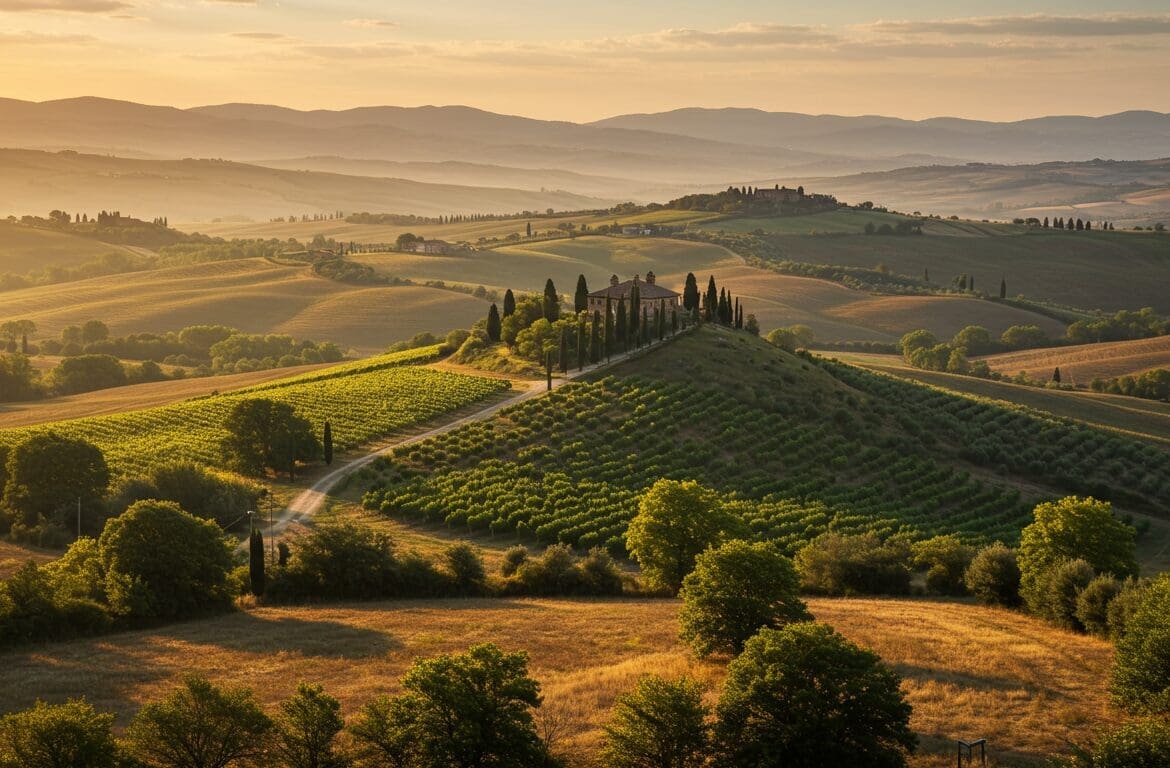
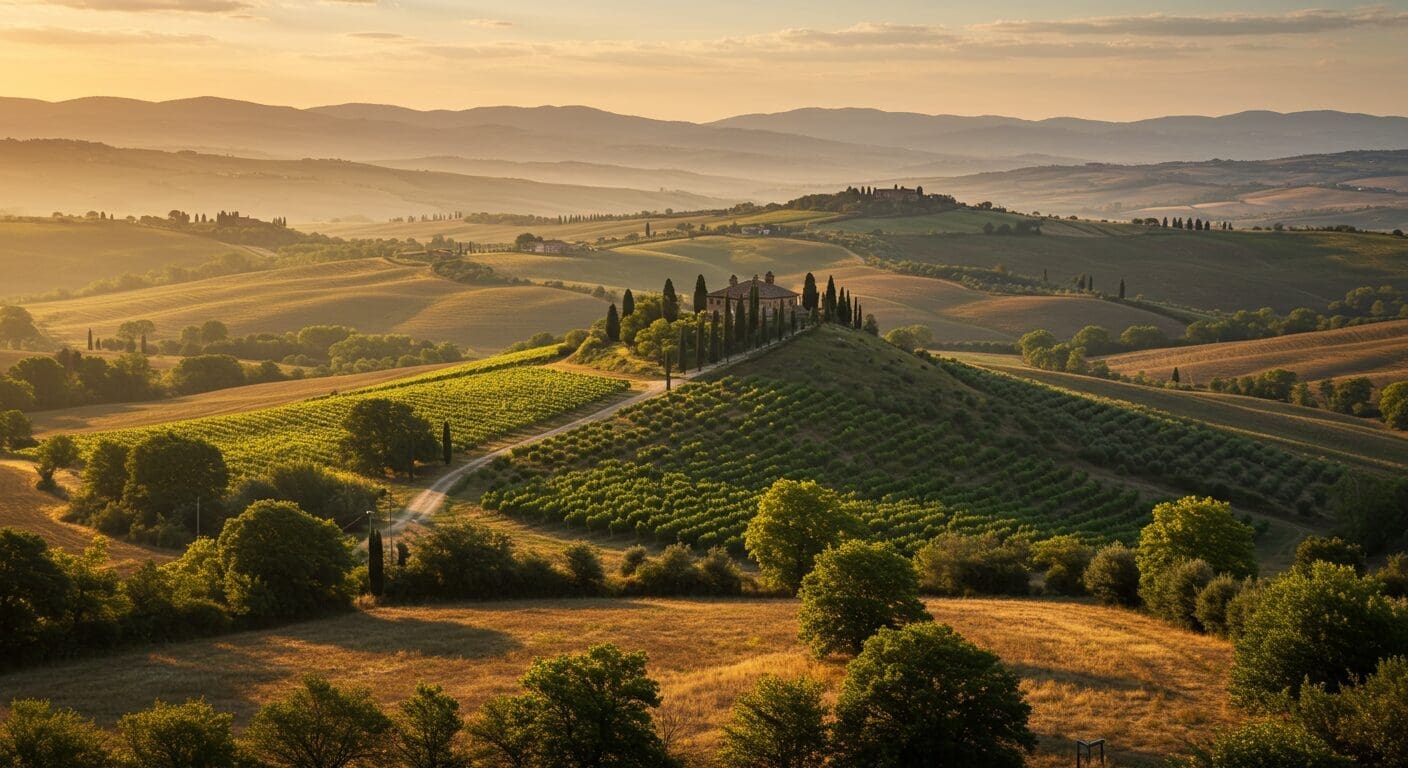
The Tuscan countryside does not ease you in gently. It is immediately, almost aggressively beautiful – which is disconcerting if you were expecting to work up to it. From almost any elevated position, the view is composed as if by someone with an unreasonable amount of talent and far too much time on their hands: hills folding into hills, vineyards in orderly rows, isolated farmhouses turning golden in the afternoon, the occasional medieval tower standing at an angle that suggests centuries of character rather than poor engineering.
The Val d’Orcia is the heart of it – a UNESCO World Heritage Site and the closest thing to a consensus Tuscany. The road between Pienza and Montalcino is one of the finest drives in Europe, full stop. It winds through landscape that has barely changed in five hundred years – you can confirm this by looking at the Renaissance paintings in the galleries behind you, which use the same backdrop. Pienza itself is a jewel of a planned Renaissance town, built by Pope Pius II in the 1460s with the ambition of creating the perfect city. He largely succeeded.
The Chianti Classico zone between Florence and Siena is the other essential countryside experience – a rolling stretch of vine-covered hills and fortified hilltowns linked by roads that have no particular reason to go in a straight line. Greve in Chianti, Castellina, and Radda are the anchors; dozens of smaller hamlets punctuate the route between them. It rewards slow travel.
Further south, the Maremma – Tuscany’s wilder, less-visited coastal hinterland – offers something rawer: rolling scrubland, thermal springs, Etruscan ruins, and a coast that hasn’t been entirely discovered yet. (Don’t spread that around.) Inland from the Maremma coast, the town of Massa Marittima sits on its ridge like something from a different century. The Garfagnana in the north, up near the Apennines, is another world entirely – green, forested, relatively cool, and barely on the tourist radar. For those who find themselves occasionally irritated by crowds, all of these places offer a corrective.
The hilltowns are the recurring motif of the Tuscan countryside. Montepulciano, Montalcino, San Gimignano (towers, tourists, worth it anyway), Volterra, Pitigliano carved from volcanic tufa – each one a compact argument for the entire region. You will, over the course of a week, develop opinions about which is the best. This is entirely normal and these opinions will be strongly held.
What to Do When You Can Tear Yourself Away from the Terrace
A luxury holiday in Tuscany presents a scheduling problem that is not altogether unpleasant: there is rather more to do than any sensible person can fit into a fortnight, and much of it is in direct competition with simply sitting somewhere beautiful and doing very little at all. The terrace always wins eventually. But before it does, the region offers the following.
Wine tasting is the obvious starting point, and Tuscany does it at every register – from the grand estates with formal cellar tours and tailored tastings to the roadside sign advertising local wine and olive oil, the latter being run by an elderly signora who will pour you three glasses of very good Chianti, sell you six bottles, and decline to charge you nearly enough. The Antinori nel Chianti Classico estate near Bargino is an experience in itself – an extraordinary piece of contemporary architecture that appears to grow directly out of the hillside, designed by Archea Associati and opened in 2012. The winery has been in the Antinori family for 26 generations. The architecture suggests they’ve invested recent profits wisely. Tours and tastings here are among the most polished in the region.
Cooking classes in a Tuscan farmhouse kitchen have achieved such popularity that they now appear on approximately every villa concierge’s list of suggestions, which means they vary wildly in quality. Seek out those led by actual local cooks – often older women who learned from their grandmothers and have strong views on the correct ratio of egg to flour in pasta dough – rather than the English-language courses designed primarily for Instagram.
Hot springs are a frequently overlooked pleasure. The Terme di Saturnia in the Maremma are free to use at the natural cascade – thermal water at 37 degrees, year round, spilling over travertine terraces in a landscape that makes no sense and is wonderful for it. Go early in the morning before the crowds arrive. Bagno Vignoni, a village built around a vast thermal pool in the Val d’Orcia, is the most atmospheric thermal experience in the region – though the pool itself is now for looking at rather than swimming in, which is Tuscany’s reminder that heritage sometimes trumps convenience.
Day trips add significant range. Cortona – the hilltop Etruscan town in the far southeast of the region, improbably perched above the Valdichiana – deserves more time than most visitors give it. The views over the lake below and across into Umbria are extraordinary, and the town itself has retained an authenticity that more famous destinations have long since mislaid. The MAEC, its Etruscan museum, is superb.
Moving Through the Landscape: Cycling, Hiking, and the More Energetic Pursuits
Tuscany rewards physical effort in direct proportion to how much you’re willing to exert. The landscape that looks so effortlessly elegant from a terrace turns out to be considerably hillier when you’re inside it on a bicycle, which is useful information to have before you commit.
Cycling is enormously popular here and for good reason – the network of back roads, strade bianche (white gravel roads), and quiet provincial routes means you can cover serious ground without encountering much traffic. The Strade Bianche cycling route through the Sienese Crete is the classic, linking villages across a landscape of pale clay hills and medieval towers. The professionals race here every spring and complain about how hard it is. This should be treated as information, not a deterrent. Electric bikes have made the more ambitious routes accessible to a wider audience, and the hire infrastructure across the region is now genuinely good.
Hiking in the Chianti hills, the Maremma, the Garfagnana, and along stretches of the Via Francigena – the ancient pilgrim route from Canterbury to Rome that passes through the heart of Tuscany – offers everything from gentle day walks to multi-day routes with luggage transfer. The Apuan Alps near Carrara, where white marble has been quarried since Roman times, provide more dramatic terrain and some of the most unusual hiking in Italy.
Horse riding is a natural fit for the Maremma, where the butteri – Tuscany’s own cowboys, who have been herding cattle on horseback here for centuries – are still a going concern. Riding through macchia scrubland with the coast somewhere in the distance is the sort of experience that recalibrates your sense of what a good day looks like.
Sailing and water sports operate from the coastal resorts and the islands of the Tuscan Archipelago – Elba chief among them, reached by ferry from Piombino and large enough to fill several days without repetition. The diving around the smaller islands, particularly Giglio and Giannutri, is exceptional by Mediterranean standards.
Why Tuscany Works Beautifully for Families
There is a version of Tuscany that appears intimidating to families – all that art, all that reverence, all those restaurants where small children’s presence is technically tolerated but not enthusiastically welcomed. That version exists. It is also avoidable.
The Tuscan countryside, as opposed to the cities, is one of the most family-friendly environments in Europe, provided the family in question is staying in a private villa with a pool. Which is, for these purposes, the assumption. A private villa removes approximately eighty percent of the logistical anxiety of travelling with children: there are no hotel corridors to negotiate at bedtime, no breakfast buffet timed to compete with someone else’s schedule, no restaurant where your eight-year-old’s pasta preferences create a diplomatic incident. The pool is there whenever it’s needed, which in August is every hour of daylight.
Children who have been adequately bribed respond well to Tuscany. The hilltowns are compact enough to explore on foot without marathon distances, the medieval towers and Etruscan tombs appeal reliably to a certain age group, and the food – pasta, pizza, gelato available every hundred metres – requires no negotiation. The Maremma coastal parks offer walking trails, wildlife (wild boar, porcupine, fallow deer), and beaches that range from the developed and convenient to the entirely wild. San Rossore Natural Park near Pisa combines beaches, pineta forests, and a pleasingly manageable sense of adventure. Older children and teenagers, given access to bikes, are essentially self-managing in the countryside. The landscape is safe, the roads are quiet, and the views provide sufficient distraction to keep the phones in a pocket at least occasionally.
Five Thousand Years of Opinions: Culture, History, and Art in Tuscany
Tuscany’s cultural history is one of the more immodest things about it. The Etruscans settled the central hills and coastal zones before Rome was a going concern. Rome absorbed and built over them. The medieval city-states fought each other with a frequency and creativity that produced some remarkable architecture in between battles. The Renaissance happened here – not exclusively, but predominantly – in a concentrated explosion of artistic genius that we’re still sorting through. The region has been producing consequential art, architecture, music, and philosophy for approximately three millennia. It’s a lot to take in over a week, but the good news is you don’t have to try.
Florence is the concentrated version of all of this, and visiting it as a day trip from a countryside villa is the sensible approach – arrive early, see the Uffizi or the Accademia (book months in advance, not weeks), walk the Oltrarno neighbourhood south of the Arno where the tourists thin and the city starts feeling like itself again, and be back for dinner at a civilised hour. The Duomo’s dome by Brunelleschi remains one of the great engineering achievements of any era. Standing beneath it makes you simultaneously impressed and slightly exhausted.
Siena, which Florence fought for centuries, is arguably more liveable than its rival – the Campo is one of the finest public spaces in Europe, and the Palio horse race held there twice yearly in July and August is one of the most intense events on the Italian calendar. Medieval rivalry, local pride, and horse management combine in ways that require witnessing directly.
The Etruscan sites of the Maremma – Vetulonia, Populonia, Sovana, Pitigliano – offer a quieter counterpoint to the Renaissance mainstream, and the Etruscan museum in Volterra is genuinely exceptional. Beyond the galleries, Tuscany’s culture is also agricultural, seasonal, and lived: the sagre, local food festivals dedicated to a single ingredient (the truffle, the chestnut, the ribollita, the lard – Tuscany celebrates lard) held in towns throughout the autumn, are among the most honest expressions of regional identity you’ll find anywhere in Italy.
What to Bring Home: Shopping in Tuscany Without Resorting to the Airport
Tuscany produces things worth owning, and the local shops and markets understand this without needing to overcharge for the privilege. Mostly.
Wine is the obvious answer to the question of what to buy, and with considerable justification. A case of properly selected Brunello di Montalcino, Vino Nobile di Montepulciano, or Chianti Classico Riserva bought from the producer will outperform almost anything you’d find in an equivalent price bracket at home. Many estates ship internationally; your villa concierge can advise. Do not leave without at least a bottle of Vin Santo, the amber dessert wine traditionally served with cantucci, which is the correct use of biscuits.
Olive oil from small Tuscan producers – look for the DOP designation and the harvest year – is another thing the region does at a level that makes the supermarket variety feel like a misunderstanding. The oils from around Lucca are particularly celebrated.
The leather goods and ceramics of the region have a long tradition and a wide spectrum of quality. Florence has the finest leather market (San Lorenzo) alongside serious leather ateliers in the Oltrarno, where artisans still work in workshops that have occupied the same buildings for generations. The blue and white ceramics of Montelupo Fiorentino, the majolica of Deruta (technically just across the border in Umbria), and the alabaster carvings of Volterra are all regional crafts with genuine heritage rather than tourist-industry provenance.
The weekly markets across the countryside towns sell everything from local cheeses and cured meats to antique furniture that someone may or may not be able to ship home. They are worth visiting even if you buy nothing. The truffles sold at the markets in season – white in autumn, black throughout the year – are genuinely good and considerably less expensive than you’d expect given what they cost in London restaurants.
Practical Matters: The Useful Stuff Without the Boring Delivery
Currency: Italy uses the euro. Cash is useful in rural areas and smaller establishments; cards are increasingly accepted but don’t assume in very small towns.
Language: Italian, and specifically Tuscan Italian, which has the distinction of being considered the purest form of the language – a fact Tuscans mention with polite frequency. English is spoken in tourist areas and most hotels; in the countryside, especially at smaller family restaurants and shops, Italian will take you further. Learning a handful of phrases – un tavolo per due, il conto per favore, non ho prenotato (I didn’t book) – is both respectful and practical.
Tipping: Not obligatory in the way it is in the US or UK, but rounding up or leaving a small amount – particularly at smaller restaurants that have treated you well – is appreciated. A coperto (cover charge) is standard at most restaurants and covers the bread, so don’t mistake it for a tip already taken.
Best time to visit: May, June, and September are the consensus answers, and they are correct. Spring brings wildflowers, green hillsides, and manageable temperatures. September combines harvest season – grapes coming in, the smell of must in the air around every winery – with weather that remains warm but no longer unreasonable. July and August are hot, crowded, and entirely bearable if you have a pool and no agenda. October is underrated: quieter, golden, with truffle season underway and an atmosphere of harvest satisfaction that is specific to agricultural regions. Winter is the secret option – cold enough for fireplaces, devoid of tourist pressure, and the cities become entirely themselves again.
Dress code: Cover shoulders and knees when entering churches, of which there are a significant number. The rule applies regardless of the temperature, which in August is a test of commitment.
Safety: Tuscany is one of the safer regions of Italy and safe by European standards generally. Pickpocketing in crowded tourist areas in Florence is the standard caution. The countryside presents no meaningful risks beyond possibly getting lost on an unmarked road and discovering somewhere unexpectedly wonderful, which is an acceptable outcome.
The Villa Argument: Why This Is the Right Way to Experience Tuscany
There is a logic to staying in a Tuscan villa that goes beyond luxury, though the luxury is very much present and should not be dismissed. A private villa – particularly in the countryside – places you inside the landscape rather than adjacent to it. You wake to the same view the Renaissance painters used as a backdrop. Your morning coffee happens on a terrace that overlooks hills rather than a hotel car park. The pool is yours. The kitchen is yours, which matters enormously in a region where the markets are this good and the urge to cook with local ingredients is essentially unavoidable.
A villa also gives you base – a fixed point from which the day can go in any direction without obligation. You can linger over dinner without watching a restaurant try to turn the table. You can open a second bottle of Brunello without calculating the bill. Children can be at the pool while adults are at the table, within earshot and not in the way. Groups of friends can converge on the same kitchen, the same terrace, the same spectacular view, and not have to manage separate hotel rooms and logistical negotiations every morning.
The villa experience in Tuscany ranges from converted farmhouses with three bedrooms and a kitchen garden to vast private estates with staff, wine cellars, olive groves, and pool complexes that suggest a very good previous century. Excellence Luxury Villas offers more than 27,000 properties worldwide, and its Tuscan portfolio spans that entire register – from the intimate and atmospheric to the comprehensively staffed and unreasonably grand. Every property in it has been selected to place you properly inside this region rather than merely visiting it.
Browse our collection of luxury villas in Tuscany with private pool and find the one that makes your version of the Tuscan week possible.
More Tuscany Travel Guides
What is the best time to visit Tuscany?
May, June, and September are consistently the best months for a Tuscany holiday. Spring brings cooler temperatures, green countryside, and wildflowers; June combines long days with manageable heat. September is arguably the finest month of all – harvest season is underway, temperatures remain warm, and the crowds have thinned noticeably. October is increasingly popular for the same reasons, with the addition of truffle season. July and August are busy and hot but entirely workable from a private villa with a pool, where the heat becomes an excuse rather than a problem. Winter offers a quieter, more authentic experience – cities feel like themselves, prices drop, and fireplaces become a legitimate selling point.
How do I get to Tuscany?
The two main airports are Florence (Amerigo Vespucci Airport, FLR) and Pisa (Galileo Galilei International Airport, PSA). Florence is the better option for the north and centre of the region, including the Chianti hills and Florence city; Pisa handles more international routes and is better placed for the coast, the Maremma, and western Tuscany. Both airports have good car hire facilities, and a rental car is effectively essential for exploring the countryside. Trains connect Pisa Airport directly to Florence in under an hour. Bologna Marconi Airport is another useful option, particularly for the northern reaches of the region, and is increasingly well-served by European and international carriers.
Is Tuscany good for families?
Genuinely, yes – particularly for families staying in a private villa with a pool in the countryside. The Tuscan landscape offers safe cycling, walking trails, wildlife parks, hot springs, and beaches, while the food is universally well-received by children. The hilltowns are compact and walkable. Medieval towers, Etruscan tombs, and the marble quarries near Carrara tend to appeal to children more than you might expect. The coastal Maremma provides wildlife encounters and accessible nature. Families who base themselves in a rural villa avoid the logistical pressures of city hotels and can structure days around the pool as much as around sightseeing, which is the most sustainable family travel arrangement known to parents.
Why rent a luxury villa in Tuscany?
Because Tuscany is a region best experienced from inside the landscape, not from a hotel room overlooking a car park. A private villa gives you the countryside views, the private pool, the morning terrace, and the kitchen that makes the markets worth visiting. You set your own pace, host your own dinners, and wake up to the same hills that have been inspiring people for five centuries. For families, the private pool and flexible mealtimes are transformative. For couples, the seclusion is the point. For groups of friends, the shared space creates the kind of holiday that becomes a reference point for years. Excellence Luxury Villas has over 27,000 properties worldwide, with a curated Tuscan portfolio ranging from intimate converted farmhouses to grand private estates with staff and wine cellars.