
Best Restaurants in California
You wake up somewhere between the Pacific and a glass of something cold, and California does what California always does – it makes the rest of the world feel slightly apologetic. By 9am you have eaten an avocado that tastes the way avocados are supposed to taste but somehow never do at home. By noon you are deciding between a Dungeness crab roll eaten with your feet in the sand and a twelve-course tasting menu that requires a reservation you sensibly made three months ago. By evening, you are sitting in a valley that produces wine serious enough to embarrass Bordeaux, and a sommelier is explaining, with quiet authority, why you should be drinking this and not that. California has always understood food – not as fuel, not even as culture, but as a kind of daily philosophy. This is a state that did not invent the farm-to-table movement so much as live it before anyone thought to give it a name.
Whether you are moving between Los Angeles and San Francisco, threading north through Napa, or lingering on the Monterey coast with no particular agenda, the best restaurants in California represent one of the great eating itineraries on earth. The guide below is your map.
The Fine Dining Scene: Michelin Stars and the Art of the Long Dinner
California takes its Michelin stars seriously, and the guide takes California seriously back. The concentration of three-star restaurants alone is enough to justify a dedicated culinary tour – and more than a few people have quietly done exactly that, pretending to their families it was a hiking holiday.
In Los Angeles, Providence stands as the city’s most decorated dining room. Chef-owner Michael Cimarusti earned a third Michelin star in 2025, a distinction that felt less like news and more like confirmation of something regulars had known for years. The eight-course dinner menu – priced at $375 – is built around seafood with a precision and artfulness that turns a piece of fish into a kind of argument about what food can be. The room is elegant without being cold, the service attentive without hovering. It also appeared on OpenTable’s Top 100 Restaurants in America for 2025, which is the kind of double endorsement that removes all doubt. Book far in advance and order whatever Cimarusti is doing with scallops at the time. You will not be reviewing the decision.
San Francisco has two three-star giants that any serious food traveller should place near the top of their list. Quince, which has held three Michelin stars since 2017, is chef Michael Tusk’s love letter to the best ingredients California can produce. The restaurant’s partnership with Fresh Run Farm – one of the state’s early champions of organic agriculture – means that heirloom fruits, vegetables and edible flowers are grown exclusively for the kitchen. There is something almost quietly radical about eating a carrot that was planted specifically for your dinner. Tusk’s cooking honours those ingredients with the kind of technique that is invisible until you realise you have been thinking about a particular bite for three days.
A few streets away, Atelier Crenn offers something altogether different in register, though no less serious in ambition. Chef Dominique Crenn – the first woman in America to helm a three-Michelin-star restaurant – produces what Michelin itself described as showing “a wonderful balance of grace, artistry, technical ability and taste.” Her modern French menu reads, famously, as poetry rather than a conventional list of dishes. Whether you find that charming or slightly alarming probably says something about you. Either way, the food resolves all uncertainty immediately.
And then there is The French Laundry in Yountville, Napa Valley – a name that has been spoken with near-religious reverence in culinary circles for three decades. Thomas Keller transformed what had been a steam laundry (and later a French stream-to-table restaurant, as it happens) into one of the defining restaurants in American food history after taking it over in 1994. The nine-course menu is rooted in classical French technique but speaks entirely in California’s accent – cauliflower velouté with toasted marcona almonds, venison with caramelised Brussels sprouts, an attention to detail that makes other restaurants feel slightly rushed. The list of chefs who trained under Keller and went on to open their own acclaimed restaurants – from Grant Achatz at Alinea to Corey Lee at Benu – tells you everything about the kitchen’s influence. Getting a reservation requires planning, patience, and a willingness to set an alarm for the exact moment the booking window opens. It is worth all three.
Holbox and the Rise of the Taqueria-Turned-Phenomenon
Not every great restaurant arrives with white tablecloths and a sommelier. Holbox, located inside Mercado La Paloma in South Central Los Angeles, is perhaps the most compelling argument California currently makes for the idea that extraordinary food can appear anywhere it chooses. Founded by Gilberto Cetina, Holbox earned its Michelin star in 2024 – the guide calling it “a distinctively Angelino phenomenon” – and then, as if to prove a point, ranked number one on Yelp’s Top 100 Places to Eat in the United States for 2025. Cetina himself was a semifinalist for Outstanding Chef at the 2025 James Beard Awards, which is the culinary world’s version of being shortlisted for a very prestigious, very delicious Oscar.
The focus is on the seafood of Mexico’s Yucatán Peninsula – ceviches, aguachiles, tostadas laden with octopus or uni or thinly sliced raw fish dressed with something bright and electric. The setting is a food market counter. The queue, on certain days, is considerable. Go anyway. This is the kind of meal that recalibrates your understanding of what the word “lunch” can mean.
Local Haunts, Neighbourhood Bistros and Where to Eat Without a Reservation
California’s food culture has never been purely the territory of the reservation-required and the expense-accounted. The state’s most pleasurable eating is often found at a lower volume – the fish tacos in a Baja-influenced shack near Ensenada Road in San Diego, the wood-fired pizza in a courtyard in Sonoma, the bowl of pho in a Vietnamese-run spot in San Jose that has been serving the same broth for twenty-five years and has no intention of changing it.
In San Francisco, the Ferry Building Marketplace remains one of the most satisfying places to eat in the country without actually sitting down. The Saturday farmers’ market draws an extraordinary collection of Northern California producers – stone fruit so good it feels impolite, cheeses from small Marin County creameries, sourdough from Acme Bread Company that the city has been quietly obsessed with since the 1980s. Walk in hungry. Leave with something wrapped in paper that you eat before you reach your car.
Los Angeles, for all its Michelin-catalogued grandeur, is also a city of extraordinary informal eating – Korean barbecue in Koreatown, hand-made pasta in Silver Lake, Japanese-Peruvian fusion in West Hollywood that sounds like it should not work and absolutely does. The best approach is to ask whoever is looking after your villa which neighbourhood they would send a friend to on a Tuesday night. That answer will be more useful than any algorithm.
Beach Clubs and Casual Dining by the Water
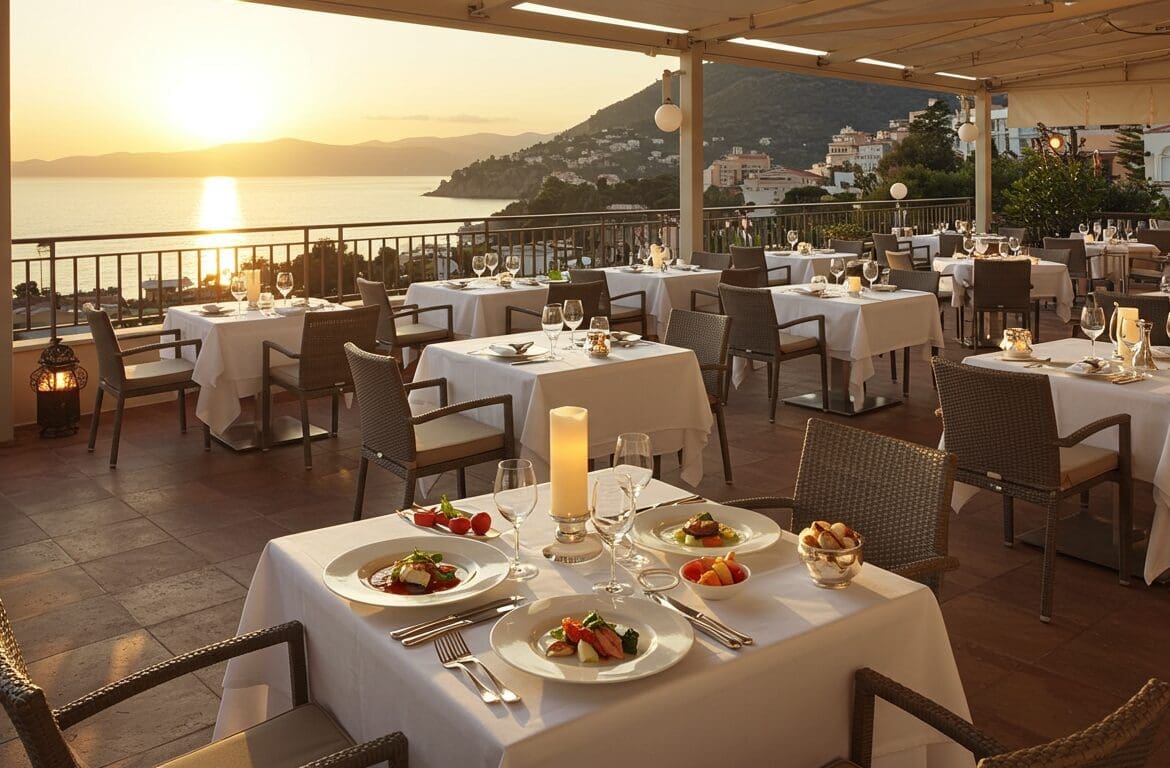
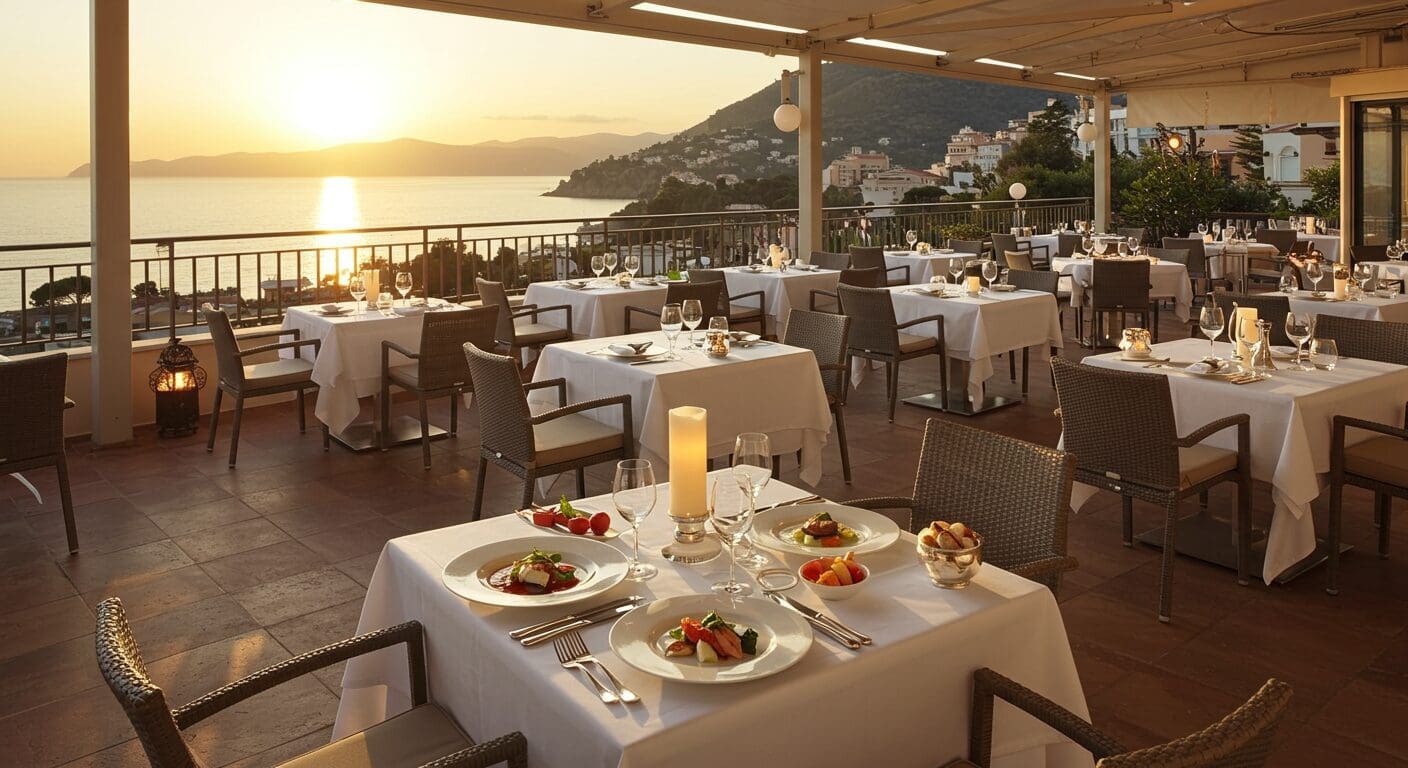
California does not separate food from landscape. Along the coast, eating well and eating outside are the same activity. The Malibu stretch is particularly well-served for those who want something sophisticated with their Pacific views – there are beach clubs and coastal restaurants here that serve excellent crudo and cold rosé to people who have clearly been in the sea recently and feel very good about it.
In Santa Barbara, the waterfront dining scene balances relaxed ease with genuine quality – local halibut, Santa Barbara spot prawns (a local ingredient so sweet and fresh they almost justify the drive alone), and wines from the Santa Ynez Valley that pair with fish in the way that only local wine with local food properly can. The Channel Islands sit just offshore, doing nothing but looking atmospheric. Nobody complains.
Further north, Carmel-by-the-Sea offers a more intimate coastal dining experience – smaller rooms, longer menus, the sense that your server has opinions about the cheese course and is not afraid to share them. This is not a criticism.
Wine, Drinks and What to Order
Any conversation about the best restaurants in California eventually becomes a conversation about wine, because California has quietly become one of the world’s great wine regions while much of Europe was still deciding whether to take it seriously. Napa Valley Cabernet Sauvignon is the obvious answer – structured, powerful, age-worthy in a way that rewards patience – but the more interesting conversation, the one that sommeliers get slightly animated about, involves Pinot Noir from the Sonoma Coast, Chardonnay from the Santa Rita Hills, and the Rhône-style blends coming out of Paso Robles that nobody who hasn’t tried them quite believes in yet.
At The French Laundry, the wine list is itself a kind of destination. At Atelier Crenn, the beverage pairing is available in a non-alcoholic format that takes the alternative seriously. At Holbox, cold Mexican beer or a sharp margarita is the correct answer, and anyone who tells you otherwise is overthinking it.
For spirits, California’s craft cocktail scene in Los Angeles and San Francisco is genuinely exceptional. House-made bitters, locally foraged garnishes, mezcal programmes that extend further than any reasonable person needs – the bars attached to fine dining restaurants here treat the pre-dinner drink with the same attention as the food that follows. This is, on balance, a very good arrangement.
Food Markets and Hidden Gems Worth Seeking Out
Beyond Holbox, Mercado La Paloma itself is worth an afternoon – a community market in a converted industrial space that houses several food vendors alongside local artisan stalls. It is one of those places that feels like a genuine neighbourhood institution rather than a curated food hall, which is precisely what makes it interesting.
The Grand Central Market in downtown Los Angeles offers a similar energy on a larger scale – Mexican food stalls alongside ramen counters, egg sandwich specialists, juice bars, and the occasional queue that tells you something nearby is exceptional. Follow the queue. This is reliable advice in Los Angeles food markets and almost nowhere else in life.
In the Bay Area, Oxbow Public Market in Napa is the luxury traveller’s version of a food market – producers at the top of their craft, prepared food of genuine quality, and a wine bar that makes waiting for your table at The French Laundry feel entirely manageable. It is also a useful reminder that California’s food culture operates at multiple price points simultaneously, and that the $6 fish taco can be as worthwhile, in its own way, as the $375 tasting menu.
Reservation Tips: How to Actually Get a Table
The gap between knowing where to eat in California and actually eating there can, at the top end, be significant. The French Laundry releases reservations two months in advance at 10am Pacific Time. They go quickly. Setting a calendar reminder is not excessive – it is necessary. Atelier Crenn and Quince operate similarly, with bookings taken through their respective reservation systems and through Tock, which is the platform of choice for California’s more serious restaurants.
Providence and Holbox are also in demand, though the latter – being a counter-service restaurant – operates on a first-come basis during market hours, which means arriving early or accepting a queue. For a Michelin-starred meal at a market counter, most people find the queue surprisingly acceptable.
The general principle: book the marquee restaurants the moment you confirm your travel dates. For everything else, the concierge service that comes with a well-chosen villa can open doors that public reservation systems politely decline to.
Staying Well: The Villa Option
The smartest way to eat in California is, increasingly, to bring the kitchen to you – at least for part of the trip. A luxury villa in California with a private chef option transforms a morning at the farmers’ market from a pleasant walk into a project. You select the produce, the chef handles the rest, and dinner happens on your own terrace with a bottle of Napa Cabernet you chose two hours ago and a view that the restaurant you almost booked cannot offer. It is a different kind of dining experience – quieter, more personal, occasionally more extraordinary – and it sits alongside the Michelin table rather than competing with it. The ideal California food trip contains both.
For more on planning your time in the state – from coastal drives to cultural highlights – the full California Travel Guide covers the ground comprehensively.