
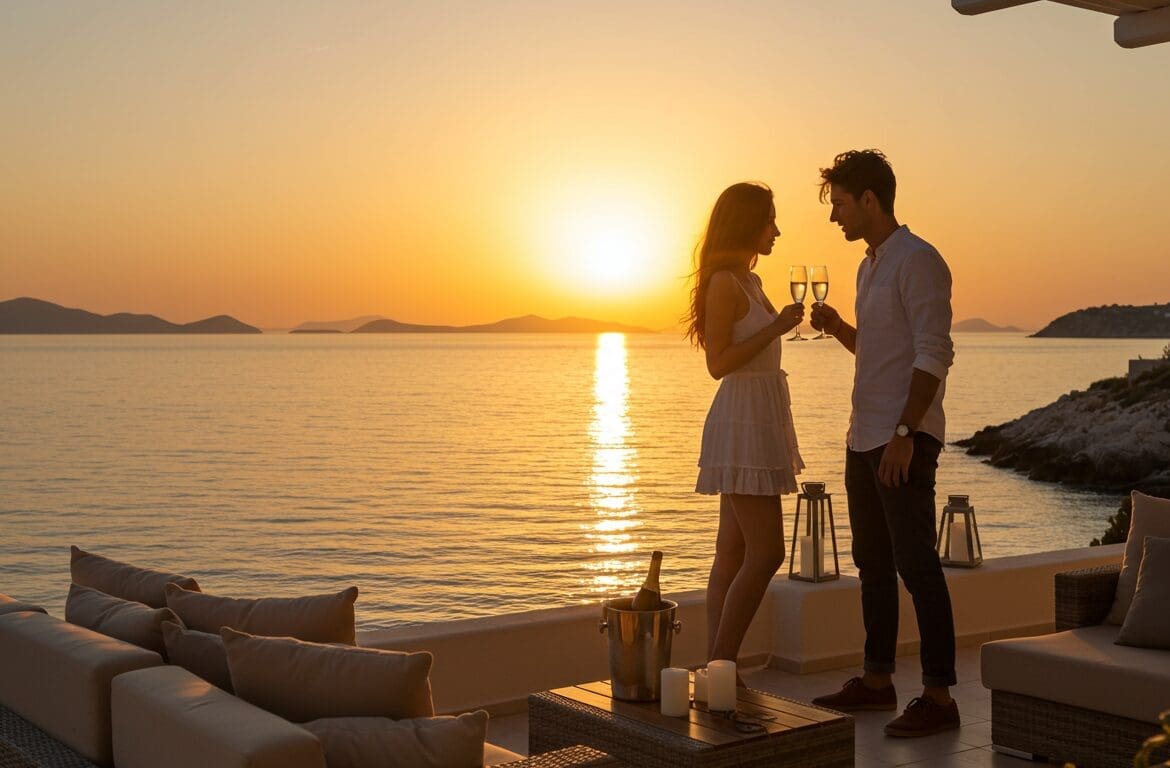
Romantic Catalonia: The Ultimate Couples & Honeymoon Guide
You wake to the sound of nothing in particular – perhaps a distant bell, perhaps the soft percussion of shutters in a warm breeze – and the light coming through the villa window is already doing something unreasonable. It has that quality particular to the Mediterranean coast: thick, golden, almost edible. You take coffee on the terrace while the hills of the Costa Brava arrange themselves in the middle distance. Later, you’ll swim from a cove that appears on no map you can find. Later still, there will be wine – local, serious, not especially expensive – and dinner somewhere small and candlelit where the menu takes its time. This is Catalonia. And it has been doing romance, quietly and without making a fuss about it, for considerably longer than you’ve been planning this trip.
Why Catalonia Works So Well for Couples
There’s a particular alchemy at work in Catalonia that many of its more famous Mediterranean rivals have long since traded away for coach parks and souvenir shops. The region manages, against considerable odds, to be both wildly beautiful and genuinely itself. It has its own language, its own cuisine, its own cultural identity that it wears with a kind of relaxed pride. For couples, this matters more than it might seem. Romance tends to flourish in places that feel real – where the people are living their lives rather than performing them for visitors, where the food in a local restaurant is good because that’s simply how things are done here, not because someone decided it would help with reviews.
The geography alone is enough to make you slightly emotional. Within an hour you can move from the wild, wind-carved coastline of the Costa Brava to the vine-threaded interior of Penedès wine country. The Pyrenees sit to the north, dramatic and surprisingly accessible. Barcelona provides the urban counterpoint – a city of genuine architectural audacity and late-night energy that somehow never feels exhausting. For couples who want variety alongside intimacy, Catalonia offers both in unusual abundance. It rewards the curious and repays those who slow down.
The Most Romantic Settings and Experiences
The Costa Brava remains, in the considered opinion of anyone who has actually been there, one of the most quietly spectacular coastlines in Europe. The name translates as “wild coast” and the cliffs, hidden coves and dark-pine headlands justify the description entirely. The medieval village of Pals, rising from the flatlands of the Baix Empordà, has the kind of golden-stone beauty that makes couples reach instinctively for each other. Tossa de Mar, with its illuminated medieval walls and sheltered bay, has the good sense to look its best at dusk, when the light goes amber and the fortress glows like something out of an illuminated manuscript.
Inland, the volcanic landscape of La Garrotxa – particularly the Fageda d’en Jordà, a beech forest growing improbably on ancient lava fields – offers something genuinely unlike anywhere else. Walking through it in autumn, when the light falls through turning leaves onto black volcanic soil, produces the kind of silence that couples find either deeply romantic or mildly unsettling, depending entirely on the state of the relationship. For most, it’s the former.
Then there is the Salvador Dalí Triangle: the artist’s house at Portlligat on its sheltered cove, the surrealist theatre-museum at Figueres, and the castle he gave to his wife Gala at Púbol. Whatever you think of Surrealism, visiting these places together is a curiously intimate experience – a reminder that great love affairs have always been a little irrational.
Best Restaurants for a Special Dinner
Catalonia’s restaurant culture is, to put it plainly, exceptional – and that’s before you even get to the Michelin stars, of which it has accumulated an embarrassing number. The high temples of Catalan gastronomy are well documented; what’s perhaps less discussed is how good the middle ground is. A family-run restaurant in the Empordà, where the chef shops at the market that morning and the wine list is two pages long and entirely local, can produce a meal that lingers in the memory as long as anything with a tasting menu and a waiting list.
For a genuinely special dinner, look to the coastal towns of the Costa Brava – Cadaqués and Begur in particular have restaurants that combine serious food with the kind of setting that does half the work for you. The cuisine of the Empordà region – which melds mountain and sea in ways that seem improbable until you taste them – is among the most sophisticated in Spain. Suquet de peix, the local fish stew, and rice dishes made with cuttlefish ink are the kind of things you will find yourself attempting to recreate at home, unsuccessfully, for years.
Wine pairing here deserves particular attention. The Penedès and Priorat regions produce wines of real character – the latter in particular, with its llicorella slate soils, makes reds of extraordinary depth and concentration. Ordering a bottle of Priorat over dinner is less a choice and more a declaration of intent.
Couples Activities: Sailing, Spa, Wine and More
Catalonia’s coastline was made for sailing in the same way that its mountains were made for hiking – with the comfortable certainty that whoever designed it had aesthetics very much in mind. Private sailing charters along the Costa Brava allow couples to reach coves that are simply inaccessible by land, to swim in water of a quite unreasonable blue, and to take lunch on deck in the kind of setting that photographs never quite do justice to. Most charter operators will arrange everything from a few hours to a full day, with lunch, wine and a skipper who knows where to find the quiet spots.
For spa experiences, the five-star properties of Barcelona and the coastal resorts offer treatments that draw on Mediterranean traditions – olive oil, sea salt, rosemary – in ways that feel genuinely connected to place rather than simply rebranded. Couples massage experiences with private terrace access are widely available and represent the kind of afternoon investment that pays significant dividends in general contentment.
Wine tourism in Penedès and Priorat is, for the right couple, close to perfect. Many producers offer private tours and tastings with advance booking – intimate, unhurried, often conducted by the winemakers themselves in the kind of cellars that have been doing this since before the concept of “wine tourism” existed. Cava – Catalonia’s own method traditional sparkling wine – is produced here too, and a private tour of a cava bodega, ending with a glass on a terrace above the vines, is both educational and thoroughly pleasant.
Cooking classes focusing on Catalan cuisine give couples not just a skill to take home but a narrative thread – the story of why this region’s food is the way it is, how the mountains meet the sea, why anchovies from l’Escala are a serious matter. They also tend to end with lunch, which is never a disadvantage.
The Most Romantic Areas to Stay
For the quintessential romantic Catalonia experience, the Costa Brava’s northern stretch – from Begur up through Cadaqués – offers the best combination of beauty, seclusion and character. Cadaqués in particular is the kind of place that makes people who discover it feel slightly possessive about it, which is understandable and entirely futile. Its whitewashed houses, deep bay and cappuccino-coloured church have attracted artists and writers for over a century, and it retains an atmosphere of creative calm that is genuinely rare.
Begur, perched on its hilltop with castle ruins and four or five small cove beaches within easy reach, strikes an excellent balance between village life and coastal luxury. The surrounding Alt Empordà – rolling farmland, medieval villages, the volcanic drama of La Garrotxa to the west – provides a setting that is endlessly explorable.
For couples who want city access alongside nature, the towns of the Maresme coast north of Barcelona offer a compelling compromise: close enough to the city for a day trip or a concert, far enough away to feel genuinely removed. And for those drawn to the wine country interior, the villages around Vilafranca del Penedès and the dramatic landscapes of Priorat – where the villages seem to have grown directly from the rock – offer something altogether more atmospheric and less visited.
Proposal-Worthy Spots
Catalonia has, without appearing to try especially hard, produced an unusual number of settings that seem designed for exactly this purpose. Cap de Creus, the most easterly point of the Iberian Peninsula, where the Pyrenees finally give up and fall into the Mediterranean, offers a wild, wind-battered beauty that is entirely its own – and a sunset that tends to make decisions feel inevitable. It is, it should be said, better visited on a calm day. The wind here has a personality.
The castle at Púbol – Dalí’s gift to Gala, surrounded by its cypress-lined moat and formal gardens – is perhaps the most architecturally theatrical proposal setting in the region. The Roman ruins at Empúries, where the Mediterranean laps against ancient columns on a long crescent beach, have a certain gravitas that serves the occasion well. And the Romanesque monastery of Sant Pere de Rodes, high in the Serra de Rodes with views down to the bay and France beyond, offers the kind of perspective – historical, geographical, emotional – that tends to concentrate the mind wonderfully.
Anniversary and Honeymoon Considerations
For honeymooners, Catalonia’s combination of variety and depth is its principal virtue. A two-week itinerary that begins in Barcelona – two or three nights, long enough to fall properly in love with the city without developing an opinion on the Sagrada Família queue – then moves to the Costa Brava for a week of coastal villa life, with a two-night detour into wine country at the end, covers more emotional ground than almost any comparable destination.
The key honeymoon principle here is deceleration. Catalonia is not a checklist destination. It rewards couples who stop somewhere and actually live in it for a few days – who find the market, discover the beach that requires a fifteen-minute walk to reach, order the same wine twice. The infrastructure for this kind of stay is excellent: private villa rentals with pools, terraces and proper kitchens allow a couple to establish something that feels less like a holiday and more like a temporary life. This is, incidentally, the best kind of honeymoon.
For anniversaries, a long weekend in the Priorat – one of Spain’s most dramatic wine regions, where terraced vineyards climb impossibly steep slopes above medieval villages – provides the kind of concentrated intensity that milestone occasions call for. Alternatively, a private charter along the Costa Brava with an overnight in Cadaqués covers sea, architecture and atmosphere in a single elegant arc. Both approaches share the quality of feeling considered rather than simply expensive – which, for an anniversary, matters considerably more.
Plan Your Romantic Catalonia Stay
Our full Catalonia Travel Guide covers everything from practical logistics to the deeper rhythms of the region – the festivals, the food culture, the best times to visit and the things that brochures tend not to mention. It’s worth reading before you arrive, and probably again when you get back and realise you missed something.
For a romantic trip to Catalonia, the accommodation choice shapes everything. A hotel, however beautiful, is a shared space – the lobby, the breakfast room, the pool that someone else is always already using. A private villa is entirely different. It is your space: your terrace, your olive trees (in a figurative sense, though sometimes in a literal one), your kitchen for when the mood takes you, your pool for midnight swimming without the quiet judgement of strangers. The privacy that a villa provides transforms the quality of a romantic trip in ways that are difficult to overstate and, once experienced, impossible to forget. For couples who want Catalonia at its most intimate, a luxury private villa in Catalonia is the ultimate romantic base – and the foundation on which the best version of this particular trip is built.