
Best Restaurants in South Africa: Fine Dining, Local Gems & Where to Eat
Best Restaurants in South Africa: Fine Dining, Local Gems & Where to Eat
There is a particular quality to the light in the Cape Winelands at around six in the evening. The vineyards go golden, the mountain ridges sharpen into silhouette, and somewhere nearby someone is opening a bottle of Chenin Blanc. The smell that reaches you first isn’t the wine – it’s the braai smoke, drifting lazily from a farmhouse you can’t quite see, the char of good meat carried on air that is warm and dry and faintly sweet with the residue of a long summer day. That is South Africa telling you it’s time to eat. You should probably listen.
What the world is slowly waking up to – and the food world in particular – is that South Africa is not merely producing world-class wine alongside world-class scenery. It is producing world-class food, anchored to a larder of extraordinary depth: Cape Malay spices, indigenous fynbos herbs, Atlantic-fresh seafood, slow-raised Karoo lamb, and a braai culture that puts every garden barbecue in the northern hemisphere to mild shame. The best restaurants in South Africa span fine dining, local gems, and everything in between – and this guide covers where to eat, what to order, and how to navigate it all without accidentally spending your first night in a tourist trap with laminated menus.
The Fine Dining Scene: Cape Town’s Place on the World Stage
Cape Town has quietly – and then very loudly – established itself as one of the most compelling fine dining cities in the world. The 2025 World’s 50 Best Restaurants list confirmed what those paying close attention already knew: this is a city that deserves serious culinary attention, not just admiring glances at Table Mountain.
La Colombe, sitting at the crest of Constantia Nek on the Silvermist organic wine estate, made its sixth appearance on the World’s 50 Best list in 2025, landing at number 55. Under chef James Gaag, the kitchen produces French-Asian fusion with a precision that makes each course feel like a considered argument rather than mere decoration. The setting – a historic homestead draped in vine, with cool valley air rolling in – does the kind of atmospheric work that no interior designer could replicate. You come for the food. You stay for the feeling that civilisation, at this particular moment, is doing rather well.
FYN Restaurant, housed on the fifth floor of a 19th-century silk factory in central Cape Town, occupies a different register entirely. Here, chef Peter Tempelhoff and his team have constructed something genuinely rare: a restaurant with a coherent philosophy. African ingredients and storytelling are married to Japanese technique and precision, resulting in dishes that feel neither borrowed nor performed. FYN ranked 82nd on the 2025 World’s 50 Best list – its fifth consecutive appearance – and holds a three-star rating from the Food Made Good Standard, making it the only restaurant on the continent to do so. It earns every one of those stars.
Newcomer to the global list but no newcomer to Cape Town’s loyal diners, Salsify at The Roundhouse entered the World’s 50 Best for the first time in 2025 at number 88. Set in a converted Georgian pavilion in Camps Bay, with the Atlantic stretching out below Lion’s Head, chefs Ryan Cole and Luke Dale-Roberts have built a restaurant around beautifully plated dishes of bold local character. The views alone could carry a lesser restaurant. Here, they’re almost beside the point – which is quite the compliment.
It is worth noting that South Africa’s fine dining operates without the Michelin framework – the guide has never covered the country. What fills that gap are the World’s 50 Best rankings, the annual Eat Out Awards, and increasingly, the considered weight of diner opinion. The food is world-class. The trophies are simply organised differently.
The Restaurants South Africans Actually Choose: Dineplan’s Best
There is a specific pleasure in knowing where locals eat – not locals performing cosmopolitanism for visiting journalists, but South Africans on a Friday evening choosing where to spend their money and their evenings with people they care about. The 2025 Dineplan Reviewers’ Choice Awards, which aggregated over 330,000 reviews across more than 1,700 restaurants, offers something the glossy rankings occasionally miss: genuine consensus.
Good to Gather in Stellenbosch took the top spot – based entirely on verified guest reviews, which is the only kind that really matters. Located in the heart of the Winelands, it represents the warm, generous, ingredient-led cooking that Stellenbosch does better than almost anywhere: food that feels connected to its landscape, served in the kind of atmosphere where conversation flows as easily as the local Pinotage. If you are spending time in the Winelands – and you should be – this is the booking to make.
Reverie Social Table in Cape Town came in at number two in the same awards. The name is apt: this is a restaurant with an ethos around gathering, around the social architecture of the table. The food is contemporary and thoughtful, the wine list inevitably excellent. Cape Town produces no shortage of places keen to impress; Reverie Social Table produces the rarer achievement of a place that puts you at ease first.
Local Gems, Neighbourhood Favourites & the Art of Eating Simply
Not every meal in South Africa should be a production. Some of the country’s most satisfying eating happens at a pavement table with a Windhoek lager, a plate of peri-peri chicken, and no strong feelings about the decor whatsoever.
The Bo-Kaap quarter of Cape Town – the cobbled, colour-washed neighbourhood that climbs Signal Hill – is the spiritual home of Cape Malay cooking. Here you’ll find bobotie made as it was intended: a spiced minced meat bake, sweetly aromatic with turmeric, bay leaf and apricot, topped with an egg custard that sets golden in the oven. It is comfort food of the highest order, and it asks nothing of you except appetite. The neighbourhood’s family-run restaurants make no concessions to fusion or reimagination, which is precisely their value.
In the Winelands, every wine estate seems to have a kitchen, and the quality ranges from excellent to quietly exceptional. Farm-to-table here is not a marketing concept – it is simply geography. A long lunch at a working wine farm, with bread from the on-site bakery and cheese made on the premises, is the kind of experience that makes other meals feel faintly apologetic by comparison.
Along the Garden Route, seafood is the language everyone speaks fluently. Knysna is famous for its oysters – farmed in the lagoon and eaten as fresh as the sea itself – and the small waterfront restaurants that serve them do so with a directness that is entirely appropriate. Order them cold, eat them fast, order more. That’s the entire instruction manual.
Beach Clubs, Sundowners & Casual Coastal Dining
Cape Town’s Atlantic Seaboard – the strip running through Sea Point, Bantry Bay, Clifton and Camps Bay – is where the city comes to be seen, and to eat with one eye on the horizon. The beach clubs here have evolved well beyond their beginnings as places to order a frozen cocktail and forget about sunscreen. The food has caught up with the ambition of the views.
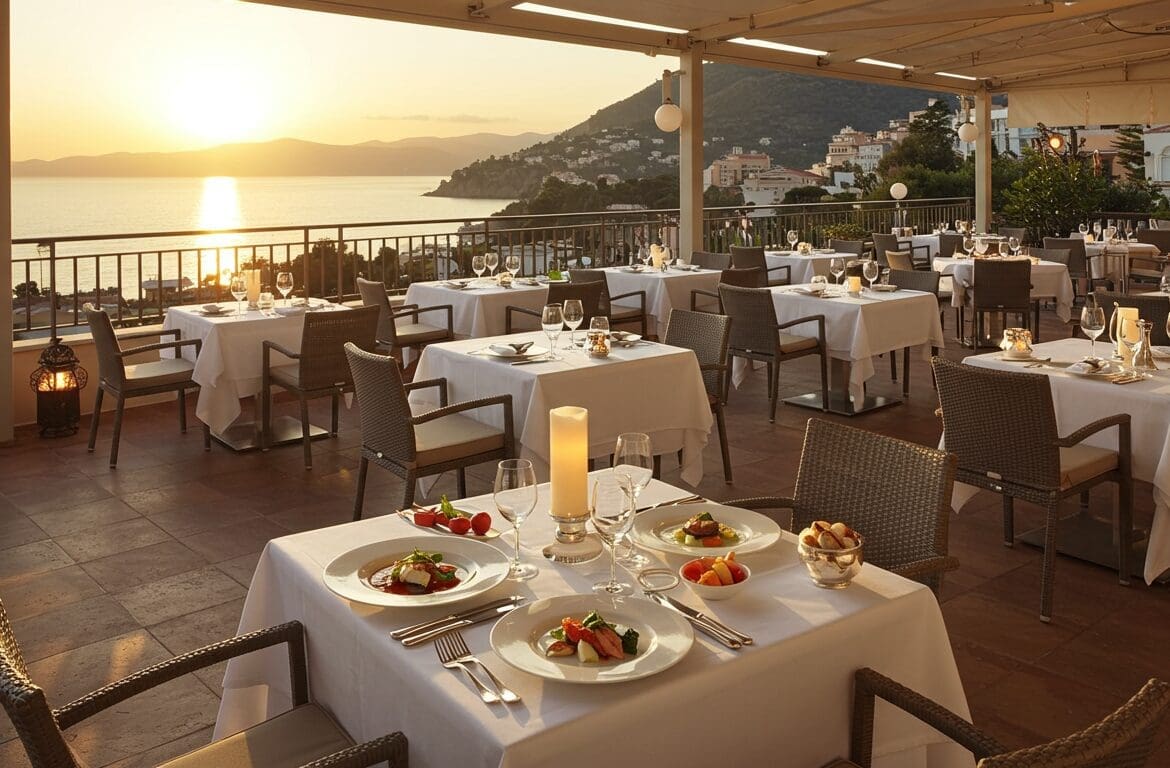
Camps Bay in particular delivers the complete package: restaurant terraces hanging above white sand, the kind of sunset that arrives like a formal announcement, and menus that take their seafood and their produce seriously. The vibe is undeniably social – this is where a sundowner becomes dinner becomes a late evening without anyone quite noticing the transition. The wine helps with the arithmetic.
For something more stripped back, the Cape Peninsula’s southern tip offers fish and chips eaten at a harbour wall in Kalk Bay – boats coming in, cats eyeing your plate with professional interest, the cold Atlantic fog rolling in from the right. It costs almost nothing and stays with you for years. This is not an accident.
Food Markets: Where the City Goes on a Saturday Morning
Cape Town’s market culture is genuinely excellent and genuinely local – a distinction worth preserving. The Oranjezicht City Farm Market at the V&A Waterfront is the most celebrated: a gathering of small producers, bakers, foragers, and makers selling everything from sourdough and biltong to freshly pressed rooibos and chilli-spiked boerewors. It is part farmers’ market, part community event, and if you arrive with no particular plan and a large tote bag, you will not leave disappointed.
The Old Biscuit Mill in Woodstock – home to the Neighbourgoods Market every Saturday morning – deserves its reputation. The building itself, a converted Victorian biscuit factory, has the right bones for a market: exposed brick, high ceilings, good acoustics for the ambient noise of a city grazing contentedly. The food stalls span South African, Persian, Indian, and everything in between, and the coffee is outstanding. Woodstock itself is a neighbourhood in confident creative transition, and wandering it after the market is a worthwhile extension of the morning.
What to Order: Dishes That Define South African Eating
Any honest guide to eating in South Africa has to begin and end with braai. This is not simply a method of cooking – it is a national institution with its own etiquette, its own equipment, its own vocabulary, and deeply held regional opinions about wood versus gas that you would be wise not to engage with unless you have several hours and a thick skin. Lamb chops, boerewors (the coiled spiced sausage that is essentially the country’s national symbol in sausage form), and sosaties – skewered meat marinated in Cape Malay spices – are the canon. Attend a braai when invited. Bring wine. Don’t touch the tongs unless asked.
Beyond the braai: bunny chow (a hollowed-out loaf of bread filled with curry, from Durban, extraordinary and deeply impractical to eat elegantly), bobotie as mentioned above, the various iterations of biltong and droëwors as snacks, and snoek – a firm, smoky Cape fish that appears on everything from toast to potjie. The potjie itself, a slow-cooked stew made in a three-legged cast iron pot over coals, is winter eating at its most satisfying.
Dessert belongs to malva pudding: a sticky, caramelised sponge of apricot jam and butter, served warm with custard or ice cream. Order it. Do not share it.
Wine, Rooibos & What to Drink in South Africa
South Africa’s wine regions – the Cape Winelands encompassing Stellenbosch, Franschhoek, Paarl and Constantia – produce wine of genuine international standing, and drinking it on-site at the estate where it was made is one of the better uses of an afternoon that travel affords. Stellenbosch Pinotage, full-bodied and distinctly South African in character, divides opinion globally but rewards the open-minded. The Chenin Blanc, known locally as Steen, is the more unambiguous success: crisp, textural, and produced in a range of styles from bone dry to richly complex.
Franschhoek, with its French Huguenot heritage, specialises in elegant Cap Classique – South Africa’s bottle-fermented sparkling wine, made by the same method as Champagne and priced in a manner that will make you feel unreasonably pleased with yourself. Wine tastings across the valley are built into the fabric of the place; many estates offer cellar tours, food pairings, and the kind of shaded terrace designed specifically for long, unhurried afternoons.
Beyond wine: Amarula, the cream liqueur made from the fruit of the marula tree, is worth trying at least once. Rooibos tea – grown only in the Cederberg mountains – is the answer to every long morning and is best drunk without milk, strong, with honey if you like. And the local craft beer scene, particularly in Cape Town and Johannesburg, has matured impressively over the last decade. You will not go thirsty.
Reservation Tips: How to Eat Well Without Stress
La Colombe, FYN, and Salsify all require advance booking – sometimes weeks in advance for weekend tables, particularly during peak season from November to February and the Stellenbosch wine harvest in March. Book early. The restaurants’ own websites are the most reliable route, though Dineplan handles reservations across a wide network of South African restaurants and is worth bookmarking for the entire trip.
Good to Gather in Stellenbosch and Reverie Social Table in Cape Town both build up healthy waitlists during busy periods – verified popularity has its costs. Midweek tables are generally easier to secure, and the experience loses nothing for the quieter room.
For market visits, arrive early. The Neighbourgoods Market at the Old Biscuit Mill is at its best before 10am, before the queues develop opinions of their own. Oranjezicht runs until early afternoon but the serious producers tend to sell through by noon. This is universally good advice for any food market, anywhere in the world, and universally ignored.
If your time includes Kruger National Park or the wider safari circuit, lodge dining is typically included in your stay and operates to a surprisingly high standard – bush dinners under the stars around a fire, with the surrounding darkness emitting occasional sounds you are encouraged to view as atmospheric rather than alarming. For those staying in a luxury villa in South Africa, the option of a private chef is transformative: a bespoke braai using market-fresh produce, a Cape Malay feast prepared in your own kitchen, or a long estate-style dinner with the right wine from a local cellar. It turns a holiday into something that feels designed entirely for you. Which, of course, it is.
For everything else you need to plan your trip – from where to stay to what to do beyond the table – the full South Africa Travel Guide covers the country in the depth it deserves.
Do I need to book restaurants in advance in Cape Town?
For the top-tier restaurants – La Colombe, FYN, and Salsify at The Roundhouse – yes, and often several weeks in advance, particularly for dinner during peak season (November to February) and around the Cape Winelands harvest in March. The Dineplan platform covers a broad range of Cape Town and Stellenbosch restaurants and is a reliable booking tool. For more casual neighbourhood restaurants and market dining, walk-ins are generally possible, but calling ahead is always worth the two minutes it takes.
Does South Africa have any Michelin-starred restaurants?
Michelin does not currently operate a guide for South Africa, so there are no Michelin stars in the country. The equivalent benchmarks are the World’s 50 Best Restaurants rankings – where La Colombe (55th), FYN (82nd), and Salsify at The Roundhouse (88th) all featured in 2025 – and the annual Eat Out Restaurant Awards, which are taken seriously within the industry. The absence of Michelin is no reflection on the quality; the Cape Town dining scene is world-class by any meaningful measure.
What are the must-try South African dishes for first-time visitors?
Start with boerewors at a braai – the spiced South African sausage is a foundational experience. Bobotie, the Cape Malay spiced meat bake, is essential. If you are anywhere near Durban, bunny chow (curry in a hollowed bread loaf) is non-negotiable. On the coast, Knysna oysters and smoked snoek deserve your attention. End with malva pudding – a warm, sticky caramelised sponge that represents pudding in its most committed form. For drinks, try the local Chenin Blanc from Stellenbosch and a cup of proper Cederberg rooibos. In that order, ideally.