
Family Guide to Split-Dalmatia County
It is nine in the morning and the Adriatic is already the colour of something a paint company would struggle to name. Your youngest is in the water before you have located the suncream. Your teenager, who claimed last night to be profoundly uninterested in anything involving the outdoors, is standing on a sea-smoothed rock looking at the islands with an expression you can only describe as wonder – though they would strenuously deny it. Somewhere behind you, breakfast is still happening. Pine trees throw long shadows across white limestone. The air smells of salt and wild herbs. Nobody is looking at a screen. This is Split-Dalmatia County, and it has a particular talent for making even the most fractious family feel, at least for a morning, entirely at ease with one another.
This is not an accident. The region – which stretches from the city of Split along some of Croatia’s finest coastline, out to the islands of Brač, Hvar, Šolta and Vis, and inland to the mountains and lakes of the Dalmatian hinterland – is built, structurally and culturally, for this kind of ease. The pace is gentle without being dull. The food is honest and good. The sea is warm, clear and (mostly) safe. Children have been welcomed at Croatian tables for centuries, long before family travel became a marketing category. For our full orientation to the region, the Split-Dalmatia County Travel Guide covers the essentials in satisfying depth.
Why Split-Dalmatia Works So Well for Families
There is a version of a family holiday that involves airports at four in the morning, hotel corridors that smell faintly of disappointment, and children who spend most of the trip complaining about Wi-Fi. Split-Dalmatia County is, by its nature, an antidote to all of that. The region offers such a density of genuinely good things to do – sea swimming, island hopping, historic cities, national parks, boat trips, food markets, kayaking, cycling, cliff jumping for the brave – that the perennial family question of what shall we do today becomes an embarrassment of pleasant options rather than a source of low-grade dread.
The geography itself works in your favour. The coastline is long and varied enough that you can find a beach for every mood: calm shallows for toddlers, clear drops for snorkellers, pebble coves that retain heat into the evening for those long, unhurried family dinners that start at seven and somehow end at eleven. The Dalmatian islands are close enough to reach by ferry or water taxi but feel genuinely separate from the mainland – the kind of distance that makes a day trip feel like a proper adventure rather than a logistical exercise.
Croatia is also, it should be said, one of the safer destinations in Europe for family travel. Roads are well-maintained, medical facilities are good, the tap water is drinkable, and the Croatian disposition towards children is one of warmth rather than tolerance – a meaningful difference if you have ever tried eating with small children in certain European cities where diners regard a toddler with roughly the same warmth they would a fire alarm.
The Best Family Beaches in Split-Dalmatia County
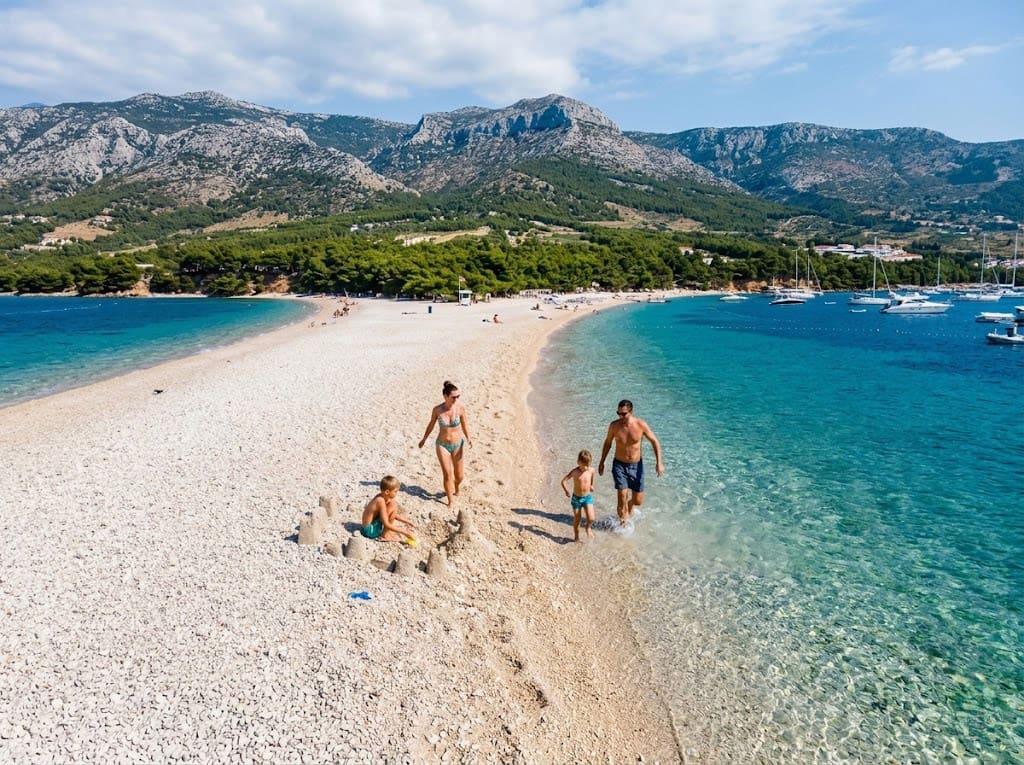
The beaches here come in roughly two formats: pebble and rock, which is most of them, and the occasional sandy exception that families tend to treat as a kind of holy site. Zlatni Rat on the island of Brač falls into the latter category – a sand and fine pebble spit that shifts shape with the currents and juts improbably into the sea near the town of Bol. It is well-known, which means it is busy in high summer, but it is also genuinely excellent for children: shallow entry, clear water, a wide beach that can absorb a family encampment of towels, inflatables and the sort of elaborate sandcastle engineering that keeps a seven-year-old occupied for three hours.
For families who prefer fewer crowds, the beaches around Omiš – where the Cetina river meets the sea – offer a different kind of pleasure. The setting is dramatic, the water is clean, and the town itself is compact enough to walk, with good food and an authentic Croatian atmosphere that has not yet been entirely reshaped for tourism. Further along, the Makarska Riviera delivers a string of well-organised beaches with safe shallow entries, beach bars, and the kind of reliable Adriatic warmth that makes the sea swimmable from May through October.
On the islands, smaller coves accessible only by boat offer what might be the luxury family beach experience at its most pure: a crescent of white rock, pine shade, water so clear it looks photoshopped, and nobody else in it. These are worth seeking out, and a private boat charter – easily arranged through your villa team – is the single best investment a family can make in a week on this coast.
Family-Friendly Experiences and Attractions
Split itself is a city that manages the remarkable trick of being genuinely historic without being dreary about it. Diocletian’s Palace – the Roman emperor’s retirement complex, which has been continuously inhabited for 1,700 years and now contains restaurants, boutiques and people’s actual apartments – is the kind of place that makes history feel vivid and slightly improbable rather than educational. Children who have just been told they are walking through a Roman emperor’s bedroom tend to find this more engaging than a museum display case. Parents who have been dreading the sightseeing portion of the holiday are often quietly surprised.
Beyond the city, the Krka National Park and Plitvice Lakes (the latter requiring a slightly longer drive) offer waterfall swimming, wooden boardwalks over turquoise water and the sort of landscape that produces genuine silence from children who spend most of their lives providing the opposite. Closer to the coast, sea kayaking tours around the islands cater to families with children from around eight upwards, and the rivers of the Dalmatian hinterland offer supervised rafting and canyoning for older children and teenagers who require a higher degree of stimulation than a beach towel can provide.
Cetina Canyon, near Omiš, is particularly well set up for active families – zip lines over the river, rafting through limestone gorge country, and a landscape that looks like it was designed by someone who had seen too many adventure films and decided to have a go themselves.
Eating Out with Children in Split-Dalmatia
Croatian food, at its honest best, is the kind of thing children tend to eat without protest: grilled fish, good bread, simple pasta, roast meats, fresh vegetables. Dalmatian cooking leans Mediterranean – olive oil, herbs, seafood – without the occasional stridency of some Italian regional cuisines that can defeat a six-year-old’s threshold for novelty. Pizza, reliably, is excellent throughout the region. This is not culinary cowardice; it is pragmatism, and it works.
Restaurants along the Dalmatian coast are almost universally accommodating to families. Tables outside are the norm from May to September, which immediately removes the ambient anxiety of a child who is required to sit still in an enclosed space. Service tends to be warm rather than formal, portions are generous, and the Croatian custom of a long, unhurried dinner is one that families can lean into rather than fight against. Children in Croatia are not a problem to be managed; they are simply part of the table.
In Split, the restaurant scene is sophisticated enough to satisfy adults who care deeply about what they eat, while remaining casual enough that arriving with a three-year-old does not require advance apology. The fish and seafood in the Riva waterfront area is worth taking seriously. The markets – particularly the open-air market adjacent to Diocletian’s Palace – provide excellent provisions for picnics and self-catering, and shopping for local cheese, honey, olives and cured meats with children in tow is, surprisingly, one of the better family activities the city offers.
Age-by-Age Guide: Toddlers, Juniors and Teenagers
Toddlers (1-4): The key with this age group in Dalmatia is water access and shade, and the region delivers on both. Beaches with gentle, gradual entry – Zlatni Rat, the calmer stretches of the Makarska Riviera, protected bays on islands like Šolta – work well for very young children. A private villa with a pool is not a luxury at this age; it is a necessity. The ability to swim in your own pool at nine in the morning, again at noon, and twice more before dinner, without packing a bag or finding parking, is the difference between a holiday and a logistical exercise. Keep day trips short, timed around naps, and do not attempt the islands in peak summer heat without a plan for shade and a cool retreat. The pace of Dalmatian life – unhurried, outdoor-facing, centred on food and water – suits toddlers better than most European destinations.
Junior travellers (5-12): This is, in all honesty, the golden age for Dalmatia. Children in this range are old enough to snorkel, kayak, take boat trips, explore Roman ruins with genuine curiosity, and eat dinner at a proper restaurant table without requiring surgical-level attention. They are also young enough to find the sea endlessly entertaining, which is fortunate, because the sea is the main event. Day trips to the islands, a morning at Krka, an afternoon on a boat looking for dolphins (who appear with gratifying regularity off the Dalmatian coast) – all of this lands well. Pack goggles, reef shoes and a waterproof camera. Everything else is optional.
Teenagers: The challenge with teenagers on a family holiday is well-documented and need not be rehearsed here. What Dalmatia offers, usefully, is enough autonomy and enough stimulation that teenagers tend to engage rather than disengage. The water sports scene is genuinely good – wakeboarding, paddleboarding, cliff jumping, sea kayaking. The islands have a social energy in summer that teenagers find compelling. Hvar Town, in particular, has a nighttime atmosphere that can be enjoyed at the family-appropriate end of the evening with a gelato and a table on the square, before it becomes something else entirely after midnight. Teenagers who have shown no interest in history will sometimes find Diocletian’s Palace interesting, which says something useful about the power of context over curriculum.
Why a Private Villa with Pool Changes Everything
There is a version of this holiday that takes place in a hotel, and it is perfectly pleasant. There is another version that takes place in a private villa with a pool above a Dalmatian bay, and that is simply a different category of experience – not marginally better, but structurally different in the way it operates and what it allows.
The pool is the obvious starting point. A private pool means swimming at seven in the morning when the light is low and golden, means an infant in the water before the beaches have opened, means a teenager doing lengths at midnight because they feel like it. It means no towels on sunbeds, no queue for the shallow end, no territorial negotiations with strangers. For families with young children, it is the single factor that most reliably determines whether a holiday is relaxing or merely scenic.
But the villa itself – the space, the kitchen, the outdoor terrace, the multiple rooms that allow teenagers and toddlers to coexist without incident – matters just as much. Families in villas eat when they choose, at their own table, with the food they have selected. Mornings are slow. The rhythms of the day emerge naturally rather than being imposed by hotel schedules. Children who fall asleep on the drive back from dinner are carried to bed without navigating a hotel lobby. Adults who want a glass of wine on the terrace at ten o’clock, watching the lights of the islands across dark water, do so without hunting for a bar.
In Split-Dalmatia County specifically, the villa stock is outstanding. Properties range from converted stone farmhouses in the hills above Split to contemporary architectural statements on private coves, from island retreats accessible only by boat to spacious family compounds on the Makarska Riviera with enough bedrooms to accommodate three generations without anyone getting on anyone’s nerves. The quality of Dalmatian villa design and build has improved markedly over the past decade. The views, it should be noted, have remained consistent throughout.
A good villa team – caretaker, housekeeper, concierge – also makes a difference that is difficult to overstate until you have experienced it. Local knowledge about which beach is quiet on a Tuesday, which restaurant will accommodate a six-year-old at short notice, which boat charter is worth the money and which is not – this is the infrastructure that turns a good holiday into one the family talks about for years.
Practical Tips for Visiting Split-Dalmatia County with Children
A few things worth knowing before you arrive. The sun in Dalmatia in July and August is genuinely powerful – more powerful than most northern European families are accustomed to, regardless of how many Spanish beach holidays they have accumulated. High-factor suncream, reef shoes for rocky shores, and a hard rule about shade between noon and four o’clock will prevent the kind of sunburn that redefines the second half of a holiday. The limestone and pebble beaches, while beautiful, can be hard on small feet; water shoes are not optional for young children, they are essential.
Ferries to the islands run reliably but get busy in peak season – book in advance if you are travelling as a larger group or taking a vehicle. Car hire is straightforward from Split Airport and genuinely useful if you plan to explore beyond the city; the coastal road is scenic and well-maintained, though the summer traffic on the approach to Makarska can test the patience of even the most equanimous parent. Water taxis from coastal towns offer a faster and more enjoyable alternative for island hops.
August is the peak of everything – crowds, prices, heat and atmosphere. June, early July and September offer the same sea temperatures with considerably less company. September in particular is one of the region’s best-kept secrets: warm sea, warm days, the schools back, the restaurants relieved and slightly more relaxed. Families who can travel outside the main school holidays should do so without hesitation.
Finally: pack less than you think you need. Dalmatia has pharmacies, supermarkets and beach shops that sell everything a family might require. The weight you save on the outbound journey can be invested in local olive oil on the way home, which is a considerably more useful item.
Plan Your Family Holiday in Split-Dalmatia County
Split-Dalmatia County rewards the families who choose it thoughtfully – who rent a villa rather than a hotel room, who take a boat out to a quiet cove rather than fighting for a position on a public beach, who eat late on a terrace and let the evening stretch. It is a destination that does not require a great deal of effort to be good to you. It simply asks, reasonably, that you slow down enough to let it work.
For families travelling with children of any age, from infants to teenagers doing their level best to appear unmoved by everything, this region of Croatia offers a combination of beauty, practicality, good food and genuine warmth that very few Mediterranean destinations can match at this level. The sea is waiting. So is breakfast, if you can prise the youngest out of the pool long enough to eat it.
Browse our full collection of family luxury villas in Split-Dalmatia County and find the property that fits your family, your pace and your idea of what a genuinely good holiday looks like.