Best Restaurants in Alpes-Maritimes: Fine Dining, Local Gems & Where to Eat
You are sitting at a table under a plane tree, somewhere between the old port and the market, and a carafe of rosé has just arrived without you quite having to ask for it. The bread is warm. The olive oil is so good you nearly drink it. Somewhere behind you, someone is arguing cheerfully about fish. This is the Alpes-Maritimes at its most itself – a department that runs from the glittering Riviera coastline up into mountain villages where the air is sharp and the tables are long and everyone has an opinion about the bouillabaisse. Eating here is not an activity. It is the whole point.
The food culture of Alpes-Maritimes sits at one of Europe’s most interesting culinary crossroads – where Provençal tradition, Italian influence (the border is close enough to feel), and serious modern ambition collide in the most agreeable possible way. Whether you are in Nice ordering socca from a paper cone, or dressed for a two-Michelin-star tasting menu in Cannes, the underlying philosophy is the same: the ingredient is sovereign. Everything else is commentary.
This guide covers the best restaurants in Alpes-Maritimes across every register – from the rarefied heights of the fine dining scene to the bistro where the menu is handwritten and changes when the market does.
The Fine Dining Scene: Michelin Stars and World-Class Tables
The Alpes-Maritimes has no shortage of serious culinary ambition. The department claims several Michelin-starred restaurants and is home to some of the most decorated chefs in France – which is, by any measure, a competitive field.
In Nice, Flaveur is the headline act. Brothers Michaël and Gaël Tourteaux run what is the city’s only two-Michelin-star restaurant, and the recognition is deserved in every course. Flaveur also appears on La Liste as one of the 100 best restaurants in the world, which is the kind of accolade that tends to make reservations both harder to get and more urgently necessary. The cooking is precise and personal – these are chefs with a clear point of view, not a team executing someone else’s vision. Book early. Book significantly early. Then confirm again.
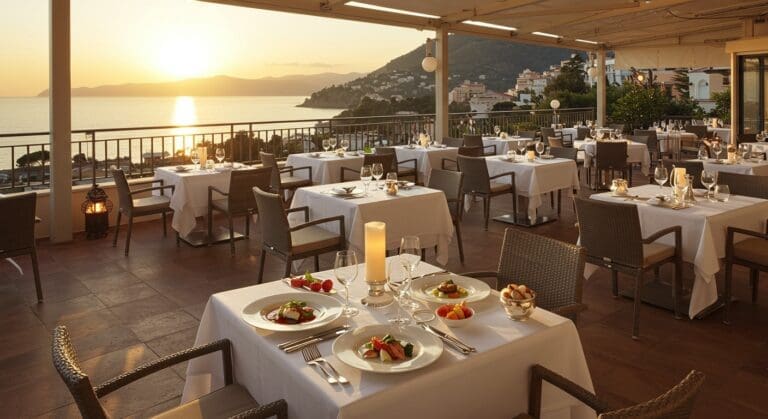
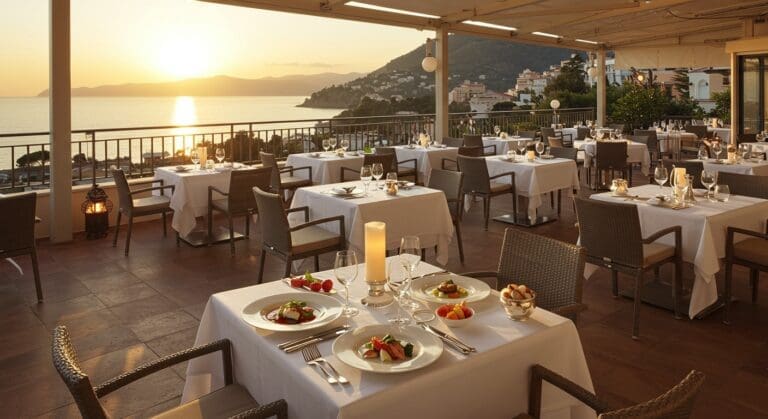
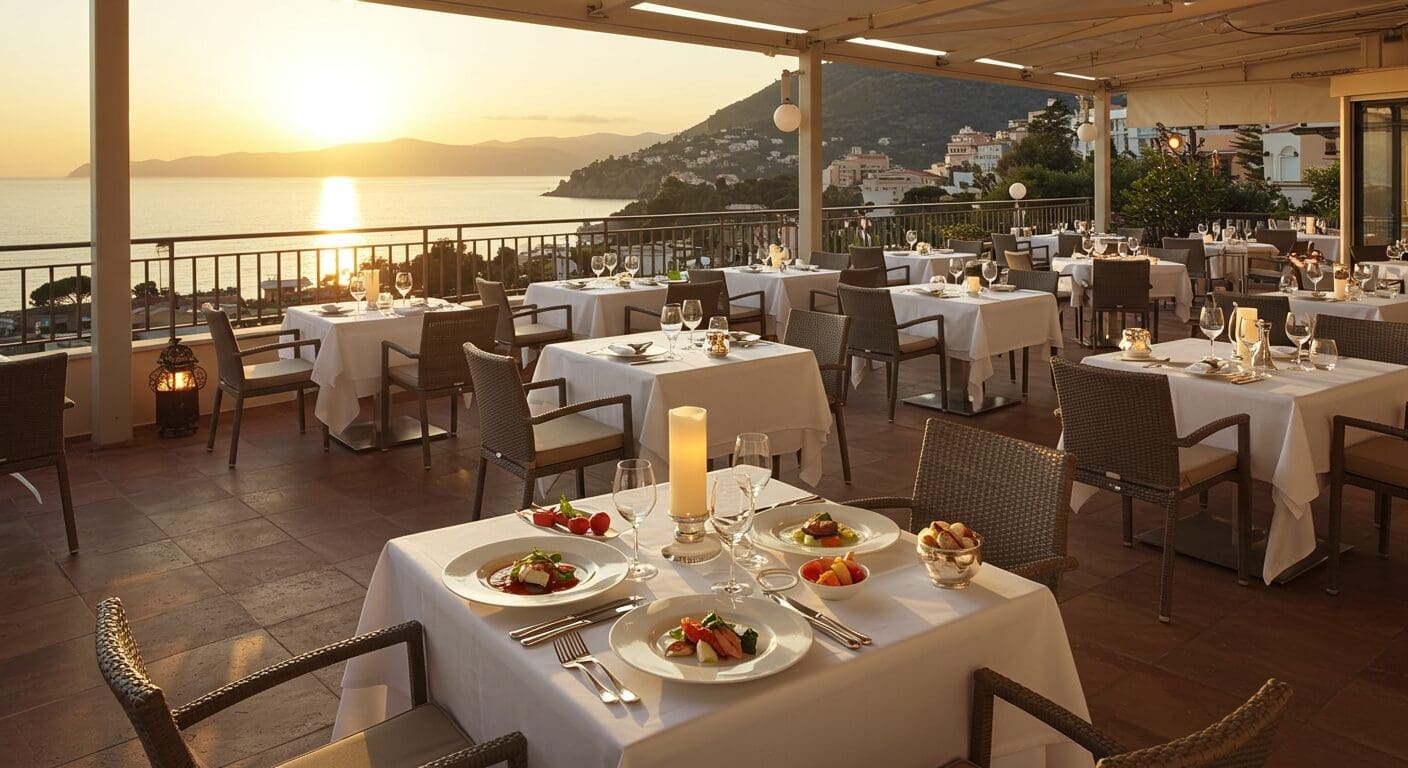
In Cannes, La Palme d’Or at the Hôtel Martinez is where the film festival crowd comes when the canapés aren’t enough. Chef Christian Sinicropi has built a set menu around the concept of each ingredient’s ecosystem – a philosophy that sounds architectural on paper and tastes extraordinary on the plate. The views across the Bay of Cannes and La Croisette are the kind that make it genuinely difficult to concentrate on the menu. This is not a criticism.
Just inland at Le Cannet, La Villa Archange offers a rather different atmosphere – intimate, charming, set in a converted farmhouse that carries its age with elegance. Chef Bruno Oger, the official chef of the Cannes Film Festival, draws on both his Breton roots and the produce of the Mediterranean in a way that should feel contradictory and somehow doesn’t. Two Michelin stars. A wine list that rewards careful attention. The kind of dinner you plan the rest of your itinerary around.
Back in Nice, Le Chantecler at the Hôtel Negresco on the Promenade des Anglais is one of those dining rooms that reminds you why the French invented the word grandiose – though here it earns every chandelier. The 18th-century décor includes woodwork dating to 1751, and one Michelin star suggests the kitchen is keeping pace with the surroundings. This is a place for occasions. Or for inventing them.
And for something more intimate with its Michelin credentials, Le Figuier de Saint-Esprit in the old town of Antibes – tucked between the Picasso Museum and the Provençal Market – is the restaurant that locals mention in the tone of voice people use when they don’t particularly want you to know about it. Chef Christian Morisset runs a family operation that distils the essence of Provence into every plate. Fresh, local, seasonal – the fig tree in the courtyard practically writes the menu. One star, and the quiet authority of somewhere that doesn’t need two.
Local Gems: Bistros, Trattorias, and the Tables That Don’t Need Stars
The Michelin map is one version of eating in Alpes-Maritimes. The more complete version involves a willingness to follow a recommendation scribbled on a napkin, or to push open a door on a back street in Nice’s Vieux-Ville because the smell coming from it is unreasonable.
Nice has a culinary identity that is quite distinct from the rest of Provence – shaped by its long relationship with Savoy and its near-Italian soul. The street food alone merits the journey. Socca – the crisp, chickpea-flour pancake cooked in a wood-fired oven – is the city’s defining snack, best eaten hot, slightly charred at the edges, with nothing but black pepper. The Cours Saleya market is the place to find it, alongside pissaladière (a tart of caramelised onions, olives, and anchovy that is more delicious than it sounds, if you are the sort of person who is suspicious of anchovies), and pan bagnat, the Niçoise stuffed roll that is essentially a salade niçoise in portable form.
The Italian border influence shows up everywhere – in the pasta, in the olive oils, in the easy way the cuisine moves between French and Ligurian without any sense of cultural anxiety. In the hill villages above the coast – Èze, Peillon, Saorge – you will find small family restaurants where the printed menu has not changed since at least 2004 and the rabbit stew takes three hours and nobody is in any hurry at all. This is not a complaint.
Antibes, too, has an excellent everyday restaurant scene operating in the shadow of its starred establishment. The old town, with its winding lanes and market square, rewards walking until hungry and then sitting down at whatever table is in the sun.
Beach Clubs and Casual Dining by the Water
The beach club is a specific institution on the Côte d’Azur – part restaurant, part theatre, part sociology experiment. The food at the serious ones is genuinely good; the scene at all of them is consistently diverting. At the better establishments along the coast between Nice and Antibes, you can eat grilled sea bass with a glass of cold Bandol rosé and watch the Mediterranean doing its unhurried glittering thing, and it is very difficult to find fault with any aspect of this arrangement.
The coast between Nice and Menton – particularly around Villefranche-sur-Mer and Beaulieu-sur-Mer – has a clutch of waterfront restaurants that serve serious fish with minimal intervention. Grilled, roasted, or in a bouillabaisse so good it constitutes an argument for the French way of life. Order the freshest thing on the menu and leave the decisions to whoever caught it that morning.
Cannes has the most polished beach club culture in the department – several of the grand hotels operate beach establishments that function as full restaurants from lunch through sunset, with the kind of service that anticipates needs you haven’t had yet. The casual dressed-down atmosphere is slightly relative: this is Cannes. People dress down in ways that take considerable effort.
Food Markets: Where the Cooking Actually Starts
Any serious engagement with eating in Alpes-Maritimes begins at the market. Not as a tourist exercise – though it is that too – but as a genuine encounter with the raw material of the cuisine.
Nice’s Cours Saleya is the most famous and, on a Tuesday to Sunday morning, one of the most beautiful markets in France – a long, colourful avenue of flowers, vegetables, cheese, and charcuterie that has been operating in essentially the same form for centuries. Go early. Go hungry. Budget time for conversation with the vendors, who are entirely willing to explain to you, at some length, why their tomatoes are superior to those of the vendor immediately adjacent.
The Marché Provençal in Antibes – conveniently close to Le Figuier de Saint-Esprit – is smaller and arguably more local in character. Excellent olives. Excellent tapenade. The kind of herb selection that makes you wish you had a kitchen nearby. (If you are staying in a villa, you do. See the end of this article.)
Smaller village markets throughout the department operate on rotating weekly schedules – Valbonne on Friday, Mougins on Tuesday, and so on. They tend to be less photographed and more genuinely useful, in the sense that the people shopping at them are largely shopping for dinner.
What to Order: The Dishes That Define This Place
Some dishes are worth travelling for specifically. In Alpes-Maritimes, the list is not short.
Socca – the chickpea pancake – is non-negotiable as an introduction to Nice. Salade Niçoise in its proper form (no boiled potatoes, no cooked green beans, and certainly no grilled chicken, a modification that locals regard with the kind of patient sadness usually reserved for incurable conditions) is a revelation when made properly with good tuna, good olives, and good anchovies. Daube Niçoise – beef braised slowly with olives and orange peel – is the cold-weather version of everything this region does well. Ratatouille here has a directness and intensity that the supermarket version has somewhat obscured.
Along the coast, order fish. Specifically loup de mer (sea bass), grilled simply and dressed with olive oil and herbs. Or the bouillabaisse if the restaurant does it properly – it should be complex, saffron-bright, and served with a rouille fierce enough to clear your sinuses.
In the mountains, the food shifts register: ravioles du Royans, mountain cheeses, truffles in season, and the earthy richness of dishes designed for altitude and cold. The bergerie restaurants of the upper valleys – simple places serving what the farms produce – are among the most satisfying meals you can eat in the entire department.
Wine and Local Drinks: What to Pour
The vineyards of Bellet, just north of Nice, produce wines that most people outside the region have never heard of, which means they remain priced at what they are actually worth rather than what the label could theoretically command. Bellet rosé is exceptional – refined and mineral in a way that distinguishes it from the broader Provençal category. The whites are equally serious. If you see them on a wine list, order them. If you see them at a market, buy them.
Beyond Bellet, the department drinks widely and well. Côtes de Provence rosé is the ambient soundtrack of any summer meal near the coast – cold, pale, and entirely appropriate. The better restaurants carry serious Rhône reds and Burgundies for those whose evenings call for something more substantial.
For aperitivo – and the Italian-inflected culture of the aperitivo is alive and well along this coast – a pastis remains the correct choice, drunk long and cold with water turning it the colour of afternoon light. In the more Italian-feeling corners of the region near Menton, a limoncello made from the extraordinary local lemons is worth investigating. The Menton lemon is given its own festival in February, which is the kind of civic devotion to a citrus fruit that you cannot help but respect.
Reservation Tips: How to Actually Get a Table
A few practical notes for those who prefer eating to queuing.
For the two-Michelin-star restaurants – Flaveur, La Palme d’Or, La Villa Archange – book a minimum of four to six weeks in advance, and more during the Cannes Film Festival period in May, when the entire food and hotel infrastructure of the department is operating at something approaching controlled chaos. If you are visiting during the festival, book before you confirm your flights. This is not an exaggeration.
Le Figuier de Saint-Esprit and Le Chantecler have their own loyal clientele and fill quickly, particularly on weekends and in summer. Most fine dining establishments in France accept reservations online through their own websites or via platforms such as TheFork – though for special occasions, a direct phone call still produces the better table and the slightly warmer reception.
For beach clubs, lunchtime reservations in July and August are essentially mandatory at the established venues. Arriving without one and expecting a table with a sea view is a form of optimism the French coastline does not generally reward.
At smaller village bistros and trattorias, the reservation calculus is different – many do not take them at all, or take them loosely. Arrive at noon or at 7.30pm, be pleasant, and the system usually resolves itself.
Eating Well from a Villa: The Private Chef Option
There is a strong case – and this is not entirely self-interested – for the proposition that the finest meal you can eat in Alpes-Maritimes is one prepared in a private villa kitchen, using produce from the Cours Saleya market that morning, by a chef who knows both what the season offers and how you take your wine.
Staying in a luxury villa in Alpes-Maritimes with a private chef option transforms the entire calculus of eating here. You have the Michelin tables for the occasions that call for them. You have the village bistros for the lunches that become afternoons. And you have your own table, your own terrace, and a chef working with the best raw materials the department produces – for the evenings when you would rather not put shoes back on. This is, by a reasonable margin, the most civilised approach to the whole enterprise.
For everything else you need to know about planning a visit to this remarkable corner of France, the Alpes-Maritimes Travel Guide covers the full picture – from where to stay to what to do when you are not eating. Though given the quality of what’s on offer, the gap between those two categories may be smaller than expected.
What are the best Michelin-starred restaurants in Alpes-Maritimes?
The department has several outstanding Michelin-starred restaurants. Flaveur in Nice holds two stars and is listed among the 100 best restaurants in the world by La Liste. La Palme d’Or at the Hôtel Martinez in Cannes and La Villa Archange in Le Cannet each hold two stars. Le Chantecler at the Hôtel Negresco in Nice and Le Figuier de Saint-Esprit in Antibes each hold one star. Reservations at all of these should be made well in advance, particularly during the Cannes Film Festival in May.
What local dishes should I try when eating in Alpes-Maritimes?
Socca (a crispy chickpea-flour pancake from Nice) is the essential starting point. Beyond that, look for an authentic salade Niçoise, pissaladière, pan bagnat, and daube Niçoise. Along the coast, fresh grilled loup de mer (sea bass) and a properly made bouillabaisse are worth seeking out. In the mountain villages, the focus shifts to mountain cheeses, truffles in season, and hearty braised dishes suited to the altitude and the climate.
What wine should I drink in Alpes-Maritimes?
The wines of Bellet – a small AOC appellation just north of Nice – are the most distinctive local choice and remain relatively unknown outside the region, which keeps both the prices and the quality at encouraging levels. Bellet rosé and white are both excellent. More widely, Côtes de Provence rosé is the natural accompaniment to most coastal meals in summer. For aperitifs, pastis is the local standard – served long, cold, and with enough water to turn it cloudy.