Mykonos Travel Guide: Best Beaches, Restaurants & Luxury Villas
First-time visitors to Mykonos almost always make the same mistake: they come expecting a Greek island. They pack their Durrell, they imagine whitewashed tranquillity, tavernas with paper tablecloths, perhaps a philosophical fisherman mending nets at dusk. What they get instead is one of the most ferociously alive party destinations in Europe, a place that runs on Aperol, ambient house music and a collective agreement that sleeping before 4am is for people who haven’t quite committed to the experience. This is not a criticism. It is, however, useful information. Mykonos is a Greek island in the way that Monaco is a coastal town – technically accurate, wildly incomplete. The Cyclades wind still howls, the light is still extraordinary, and the sea still that particular shade of blue that makes you question every colour decision you’ve ever made in your home. But the island has become something entirely its own: a global stage for people who like their holidays glamorous, their sunsets witnessed from a bar and their seafood arriving with a wine list longer than some novels.
Who does Mykonos actually suit? More people than you might think, and more specifically than the Instagram version of the island suggests. Couples on milestone trips – anniversaries, honeymoons, significant birthdays – find it intoxicating: the combination of beauty, exceptional food and the sense that something interesting is always about to happen. Groups of friends who want a holiday with actual momentum, where each day builds rather than drifts, thrive here. Families seeking genuine privacy – away from the packed hotel corridors and scheduled entertainment – find that a well-chosen luxury villa in Mykonos transforms the experience entirely: private pool, private terrace, no-one else’s children. Remote workers who’ve graduated from “I’ll work from a coffee shop” to “I’ll work from a cliff-top villa with fibre broadband and a view across the Aegean” have discovered that Mykonos, particularly outside the peak summer frenzy, is quietly excellent for exactly this. And wellness-focused travellers who might have assumed the island is purely hedonistic will find, if they look slightly sideways, a quieter Mykonos of early morning sea swims, yoga terraces and menus built around fresh produce from the island’s own farms. It contains multitudes. It will, almost certainly, surprise you.
Getting Here Without Losing Either Your Luggage or Your Composure
Mykonos is served by its own international airport – Mykonos Island National Airport (JMK) – which sits close enough to Mykonos Town to feel almost improbably convenient, particularly when you’ve just flown in from somewhere grey and are suddenly confronted with bougainvillea and warm air. Direct flights operate from most major European cities throughout the summer season, with British Airways, easyJet, Ryanair and various charter carriers all making the connection. From Athens, the flight is around forty-five minutes, or you can take the high-speed ferry from Piraeus – a journey of roughly two to two and a half hours on the faster vessels, which offers its own pleasures, not least the slow reveal of islands on the horizon as you approach.
From the airport, taxis are plentiful and the journey to most villa locations is short – rarely more than fifteen or twenty minutes. For larger groups, pre-arranging a private transfer is worth the modest effort; arriving at a luxury holiday in Mykonos in a cramped taxi with eight pieces of luggage is technically possible but sets an odd tone. Once on the island, a hire car or quad bike gives you genuine freedom to explore, though Mykonos Town’s labyrinthine streets were seemingly designed to disorient – intentionally, some say, to confuse the pirates who once raided the island. Whether that’s true or not, the streets certainly still work on tourists. Water taxis connect the main beaches during high season, which is a genuinely pleasant way to move around the southern coast.
Eating on Mykonos: Where Every Meal Feels Like an Occasion
Fine Dining
The fine dining scene on Mykonos has evolved well beyond what the island’s party reputation might suggest – it is, at this point, one of the strongest in Greece. Zuma Mykonos, positioned near the Old Port with an endless pool that appears to dissolve into the sea beyond, brings the global brand’s Japanese-inflected menu to one of the most dramatically beautiful settings you’re likely to eat in. The tiger prawns and wagyu beef are not accidental choices on the menu – they’re the kind of dishes that make you briefly resent everything you’ve eaten for the past year by comparison. The combination of the view, the DJ soundtrack warming up for the evening and the food arriving in precise, beautiful waves makes dinner here feel like a properly choreographed event. Arrive with a loose schedule.
Krama Mykonos takes a different approach – more considered, more intimate, the kind of restaurant that rewards people who actually read the menu rather than photographing it. The tasting menu is the move here, a progression through innovative dishes built from seasonal ingredients that demonstrates what happens when genuine culinary ambition meets an exceptional Greek larder. It is consistently praised by people who eat at a lot of restaurants and are not easily impressed. BEEFBAR Mykonos, set within the five-star Bill & Coo Coast Suites on Agios Ioannis Beach, makes a compelling case for itself as the island’s best steakhouse – which sounds like a narrow category until you’re actually sitting there, watching the sun do extraordinary things to the sea, eating premium cuts with the kind of Riviera confidence the whole operation radiates.
Interni has been a Mykonos institution long enough that it doesn’t need to try particularly hard, which of course means it continues to try very hard. The open-sky setting, whitewashed walls and beautiful courtyard create an atmosphere that manages to feel celebratory without being loud about it. Chef Christos Fotos works with modern techniques and traditional Greek ingredients in a way that feels genuinely considered rather than merely fashionable – which is a harder balance to strike than it sounds. And M-Eating, tucked into a quieter corner of Mykonos Town in a beautifully restored townhouse, brings a level of craft and calm to traditional Cycladic cuisine that is not always associated with the island. Octopus with fava purée, sous-vide lamb, slow-cooked cockerel with pastitsada: these are the kinds of dishes you remember on the flight home.
Where the Locals Eat
The locals – those who actually live on Mykonos rather than visit it – eat earlier, more quietly and considerably closer to the ground. Around Little Venice and the back streets of Mykonos Town, there are traditional tavernas that have been operating since well before the island became a destination, serving grilled fish, horiatiki salad with proper blocks of feta (not crumbled over everything like a guilty conscience) and the kind of rough house wine that improves dramatically after the first glass. The morning food market is worth an early visit: the island grows more of its own than most people realise, and the produce reflects the volcanic, wind-battered soil in ways that supermarket equivalents simply don’t. Beach clubs serve lunch that is considerably better than beach club food has any right to be – the island has a way of elevating everything.
Hidden Gems Worth Seeking Out
Ask your villa concierge – and if you have one, this is precisely what they’re for – about the smaller, less-Instagrammed spots along the island’s less-trafficked northern coast. There are family-run tavernas in the quieter villages like Ano Mera, the island’s second-largest settlement and the one place on Mykonos that operates largely independently of the tourist economy, that serve food of genuine character. Ano Mera has a proper central square, a monastery of real historical interest and a pace that feels like a different island entirely. It is about a fifteen-minute drive from the chaos of the southern beaches. The contrast is useful, occasionally startling and absolutely worth building into your week.
Beaches That Earn Their Reputation – and Some That Don’t Need One
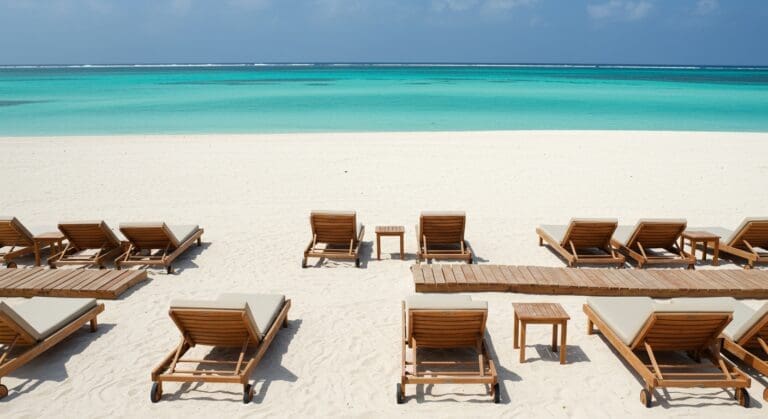
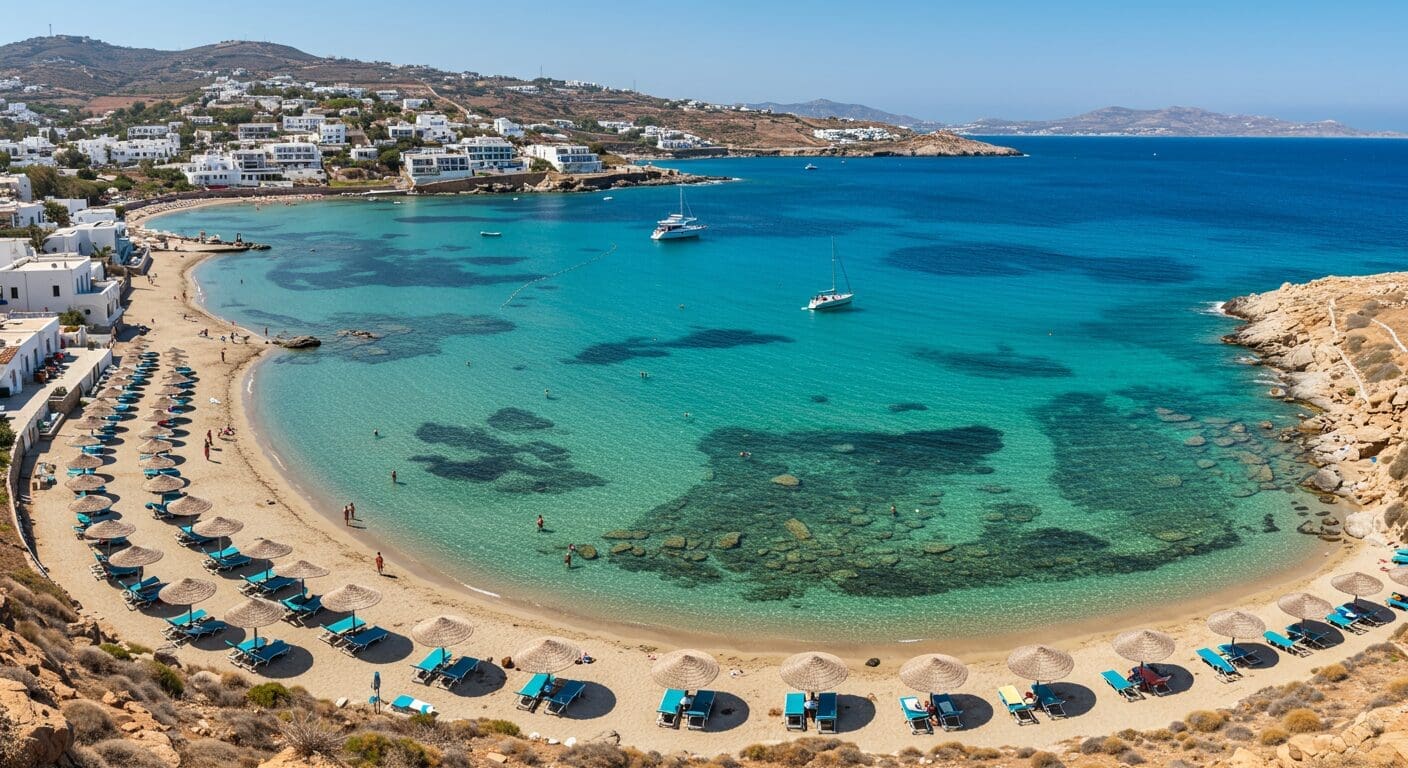
Mykonos has beaches the way other islands have hills – in abundance, each with a distinct personality, and some frankly more compelling than their fame suggests. The southern coast is where most of the action concentrates: Paradise and Super Paradise have the wildest reputations, which they maintain with some enthusiasm, particularly in peak July and August when the beach clubs run their music at volumes that preclude any kind of ambient nature experience. If this is what you want, they deliver it superbly. If it’s not quite what you had in mind, adjust your expectations or your beach accordingly.
Psarou Beach is where the luxury conversation really begins. Nammos beach club has dominated Psarou since 2003 and has, in the intervening two decades, developed into something closer to a fully-fledged Mediterranean institution. The Nammos Cabanas – four private enclosures with personal butlers, dedicated chefs and the kind of service that anticipates what you’d like before you’ve quite decided – represent beach club hospitality at its most evolved. Even without a cabana, lunch here is an occasion. The crowd is international, well-dressed and largely behaving as though they’ve decided in advance that they’re having a wonderful time. It is, somehow, infectious rather than exhausting.
Agios Ioannis – the beach immortalised in the 1988 film Shirley Valentine, a fact the island could mention less but somehow still mentions – is quieter, more laid-back and offers one of the better sunset views on the southern coast, with Santorini visible on a clear day as a thin dark line on the horizon. Panormos and Ftelia on the northern coast are wilder, windier and less crowded – popular with windsurfers for reasons that will become apparent the moment you arrive. Kapari, barely known outside the island, is a small rocky cove near Agios Ioannis that rewards those who don’t mind a short scramble with near-total solitude. In August on Mykonos. This is remarkable.
Things to Do in Mykonos That Aren’t Just Lying on a Beach (Though That Is Also an Option)
The best things to do in Mykonos are more varied than the island’s nightlife reputation implies, though the nightlife itself is worth treating as an activity in its own right, approached with appropriate preparation and sensible footwear. Little Venice – the row of bar and restaurant buildings that hang directly over the sea on the western edge of Mykonos Town – is best at sunset, when the light goes warm and orange and the whole setting takes on the quality of a particularly well-composed photograph. The windmills that overlook it have been photographed approximately eleven million times, but they still look genuinely lovely. Some things are famous for good reasons.
Delos, the uninhabited island a twenty-minute boat trip from Mykonos Old Port, is one of the most significant archaeological sites in the entire Mediterranean – the mythological birthplace of Apollo and Artemis, a UNESCO World Heritage Site, and almost completely unvisited relative to its historical importance. The ancient ruins spread across the island in extraordinary density: marble statues, mosaic floors, an avenue of stone lions. The contrast with the previous evening in a beach club is, to put it mildly, pronounced. The site closes in the early afternoon and boats run regularly from the Old Port – go early, take water and wear shoes with grip. It is one of those experiences that recalibrates the whole trip.
Mykonos Town itself rewards genuine exploration beyond the main shopping streets. The Aegean Maritime Museum charts the island’s seafaring history with unexpected depth. The local archaeological museum holds artefacts from Delos and the island’s own rich past. Cooking classes using local Cycladic ingredients are available for those who want to bring something home beyond a tan and a lingering sense that they should eat less. Private boat charters allow you to design your own coastal itinerary – the sea caves along the northern coast are best reached this way, and the experience of swimming off your own hired vessel into deep Aegean water is one that is extremely difficult to replicate anywhere else.
Adventure on the Water – and Occasionally Above It
The Aegean around Mykonos is not a passive body of water. The meltemi – the seasonal north wind that characterises the Cyclades from roughly June through August – creates conditions that adventure sports enthusiasts treat as the main event. Windsurfing and kitesurfing are serious pursuits here, particularly at Ftelia Beach on the northern coast, where the wind arrives reliably and the stretch of water is generous enough to make mistakes. Several established centres offer lessons at all levels, from complete beginners who are about to have a difficult first hour to experienced windsurfers who come specifically for the conditions.
Scuba diving around the island reveals an underwater landscape of remarkable variety – wrecks, caves, reefs and clear water with visibility that can exceed thirty metres on a good day. The PADI-certified diving centres operating from the main beaches cater equally to first-timers and certified divers wanting to explore the more interesting sites. Sailing is perhaps the most elegant way to experience the Mykonian coastline – private yacht charters ranging from a single day to a full week allow you to reach the island’s more inaccessible coves, potentially island-hop to Paros or Naxos, and create the particular freedom of having no fixed address for the day beyond the boat. Sea kayaking along the quieter northern coast has grown in popularity as an activity that requires genuine physical effort, which earns the subsequent sundowner with unusual conviction.
On land, cycling is possible – the island’s interior roads see relatively light traffic in the early morning and the views across the Cycladic landscape to the sea are considerable. The routes are not flat. This is worth knowing in advance.
Mykonos with Families: Better Than They’ll Tell You, Exactly As Complicated As You’d Expect
The honest answer to whether Mykonos works for families is: yes, emphatically, with the right approach – and the right approach almost always involves a private villa. The island’s hotel and beach club infrastructure is oriented primarily toward adults seeking a good time with limited interruption, which is entirely reasonable but not always compatible with travelling with children. A luxury villa in Mykonos changes this equation completely. A private pool means small children can splash without either endangering themselves in the sea or monopolising communal hotel facilities. A private terrace means family meals at whatever hour the children have decided is dinner time (which is rarely the hour you intended). Private staff – a chef, housekeeper, concierge – means the friction of travelling with children in a foreign country is reduced to near zero.
The southern beaches, particularly Agios Ioannis and Ornos, are calmer and more sheltered than the wilder northern stretches, which suits younger swimmers well. Ornos is probably the family-friendliest beach on the island: relatively flat entry into the water, genuinely clear sea and a beach bar that provides lunch without requiring anyone to travel. The boat trip to Delos is genuinely compelling for children old enough to engage with ancient history – or old enough to run between ruins dramatically, which is also valid. The donkeys that still occasionally work the older paths on the island are either charming or complicated depending on the child’s position on animal rights. Both reactions are understandable.
History, Mythology and Architecture That Actually Has Something to Say
Mykonos is not, in the popular imagination, a history destination. This is a significant underestimation. The island sits at the centre of one of the ancient world’s most important maritime crossroads, and its proximity to Delos – the sacred island that was, for several centuries, one of the most important religious and commercial hubs in the Aegean – gives it a historical weight that the cocktail bars of Fabrika don’t immediately suggest. The mythology runs deep: Delos as the birthplace of twin deities Apollo and Artemis, the ancient belief that no birth or death could occur on sacred ground, the extraordinary preservation of ruins that have been sitting in the Cycladic wind for over two thousand years.
Mykonos Town itself – Chora – is an architectural document of Cycladic tradition: the cubic whitewashed houses built to maximise shade and deflect wind, the narrow streets designed as much for shelter as for movement, the blue-domed churches (there are reportedly 365 on the island, one for each day of the year, though counting them all sounds like a particular kind of holiday). The island has a documented history of tolerance and openness to different communities that stretches back to its prominence as a trading port – it became a celebrated destination for the gay community from the 1970s onwards, and that tradition of welcome remains one of the island’s more admirable characteristics. The Lena House museum, a preserved bourgeois home from the 19th century, gives an unusually intimate glimpse of island life before the airport arrived.
Shopping in Mykonos: From Serious Jewellery to Things You’ll Display Ironically
Shopping in Mykonos divides fairly cleanly into two categories: genuinely excellent and cheerfully unnecessary. The island has developed a strong jewellery tradition – Ilias LALAoUNIS and several other serious designers have boutiques that are worth visiting even if you’re not buying, which you will be. Greek gold and silver work, often inspired by Cycladic and Minoan motifs, represents one of the more worthwhile things to bring home from Greece as a general rule. The main shopping streets of Mykonos Town – Matogianni is the most concentrated stretch – carry a mix of international luxury brands (not unique to the island, but present in abundance) and local designers whose work is specific enough to be interesting.
For things that are actually from Mykonos rather than available in any airport duty-free: local honey, which the island’s beekeepers produce with considerable pride; Kopanisti, the protected-designation cheese with a sharp, slightly spicy character that bears no resemblance to supermarket feta; and the island’s preserved meats, which have been a culinary staple since the days before refrigeration made such things optional. Ano Mera has a small but worthwhile selection of shops selling local produce and craft work at prices that reflect the fact that the rent is substantially lower than on Matogianni. Ceramics, textiles and handmade sandals round out the local craft offering – Greek leather sandals remain one of the more defensible holiday purchases, being both genuinely useful and increasingly expensive at home.
What You Actually Need to Know Before You Go
Greece uses the euro (€), card payments are widely accepted in restaurants and shops, though some of the smaller tavernas and market stalls remain cash-preferring. ATMs are plentiful in Mykonos Town. Tipping is expected but not at the punishing levels of North America – rounding up the bill or leaving ten percent in a restaurant is entirely appropriate. At the beach clubs, where minimum spends can be substantial, additional tipping for good service is noted and appreciated.
The best time to visit Mykonos for a luxury holiday depends substantially on what you want from it. June and September offer a version of the island that is warm, beautiful and substantially less crowded than the July-August peak – the sea is warm, the restaurants are excellent, and you can actually walk through Mykonos Town without adopting the resigned shuffle of someone who has accepted that forward movement is aspirational. July and August are the peak of peak season: the island is at full volume, the beaches at full capacity, the prices at full stretch. This is also when Mykonos is most completely itself – if you want the grand theatre of the thing, this is when it plays. October through April sees the island largely close down; some restaurants and villas operate year-round, but this is a significantly quieter experience. Spring, particularly May, offers wildflowers, empty beaches and perfect walking weather. Most visitors haven’t discovered this yet. This is useful information.
The language is Greek, and while English is spoken fluently by almost everyone working in tourism, learning a few words – kalimera (good morning), efcharisto (thank you) – is received with disproportionate warmth. The tap water on the island is drinkable but has a mineral quality that not everyone adjusts to immediately; bottled water is cheap and ubiquitous. The sun is serious from May through September – factor 30 minimum, reapplied obsessively, is not overcaution but basic self-preservation. The meltemi wind, while spectacular for sailing, can make beach days on the windward coast unexpectedly blustery; the southern beaches are more sheltered when it’s blowing hard.
Why a Private Villa in Mykonos Is the Only Way You’ll Want to Do This
There are hotels in Mykonos that are genuinely exceptional – architecturally considered, beautifully run, with staff ratios and service levels that the industry uses as benchmarks. And then there is the experience of arriving at a private luxury villa in Mykonos: a gate opens, a private pool appears, the terrace faces west over the Aegean, and the particular weight of travelling in public – shared lobbies, shared pools, the low-level performance of being a hotel guest – dissolves entirely. This is not a small distinction. It is, in the way of all genuinely good things, immediately obvious the moment you experience it.
For families, the private villa dynamic is transformative in ways that are difficult to overstate. Children can be children – actually loud, actually wet, actually running – without the social performance of hotel behaviour. Parents can be adults. The private pool is not shared with anyone whose habits you haven’t pre-approved. The kitchen means meals happen at the family’s pace rather than the restaurant’s. For groups of friends, the villa creates a shared home rather than a collection of adjacent hotel rooms – the terrace becomes the communal living space, the evenings unfold organically, and the villa’s gathering spaces allow the group to be together or separate according to the mood of the moment. Nobody has to sit in a lobby.
The concierge and staffing options available through a properly managed luxury villa rental are where things become genuinely seamless. A private chef who shops at the morning market and prepares Cycladic cuisine in your own kitchen is a different experience to booking a restaurant. Villa staff who know the island and its rhythms can secure reservations at places that are, nominally, fully booked. A villa manager who has relationships with the island’s yacht charter operators, diving centres and private drivers turns logistics into decisions rather than problems. For remote workers who’ve realised that working from home doesn’t have to mean the specific home they own in England, the villa’s reliable broadband – increasingly Starlink-equipped across the premium market – and private working terrace represents a combination that no co-working space has yet matched aesthetically. And for wellness-focused guests, the combination of a private pool, a yoga terrace and proximity to the Aegean at dawn is a more honest form of self-care than most spa brochures manage to describe.
The island, in short, rewards those who choose their base carefully. Browse our private pool villa rentals in Mykonos to find the property that fits your version of the island – whether that’s a cliffside retreat for two, a sprawling estate for a large group, or anything in between.
More Mykonos Travel Guides
- Best Restaurants in Mykonos: Fine Dining, Local Gems & Where to Eat
- Best Beaches in Mykonos: Hidden Coves, Beach Clubs & Coastal Secrets
- Mykonos with Kids: The Ultimate Family Holiday Guide
- Best Time to Visit Mykonos: Month by Month Weather, Crowds & Tips
- Mykonos Luxury Itinerary: The Perfect 7-Day Guide
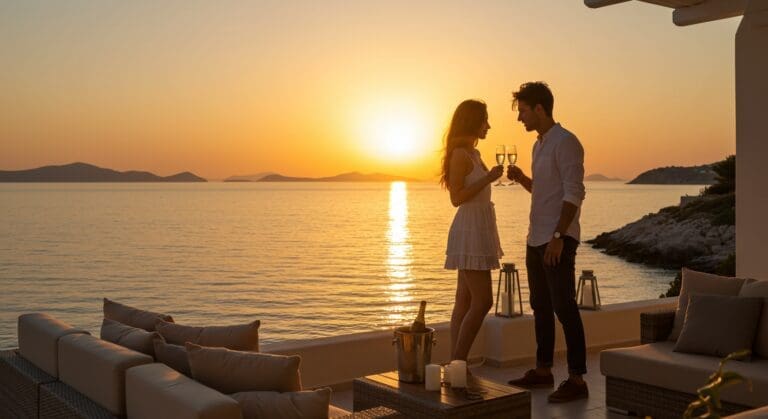
- Romantic Mykonos: The Ultimate Couples & Honeymoon Guide
What is the best time to visit Mykonos?
June and September offer the most balanced version of Mykonos – warm sea temperatures, excellent weather, fully operational restaurants and beach clubs, and crowds that are busy rather than overwhelming. July and August are peak season in every sense: maximum atmosphere, maximum prices, maximum people. May is genuinely underrated for those who want the island’s beauty without the high-summer intensity – the light is extraordinary, the wildflowers are out and the beaches are accessible. October through April sees much of the island’s tourist infrastructure close; a handful of properties and restaurants operate year-round for those who want the island in an unusually quiet register.
How do I get to Mykonos?
Mykonos Island National Airport (JMK) receives direct flights from most major European cities throughout the summer season, including direct services from London, Amsterdam, Paris and Frankfurt among others. From Athens International Airport, the flight is approximately 45 minutes. Alternatively, high-speed ferries run from Piraeus (Athens’s main port) and take roughly two to two and a half hours on the faster vessels – a genuinely enjoyable journey on calm days. Slower conventional ferries take around four to five hours but are considerably cheaper. The airport is close to Mykonos Town and taxis are readily available on arrival; private transfers can be pre-arranged for groups with significant luggage.
Is Mykonos good for families?
Yes – more so than the island’s reputation implies, but with the important caveat that the approach matters considerably. Mykonos’s hotel and beach club scene is primarily adult-oriented, which can make families in hotel accommodation feel peripheral to the main event. A private luxury villa changes this entirely: private pool, private outdoor space, kitchen facilities and dedicated staff mean that family life can operate on its own terms rather than around the hotel’s. Beaches like Ornos and Agios Ioannis are calm, sheltered and well-suited to younger swimmers. The boat trip to the archaeological site of Delos is a genuinely worthwhile experience for older children. The island is safe, well-serviced and, from the right base, an excellent family destination.
Why rent a luxury villa in Mykonos?
Privacy, space and the absence of a lobby are the immediate answers. Beyond those: a private pool that belongs exclusively to your group, outdoor living spaces where no social performance is required, kitchen facilities that allow meals to happen at your pace, and the option of private staff – chef, housekeeper, concierge – whose attention is focused entirely on your stay rather than divided across two hundred rooms. The staff-to-guest ratio at a properly managed private villa is simply not achievable in any hotel format. For groups, the villa creates a shared home rather than adjacent hotel rooms. For couples, the intimacy is of a different order entirely. For families, the logistics of travelling with children become manageable rather than exhausting.
Are there private villas in Mykonos suitable for large groups or multi-generational families?
Yes – the Mykonos villa market includes properties of considerable scale, with the largest sleeping twelve or more guests across multiple bedroom suites, separate living wings and extensive outdoor entertaining areas. Multi-generational families in particular benefit from villas with distinct zones: adults can have their terrace and evening spaces while children have separate areas and supervised pool access. Many of the larger properties include staff accommodation, allowing a full team – chef, housekeepers, concierge, pool attendant – to be in residence without impinging on the family’s privacy. Multiple living rooms, outdoor dining areas of genuine scale and private pool facilities that can comfortably accommodate a large group make these properties a qualitatively different experience from even the best hotel suites.
Can I find a luxury villa in Mykonos with good internet for remote working?
Increasingly, yes. The premium villa market in Mykonos has invested significantly in connectivity infrastructure, and many properties now offer fibre broadband or Starlink satellite internet capable of supporting video calls, large file transfers and all the connectivity demands of serious remote work. When enquiring about a property, it is worth specifying your requirements in advance – connection speeds and reliability vary between properties, and the best villa management companies will verify the technical specifications rather than offering a general assurance. A dedicated workspace or a private terrace with reliable connectivity and a view across the Aegean is, objectively, an upgrade on the average home office.
What makes Mykonos a good destination for a wellness retreat?
The combination of outdoor elements – sea swimming, consistent sunshine from May through October, clean air, access to hiking and water sports – with the high standards of the island’s villa and hospitality infrastructure creates genuinely strong conditions for a wellness-focused stay. Early morning swimming in the Aegean before the beaches fill is one of the more honest forms of physical and mental restoration available anywhere in Europe. Several luxury villa properties offer dedicated wellness amenities: private gyms, outdoor yoga terraces, sauna and treatment rooms, and chefs who can build menus around specific dietary requirements or wellness goals. The island’s quieter season – May, June, September – allows a pace that supports this kind of intentional holiday rather than competing with the peak-season energy.