Occitanie Food & Wine Guide: Local Cuisine, Markets & Wine Estates
Here is the thing no guidebook tells you about eating in Occitanie: the most important meal of the day is not breakfast, lunch, or dinner. It is the one that happens at around eleven in the morning, when market traders start quietly packing up their excess and someone nearby opens a bottle of something cold and local, and a plate of saucisson appears from nowhere in particular. You will not find this in any itinerary. You will simply find it, if you pay attention. That, more than anything, is the ethos of food and wine in this enormous, underestimated southern region – generous, unperformative, and entirely serious about pleasure. This is our full Occitanie food and wine guide: local cuisine, markets and wine estates, written for travellers who eat well at home and expect to eat better when they are away.
The Regional Cuisine: What Occitanie Actually Tastes Like
Occitanie is not a small region with a unified culinary identity. It stretches from the Atlantic-edged Pyrenees in the south-west to the Mediterranean coast in the east, taking in the Languedoc, the Lot, the Aveyron, and the Tarn along the way. The food shifts accordingly – and this is part of what makes it so rewarding for serious travellers. You are not eating one cuisine. You are eating a conversation between several.
On the Mediterranean side, olive oil replaces butter, tomatoes arrive in abundance, and the cooking has a confidence that comes from centuries of warm weather and fertile ground. Move inland toward the Massif Central and things become earthier, more fortifying – the food of mountain winters and deep valleys. Cassoulet belongs to this landscape in the same way that a stone farmhouse does: it did not arrive here, it grew here.
The signature dishes of Occitanie are not mere regional curiosities for tourists to photograph. They are genuinely excellent. Cassoulet – the slow-cooked bean and meat dish from Castelnaudary, Carcassonne, and Toulouse – is perhaps the most famous, though the regional debate about who makes it properly has been ongoing since approximately the fourteenth century. Brandade de morue, the silky salt-cod preparation of Nîmes, is another essential. In the Aveyron, aligot – molten mashed potato stretched with fresh tome cheese until it pulls like taffy – is the kind of dish that makes you reconsider everything you thought you knew about potato. The roquefort of the Aveyron has been produced in the caves at Roquefort-sur-Soulzon for over a thousand years and remains one of the world’s great cheeses. It deserves more than a cracker.
The Wine: Languedoc-Roussillon and the Estates Worth Knowing
If Bordeaux is the establishment and Burgundy is the academy, the wines of Occitanie – and particularly the Languedoc-Roussillon – are the independent thinkers who turned out to be right. For decades this was dismissed as bulk-wine country, a region that produced volume rather than quality. That reputation is now so thoroughly outdated it has become a useful filter: travellers who have not done their homework arrive expecting cheap table wine and are quietly astonished. The rest of us arrive knowing exactly what we are here for.
The appellations span an extraordinary range. Pic Saint-Loup produces reds and rosés of real elegance – grenache, syrah, and mourvèdre navigating limestone and clay with considerable grace. Faugères, with its distinctive schist soils, creates garrigue-scented reds that taste of the landscape in the most literal sense. Saint-Chinian, Minervois, and Corbières each offer their own character, and the fortified wines of Banyuls and Maury – made from grenache on ancient terraced vineyards near the Spanish border – are among the great underrated wines of France. Pair a Banyuls with aged roquefort if you want a moment that stays with you.
Wine estates throughout the region welcome serious visitors, and many of the finest are small, family-run domaines where the winemaker will quite likely pour for you personally. Seek out producers working with older vines and indigenous varieties – carignan, particularly, has undergone a remarkable rehabilitation and old-vine examples can be genuinely thrilling. Picpoul de Pinet, a crisp white from the shores of the Étang de Thau, is what you drink with oysters and moules at a table overlooking the lagoon. It is not complicated. It does not need to be.
The Markets: Where to Go and What to Look For
The markets of Occitanie are not artfully curated food halls with ambient lighting and branded tote bags. They are working markets – noisy, opinionated, and genuinely important to the communities they serve. This is precisely why they are worth your time.
Montpellier’s Marché du Lez is one of the larger urban examples – a converted industrial space on the banks of the Lez river that manages to feel both contemporary and completely authentic. For something more elemental, the markets of the smaller medieval towns – Uzès, Limoux, Saint-Guilhem-le-Désert – offer an experience that has changed remarkably little in several centuries. The Uzès market on Wednesday and Saturday mornings is particularly fine: local producers sell directly, the truffle dealers appear in season without fanfare, and the cheese selection is the kind that requires a second walk around before committing.
The covered market of Narbonne – the Halles de Narbonne – is one of the great indoor markets of southern France. Built in the nineteenth century, it remains in continuous daily use and houses a remarkable concentration of local produce: oysters from Leucate, wine from the Corbières, charcuterie from the Montagne Noire, cheeses from throughout the Aveyron. Go in the morning, eat at one of the stalls inside, and resist the temptation to photograph everything. You will enjoy it more.
At the height of summer, look for the travelling village markets that operate in rotation across the smaller communes. These are not tourist markets. The audience is almost entirely local, the prices are honest, and the produce is whatever arrived that week. This is where you find the season, rather than the idea of it.
Truffle Country: The Black Diamond of the Lot and Périgord Noir
The truffle territory of Occitanie begins in the Lot and extends across the limestone causse landscape toward the Périgord border – a region of quiet fields and ancient oak woodland that produces some of the finest Tuber melanosporum in France. The black truffle season runs from roughly December through March, and dedicated truffle markets operate throughout this period in towns including Lalbenque, Limogne-en-Quercy, and Martel.
Lalbenque holds what is widely considered the finest dedicated truffle market in the south-west. On Tuesday afternoons from December to February, producers arrive with their harvest wrapped in cloth bags and the market proceeds according to customs that have barely altered in a century. Buyers and sellers negotiate quietly, weighing and inspecting with the focused attention usually reserved for considerably more dramatic transactions. Attending this market – even simply watching – is one of the more genuinely memorable food experiences Occitanie offers.
For those who want the full experience, truffle hunting excursions with trained dogs are available through various estates and producers across the Lot. This involves rather more walking across uneven ground in cold weather than the phrase “truffle hunting” tends to suggest, but the payoff – watching a dog locate something beneath six inches of soil that you cannot detect from two centimetres away – is remarkable. The meal that follows is better still. Several private estates that accommodate guests will arrange these excursions exclusively for villa residents during the season, which is the only sensible way to do it.
Olive Oil and the Mediterranean Pantry
Occitanie is the northernmost edge of serious olive oil production in France, and the oils from the Gard and the Hérault have a character that reflects their position at the boundary of the Mediterranean world – fruitier and more delicate than Provence, with a freshness that makes them particularly good for eating raw rather than cooking. The olive varietals here include the small and intensely flavoured Lucques, which also happens to produce one of the finest eating olives in France when cured correctly.
Several small mills around Nîmes and along the Gard river valley press oil from October through January and welcome visitors during the harvest period. Tasting freshly pressed oil – vivid green, grassy, with a sharp finish that softens over the following weeks – is not something you can replicate at home. Buy a litre or three and pack it carefully. Customs officials have seen worse.
Beyond olive oil, the broader pantry of Mediterranean Occitanie includes extraordinary honey from the garrigue – wild thyme, lavender, rosemary – artisanal fleur de sel from the salins of the Camargue on the region’s south-eastern edge, and the preserved anchovy preparations of the coast around Collioure, which are to tinned anchovies what a proper cassoulet is to canned beans.
Cooking Classes and Food Experiences Worth Spending On
For travellers who want to understand a region’s food rather than simply consume it, Occitanie offers a range of experiences that go considerably deeper than the average cooking class. Several working farms and wine estates throughout the region offer residential programmes combining hands-on cooking with time in the kitchen or vineyard, typically structured around a stay of several nights rather than a single afternoon. These tend to be arranged privately and do not advertise widely, which means booking through a specialist operator or asking your villa concierge is the most effective approach.
Cassoulet workshops are available in and around Castelnaudary – the town that claims, with considerable conviction, to be the dish’s spiritual home. Learning to build a proper cassoulet over several hours, understanding the sequence of the confit duck, the Toulouse sausage, the beans, the gratinéed crust, is the kind of culinary education that changes the way you cook at home permanently. Whether it ends the regional cassoulet debate is another matter entirely. It does not.
In the wine country around Montpellier, Pic Saint-Loup, and the Minervois, some estates offer harvest participation in September and October – genuine working involvement rather than symbolic grape-carrying for photographs. Combined with a cellar tour and tasting with the winemaker, this is the kind of experience that money can buy but effort is also required to access.
For truffle experiences, see the section above – and think about timing your visit accordingly. The best luxury travel is often simply good timing.
The Best Food Experiences Money Can Buy in Occitanie
There is a tier of food and wine experience in Occitanie that operates entirely outside the tourist economy – available to those who know to look, who ask the right questions, and who have the flexibility that comes with a private villa and genuine time. This includes private dinners prepared by chefs who work for specific estates rather than the general public, wine tastings conducted by winemakers who rarely open their cellars to visitors they have not met, and access to market traders who sell their best produce before the market opens.
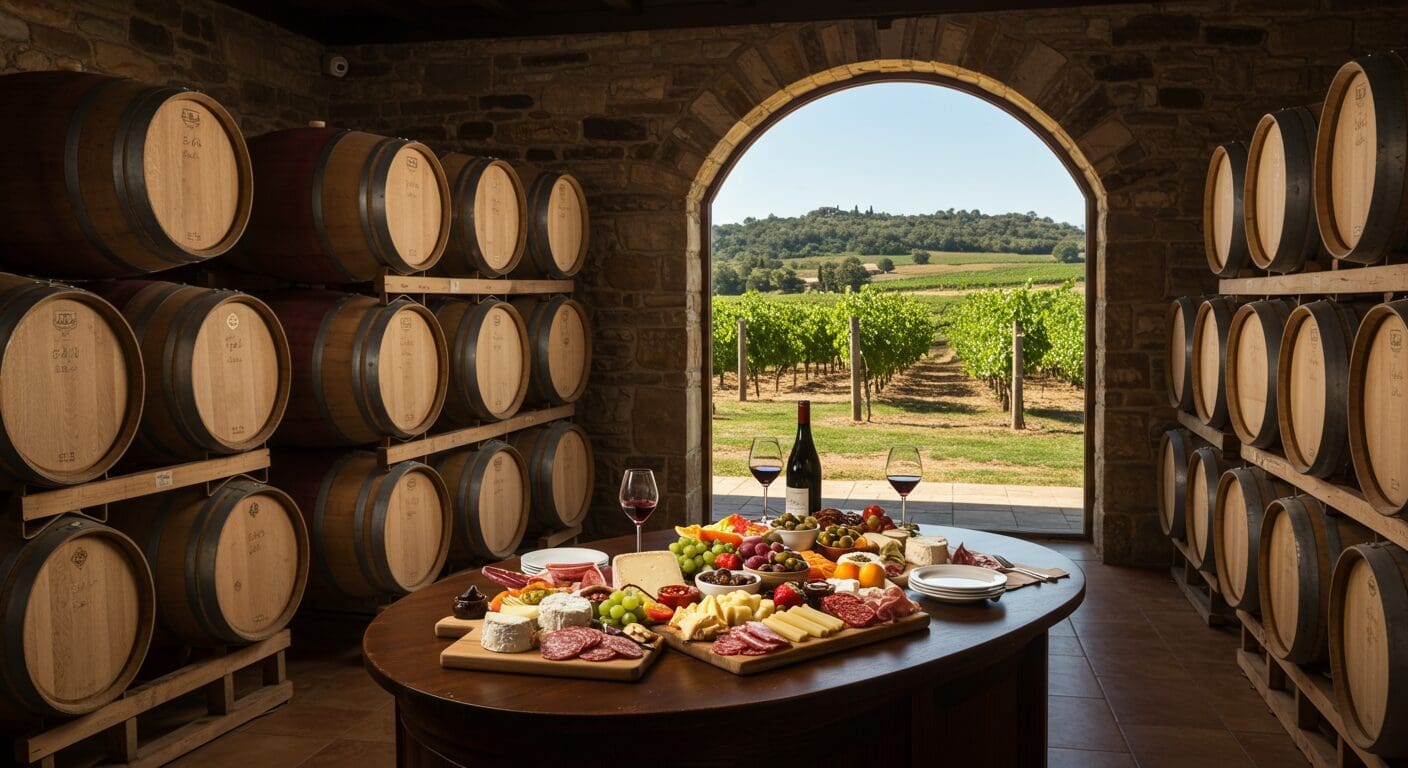
A private dinner at a wine estate in the Minervois or the Pic Saint-Loup – arranged in advance, prepared in the estate’s own kitchen, eaten in the courtyard or the vaulted cave with wines drawn directly from barrel – is the kind of meal that does not appear on any restaurant review site because it is not a restaurant. It is an invitation. These invitations are extended, but not easily, and the path to them runs through knowing someone who knows the estate, or through a concierge service that has genuinely done the work.
On the coast, dining on oysters and sea urchin at a producer’s table directly above the oyster beds at Bouzigues on the Étang de Thau is an experience that costs relatively little in financial terms and a great deal in knowledge of where to go. The Étang de Thau is a large, shallow lagoon separated from the Mediterranean by a narrow strip of land, and the shellfish farmed here – particularly the oysters and mussels – are among the finest in France. A table at the water’s edge, a bottle of Picpoul, a bucket of oysters at midday. Few things are more purely enjoyable.
Plan Your Stay
Food and wine in Occitanie reward time, curiosity, and the kind of freedom that comes with a private base. A villa gives you the ability to bring the market home, to store a case of wine properly, to invite a private chef to cook with the produce you found that morning, and to eat on your own terrace with no one asking if you want another basket of bread. It is, in short, the correct way to experience a region that has never been in any particular hurry.
For more on planning your visit to the region – beaches, villages, driving routes, the places the guidebooks got right and the ones they got wrong – read our full Occitanie Travel Guide.
When you are ready to find the right base for your stay, browse our selection of luxury villas in Occitanie – from wine country farmhouses in the Minervois to coastal properties above the Étang de Thau, chosen for travellers who intend to eat and drink exceptionally well.