Umbria Food & Wine Guide: Local Cuisine, Markets & Wine Estates
It is half past seven on a Tuesday morning in a hilltop Umbrian town, and the baker has already been at work for three hours. The smell of bread finds you before your eyes fully open – warm, yeasty, elemental, drifting through a stone window that has been open since April. Downstairs, someone is pressing olive oil into a dark bottle. A dog crosses the piazza without urgency. The market stalls are going up. This is not a performance of Italian life for visiting tourists. This simply is Italian life, and Umbria happens to be where it is lived with particular, unhurried conviction. The food here is not trying to impress you. That, paradoxically, is what makes it so impressive.
While Tuscany has spent decades perfecting its own mythology, Umbria has been quietly getting on with things – growing better lentils, hunting better truffles, making wines of real character that most of the world hasn’t discovered yet. For the luxury traveller who has eaten their way through the more obvious Italian destinations, this landlocked region in the centre of the country is something closer to a revelation. This is your complete Umbria food and wine guide, from the local cuisine to the wine estates, the markets to the truffle grounds, and everything that makes eating here feel like an education with very good table manners.
The Soul of Umbrian Cuisine
Umbrian cooking is mountain food made magnificent. The region has no coastline and no interest in pretending otherwise – this is a cuisine built on pork, legumes, wild herbs, game, and the extraordinary produce that emerges from its forests and fields. The cooking is direct. It doesn’t fuss. A piece of pork roasted with rosemary and garlic over a wood fire – the porchetta that appears at every market and festival – needs nothing more than bread and your full attention.
The local cuisine is shaped by its terrain: the Apennine hills and valleys produce an extraordinary variety of ingredients. Wild boar (cinghiale) appears in rich ragù across the region. Lentils from Castelluccio, grown on a high plain at over 1400 metres and now protected by IGP status, are considered by many Italian chefs to be the finest in the country – small, thin-skinned, and with a depth of flavour that makes the supermarket variety seem like a different species entirely. Chickpeas, farro (emmer wheat), and black-eyed beans complete a pantry that would have sustained farmers through hard winters for centuries. Umbrian cooks haven’t stopped using them just because times got easier.
Cured meats deserve their own paragraph – or possibly their own holiday. Norcia, a small town in the east of the region, has given the Italian language the word norcino, meaning a pork butcher, which tells you something about the town’s historical reputation. The local salumi – salami, lonza, capocollo, and particularly the black truffle-scented products unique to this area – are exceptional, and the shops of Norcia are themselves worth the detour. The town suffered devastating earthquakes in 2016 but has been rebuilding, and its producers continue their work with an admirable stubbornness.
The Truffle: Umbria’s Most Valuable Forest Floor
No guide to Umbrian food would be honest without a serious treatment of the truffle. Umbria is one of Italy’s most important truffle regions, and unlike some areas that trade largely on reputation, it genuinely delivers. The region produces both black truffles (Tuber melanosporum, the prestigious Périgord variety) and the rarer white truffle (Tuber magnatum pico), along with summer truffles and other varieties found throughout the year. Norcia and Spoleto are the heartlands of the black truffle. Gubbio in the north produces notable white truffles in autumn.
For luxury travellers, the truffle hunting experience is one of the most genuinely memorable things Umbria offers – not because it is theatrical (though it has its theatrical moments), but because it is real. A proper truffle hunter with a well-trained Lagotto Romagnolo dog working the oak and beech woodland at dawn is not putting on a show. The dog doesn’t know you’re there. It is doing what it was bred to do with total, nose-down seriousness, and when it finds something – pausing, pawing carefully at the earth – the silence is electric. Many private villas in the region can arrange truffle hunting experiences through local guides, followed by a cooking session to use what you find. If that sounds self-indulgent, you are reading correctly.
The finest restaurants in the region use fresh truffles with restraint and intelligence – shaved over a simple pasta al burro, incorporated into a soft egg dish, or paired with aged local cheese. The mistake is quantity. A good Umbrian chef knows that one gram of perfect truffle on the right base does more than five grams on the wrong one.
Umbrian Wines: The Case for Paying Attention
Umbria produces wines of real ambition and, increasingly, international recognition – though the region has been characteristically unbothered about seeking the spotlight. The two main DOC and DOCG zones are Orvieto in the south-west and Montefalco in the centre, and they produce wines of entirely different character.
Orvieto is white wine country, historically – a blend typically dominated by Grechetto and Trebbiano Spoletino, crisp and mineral, perfect with the lighter dishes of the region. The wine has an ancient reputation (it was reportedly beloved by Pope Gregory XVI, which is the kind of endorsement that travels) and the more serious modern producers have moved well beyond the simple, sometimes forgettable whites of earlier decades toward wines of real complexity and age-worthiness.
Montefalco is where Umbria asserts itself most powerfully in red wine terms. The Sagrantino grape – grown almost nowhere else in the world – produces wines of extraordinary tannic structure, deep fruit, and considerable longevity. Montefalco Sagrantino DOCG requires a minimum of 37 months ageing, including at least 12 in oak. The result can be formidable in youth and genuinely thrilling at ten years or more. The Montefalco Rosso DOC, which blends Sangiovese with Sagrantino, offers a more approachable entry point. Grechetto appears across the region as a white variety of character – nutty, full-bodied, and happily underpriced relative to its quality.
Wine Estates Worth Your Time
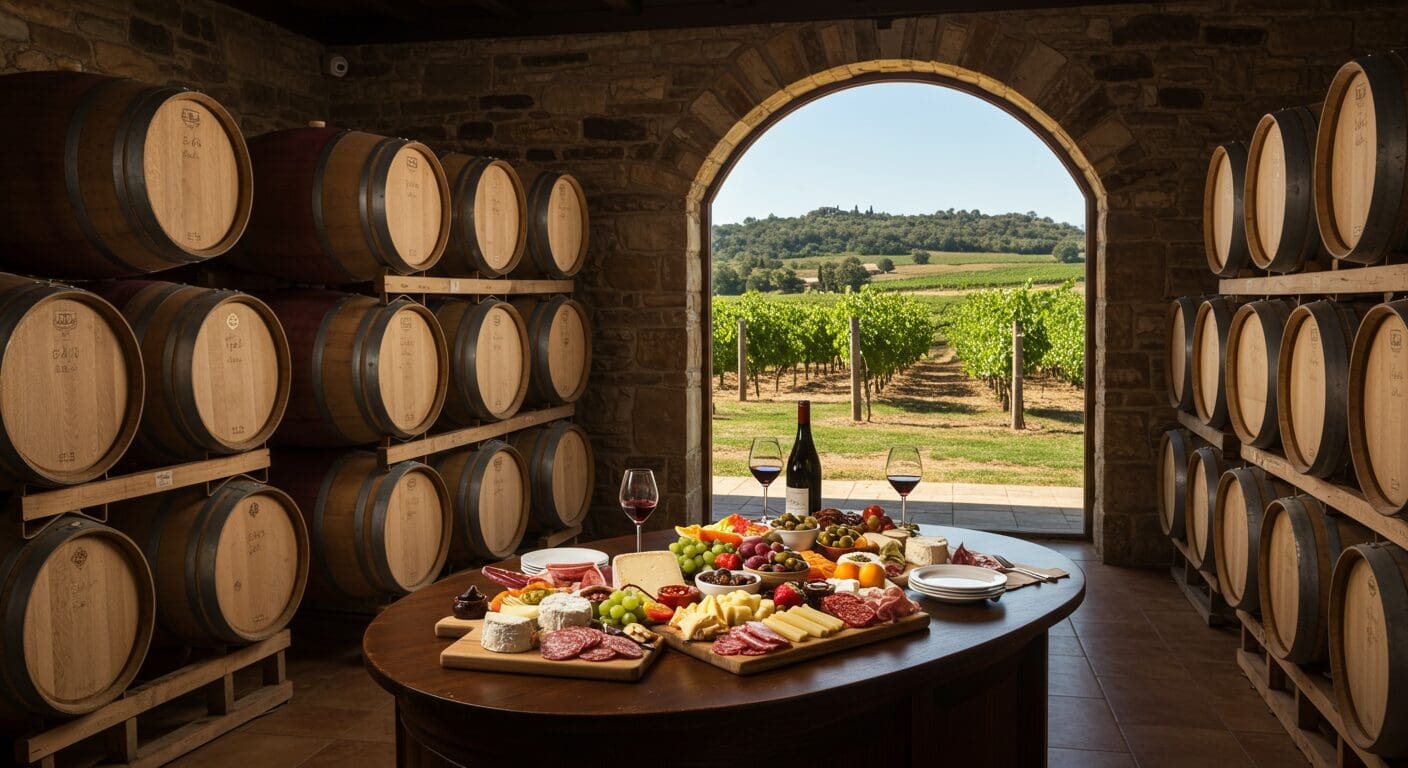
The wine estates around Montefalco are serious operations that take visitors seriously in return. Several offer exceptional tasting experiences in historic cantinas, with cellars carved from the hillside and barrel rooms that smell of everything time does slowly to wine. Estates in the area range from small family producers working just a few hectares to larger operations with beautiful agriturismo accommodation and full restaurant facilities – though the most rewarding visits tend to be to the smaller producers where the winemaker is also the person pouring your glass and explaining, with obvious pride and occasional impatience, why their Sagrantino needs three more years before it’s ready.
Around Orvieto, the wine landscape is different – softer, more ancient-feeling, with vineyards that slope toward the famous tufa cliffs. Several estates here produce excellent Grechetto alongside their Orvieto Classico, and a few have begun experimenting with international varieties with genuinely interesting results. A structured wine tour of both zones – north to Montefalco, south to Orvieto, with a night in between – makes for one of the most satisfying two-day itineraries in Italian wine tourism. Book tasting appointments in advance. Umbrian winemakers are hospitable but they are not standing around waiting.
Olive Oil: The Other Liquid Gold
Umbrian olive oil is, among people who know about these things, regarded as some of the finest in Italy – which is, in context, a significant claim. The principal variety is the Moraiolo olive, which produces an oil of notable intensity: grassy, peppery, with a finish that makes itself known at the back of the throat in a way that is entirely deliberate and entirely correct. The best Umbrian oils have DOP (Protected Designation of Origin) status under the Umbria DOP classification, divided into five geographical sub-zones reflecting the considerable variation across the region.
The olive harvest in October and November is one of the most atmospheric times to visit. Many estates welcome visitors during the harvest and pressing season, and a tour of an operating frantoio (oil mill) at this time of year – watching the freshly milled oil emerge in its vivid green brilliance, tasting it on warm bread with nothing else – is one of those experiences that quietly recalibrates what you thought food was for. Bring home as much as your luggage allowance permits. You will not regret this.
Food Markets and Where to Shop
Umbrian markets are not artisan food fairs with artfully distressed signs and influencers photographing sourdough. They are actual markets where actual people buy actual food, and they are all the better for it. Most towns hold weekly markets, and the quality of local produce on offer – seasonal vegetables, local cheese, cured meats, honey, legumes, preserved truffles, bread – is consistently high. The daily markets in larger towns like Perugia and Spoleto are worth visiting simply to understand what people in this region consider ordinary food. The answer is quite humbling.
For specialist food shopping, Norcia remains the essential destination for cured meats and truffle products. Spello is known for its olive oil. Foligno holds one of the region’s most significant annual food events. Orvieto’s market, held in the main squares, has excellent local cheese and wine. For a broader regional overview, the town of Todi hosts a particularly good weekly market with producers travelling in from the surrounding countryside. The etiquette is simple: taste before you buy, bring your own bag, and do not ask for a receipt with the air of someone who intends to file it under expenses. That is not the spirit of the thing.
Cooking Classes and Culinary Experiences
The appetite for hands-on cooking experiences in Umbria is well served by a range of options, from informal morning classes in private homes to structured courses at dedicated culinary schools in converted farmhouses. The best experiences tend to focus on the honest fundamentals of the local cuisine: pasta making (pici, the thick hand-rolled Umbrian pasta, is satisfyingly difficult to get right), bread baking, the preparation of legume dishes, and the correct use of truffle. Some villas can arrange private cooking sessions with local chefs or nonnas of significant expertise – often the most memorable culinary experience available, both for what you learn and for the conversation, mediated or otherwise.
More structured immersive programmes are available at agriturismi throughout the region, often combining morning cooking instruction with afternoon visits to local producers – an olive mill, a wine estate, a cheese maker. For serious food travellers, a multi-day culinary programme based in a private villa provides the best of all worlds: instruction during the day, privacy in the evening, and a table to eat at that you set yourself. The food always tastes better when you’ve made it. This is especially true of Umbrian pasta, for reasons that are partly philosophical and partly to do with the quality of the local eggs.
The Best Food Experiences Money Can Buy in Umbria
If you are going to spend seriously, spend on the following: a private truffle hunt at dawn followed by breakfast cooked with what you’ve found. A tasting at one of the great Montefalco estates with vertical vintages of their Sagrantino. A private dinner in your villa prepared by a local chef using hyper-seasonal produce sourced that morning. A full day’s immersion in the olive harvest if your timing is right. A tour of the norcino shops in Norcia with a guide who can explain the provenance of every cut and the precise difference between four types of salami that look, to the untrained eye, identical.
None of these experiences are designed for Instagram, which is perhaps their greatest recommendation. They are designed to be eaten and drunk and remembered at a different kind of pace – the Umbrian pace, which is to say unhurried, deliberate, and fundamentally unconvinced that anywhere else is doing it better. After a week here, you may find yourself agreeing with them. This is the effect Umbria tends to have, and the food and wine is precisely where it begins.
For more on planning your visit to the region, including where to go and what to see beyond the table, read our full Umbria Travel Guide.
The right base makes all the difference to how well you eat in Umbria – a private villa with a proper kitchen, outdoor dining space, and proximity to the best local producers transforms a good holiday into an exceptional one. Browse our collection of luxury villas in Umbria and find the one that suits your appetite.