
Algarve Travel Guide: Best Beaches, Restaurants & Luxury Villas
Here is a confession that might get a travel writer struck off: the Algarve is better than its reputation suggests. That sounds like faint praise until you understand what its reputation actually is – a sun-scorched package holiday favourite, Europe’s most reliably exploited coastline, somewhere your parents went in the 1980s and came back looking orange. All of that is, technically, true. And yet the Algarve has spent the past decade quietly becoming one of Europe’s most compelling luxury destinations, with a restaurant scene that would embarrass cities twice its size, a coastline so architecturally dramatic it looks like it was designed by someone who’d had quite enough of flat beaches, and a particular quality of light in the late afternoon that makes even the most confirmed cynic reach for their camera. The trick, as with most places, is knowing where to look – and, more importantly, where not to go.
Who actually thrives here? The answer is a satisfying range. Families who want privacy without sacrificing proximity to great beaches will find the Algarve straightforwardly excellent – particularly those who’ve graduated from the “kids club at the hotel” stage and want space, a private pool, and the ability to have a glass of wine at 11am without anyone judging them. Couples marking milestones – anniversaries, honeymoons, the kind of trip you plan when you realise you haven’t actually been anywhere properly good for a while – will find the combination of world-class food, dramatic scenery and genuine seclusion hard to argue with. Groups of friends, remote workers who’ve discovered that a well-equipped villa with reliable internet is a more civilised office than a WeWork in Shoreditch, wellness-focused guests drawn by the outdoor lifestyle and the Algarve’s almost indecent generosity with sunshine – all of them land here and, within about 48 hours, start quietly researching how to stay longer.
Getting Here Without the Indignity of It All
Faro International Airport is the Algarve’s main gateway, and it is – not to put too fine a point on it – a small airport doing an outsized job. It handles roughly ten million passengers a year, which explains why arrivals in August can feel like a particularly sweaty game of Tetris. The good news: most premium villas offer private transfer services, meaning a driver with your name on a card, a cold bottle of water, and a car that doesn’t smell of other people’s suncream. Book this in advance. It costs relatively little compared to the holiday itself and sets the correct tone from the moment you land.
Direct flights to Faro operate from most major UK airports – Heathrow, Gatwick, Manchester, Edinburgh, Bristol – as well as from across Europe and, seasonally, from North America via Lisbon. Flight time from London is approximately two and a half hours. Lisbon itself connects onwards to Faro by air (45 minutes) or by train (around three and a half hours, through countryside that ranges from pleasant to quietly lovely). The train option is worth knowing about if you want to see a little more of Portugal before the holiday begins in earnest.
Once in the Algarve, a hire car is the single best investment you will make. Public transport exists and is used by people who have infinite patience and nowhere particularly urgent to be. The region stretches roughly 155 kilometres east to west, and the difference between the western wilds near Sagres and the marina glamour of Vilamoura is not just geographical. Having your own wheels means finding the cove that doesn’t appear on anyone’s Instagram, the village restaurant with no English menu, the Thursday market that nobody told you about. This is, really, the point.
Where to Eat in the Algarve: From Two Michelin Stars to a Paper Plate of Percebes
Fine Dining
The Algarve has no business having this many Michelin stars. A coastal region historically associated with chargrilled sardines and cheap lager has, in the space of about fifteen years, assembled a fine dining scene that serious food people now travel specifically to experience. There are, at time of writing, five Michelin-starred restaurants along this stretch of coast, and each one earns its place for entirely different reasons.
Vila Joya, on Galé Beach near Albufeira, holds two stars and has held them with the quiet confidence of someone who doesn’t need to make a fuss about it. Austrian chef Dieter Koschina has been at the helm for decades, crafting seasonal tasting menus that bring Central European precision to bear on Portuguese ingredients – local fish, regional game, vegetables that taste like they were picked that morning because they were. The setting, overlooking the Atlantic, provides a backdrop that does the restaurant no harm whatsoever.
Also holding two stars is Restaurante Ocean at Vila Vita Parc in Porches, where chef Hans Neuner has built one of Portugal’s most serious culinary reputations. The menu is rooted in the sea and the Algarve’s maritime history, with a sustainability focus that feels genuine rather than performative. There are people in the food world who think it should have three stars. They are probably right.
Gusto by Heinz Beck at the Conrad Algarve in Almancil carries the weight of its creator’s three-star Roman reputation without being crushed by it – the atmosphere is elegant but genuinely alive, and the Mediterranean menu is constructed with the kind of rigour that makes you reassess what you thought you knew about good cooking. Vista, at Bela Vista Hotel & Spa in Portimão, earns its star year after year with seafood cookery of real intelligence – layers of texture and flavour that reward proper attention. And Bon Bon, just outside Carvoeiro, is the intimate counterpart to all the resort grandeur: an open kitchen, a handful of tables, chef José Lopes cooking to order, and a seasonal tasting menu that changes with the kind of frequency that makes you want to visit quarterly.
Where the Locals Eat
Pull up a plastic chair. Order the catch of the day without asking what it is. Accept that the house wine will be perfectly good. This is how you eat in the Algarve’s village restaurants – the ones with handwritten menus, no website, and a proprietor who has never thought to photograph anything for social media because they are too busy actually cooking. Look for the chalkboard outside, look for the tables full of people who arrived on foot, and look for the grill. Fresh-caught sea bream over charcoal, amêijoas à bulhão pato (clams with garlic, olive oil and coriander), and cataplana – the copper-pot seafood stew that is essentially the Algarve’s edible signature – are the things you should be eating in these places, not the things that have been translated into four languages.
The market in Loulé, held every Saturday, is the region’s best food market – good enough, in fact, that it has started to attract visitors who come specifically for it, which means you should go early. The covered market building itself is worth seeing, a 1908 Moorish Revival structure that someone at some point decided to paint a confident shade. Buy almonds, figs, local honey, and chouriço. Eat a pastel de nata from the stall that always has a queue. The queue is the tell.
Hidden Gems Worth Seeking Out
Purobeach in Vilamoura straddles the line between beach club and genuinely good food destination – the cocktails are excellent, the Balinese sun beds face the right direction, and the kitchen takes itself more seriously than most beach clubs bother to. The formula of DJ sets, sea views and a menu that rewards actual ordering (rather than grazing on chips because it’s easier) has made it a fixture for visitors who want the beach club experience without sacrificing quality entirely. For a different mood entirely, explore the seafront restaurants in the smaller fishing villages east of Faro – Olhão and Tavira both have genuine culinary character that the central Algarve sometimes trades away for convenience.
The Coastline: What the Postcards Don’t Prepare You For
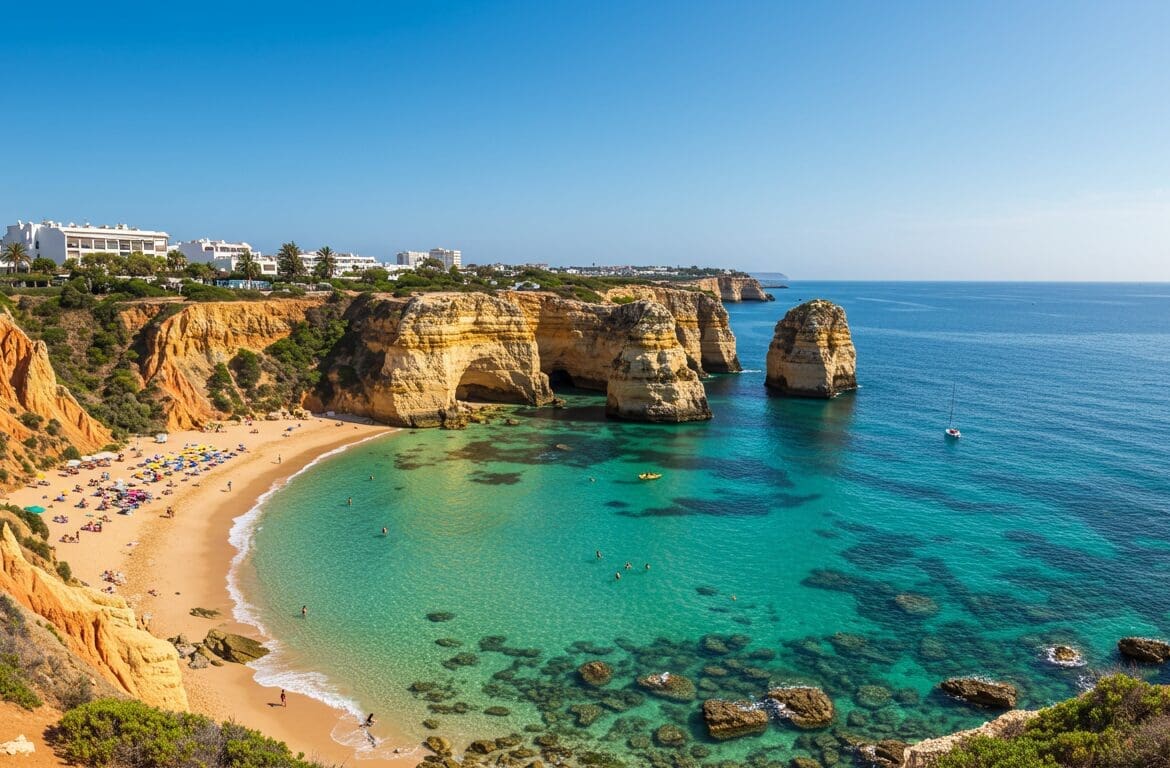
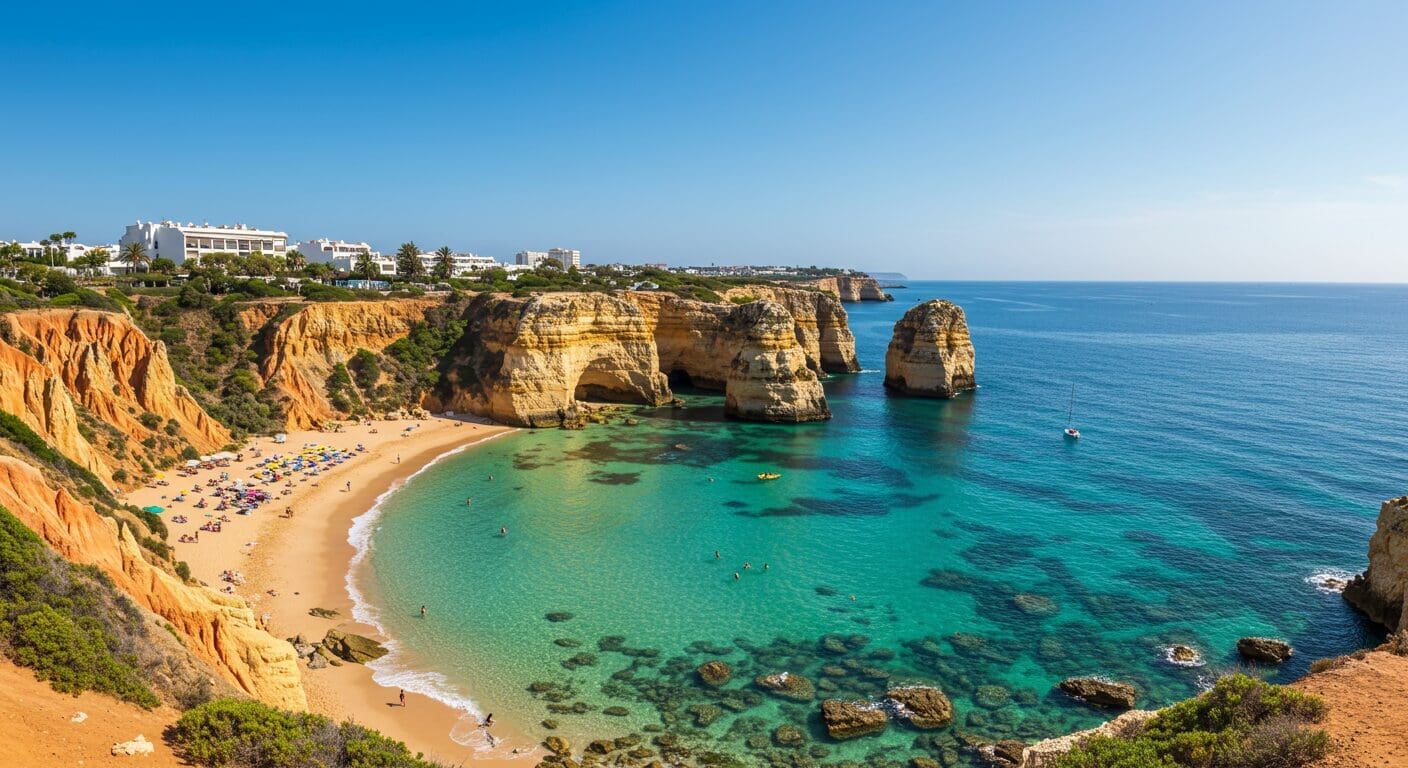
The west-central Algarve coast – roughly from Lagos to Portimão – is where the coastline does its most theatrical work. The limestone cliffs here have been carved by the Atlantic into forms that seem structurally improbable: arches, grottos, sea stacks and hidden coves accessible only by kayak or boat, which is the ideal number of barriers to keep them from getting too popular. Praia de Dona Ana, just south of Lagos, is the kind of beach that people use as their phone wallpaper. Praia da Marinha, near Carvoeiro, is regularly cited as one of Europe’s most beautiful beaches – the fact that getting to it involves a bit of a walk keeps the crowds at the level of “lively” rather than “impossible.”
The far west, around Sagres and Cabo de São Vicente – the southwestern tip of continental Europe, where the land runs out and the Atlantic takes over without any further discussion – is entirely different in character. The beaches here are wide, often empty, and washed by swells that have travelled uninterrupted from North America. They are not the beaches for a leisurely float on an inflatable flamingo. They are the beaches for people who want to feel genuinely small for a moment. The light here in the late afternoon is something that painters have been trying to capture for centuries, with mixed success.
The eastern Algarve, the Sotavento coast between Faro and the Spanish border, is the region’s best-kept secret – barrier islands, lagoons, and beaches reachable only by ferry that feel, even in midsummer, like somewhere the 21st century hasn’t quite reached. The Ria Formosa Natural Park stretches for 60 kilometres along this coastline, a complex of salt marshes and tidal channels that is home to flamingos (an unexpected Algarve detail), chameleons (a really unexpected one), and the kind of silence that makes city people slightly anxious at first and then deeply grateful.
What to Actually Do: Beyond the Sun Lounger
The Algarve’s outdoor offer is wider than its reputation implies, which is mostly just “get very brown by a pool.” The golf, to get the obvious out of the way, is world-class – the Golden Triangle around Quinta do Lago, Vale do Lobo and Vilamoura has courses that attract serious players from across Europe, and the climate means year-round playability without the philosophical courage required to golf in Scotland in February. The marina at Vilamoura is the place to organise sailing – day charters, sunset cruises, multi-day coastal passages – with a fleet and a guide network that is reliably professional.
Inland Algarve – the Serra de Monchique, the medieval village of Silves with its Moorish castle, the valley towns that tourists routinely drive through without stopping – deserves more attention than it gets. Silves, in particular, repays a proper visit: the red sandstone castle overlooking the town is one of the best-preserved Moorish fortifications on the Iberian Peninsula, and the town below it is good for lunch in the particular way that places are when they haven’t yet had to try too hard. The Monchique mountains, rising to around 900 metres in the northern Algarve, offer hiking, mountain biking and thermal spa towns (Caldas de Monchique has been a spa destination since Roman times, which puts recent wellness tourism in some perspective).
Dolphin-watching boat trips operate from Lagos, Portimão and Albufeira – common dolphins and bottlenose dolphins are genuinely common here, which is the kind of information that sounds like marketing but is simply accurate. Jeep safaris through the cork oak forests of the interior are a reliable half-day for families wanting to understand what the Algarve looks like when it isn’t facing the sea. Wine touring in the Alentejo, just north of the Algarve, is a natural day trip – the drive up through cork plantations and wheat plains is satisfying in itself.
Adventure on the Atlantic Edge: Water, Wind and Waves
The Algarve’s western coast, exposed to the full force of the Atlantic, has become one of Europe’s most respected surfing destinations – Sagres and the beaches around it attract serious surfers from across the world, and several excellent surf schools operate here for those approaching the sport at a more tentative angle. The waves here are consistent, powerful and not particularly interested in beginners, which means instruction is genuinely worthwhile rather than just a formality.
Kitesurfing has colonised certain beaches, particularly around Meia Praia near Lagos and the flatter lagoon areas of the eastern Algarve, where the conditions are more forgiving. Stand-up paddleboarding through the sea caves and arches near Lagos and Carvoeiro is one of those activities that sounds mildly strenuous and turns out to be quietly extraordinary – floating at eye level into a limestone grotto with the water lit green from below is the kind of thing that recalibrates your sense of what a good day looks like.
Scuba diving around the rocky reefs of the central and western Algarve reveals an underwater landscape that most visitors overhead at the airport never suspect exists – octopus, moray eels, various species of bream and bass, and the particular light-through-water effects that divers travel considerably further to experience. Several operators in Lagos and Portimão run PADI courses and guided dives for all levels. Cycling the coastal paths – either via guided tour or independently, with decent bike hire increasingly available – has grown significantly as an activity, and the western Algarve’s Via Algarviana walking trail, running 300 kilometres from Alcoutim on the Spanish border to Sagres, can be tackled in sections that range from an afternoon stroll to a week-long commitment.
Why Families Actually Come Back Here: The Honest Version
The Algarve is straightforwardly one of Europe’s best family destinations, and it has managed this without relying on theme parks or organised entertainment that involves a man in a costume doing something with a microphone. The beaches are safe – the central Algarve’s coves in particular tend to be sheltered, with calm water well-suited to children who haven’t yet achieved confidence in open swells. The weather is reliable in the way that matters for a family holiday: long, consistently warm days from June through September, without the crippling heat of the Greek islands in August.
The private villa with pool dynamic – which we’ll come back to – is particularly powerful for families who have been on enough hotel holidays to know the limitations. No negotiation for pool loungers. No eating at 6pm because that’s when the children’s menu is served. No corridor noise at midnight. The ability to barbecue on a terrace while the children do exactly what they want in a private garden is, for parents who have earned a holiday, not a small thing. Zoomarine, near Albufeira, provides a reliable family day if the children need something structured. The Slide & Splash water park near Lagoa has the approval of roughly every child who has visited it. But genuinely, the simpler pleasures – rockpooling at low tide, boat trips to see dolphins, an afternoon ice cream in a marina town – tend to be what families remember most clearly afterwards.
The History Beneath the Holiday: Moors, Romans and That Earthquake
The Algarve has been coveted for a long time. The Romans settled it, called it Lusitania, built roads through it and exploited its fish – the garum (fermented fish sauce) factories at Cerro da Vila near Vilamoura and at Milreu near Faro are among the best-preserved Roman archaeological sites in Portugal, and they have the quality of genuine surprise that prepared ruins rarely do. The Moors arrived in the 8th century and stayed for five hundred years, long enough to shape the landscape, the language (the name “Algarve” derives from the Arabic al-Gharb, “the west”), the agricultural terracing, and the distinctive whitewashed chimney architecture that still defines the region’s villages.
The earthquake of 1755 – one of the most powerful in European history, followed by a tsunami and fire that destroyed Lisbon and much of the Algarve – reset much of what had come before architecturally. Faro’s old town, surrounded by its medieval walls, survived better than most and is worth an afternoon’s serious exploration. The Igreja do Carmo in Faro contains its famous (or infamous) chapel of bones – walls lined with the skulls and femurs of 1,245 Carmelite monks, assembled not with any particular menace but with a certain Baroque sincerity about the nature of mortality. It is, it must be said, a conversation starter.
Tavira, in the eastern Algarve, is arguably the region’s most historically intact town – Roman bridge, Moorish castle foundations, 37 churches for a town of 26,000 people (a ratio that either reflects deep faith or an impressive approach to property repurposing). The Festival MED in Loulé each June brings world music to one of the Algarve’s most characterful medieval towns, and the Silves Medieval Fair in August reconstructs the town’s Moorish past with the kind of commitment that involves actual jousting.
Shopping: What to Bring Home That Isn’t a Fridge Magnet
The Algarve’s most worthwhile shopping is concentrated around the things it actually produces well: ceramics, cork products, local food, and the particular category of artisan goods that take up too much room in a suitcase and are entirely worth it. The traditional pottery of the region – hand-painted tiles, terracotta pieces, the bold hand-decorated bowls and plates you see everywhere from markets to Michelin-starred restaurant tables – is a legitimate reason to buy a second bag on the way home.
Cork, which the Algarve and broader Alentejo produce for a substantial percentage of the world’s supply, has been reimagined by local designers into everything from wallets and handbags to homeware and wine stoppers (obviously). The quality of genuinely good cork goods – flexible, light, warm to the touch – is considerably higher than the novelty items at airport souvenir shops might suggest. Seek out dedicated cork boutiques in Lagos and Faro for the real range. The market in Olhão, held Tuesday through Saturday, is one of the best food markets in the country – the covered fish market in particular, supplied directly by local fishing boats, is worth visiting even if you’re staying in a hotel and have no intention of cooking anything.
Medronho, the local firewater made from arbutus berries, is the thing to bring home if you want to give a gift that generates a memorable reaction. It is strong (sometimes very strong, depending on who made it and how they were feeling that day), singular, and completely unavailable anywhere else. Whether this is the selling point or the warning depends on the recipient.
Practical Matters: The Useful Information That Actually Changes Your Trip
Portugal uses the Euro, and the Algarve is, relative to comparable European coastal destinations, still good value – though prices have risen significantly in the luxury sector over the past five years, reflecting the region’s growing international profile. Credit cards are accepted almost universally; tap-to-pay works reliably in towns and at most restaurants. Tipping is appreciated but not aggressive – 10% in a restaurant is generous, rounding up at a café is standard.
The best time to visit for a luxury holiday in the Algarve depends on what you’re optimising for. July and August deliver maximum sunshine (300-plus days annually average out differently across the year) and the full complement of open restaurants, beach clubs and activities, but also peak prices and peak crowds – particularly on the most famous beaches. June and September are the considered traveller’s months: warm enough for the sea, quieter, and with prices that don’t require a separate conversation with your accountant. May is genuinely lovely and underrated. April can be remarkable. The winter – October through March – is mild, green and increasingly popular with remote workers and golfers who prefer their fairways without a four-hour wait.
Portuguese is the language. English is spoken reliably in tourist areas and at any restaurant or villa that considers itself serious about hospitality. Learning a handful of phrases – obrigado/a (thank you), bom dia (good morning), por favor (please) – is worthwhile not because you’ll need them but because the Algarve, like most places, responds warmly to the modest effort. Tap water is safe. Pharmacies are well-stocked and easy to find. Crime is low by European standards. The driving is, occasionally, expressive.
Luxury Villas in the Algarve: The Case for Not Staying in a Hotel
There is a version of an Algarve holiday that involves a large resort hotel with a buffet breakfast, a pool shared with four hundred other guests, and the specific despair of realising on day three that you have successfully recreated the experience of your office, but warmer. This guide is not for that holiday.
A private luxury villa in the Algarve reframes the entire experience. The privacy argument is the obvious one – a walled garden, a pool that belongs exclusively to your party, mornings where the only sounds are cicadas and distant sea – but it understates the more subtle advantages. Space, primarily. The ability to spread a group of eight or twelve across a house with multiple living areas, so that no one is ever forced into company they didn’t specifically request. The option of a private chef who arrives each evening and makes dinner feel like a proper occasion without the effort of making a reservation. The concierge who knows which boat captain to call, which restaurant actually has a table, and which beach is worth the drive this particular week.
For remote workers – and the Algarve has become a genuine destination for the work-from-anywhere community, not least because Portugal introduced a Digital Nomad Visa in 2022 – the better villa properties now offer reliable high-speed internet, dedicated workspace, and the particular productivity that comes from being somewhere worth leaving the desk for at 6pm. Several properties offer Starlink connectivity, which effectively removes location as a variable from the equation.
Wellness-focused guests find that the villa format suits their requirements particularly well: a pool for morning laps, a gym for the days when the yoga mat feels insufficient, the ability to coordinate with an in-villa chef around dietary requirements without the awkward hotel conversation, and access to some of Portugal’s best spas as day excursions rather than the primary reason for being there. The pace of life that a well-chosen Algarve villa makes possible – unhurried, self-directed, deliberately removed from the structure that fills the rest of the year – is not a luxury in the indulgent sense. It is, for most people who experience it properly, something closer to necessary.
Excellence Luxury Villas offers an extensive collection across the region – from cliff-top properties with Atlantic views above Lagos to estates within the Golden Triangle that are, frankly, architecturally serious. Browse our full collection of beachfront luxury villas in Algarve and find the one that makes you stop scrolling.
More Algarve Travel Guides
- Best Restaurants in Algarve: Fine Dining, Local Gems & Where to Eat
- Best Beaches in Algarve: Hidden Coves, Beach Clubs & Coastal Secrets
- Algarve with Kids: The Ultimate Family Holiday Guide
- Best Time to Visit Algarve: Month by Month Weather, Crowds & Tips
- Algarve Luxury Itinerary: The Perfect 7-Day Guide
- Romantic Algarve: The Ultimate Couples & Honeymoon Guide
What is the best time to visit Algarve?
June and September are the sweet spot for most travellers – warm enough for swimming, quieter than peak summer, and with accommodation prices that reward the slight flexibility. July and August deliver the full, unambiguous Algarve summer experience (reliably hot, busy, everything open) and are ideal if school holidays dictate your timing. May is increasingly popular with couples and remote workers who want warmth without crowds. The Algarve’s mild winters make October through March genuinely viable for golf, hiking and cultural visits, with average temperatures around 15-18°C and a landscape that turns unexpectedly green.
How do I get to Algarve?
Faro International Airport is the main gateway, with direct flights from most major UK airports (Heathrow, Gatwick, Manchester, Edinburgh, Bristol) taking approximately two and a half hours. Multiple European carriers operate routes from across the continent. Alternatively, fly into Lisbon and connect onwards by domestic flight (45 minutes), train (around three and a half hours) or hired car. A private airport transfer from Faro is strongly recommended for villa arrivals – it costs relatively little and starts the holiday in the correct register.
Is Algarve good for families?
Genuinely excellent, and for reasons that go beyond the obvious. The beaches are mostly safe and sheltered, the sea temperature is agreeable from June through October, the food is reliably child-friendly without being infantilised, and the range of activities – boat trips, water parks, wildlife watching, rockpooling – covers multiple ages and attention spans simultaneously. A private villa with pool significantly improves the family holiday experience: flexible meal times, private outdoor space, no shared facilities, and the ability to operate at your own pace rather than the hotel’s. Families who have tried both rarely go back to the hotel format.
Why rent a luxury villa in Algarve?
Privacy, space and a guest-to-staff ratio that no hotel can replicate. A private villa means a pool that belongs entirely to your party, a garden with no strangers in it, mornings at whatever pace you choose, and the option of a private chef, concierge and housekeeping staff who are there specifically for you. For families, the space to spread out across multiple rooms and living areas transforms the holiday dynamic. For couples, the seclusion and quality of service is genuinely comparable to a high-end hotel at a price point that, divided across a week, often makes better financial sense. The Algarve’s villa stock has improved dramatically in the past decade – properties now range from modernist cliff-top architecture to traditional quinta estates with serious culinary facilities.
Are there private villas in Algarve suitable for large groups or multi-generational families?
Yes, and this is one of the Algarve’s particular strengths. The region has a well-developed stock of large-footprint properties – six, eight and ten-bedroom villas with multiple living areas, separate wings for different family generations, oversized private pools, games rooms, outdoor dining spaces and in some cases guest annexes that provide genuine separation when required. Staffing these properties with a cook, housekeeping and a concierge is straightforward through a quality villa specialist. The Golden Triangle area around Quinta do Lago and Vale do Lobo has some of the most impressive large-group properties, though the western Algarve and eastern coast both offer excellent options with different characters.
Can I find a luxury villa in Algarve with good internet for remote working?
Yes – increasingly so. The Algarve has become a serious destination for remote workers and digital nomads, partly as a result of Portugal’s forward-thinking visa policies and partly because the quality of life to productivity ratio here is difficult to argue with. The better luxury villas now specify high-speed broadband as a standard amenity, and a growing number offer Starlink satellite connectivity, which effectively resolves any residual rural signal issues. When booking, it is worth confirming internet speeds and asking about dedicated workspace – many larger villas have studies or terrace areas that work well as home offices, with the added advantage of a view that makes the 5pm screen-off moment feel genuinely earned.
What makes Algarve a good destination for a wellness retreat?
The combination of climate, outdoor activity and villa infrastructure makes the Algarve one of Europe’s more natural wellness destinations – without the slightly evangelical atmosphere that some dedicated retreat centres cultivate. The outdoor offer is substantial: year-round hiking, coastal cycling, surfing, paddleboarding and open-water swimming, all in reliable sunshine. The food scene increasingly supports wellness-oriented eating, with several restaurants and private chefs well-versed in specific dietary requirements. Many luxury villas come equipped with private pools for morning laps, outdoor gyms, hot tubs and yoga terraces. The Caldas de Monchique thermal spa in the northern Algarve has been a therapeutic destination since Roman times. And the pace of life – genuinely unhurried, warm, oriented around outdoor meals and long evenings – does more for most people’s wellbeing than any specific programme.