
Best Restaurants in Hithaadhoo: Fine Dining, Local Gems & Where to Eat
What do you actually eat when you visit one of the most remote inhabited islands in the Maldives? It’s a question most luxury travellers don’t think to ask until they’re already there, standing in warm sand, watching a dhoni cut across the lagoon, and realising that the answer is considerably more interesting than they expected. Hithaadhoo – a quiet, largely untouristed island in Addu Atoll at the very southern tip of the Maldivian archipelago – is not a place that trades in celebrity chef pop-ups or tasting menus with fourteen courses and a story about foraging. What it offers instead is something rarer: food that is genuinely of its place, cooked by people who have been cooking it this way for generations, eaten in conditions of mild, unhurried beauty. This is a guide to making the most of that – and to understanding exactly where, and what, to eat while you’re here.
Understanding Hithaadhoo’s Food Scene
A few gentle recalibrations are required before we begin. Hithaadhoo is not Malé. It is not a resort island. There is no infinity-pool restaurant with a sommelier and a degustation menu. The island is a working Maldivian community – one of the larger settlements in Addu Atoll, with its own distinct culture shaped by centuries of trade routes, Indian Ocean crosswinds, and a proximity to Sri Lanka and southern India that has left a very noticeable mark on the food. The culinary scene here is real in the most literal sense: it exists to feed local people, not to perform luxury for visitors. Which, if you approach it correctly, is one of the most quietly thrilling things about eating here.
What this means practically is that the best restaurants in Hithaadhoo are not glamorous by conventional luxury-travel standards. They are small, often family-run, almost always unpretentious, and frequently revelatory. Tuna – in particular the skipjack tuna known locally as kalhubilamas – is the backbone of almost everything. Coconut milk, chillies, curry leaves, and dried fish bring depth and heat. Rice and roshi (a thin, unleavened flatbread) appear at almost every meal. If you came expecting a French bistro, you’ll need to adjust your expectations. If you came expecting to eat extraordinarily well in a completely unfamiliar register, you’re in exactly the right place.
Fine Dining in Hithaadhoo: What to Expect
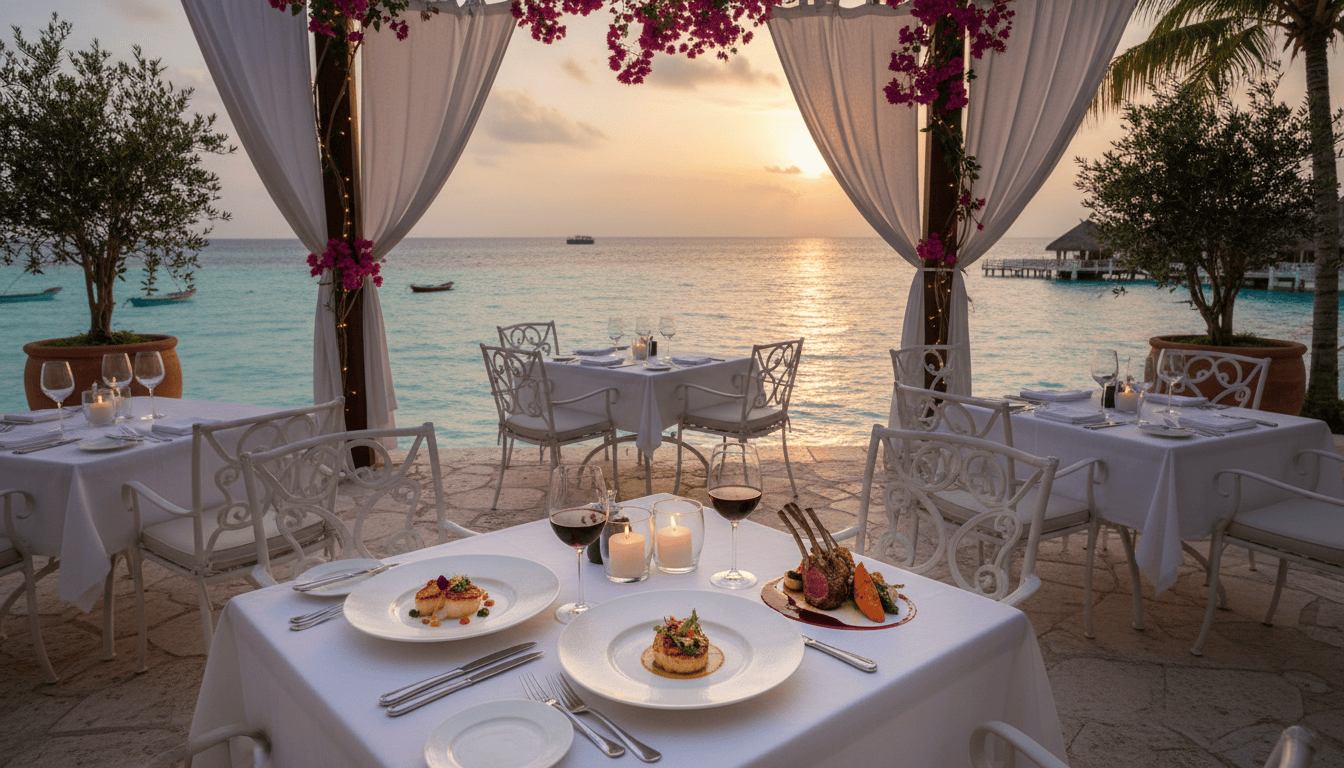
There are no Michelin-starred restaurants in Hithaadhoo. There are no Michelin-starred restaurants in the Maldives at all, as it happens – the archipelago has so far remained outside the guide’s geographic scope, which says more about the logistics of tyre-company restaurant inspectors reaching Addu Atoll than it does about the quality of the food. Fine dining in Hithaadhoo exists on its own terms: it looks less like a white tablecloth and more like exceptional ingredients, treated with genuine skill, in a setting that happens to involve the Indian Ocean in the background.
For travellers staying in private villas – particularly those who have arranged a private chef as part of their stay – the standard can be genuinely exceptional. A skilled local chef working with the day’s catch, fresh coconut, locally grown herbs, and traditional Maldivian techniques can produce meals that are far more memorable than many a formal restaurant dinner. This is the real fine dining proposition in Hithaadhoo: intimacy, provenance, and flavour, rather than theatre and ceremony. If your idea of dining well includes knowing exactly where your fish was caught that morning, this island will exceed your expectations considerably.
Local Cafés and Tea Houses: The Heart of Hithaadhoo Eating
The social infrastructure of any Maldivian island revolves, to a striking degree, around the local café – known as a sai hotel, or simply a teashop. These are the places where locals eat breakfast, take tea in the late afternoon, and gather in the evening. They are emphatically not tourist destinations. They have no Instagram presence. The décor tends toward plastic chairs and fluorescent lighting, which is either charmingly honest or slightly startling depending on your disposition.
What they do have is food of genuine quality and character. Breakfast in a Hithaadhoo sai hotel is a particular pleasure: mas huni – shredded smoked tuna mixed with freshly grated coconut, onion, and chilli – served with warm roshi is one of the great simple morning meals of the Indian Ocean world. It is the kind of dish that has no business being as good as it is, and yet. Alongside it you might find bis keemiya (thin pastry filled with tuna and egg, vaguely reminiscent of a samosa), or gulha (small, satisfying fish-filled dumplings), or boakibaa, a rice cake with a faintly sweet, coconutty depth that functions perfectly as either breakfast or afternoon snack.
The tea itself – sweet, strong, often made with condensed milk – is drunk in small glasses and replenished frequently. It costs almost nothing. It is very good. Going for tea in a local café is, without question, one of the best things you can do on this island, and it will cost you the price of a single cocktail at most luxury resort bars. The contrast is noted without further comment.
What to Order: The Dishes That Define Hithaadhoo
Any serious engagement with the food of Hithaadhoo begins and ends with tuna, but there is considerably more range within that category than the word suggests. Garudhiya is the essential dish: a clear, deeply savoury fish broth made from boiled tuna, typically served with rice, lime, chilli, and onion. It is humble in appearance and profound in flavour – the kind of soup that makes you understand, immediately, why this has been the staple of Maldivian life for centuries. Eat it here, where the tuna is genuinely fresh, and you will see it differently.
Rihaakuru is a thick, intensely flavoured fish paste that appears as a condiment alongside many meals. It is an acquired taste – very pungent, very concentrated, very good once you’re past the initial surprise. Mas riha is a tuna curry with coconut milk and a warming blend of spices, the sort of thing that rewards patience and a willingness to eat with your hands. For something lighter, the fresh tuna prepared simply with lime and chilli, served cool, is a recurring pleasure.
Dessert, when it appears, tends toward the sweet and coconut-forward: bondibaiy (coconut rice pudding) is gentle and aromatic; dodol, a dense confection made from coconut milk, rice flour and jaggery, is rich enough to require a considered pause between bites. Do not skip either.
Drinks: Local and Otherwise
The Maldives is a Muslim country, and Hithaadhoo is a local island rather than a resort, which means alcohol is not available anywhere in the town. This is worth knowing before you arrive with expectations of a well-stocked wine list. What is available, however, is a range of fresh juices – watermelon, mango, passionfruit – that in this heat feel less like a consolation prize and more like the obviously correct choice. Coconut water, drunk straight from a freshly cracked young coconut, is abundant and excellent.
For those who feel the absence of wine at dinner, the practical answer is to plan ahead: guests staying in a private villa can typically arrange for alcohol to be stocked as part of their accommodation setup, consumed privately within the property. It’s a useful distinction – the island’s rules apply to public spaces, and your villa’s sundowner arrangements are a separate matter entirely.
Food Markets and Fresh Produce
Addu Atoll has a functioning local market culture, and visiting the local produce market in Hithaadhoo is a worthwhile early morning exercise – partly for the obvious reason that it gives you a sense of what is actually seasonal and available, and partly because it is simply a lively and interesting place to be. Vendors sell fresh fish hauled in overnight, alongside coconuts, chillies, bananas, and a rotating cast of tropical vegetables. The tuna you see here in the morning is very likely to appear on a local café table by noon. There is something satisfying about that chain being short enough to observe directly.
Those with villa access and a private chef arrangement will find the market particularly valuable as a sourcing opportunity: a chef who knows the local vendors and can select the morning’s best fish is operating with a raw-ingredient advantage that no amount of formal restaurant infrastructure can quite replicate.
Practical Tips: Reservations and Timing
The concept of reservations, in the formal sense, does not really apply to Hithaadhoo’s local dining scene. The cafés and tea houses operate on a first-come basis, open and close according to prayer times, and are refreshingly indifferent to the idea of advance booking. The practical implication is that you should eat when locals eat: breakfast early, lunch around midday, and the evening meal tends to be relatively late by European standards. During Ramadan, the rhythm shifts significantly – many establishments will be closed during daylight hours and considerably busier after sunset, when the breaking of the fast becomes a communal occasion of real warmth.
Dress modestly when eating in local establishments – this is an inhabited Muslim island, and the usual respectful conventions apply. The locals are, in the author’s experience, consistently hospitable toward visitors who treat the place with basic courtesy and genuine curiosity.
The Private Villa Option: Dining on Your Own Terms
For a significant proportion of visitors who come to Hithaadhoo through a luxury villa rental, the most memorable meals will not take place in a café or a restaurant at all. A luxury villa in Hithaadhoo with a private chef option transforms the dining equation entirely: you have access to local knowledge, to the morning market, to the full range of Maldivian culinary tradition, and you get to eat it in complete privacy, at your own pace, to whatever schedule suits you. Breakfast on the terrace as the lagoon turns from purple to gold, a long late lunch with the ceiling fans turning overhead, a tasting dinner of Maldivian classics prepared specifically for your table – this is, when you think about it, a rather convincing argument for the private villa model.
For further context on everything Hithaadhoo has to offer beyond the table, the full Hithaadhoo Travel Guide covers the island in considerably more depth – including where to stay, what to do, and how to make the most of one of the Maldives’ most genuine and least visited destinations.

