
Best Restaurants in Trogir: Fine Dining, Local Gems & Where to Eat
Best Restaurants in Trogir: Fine Dining, Local Gems & Where to Eat
What does it actually mean to eat well in a medieval Croatian city where the old town is a UNESCO World Heritage Site, the Adriatic is twenty metres away, and half the tourists are still arguing about which is the correct way to photograph a cathedral? It means ignoring quite a lot of what’s directly in front of you – the laminated menus with stock photos, the places that have clearly decided their location does the heavy lifting – and finding instead the restaurants where the food is the reason people come back year after year. Trogir rewards that effort handsomely. The dining scene here is more layered than it first appears: there’s serious cooking happening in these narrow stone lanes, whole grilled fish that will ruin you for supermarket seafood forever, and wine lists that reflect a region most of the world is still catching up on. This is the guide to finding all of it.
Understanding the Trogir Dining Scene
Trogir sits on a small island connected to the mainland and to the larger island of Čiovo by bridges, which means that geographically, you are almost never far from the sea. This has consequences for what ends up on your plate. The cuisine here is Dalmatian at its heart – defined by olive oil rather than butter, by the Adriatic rather than any farmyard, by the kind of simplicity that either looks effortless or reveals its difficulty immediately, depending on who is cooking.
The old town itself contains a concentrated cluster of restaurants along the waterfront promenade – the Riva – and threading back through the medieval lanes. The promenade tables are undeniably beautiful to sit at. They are also, if you’re honest, not always where the most serious cooking happens. The restaurants slightly further from the tourist current, the ones where you have to make a decision to walk there rather than simply fall into them, tend to reward the extra twenty steps considerably. Lunch here is an event. Dinner even more so. The Croatian custom of eating late by northern European standards suits this climate and this architecture entirely.
There are no Michelin-starred restaurants in Trogir at the time of writing – the Michelin Guide has made inroads into Croatia but remains concentrated in Zagreb and along the more developed stretches of the Dalmatian coast. What Trogir has instead is something arguably more interesting: a generation of chefs who grew up with this produce and these techniques, cooking with genuine investment rather than institutional ambition.
Fine Dining and Serious Restaurants in Trogir
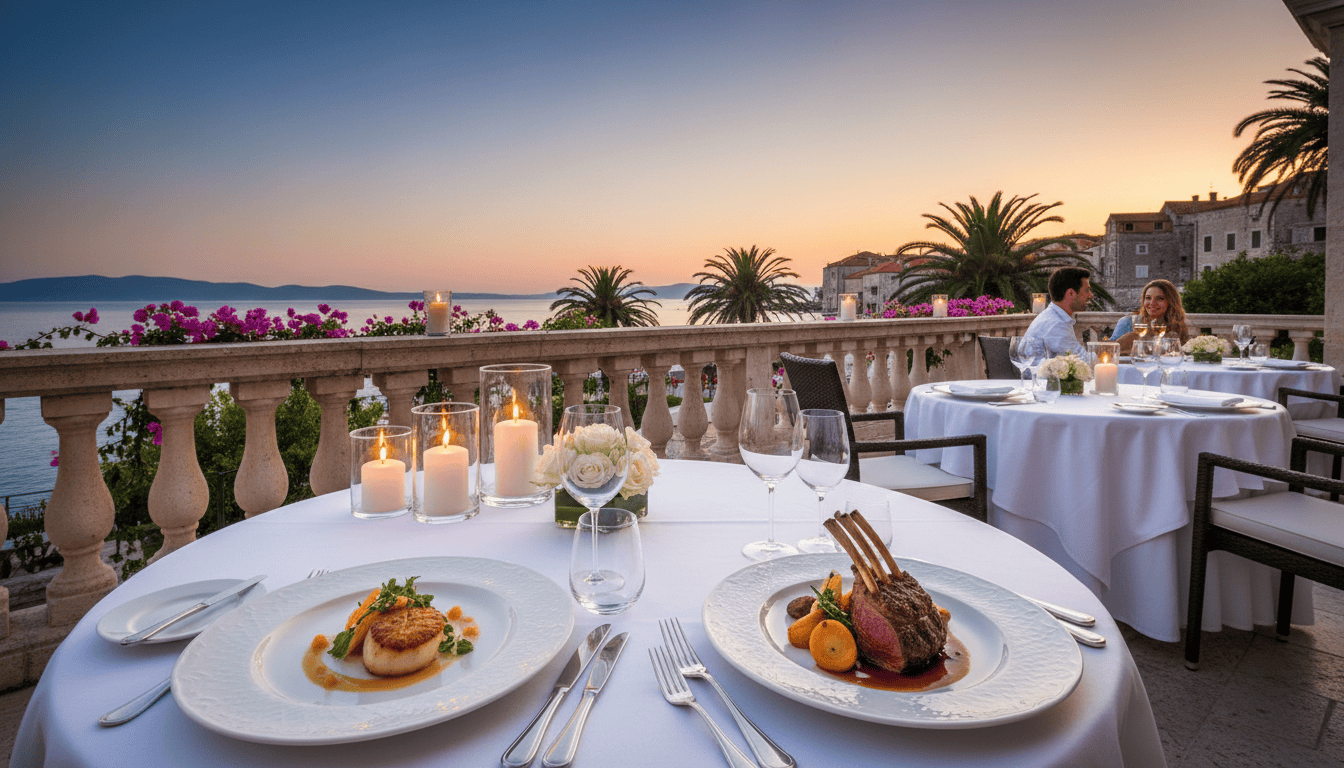
The upper end of Trogir’s restaurant scene is defined less by white tablecloths and more by evident care – the kind of cooking where you can tell that someone has thought carefully about what goes on the plate and why. Several restaurants in and around the old town have built strong reputations on exactly this basis, drawing guests from the larger yachts moored in the marina, from Split’s more discerning visitors, and from the growing number of travellers who come specifically because they’ve heard the food is worth making the trip for.
Look for restaurants that lead with fresh catches from local fishermen – the relationship between kitchen and boat is still direct here in a way that has largely disappeared from more commercialised coastal destinations. Sea bass, bream, dentex and John Dory appear regularly, typically prepared with the Dalmatian restraint that lets the fish speak rather than burying it in sauce. Shellfish from the nearby Šibenik channel – oysters, mussels, clams – appear at the better establishments with a provenance that is both genuine and traceable.
Pasta dishes here tend toward the Dalmatian rather than the Italian, though the influence is obvious and unashamed – black risotto made with cuttlefish ink is a litmus test for any kitchen along this coast, and in Trogir you’ll find versions that range from competent to genuinely exceptional. Order it. Compare it. Develop an opinion. You will find, over the course of a few evenings, that you have become unexpectedly expert.
Tasting menus are beginning to appear at the more ambitious establishments, typically featuring four to six courses that track the season carefully. Given that Dalmatian produce follows a genuinely compelling seasonal rhythm – spring lamb, summer shellfish, autumn truffles from Istria filtering south, winter citrus from the islands – this format suits the region well. Ask when booking whether a tasting option is available, as some kitchens offer it without advertising it publicly.
Local Trattorias, Konobas and Hidden Gems
The word to know in Croatia is konoba. It translates roughly as tavern or bistro, but neither word quite captures the specific character of a good one: stone walls, wooden beams, a menu that doesn’t change much because it doesn’t need to, cooking that connects directly to the way this coast has eaten for generations. Trogir has several that deserve your time considerably more than their modest appearances might suggest.
In the old town’s interior lanes – particularly away from the main cathedral square and deeper into the residential streets – you’ll find family-run establishments where the kitchen is essentially domestic in scale and philosophy. These are not places for innovative plating. They are places for slow-cooked lamb under a peka – the traditional Croatian bell-shaped lid under which meat and vegetables cook in their own heat and fat for hours – for grilled fish that arrived that morning, for octopus salad dressed with the local olive oil that you will seriously consider filling your suitcase with on the way home.
The peka deserves its own paragraph because visitors routinely underestimate it. This is not a rustic consolation prize for people who can’t get a table at a proper restaurant. It is one of the great cooking methods of the Mediterranean – patient, transformative, deeply flavoured – and in the hands of a family that has been making it for decades, it produces results that no amount of technical sophistication in a modern kitchen can easily replicate. The catch is that it requires advance ordering, typically by the morning of the day you want to eat it. Plan accordingly. It is worth planning accordingly.
Čiovo island, connected to the old town by a short bridge, offers a quieter version of the same dining culture with rather fewer tourists and rather more locals eating their actual dinner. Wandering over and finding a terrace table looking back at the old town in the early evening is one of those travel experiences that costs almost nothing and creates a memory that stays.
Beach Clubs and Casual Dining
The coastline around Trogir – particularly along the Čiovo shore and the beaches that extend south – has developed a modest but pleasing beach club culture that manages to remain relatively low-key by Adriatic standards. (Hvar, it is not. This is mostly a compliment.)
Beach bar dining here tends toward the honest and the well-sourced rather than the elaborate. Grilled fish, cold local beer, excellent olive oil, bread that arrives warm. Tables close enough to the water that you occasionally reconsider getting up to swim only because the food is too good to leave. The quality benchmark is higher than the casual setting implies – Dalmatian cooks have a pride of produce that doesn’t relax just because the dress code does.
Several beach clubs have invested in proper kitchens rather than simply grills, and their menus reflect this: seafood pasta, carpaccio of the morning’s catch, seasonal salads using the excellent local tomatoes that appear in late summer with an intensity that makes the word “tomato” feel like it’s been redefined. Lunch at a good beach club, followed by an afternoon that involves nothing more demanding than the sea and a sun lounger, is the Trogir afternoon done correctly.
For those staying in a villa on the coast, beach club dining is also a social occasion – a place to compare notes with other travellers, to hear what everyone else has been doing and eating, and to quietly congratulate yourself on your accommodation choices.
Food Markets and Local Produce
Trogir’s market sits close to the old town and operates primarily in the morning hours – the correct hours for a market, as anyone who has arrived at two in the afternoon to find only a few wilting herbs and a vendor who has clearly given up will confirm. Go early. The morning market is where the genuine local food culture is most visible and most accessible.
The produce reflects the agricultural character of the Dalmatian hinterland as much as the coast: seasonal vegetables grown on small plots, fruit that has been left to ripen rather than picked for transport, honey from island bees, olive oil in unlabelled bottles from someone’s family grove that is almost certainly better than anything you’ll buy in a supermarket. Fig season in late summer produces figs that bear almost no resemblance to the wan specimens available in northern European shops. It is a mild revelation.
Local cheese – particularly the sheep’s milk varieties from nearby islands like Brač and Hvar – appears at market stalls with an informality that belies its quality. Pag cheese, from further along the coast, is more famous and rightly so, but the smaller-production cheeses available at Trogir’s market reward exploration and are, by any honest measure, excellent additions to a picnic or a private dinner.
Fish markets operate on their own schedule, tied to the morning catches. Fresh catch laid out simply on ice, prices negotiated with the kind of brevity that suggests the transaction has happened approximately ten thousand times before. If you are staying in a villa with kitchen access, buying direct from the morning catch and cooking that evening is one of the most satisfying things the Croatian coast makes possible.
What to Order: Essential Dishes and Drinks
A short list of what you should eat before you leave Trogir, because some things need saying plainly:
Black risotto (crni rižot) – made with cuttlefish or squid ink, deeply savoury, the colour of midnight. A signature of this coast and a test of any kitchen that serves it.
Peka – lamb, veal or octopus slow-cooked under the bell lid with vegetables, olive oil and herbs. Order in advance. Do not skip it.
Grilled fresh fish – ordered by weight, typically brought to the table whole to confirm your choice before cooking. Sea bass and bream are the classics. Dentex, if available, is worth the premium.
Octopus salad (salata od hobotnice) – cold cooked octopus with olive oil, vinegar, capers and onion. Simple, perfect, the kind of thing you attempt to recreate at home and which never tastes quite the same.
Pašticada – a slow-braised beef dish with a sweet-sour sauce made from prunes and wine, typically served with gnocchi. Dalmatian Sunday cooking at its finest, available at better konobas.
On the wine front: Croatian wine has been quietly producing world-class bottles for years while the rest of the world focused elsewhere. Plavac Mali – a red grape grown on the steep coastal terraces of the Pelješac peninsula – produces wines of genuine structure and character. Pošip is the white to seek out: a grape native to Korčula island that makes fresh, mineral wines with more complexity than their easy drinkability suggests. Grk, from the same island, is rarer and stranger and worth trying if you encounter it.
Local brandies – rakija in various fruit and herb forms – arrive as complimentary digestifs at traditional restaurants, offered with the particular insistence that suggests declining would be both impossible and inadvisable. Embrace this. The herb version, travarica, is the one to start with.
Reservation Tips and Practical Advice
Trogir is not vast, but in high season – July and August particularly – the better restaurants fill quickly, especially for dinner. The rule of thumb: the more serious the kitchen, the more necessary the advance booking. For fine dining or restaurants with established reputations, booking two to three days ahead during peak season is minimum sensible practice. A week in advance is not excessive.
For konobas and family restaurants, calling the morning of the day you want to eat is generally acceptable, though ordering a peka will always require advance notice – typically at least the morning of, and some places prefer the day before. This is not bureaucracy. This is physics.
Lunch reservations are considerably easier to obtain than dinner ones, and there is a genuine argument that lunch is the better meal in this climate anyway: cooler than the afternoon heat, long enough to extend into the early evening if the wine and company warrant it, and leaving the evening free for aperitivo on the Riva without the pressure of a reservation hanging over proceedings.
Most restaurants in Trogir accept credit cards, but cash remains appreciated at smaller establishments. Tipping is not obligatory in the local culture but is warmly received at around ten percent for good service. Language is rarely an obstacle – English is widely spoken at tourist-facing establishments – but a few words of Croatian are received with a warmth that is entirely disproportionate to the effort required. Hvala (thank you) costs nothing and buys considerable goodwill.
For groups, some restaurants offer private room or terrace options that can be reserved for special occasions – particularly useful for celebratory dinners where the combination of Dalmatian food, excellent wine and a medieval stone backdrop does most of the work for you.
Dining with a Private Chef: The Villa Option
There is, of course, another way to eat exceptionally well in Trogir – one that involves neither a reservation nor sharing a terrace with a tour group that has decided this is the appropriate moment for a birthday song. Staying in a luxury villa in Trogir with a private chef option transforms the morning market from a pleasant excursion into a purposeful mission: selecting the morning’s catch, choosing the season’s best produce, briefing a chef who knows exactly what to do with all of it, and eating that evening on your own terrace with a view that no restaurant in the old town can match.
Private chef dining in a villa also accommodates what restaurant dining cannot: the entirely flexible menu, the dietary preferences that are neither apologised for nor a problem, the dinner that starts when you’re ready rather than when the kitchen is, the ability to linger over a second bottle of Pošip without ever considering the bill. It is, in the specific context of Trogir’s extraordinary food culture and setting, a rather compelling way to eat.
For everything you need to know about making the most of this extraordinary small city – beyond the dining table – our full Trogir Travel Guide covers the old town, the islands, the beaches, and the practicalities of getting here and getting around.
Does Trogir have any Michelin-starred restaurants?
At the time of writing, there are no Michelin-starred restaurants in Trogir itself. The Michelin Guide has expanded its coverage of Croatia in recent years, with starred restaurants concentrated in Zagreb and other parts of the Dalmatian coast. However, Trogir has a strong and genuinely accomplished dining scene, with several restaurants producing cooking of a quality that reflects serious culinary investment – particularly in fresh seafood, traditional Dalmatian techniques like peka, and the region’s excellent local wines.
What is the best food to eat in Trogir?
Trogir’s best dishes are rooted in Dalmatian coastal cooking: grilled fresh fish ordered by weight (sea bass, bream and dentex are all excellent), black risotto made with cuttlefish ink, octopus salad dressed with local olive oil, and peka – lamb, veal or octopus slow-cooked under a traditional bell-shaped lid. Peka requires advance ordering, typically the same morning or the day before, but is one of the most rewarding things you can eat on the Dalmatian coast. Pair any of the above with local white wines such as Pošip or Grk from nearby islands.
Do I need to make restaurant reservations in Trogir?
In high season (July and August), reservations at the better restaurants in Trogir are strongly recommended, particularly for dinner. Two to three days in advance is a sensible minimum for well-regarded establishments, and a week ahead is not unreasonable for the most popular ones. If you want to order peka – the slow-cooked dish made under a traditional Croatian bell lid – you should inform the restaurant at least on the morning of the day you’re visiting, as it requires several hours of preparation. Lunch reservations are generally easier to arrange than dinner bookings and can often be made the same day.
