Best Time to Visit Charente: Cognac, Vines & River Towns
The best time to visit Charente is May, June or September, when daytime temperatures sit between 18-24°C (64-75°F), accommodation is easier to book and the region’s markets and vineyards are fully active without the July-August squeeze. Summer brings the warmest, driest weather but also the busiest roads and campsites, while winter is quiet, cool and often damp, better suited to cellar visits than long walks. Spring and early autumn offer the clearest combination of good weather, manageable crowds and lower prices.
Here is a fact that most guidebooks skip entirely: the best moment to actually watch Cognac being made is not the sun-warmed afternoon tasting most visitors imagine, but a grey, cold morning in January or February, when the copper stills along the Charente river are working day and night. French law permits distillation only between autumn and the following 31 March, so anyone arriving in August expecting to see the alchemy in motion will instead find the pot stills resting and the cellar master on an actual holiday himself.
That small detail tells you something true about Charente: its rhythms run on harvests and distilling seasons, not on school terms or bank holidays, and working out the best time to visit Charente is really a matter of deciding which of those rhythms you’d like to catch. There is no single grand unveiling here, no one month everyone circles on the calendar – well, almost, more on that shortly. It is a quietly productive corner of France, and the seasons matter more for what’s happening in the fields and warehouses than for what’s been laid on for tourists. If you haven’t yet got your bearings on the wider region, the Charente Travel Guide is worth a look before you settle on dates.
Charente at a Glance: Best Time to Visit by Month
- Warmest and busiest: July and August, 24-28°C (75-82°F)
- Best balance of weather and calm: May, June and September
- Coolest and quietest: December to February, 4-10°C (39-50°F)
- Main festival dates: late January in Angoulême, July in Cognac
- Grape harvest (vendanges): mid-September to early October
- Distilling season: November to 31 March
Spring in Charente: March to May
Spring here arrives in fits and starts rather than one clean sweep. Rain showers interrupt sunshine, hedgerows green up ahead of the vines, and the countryside around the Charente river turns a particularly deep shade of green that photographs better than it feels underfoot. It’s an excellent season for walkers, cyclists and anyone who’d rather see Romanesque churches and market towns without sharing the pavement.
March in Charente
Highs around 13°C (55°F), lows near 4°C (39°F). Still properly damp, with many seasonal attractions only just reopening after their winter closure. Prices are low and tourists thin on the ground – this is budget travel, not polished travel.
April in Charente
Highs climb to 16-17°C (61-63°F), lows around 6-7°C (43-45°F). Markets fill out, orchards blossom, and Easter weekend brings a modest flurry of domestic visitors to the bigger towns, though nothing that troubles a restaurant reservation.
May in Charente
Highs of 19-20°C (66-68°F), lows near 9-10°C (48-50°F). This is spring at its most convincing: long evenings, gardens in full flower, and the French public holidays (VE Day, Ascension) occasionally pushing up weekend crowds at popular riverside spots. Still, overall, a genuinely good month.
Summer in Charente: June to August
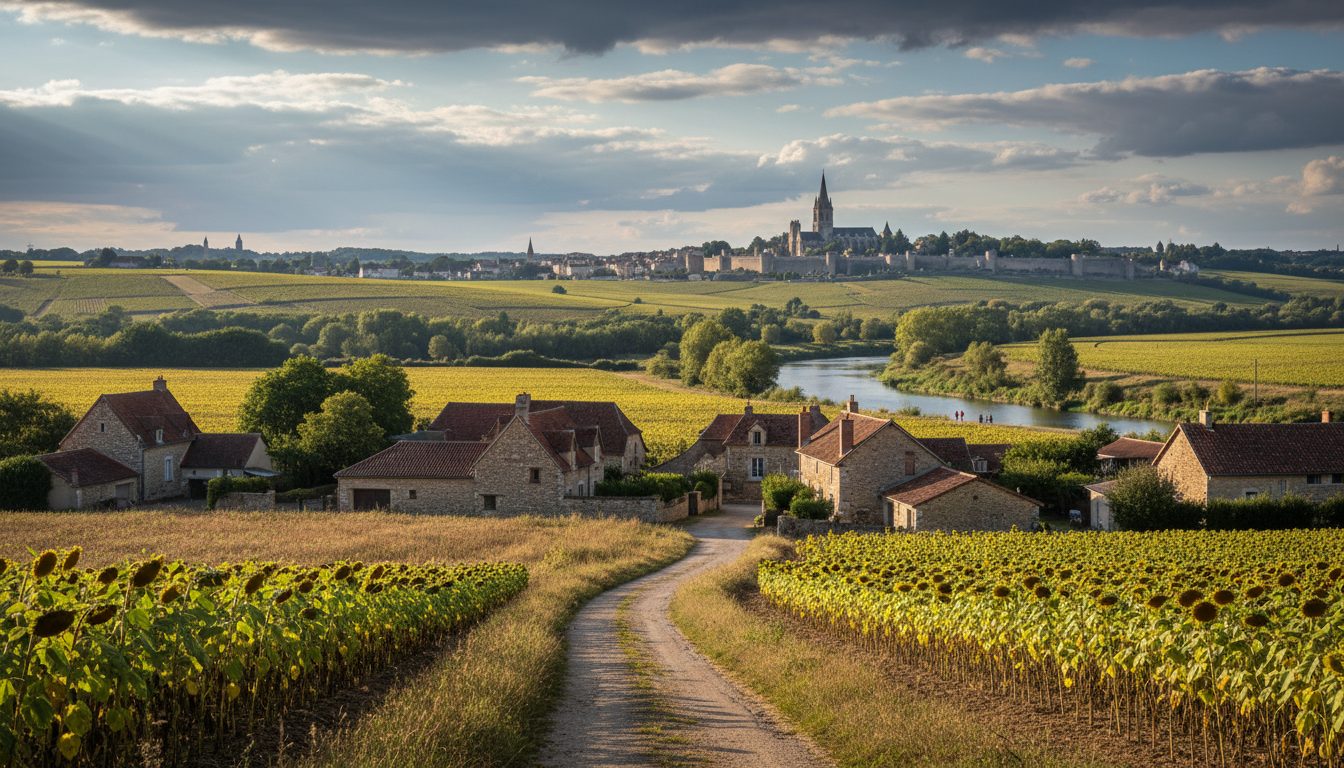
Summer is when Charente looks most like the postcard version of itself – sunflower fields, slow rivers, long lunches that drift into early evening. It’s also when the region fills up fastest, since this is prime French domestic holiday territory as well as a draw for overseas visitors chasing the Atlantic coast nearby.
June in Charente
Highs around 23°C (73°F), lows near 12°C (54°F). Arguably the pick of the summer months: warm, mostly dry, and still ahead of the main crowd surge that arrives with the French school holidays.
July in Charente
Highs of 26-27°C (79-81°F), lows 14-15°C (57-59°F). Cognac’s Blues Passions festival draws music fans into the town, river activities pick up, and bookings for July and August tighten considerably. Expect warm, generally dry weather with the occasional thunderous evening storm.
August in Charente
Highs of 27-28°C (81-82°F), occasionally edging higher during a heatwave. This is peak French holiday month, which means busy roads and higher prices – and, with a certain dry irony, some small family-run shops and restaurants closing for their own break precisely when demand is highest. Plan around it rather than being caught out by it.
Autumn in Charente: September to November
Autumn is, for many returning visitors, the quiet favourite. The light softens, the vineyards turn, and the grape harvest gives the whole region a sense of purposeful activity rather than performance for tourists. Crowds fall away sharply after 15 August, and prices follow them down.
September in Charente
Highs around 23°C (73°F), still warm enough for outdoor dining, but noticeably calmer than August. The vendanges begin mid-month, and in some years Angoulême’s historic car race through the old ramparts brings a brief, noisy charm to the town.
October in Charente
Highs near 18°C (64°F). Harvest continues into early October, countryside colour is at its best, and this is a strong month for food-focused travel – markets are generous and restaurants attentive, with far fewer tables to compete for.
November in Charente
Highs of 12-13°C (54-55°F), greyer skies and shorter days. Distilling season begins, which means cellar visits regain their genuine theatre. Many open-air attractions scale back hours or close for winter.
Winter in Charente: December to February
Winter is Charente’s least glamorous season and, for a particular sort of traveller, its most interesting. The weather is cool, grey and reliably damp – this is not a snow destination, though a hard frost is common enough. What winter offers instead is access: to working distilleries, to empty market squares, and to one genuinely significant event.
December in Charente
Highs around 9-10°C (48-50°F). Christmas markets appear in the larger towns, distilling runs at full pace, and days are short – sunset well before 5.30pm.
January in Charente
Highs around 8°C (46°F). This is the one month Charente does circle on the calendar: the Angoulême International Comics Festival, a major event that fills the town’s hotels well in advance and is worth booking around rather than stumbling into unprepared.
February in Charente
Highs of 9-10°C (48-50°F), still quiet outside Angoulême’s festival afterglow. A good month for cellar visits and long lunches indoors, less good for anyone hoping for outdoor sightseeing in short sleeves.
Charente Shoulder Season: Why May, June and September Win
If there’s a single answer to the best time to visit Charente, it’s the shoulder season – loosely, May, June and the first half of September. Temperatures are comfortable rather than punishing, accommodation is both available and reasonably priced, and the region’s markets, vineyards and churches are all functioning normally without the July-August scrum. Restaurants have time for you. Roads are passable without planning your journey around someone else’s traffic jam. The light, particularly in late September, has a clarity that August’s haze simply doesn’t manage. For travellers who value a slower pace over guaranteed beach weather, this window suits Charente better than any other.
Charente Off-Season: The Case for Winter
Winter won’t suit everyone, and it shouldn’t pretend to. Days are short, skies are grey more often than not, and some seasonal attractions simply shut their gates until spring. But there’s a case to be made for it beyond stubbornness. Prices drop to their lowest point of the year, towns return to locals rather than visitors, and – as mentioned – this is when Cognac’s distilleries are genuinely working rather than performing for tour groups. Add the Angoulême comics festival in late January, and winter stops looking like an off-season and starts looking like a deliberate choice for a particular kind of traveller: one who’d rather see a place at rest than in costume.
Whichever month you choose, the practical business of where to stay still needs settling – you can browse villas in Charente for any season on this list.
Charente Weather and Seasons FAQs
Does it get very hot in Charente in summer?
Most summer days sit in the mid-20s°C (mid-70s°F), but Charente does experience occasional heatwaves, with temperatures climbing into the low 30s°C (high 80s-90s°F) for short spells in July and August. These stretches are irregular rather than guaranteed each year.
How much does it rain in Charente?
Charente has an oceanic climate with rainfall spread fairly evenly across the year rather than concentrated in one wet season. Spring and autumn tend to bring more frequent, lighter showers, while summer rain usually arrives as short, heavier thunderstorms.
What is the coldest month in Charente?
January is typically the coldest month, with daytime highs around 8°C (46°F) and overnight lows close to freezing. Snow is uncommon and rarely settles for long, but frost is a regular feature of winter mornings.
Keep reading
More on Charente
Guides nearby in Nouvelle-Aquitaine
Where to stay
Villas in Charente
A selection from our 19 luxury villas in Charente.