
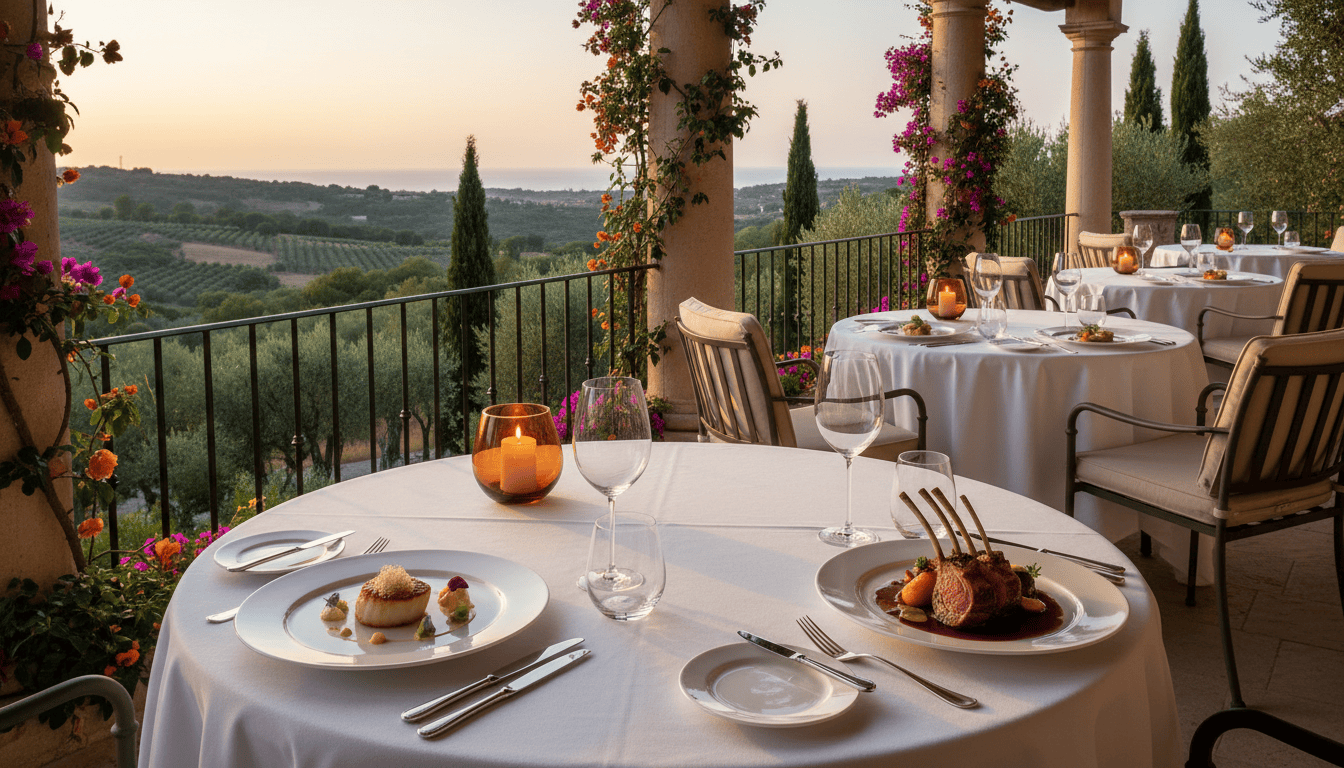
Best Restaurants in Audrix: Fine Dining, Local Gems & Where to Eat
There is a particular moment in Audrix – and if you time it right, you will know exactly the one – when the light drops behind the limestone ridges of the Dordogne valley and the air fills with the smell of woodsmoke, walnut oil and something unidentifiable but deeply, ancestrally good. You are sitting outside. A carafe of Bergerac rouge has appeared without ceremony. Nobody is rushing you. The France of your imagination, the one that has been disappointing you in capital cities for years, turns out to have been here all along, in a village so small you almost drove through it without stopping. The food in Audrix and its immediate surroundings is the kind that earns its reputation not through press releases but through decades of people quietly returning, year after year, and ordering exactly the same thing.
This guide covers the best restaurants in Audrix – from fine dining in the wider Périgord Noir region to the local gems that reward the curious traveller willing to follow a handwritten sign down a farm track. We will tell you what to order, what to drink, and how to make sure you are not the person eating alone at seven because they failed to book.
The Fine Dining Scene Around Audrix
Audrix itself is a village rather than a gastronomic metropolis – let us be honest about that from the start. What it offers, though, is proximity to some of the most seriously accomplished cooking in southwest France, all within a twenty to thirty minute drive through countryside that makes the journey part of the pleasure. The Périgord Noir has long been regarded as one of France’s great larder regions: black truffle from Sarlat, duck confit and foie gras from family farms that have been doing this for generations, walnut oil pressed locally, and Cabécou goat’s cheese so fresh it barely holds its shape.
For formal fine dining, the towns of Les Eyzies, Sarlat-la-Canéda, and Beynac are your primary destinations. The restaurant scene here operates at a level of technical seriousness that would not embarrass Paris – the difference being that your table looks out over the Vézère valley rather than a Haussmann boulevard, and the sommelier will not make you feel inadequate for not knowing the exact elevation of the vineyard. Menus in the upper bracket lean heavily on the holy trinity of Périgord cuisine: foie gras, truffle, and confit, prepared with a lightness of touch that belies their richness. Tasting menus are available at the better establishments and represent, frankly, excellent value when compared to equivalently rated restaurants in Paris or Lyon.
Michelin recognition does exist in the wider département – Dordogne has several starred establishments – and while none sit in Audrix village itself, the regional reputation is earned and maintained year on year. If you are planning a special occasion dinner, book well ahead, particularly in July and August when competition for tables is fierce and the locals are quietly irritated by how crowded everywhere has become.
Local Bistros, Auberges and the Art of the Set Menu
The real soul of eating in Audrix country is found not in tasting menus but in the set lunch. This is not a consolation prize. A three-course formule in a good Périgord auberge, served without fuss in a stone-walled room with checked tablecloths, can be one of the most satisfying meals of your year. You will begin with a terrine of duck rillettes and cornichons. You will have a magret de canard, cooked properly, which is to say pink and rested, with a sauce that suggests someone thought about it for considerably longer than it takes to pour. You will finish with walnut cake or a slice of tarte aux noix with crème fraîche so thick a spoon stands up in it.
The auberge tradition runs deep in villages like Audrix, Le Bugue, Campagne, and the surrounding hamlets. Many of these establishments have been in the same family for two or three generations, and the menus change with the season in a way that feels genuinely connected to what is happening in the fields rather than to what a food trend consultant has suggested. Look for chalkboards, handwritten daily specials, and the reassuring presence of tables occupied by people who clearly eat here every week. Those people are your quality guide. Follow them. Sit near them if possible. Order what they order.
Lunch service typically runs from noon to two, and this is not a suggestion – it is a deadline in the rural French imagination. Arriving at 1:45 pm is technically permissible. Arriving at 2:15 pm will earn you a look that has been refined over several centuries.
Hidden Gems and Farm Producers Worth Seeking Out
Some of the best eating in the Audrix area does not happen in restaurants at all. The Dordogne is thick with farm shops, cave-aged cheese producers, walnut oil mills offering tastings, and small artisan operations where you can buy duck confit still warm from the pot. These are not tourist attractions dressed up as authenticity – they are the actual supply chain for the region’s restaurants, and visiting them directly is both a pleasure and a revelation.
The walnut harvest in autumn transforms the landscape and the local economy in equal measure. Walnut oil pressing operations – huileries – often welcome visitors, and tasting fresh-pressed oil on bread is one of those experiences that recalibrates your understanding of what a nut is capable of. Similarly, small truffle markets operate in Sarlat and surrounding villages from November through February, and while the prices will not surprise you pleasantly, the atmosphere – serious men with serious bags conducting serious transactions – is worth seeing at least once.
Farm stays and ferme-auberges – working farms that serve meals to the public – are scattered throughout the Périgord Noir and offer an experience somewhere between a restaurant and a dinner party hosted by people who grow their own everything. Tables must be reserved in advance, portions are generational in scale, and you will leave with a clearer understanding of why Périgord cuisine became famous in the first place. It is not complicated. It is just extraordinarily good ingredients, treated with respect.
What to Order: A Brief Primer in Périgord Eating
If you arrive in Audrix without a working knowledge of the local menu vocabulary, consider this a gentle orientation. Foie gras appears on nearly every serious menu in two forms: mi-cuit, which is slow-cooked and served chilled as a terrine, or pan-seared and served hot, ideally on a slice of toasted brioche with something sharp and fruity alongside to cut the richness. Both are correct. Both are excellent. Ordering one and then the other across two separate meals is perfectly rational behaviour and should not require justification.
Confit de canard – duck leg slow-cooked in its own fat until the meat falls from the bone – is the region’s most iconic dish and, in a good kitchen, also one of its most satisfying. Served with sarladaise potatoes, cooked in duck fat with garlic and parsley in a technique perfected in Sarlat, it is the sort of dish that makes you briefly reconsider the concept of eating anything else, ever again.
Truffle appears most visibly in winter menus: shaved over scrambled eggs, stirred through pasta, tucked under poultry skin. In season, it is worth ordering whatever the chef has done with it that day. Out of season, approach truffle-flavoured oil with appropriate scepticism – it is a reasonable flavouring but it is not the real thing, and no amount of menu prose will make it so.
For those with interest beyond the duck and truffle axis, the Dordogne produces excellent freshwater fish – trout in particular – and there is a growing movement among younger chefs in the region toward lighter, vegetable-forward cooking that uses the same exceptional local produce in less traditional ways. Both approaches have merit. Neither cancels the other out.
Wine, Bergerac and What to Drink
The wine of the Périgord is Bergerac – and if you arrived assuming this meant a stepping stone toward Bordeaux, the vignerons of the appellation would like a word. Bergerac rouge, made primarily from Merlot and Cabernet Franc, is fruit-forward, accessible, and genuinely good with the rich food of the region. It is also, by the standards of comparable quality in France, extremely well priced. Ordering a bottle rather than glasses is both economical and socially correct.
Monbazillac, the sweet white wine produced from botrytised grapes just south of Bergerac, is the traditional partner to foie gras and one of those pairings that makes immediate instinctive sense the moment you try it. The sweetness cuts against the richness rather than amplifying it, and the wine itself – golden, honeyed, complex – is worth understanding as a destination in its own right rather than merely an accompaniment. The Château de Monbazillac offers visits and tastings if you find yourself wanting to go deeper, which you probably will.
For something non-alcoholic, the local walnut liqueur – noix de Périgord – is worth trying as a digestif, though strictly speaking it is very much alcoholic, just in a gentle and deceptively smooth way. Consider yourself warned.
Food Markets in and Around Audrix
Markets in this part of France are not curated lifestyle events. They are the actual weekly mechanism by which people acquire food, and they operate accordingly – with efficiency, with regularity, and with a level of ambient noise that suggests everyone has strong opinions about cheese. Le Bugue, the nearest market town to Audrix, holds its market on Tuesday mornings and on Sundays, and it is the kind of experience that reminds you what a market is actually for.
The Saturday market in Sarlat is larger, more famous, and correspondingly busier – but the produce quality is exceptional and the atmosphere, particularly in the old stone streets of the medieval centre, is difficult to replicate anywhere else in France. Arrive early. By ten o’clock, the best of the foie gras and cheese stalls have already sold out, and the car parking situation has become everyone’s problem.
Seasonal truffle markets, operating primarily from November to February in villages including Sainte-Alvère – which hosts one of the oldest established truffle markets in the region – are a different kind of experience entirely: quieter, more deliberate, and conducted in a register somewhere between auction house and village fête. Even if you are not buying, they are worth attending purely for the atmosphere and the education. Fresh black truffle smells nothing like the truffle oil you have encountered elsewhere, and understanding this distinction is genuinely useful.
Practical Tips: Reservations, Hours and Local Etiquette
The single most useful piece of advice for eating well around Audrix is this: book ahead, and then book ahead again for the places that matter most. Rural France retains a charming indifference to the concept of walk-in dining at popular establishments, particularly during the high season months of July and August when the entire population of northern Europe appears to have converged on the Dordogne valley simultaneously.
Many of the best smaller restaurants – the ferme-auberges, the family-run auberges in the villages – operate with fixed sittings rather than continuous service. Dinner is typically from seven-thirty onwards, though in high summer some places push this to eight. Lunch, as noted, closes at two, and this is not negotiable in any meaningful sense of the word.
Credit cards are accepted almost universally now, but carrying some cash remains sensible for markets, farm shops, and the occasional establishment that has not updated its payment infrastructure since the early 2000s. Tipping is not mandatory in France – a service charge is included in the bill – but leaving a few euros for particularly good service is appreciated and quite correct. Attempting to order in French, even imperfectly, is received warmly and will occasionally result in a better table.
For a complete picture of everything the region offers beyond its restaurants – the archaeology, the rivers, the villages, the extraordinary depth of the countryside – the Audrix Travel Guide covers the destination in full and is the natural companion to this eating guide.
Dining from a Luxury Villa: The Private Chef Advantage
There is a particular pleasure in eating extraordinarily well without leaving your own terrace, and it is one of the less obvious arguments in favour of a luxury villa in Audrix. Many properties available through Excellence Luxury Villas come with the option of a private chef – someone who knows the local producers, knows what is in season that week, and is equally comfortable producing a long, relaxed dinner with foie gras and confit as they are with a lighter lunch on the days you want to spend less time at the table and more time at the river. Buying directly at the Le Bugue market on a Tuesday morning and having the same ingredients appear on your dinner table that evening is one of those simple sequences that makes a holiday feel genuinely effortless. The restaurants will be there on the other nights. This is for the ones when you cannot quite face leaving the view.


