Portimão Travel Guide: Where to Stay, Eat & Explore in Luxury
Here is a mild confession to open with: Portimão is not, strictly speaking, a beautiful town. The centre has the slightly unfinished air of a place that grew faster than its planning department could keep up with, and the industrial sardine-canning heritage – though now smartly repurposed – does not exactly whisper “Riviera.” And yet somehow, inexplicably, you end up loving it. The Algarve’s second-largest city has a quality that bypasses the usual checklist entirely. It earns your affection through beaches that genuinely beggar belief, a restaurant scene that punches well above its weight, a river frontage that glows amber at dusk, and a general atmosphere of unhurried competence that Europe‘s more manicured resorts somehow never quite achieve. You arrive a little puzzled. You leave planning your return.
The question of who Portimão suits is almost easier to answer by exclusion – it suits almost everyone who isn’t looking for a city break or a ski slope. Families seeking genuine privacy away from crowded hotel pools find it ideal: the surrounding countryside and clifftop developments are exactly the kind of territory where a luxury villa with its own pool, its own kitchen and its own timetable makes complete sense. Couples marking milestone anniversaries gravitate here for the combination of world-class beaches, exceptional seafood and Atlantic sunsets that arrive on schedule every evening like the best kind of habit. Groups of old friends – the kind who have graduated from package holidays to private villas where nobody has to agree on a restaurant before 9pm – find everything they need within easy reach. Remote workers increasingly arrive with laptops and ambitious productivity goals, most of which dissolve gently by day three. And for the wellness-focused traveller, the Algarve’s outdoor life – coastal hiking, open-water swimming, early-morning yoga with a sea view – provides a more restorative backdrop than any spa brochure ever quite manages to capture.
Getting Here Without the Faff: Airports, Transfers and Getting Around
Faro Airport is the gateway to the Algarve and sits roughly 65 kilometres east of Portimão – about 45 minutes to an hour by car under normal conditions, which the Portuguese highway system generally accommodates without drama. Faro receives direct flights year-round from major United Kingdom airports including Heathrow, Gatwick, Stansted, Manchester and Edinburgh, as well as connections from across northern Europe. Flight time from London is approximately two and a quarter hours, which means you can realistically be in a villa pool by early afternoon if you catch a morning departure. Private transfers from Faro are the obvious choice for villa guests – they eliminate any anxiety about hire cars, deliver you directly to your property, and allow you to begin the holiday the moment you step off the aircraft.
That said, a hire car is genuinely worth considering if your itinerary involves any exploration beyond central Portimão. The EN125 coastal road and the A22 motorway connect the Algarve’s towns and beaches efficiently, and much of what makes the region extraordinary – the hidden coves, the cork-oak hills of the interior, the pottery villages – is difficult to access without one. Portimão itself is walkable in the centre, with the riverfront, the old market and the main shopping district all within comfortable distance of each other on foot. For day trips further afield, Lisbon is around two and a half hours north on the A2 – entirely manageable as a day excursion if someone else is doing the driving, considerably less so if you’re navigating Lisbon traffic yourself for the first time. Taxis and rideshares operate reliably in Portimão. The train – the Algarve line – connects the major towns but operates on timescales that suggest a different relationship with urgency than most visitors are used to.
Eating Well in Portimão: From River Tables to Raucous Tascos
Fine Dining
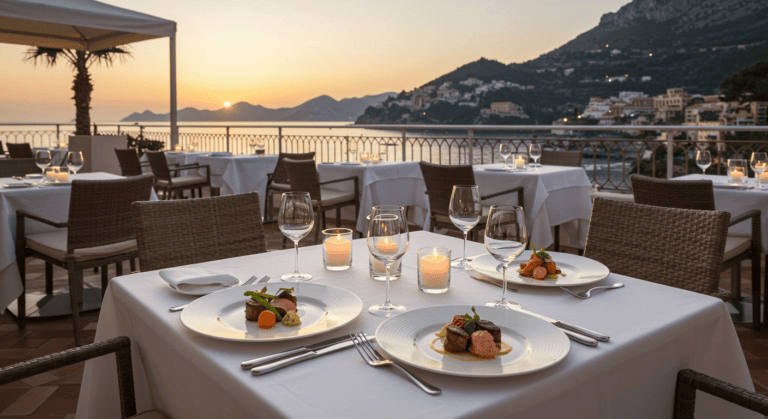
Portimão is not Lisbon. It does not have a cluster of Michelin-starred restaurants competing for column inches. What it has instead is something arguably more satisfying: a dining scene built around exceptional raw ingredients treated with confidence rather than theatre. The tuna here – often caught the same morning – is of a quality that makes you reconsider everything you thought you knew about the fish. The grilled sea bass and gilt-head bream emerge from simple preparations that reveal what the fish actually tastes like rather than what the chef thinks it should taste like. Several restaurants along the Arade riverfront have developed reputations for exactly this kind of elevated simplicity: white tablecloths, serious wine lists featuring underappreciated Alentejo and Douro bottles, and a kitchen philosophy that resists novelty in favour of precision. For the full experience, book a table with a river view for around 8pm when the light is doing something memorable to the water and the local couples are arriving in their Friday-best, unhurried and unhassled. This is the Algarve at its most quietly sophisticated.
Where the Locals Eat
The Mercado Municipal de Portimão – the town’s main covered market – is where you go to understand what people actually eat here as opposed to what they serve tourists. Stalls of gleaming fish, local cheeses, smoked sausages, seasonal produce and the inevitable wall of tinned sardines (buy several – the Portuguese have elevated the tinned sardine to something approaching an art form, and the good ones make extraordinary presents). Around the market and the old town squares, the tascos – small, family-run restaurants that have typically been operating under the same name since before anyone thought to review them on the internet – serve plates of cataplana (the copper-pot seafood stew that the Algarve invented and the world has been imperfectly copying ever since), grilled sardines and bifanas at prices that make you slightly concerned about their business model. The town’s beach clubs and riverside bars handle the more casual end of the spectrum: cold Sagres beer, petiscos – Portugal’s answer to tapas – and a sunset view that costs nothing.
Hidden Gems Worth Seeking Out
The genuinely local dining experience in the Algarve’s inland villages is something that most coastal visitors miss entirely, which is their loss and your opportunity. The small agricultural towns north of Portimão – in the Serra de Monchique foothills and the rolling countryside between the coast and the Spanish border – contain restaurants that exist for locals, serve lunches of remarkable quality at prices from another era, and require absolutely no reservation because nobody outside the village knows about them. Ask your villa’s concierge or property manager. They will know. The other hidden gem worth seeking out is the aguardente de medronho – a fiery, almost herbal spirit distilled from wild strawberry tree berries – available in the right bars and shops, and the sort of thing you will either love immediately or pretend to love while quietly resolving never to order again.
Beyond the Beaches: The Algarve’s Landscapes Are More Varied Than They Get Credit For
The Algarve is not simply a coastline. That is the received wisdom – the thing everyone knows – and it happens to be almost entirely wrong. The western Algarve around Portimão contains several distinct landscapes that reward exploration in entirely different ways. The coast itself divides between two dramatically different personalities: the central and eastern Algarve, where the beaches are wide, the sand is fine and the waters are relatively calm; and the southwest, around the Vicentine Coast Natural Park near Sagres, where the Atlantic arrives without apology, the cliffs are monumental, and the light has a clarity that photographers cross continents to find.
Behind the coast, the Barrocal – a limestone belt of almond groves, carob trees, fig orchards and ancient farmhouses – forms a middle landscape between the shore and the mountains that most villa guests drive through on the way to somewhere else without quite registering what they’re passing. Then above it, the Serra de Monchique – the mountain range that forms the Algarve’s northern boundary – rises to just over 900 metres through eucalyptus and oak woodland, delivering panoramic views southward over the entire coast and a climate noticeably cooler and damper than the shore below. The spa town of Monchique itself has been drawing visitors to its thermal springs since Roman times. The Romans were, on the evidence of their site selection throughout the peninsula, generally excellent at identifying agreeable places to recover from things.
Praia da Rocha, immediately south of Portimão, is the anchor beach – long, broad, gold and dramatically backed by those distinctive Algarve cliffs in amber and ochre sandstone. Alvor, a few kilometres west, preserves a whitewashed fishing village alongside one of the Algarve’s most important wetland estuaries. The boardwalk through the Alvor estuary at low tide, with the dunes and ocean beyond and wading birds working the mudflats, is one of the genuinely underrated natural experiences in southern Portugal.
Things to Do in Portimão That Actually Justify Getting Off the Villa Terrace
The honest answer is that the villa terrace requires significant justification to abandon, particularly when it has a private pool and a view of the Atlantic. However. The Museu de Portimão – housed in a former sardine cannery on the riverfront – is one of the most thoughtfully curated regional museums in Portugal, and that is not damning with faint praise. It tells the story of the Algarve through archaeology, industrial history and the ocean’s role in shaping everything from the economy to the cuisine, with original canning machinery intact in ways that manage to be atmospheric rather than merely industrial. It is worth two hours of anyone’s afternoon.
River cruises up the Arade from Portimão’s marina are a reliable pleasure: the estuary opens onto a series of limestone caves, grottos and sea stacks accessible only by boat, the quality of light on water at certain hours is genuinely affecting, and the whole experience requires absolutely no exertion whatsoever. For those who prefer their leisure more active, dolphin-watching boat trips operate from the marina with reasonable year-round success – the bottlenose dolphins that inhabit the Atlantic approaches to the Algarve are present in numbers that make sightings more rule than exception. The Portimão International Autodrome hosts events throughout the year and operates driving experiences for those whose idea of a Portuguese holiday involves considerably more horsepower than a cataplana. Day trips to Cape St. Vincent – the southwestern tip of the European mainland, where the wind is always doing something emphatic and the lighthouse stands against a sky that seems bigger here than anywhere else – are among the most memorable excursions available from Portimão.
Into the Atlantic: Adventure Sports and Active Pursuits
The stretch of Atlantic coastline around Portimão is one of Europe‘s most productive zones for water-based adventure, and the infrastructure that serves it has matured considerably over the past decade. Surfing is the obvious headline act: the southwest Algarve, particularly around Arrifana and the beaches approaching Sagres, receives consistent Atlantic swell that works across a wide range of ability levels. Several well-regarded surf schools operate day lessons and multi-day programmes accessible from Portimão, and the intermediate surfer will find excellent conditions without the crowds that have somewhat overwhelmed the breaks further north. Stand-up paddleboarding on the calmer waters of the Alvor estuary or the Arade river offers a gentler but genuinely rewarding perspective on the landscape.
Diving around the Algarve’s underwater rock formations delivers visibility that frequently exceeds fifteen metres, with marine life including moray eels, octopus, sea bream and – during the right season – pelagic visitors. The Portimão dive operators cater for everything from complete beginners through PADI instructor certification. Sea kayaking from the beaches east of the river allows access to sea caves and cliff arches unreachable on foot, and the experience of paddling through a natural stone arch into a sunlit grotto is the sort of thing you find yourself describing to people long after you had intended to stop. Coastal hiking trails connect the beaches and clifftops of the western Algarve with routes that range from gentle waterfront walks to more demanding circuits through the Vicentine Coast Natural Park. Cyclists are increasingly well served by a growing network of signed routes, including off-road trails through the Monchique hills that deliver views equal to their considerable climbs.
Portimão With Children: The Unexpectedly Good Argument for Not Going Anywhere Else
There is a certain category of family holiday where everyone gets something – genuinely, not in the compromised way where the adults spend a week at a waterpark and the children spend a week sunburned outside a restaurant. Portimão sits squarely in this category. The beaches are safe, the sea temperature cooperative from May through October, and the gradient from shore to deep water gentle enough for even cautious younger swimmers. Praia da Rocha in particular – wide, sheltered by cliff headlands at each end, and with the town directly behind – has a forgiving quality that anxious parents tend to appreciate.
The Zoomarine theme park east of Portimão provides the kind of day that children discuss in exhaustive detail for the entire journey home. The Arade River is excellent for kayaking with older children – calm water, no currents to worry about, and interesting enough scenery to maintain the interest of anyone above the age of about eight. Dolphin-watching trips work at almost any age. The practical case for a private villa rather than a hotel becomes particularly clear with families: everyone sleeps when they want to, meals happen on a schedule that suits small people rather than restaurant kitchens, the private pool removes the daily sunbed negotiation entirely, and the sheer space of a properly sized villa means that the question of what the children are doing is answered before it needs to be asked.
Six Thousand Years of History, More or Less: Portimão’s Cultural Depth
Portimão does not announce its history loudly. The town centre does not have the Moorish medina quarter of Faro or the Roman theatre of Évora. What it has instead is a layered historical identity that reveals itself gradually and rewards curiosity. The mouth of the Arade river has been a strategically significant anchorage since Phoenician traders first identified it around 700 BC – it offered the deep-water shelter and protected estuary that Bronze Age commerce required. The Romans named the settlement Portus Magnus, which is more or less exactly what it says on the tin, and used the river route to access the mineral-rich interior. The Moorish presence from the eighth century left its mark in the region’s agricultural vocabulary, its water management systems, and the geometric tile traditions that persist in Portuguese decorative arts to this day.
The Reconquista brought Christian kingdoms southward through the peninsula, and the Algarve’s definitive incorporation into Portugal came in 1249 – making it the last part of the mainland acquired, a fact the Alentejans like to mention. The Age of Discovery transformed Portimão from a regional fishing port into a node on one of history’s most consequential maritime networks: ships provisioned here, crews were recruited here, and the income from the fishing industry bankrolled ventures that eventually reached Brazil, India and beyond. The sardine canning industry – which arrived in the nineteenth century and dominated the twentieth – is celebrated rather than hidden in the Museu de Portimão, which is frankly the correct attitude. The Algarve’s festivals reflect both the Catholic calendar and older seasonal traditions: the Festa do Sardinha in August draws visitors from across Portugal for a celebration of the grilled sardine that manages to be simultaneously earnest and tremendous fun.
What to Buy in Portimão and the Algarve: Things Worth Carrying Home
The question of what to bring back from the Algarve has a relatively clear answer, which is: things you can eat or drink. The artisanal producers of the region have raised their game considerably over the past decade, and the products available in the better delis, markets and specialist shops represent genuine quality rather than airport-lounge approximations of Portuguese culture. Tinned fish – specifically the premium producers who use traditional methods and good olive oil – travel well, taste extraordinary and make presents that people actually want. The region’s olive oils and carob-based products are increasingly well regarded outside Portugal. The medronho spirit mentioned above is worth a bottle for the right recipient.
For non-edible souvenirs, the hand-painted azulejo tiles available from specialist studios and certain market stalls are the obvious choice – distinctive, genuinely craft-produced and considerably more interesting than the mass-produced versions that crowd the tourist shops near the beach. The Portimão market and the Alvor market (held twice weekly) are good sources for local ceramics, embroidered linens and the leather goods that Portuguese craftspeople have been producing to excellent standard for centuries. The town centre’s main commercial street mixes international high street brands with local independents – useful for anything forgotten at home, not particularly distinctive otherwise. For those interested in gastronomy specifically, the specialty food shops around the riverfront area stock the kind of regional products that rarely make it to supermarket shelves outside Portugal.
Practical Portimão: What You Need to Know Before You Arrive
Portugal uses the euro. English is spoken to a genuinely impressive standard throughout the Algarve’s tourism infrastructure – higher than in comparable coastal resorts in Spain, probably a consequence of decades of British tourism and, more recently, the significant English-speaking expat community in the region. That said, even the most rudimentary attempt at Portuguese will be received warmly – “obrigado/obrigada” (thank you, masculine/feminine) and “por favor” (please) cover most situations and are universally appreciated.
Tipping is expected but not compulsive: a round figure or five to ten percent in restaurants is standard, and small change for bar service appreciated. The best time to visit Portimão depends almost entirely on what you want from it. July and August deliver the full Algarve summer experience – guaranteed sun, temperatures between 28 and 32 degrees, seas in the mid-twenties, and crowds at the popular beaches that require a degree of tolerance. May, June and September are the months that those who know the region tend to prefer: temperatures warm and absolutely reliable, sea swimmable from June onwards, accommodation more available and less expensive, and the general atmosphere noticeably calmer. October remains mild – typically 22-24 degrees – and works well for walkers, golfers and those whose primary interest is the landscape rather than the beach. Winter is quiet but rarely cold – daytime temperatures hover between 15 and 18 degrees, and the clarity of light on those winter days has an entirely different quality to it, not worse, just different. The restaurants are full of local people rather than tourists, which has its own considerable charm.
Safety in Portimão and the Algarve generally is not a significant concern – Portugal consistently ranks among the safest countries in Europe. Normal precautions apply in crowded beach areas – unsupervised valuables on a beach anywhere in the world are an optimistic choice. The sea deserves respect: rip currents and strong beach breaks exist on the Atlantic coast, particularly on the exposed western beaches, and the flag system at lifeguarded beaches (green, yellow, red) is not decorative.
Why a Private Luxury Villa in Portimão Changes the Whole Equation
There is a particular quality to a luxury villa holiday in the Algarve that hotels – even very good ones – cannot replicate, and it comes down to the specific geometry of the experience. A private villa gives you a relationship with a place rather than a relationship with a resort. You wake up to your own pool, your own terrace, your own kitchen filled on arrival with whatever you asked to be there. Nobody is setting up sunbeds outside your room at 7am. Nobody is piping music into a lobby. The staff ratio at a staffed villa – the kind that includes a private chef, housekeeper or concierge – is simply incomparable to anything a hotel can offer without moving into the stratospheric end of the market, and the service is personalised in ways that institutionalised hospitality structurally cannot be.
For families, the villa dynamic is transformative. A three or four-bedroom villa with its own pool, gardens and outdoor dining space allows multiple generations to occupy the same holiday without the spatial negotiations that hotel rooms impose. Grandparents can retire when they need to. Children can have dinner at a sensible hour. The adults can eat late around a terrace table without any of these schedules affecting each other. For groups of friends who have arrived at the stage of life where a shared hotel corridor is no longer the preferred architecture for a holiday, the same logic applies with equal force – a large villa becomes a base, a meeting point, and a place with enough independent space that being together remains a choice rather than an inevitability.
The remote working case for the Algarve is increasingly well established. Fibre internet connectivity has expanded significantly across the region, and many luxury villas now offer Starlink or equivalent connectivity as standard, meaning the reliable high-speed connection that professional remote work requires is increasingly available even in more rural locations. The practical reality – a villa terrace with Atlantic views, a pool for the midday break, and a kitchen that does not require you to leave the property to eat well – makes for a working environment that is difficult to improve upon. For wellness-focused guests, the combination of private pool, access to outdoor activities, the Monchique thermal spa tradition, and the general pace of Algarve life – which moves at exactly the speed the human nervous system seems to prefer – creates conditions for genuine restoration rather than the performative version available at dedicated wellness resorts.
The villas available around Portimão range from cliff-edge properties with panoramic ocean terraces to countryside estates set back in the Barrocal’s almond and orange groves, from sleek contemporary architecture with infinity pools to restored farmhouses with the kind of quiet that reminds you silence is something you had forgotten to miss. If you are planning a luxury holiday in Portimão and want a base that does justice to everything the region offers, browse our full collection of luxury holiday villas in Portimão.
More Portimão Travel Guides
What is the best time to visit Portimão?
May, June and September are widely considered the sweet spot – warm, reliable sunshine, a swimmable sea from June onwards, and noticeably fewer crowds than the peak summer months. July and August deliver the full Algarve experience with guaranteed heat (28-32°C) but require patience at popular beaches. October remains mild at around 22-24°C and works excellently for walking, golf and countryside exploration. Winter is quiet and mild by northern European standards – typically 15-18°C – with exceptional clarity of light and a more authentic local atmosphere in the restaurants and markets.
How do I get to Portimão?
Faro Airport is the primary gateway, approximately 65 kilometres east of Portimão – around 45-60 minutes by road. It receives direct flights year-round from major UK airports including Heathrow, Gatwick, Stansted, Manchester and Edinburgh, as well as connections from across northern Europe and beyond. Flight time from London is approximately two hours and fifteen minutes. Private transfers from Faro to your villa are the most straightforward option. A hire car is worth considering if you plan to explore the wider region – the Algarve’s roads are well maintained and the coastal and inland routes accessible without difficulty.
Is Portimão good for families?
Exceptionally so. The beaches around Portimão – particularly Praia da Rocha – offer gentle gradients, relatively calm inshore waters and lifeguard coverage through the summer season. The variety of activities suitable for children of different ages is broad: dolphin-watching boat trips, river kayaking on the Arade, the Zoomarine theme park, and beach days that work for almost any age. The private villa format suits family holidays particularly well – children can swim in a private pool on their own schedule, meals happen at times that suit small people, and the space of a proper villa removes the friction that hotel rooms impose on family groups.
Why rent a luxury villa in Portimão?
The core advantage is space, privacy and a staff-to-guest ratio that hotels cannot match without moving into genuinely rarefied territory. A staffed villa with private chef, housekeeper and concierge delivers a level of personalised service – tailored to your schedule, your preferences and your group specifically – that institutionalised hotel hospitality is structurally unable to replicate. Beyond service, a private pool, your own terrace, your own kitchen and the absence of any shared infrastructure means the holiday operates on your terms from the moment you arrive. For families and groups particularly, the difference between a villa and a hotel is not one of degree but of kind.
Are there private villas in Portimão suitable for large groups or multi-generational families?
Yes – the villa inventory around Portimão and the wider western Algarve includes properties ranging from three-bedroom coastal retreats to large estate houses sleeping twelve or more across multiple wings. Well-designed larger villas typically include separate sleeping wings that allow different family groups – adults and children, or parents and grandparents – to share a holiday without sharing every moment of it. Private pools, expansive outdoor dining areas, games rooms and staff quarters are standard features at the top end of the market. Concierge and staffing arrangements can be scaled to the size of the group.
Can I find a luxury villa in Portimão with good internet for remote working?
Increasingly, yes. Fibre connectivity has expanded significantly across the Algarve region in recent years, and a growing number of luxury villas now offer Starlink satellite broadband as standard – delivering reliable high-speed connectivity even in more rural or clifftop locations where infrastructure has historically been patchy. When booking, it is worth confirming connectivity specifications directly – the better villa companies will have verified this information. Many properties also now offer dedicated workspace or home-office setups alongside the pool-and-terrace environment that makes the remote working proposition so attractive in the first place.
What makes Portimão a good destination for a wellness retreat?
Several things working in combination. The outdoor life available around Portimão – coastal hiking, open-water swimming, surfing, kayaking, stand-up paddleboarding – provides the kind of physical activity that actually restores rather than depletes. The thermal spa tradition at Monchique in the hills above the coast has been drawing people seeking recuperation since Roman times, and the facilities there remain excellent. At villa level, private pools, outdoor yoga terraces, gym equipment and the simple fact of a property that does not require you to be anywhere, do anything, or see anyone creates conditions for genuine rest. The pace of Algarve life – unhurried, outdoor-oriented, centred on good food and long evenings – does the remaining work quietly and without announcement.