
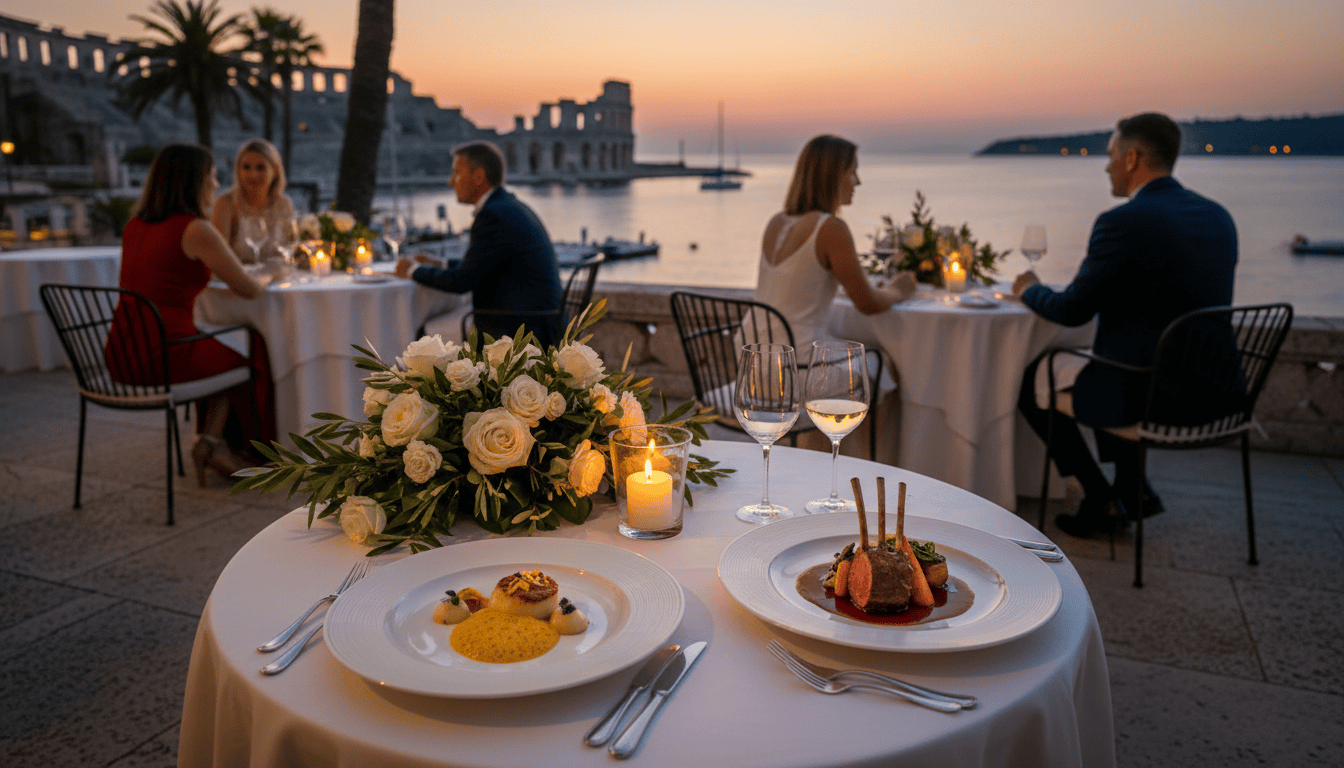
Best Restaurants in Pula: Fine Dining, Local Gems & Where to Eat
Pula has a Roman amphitheatre that has been standing for two thousand years and still hosts concerts. That alone should tell you something about the city’s relationship with quality. The locals have always known how to do things properly – and that extends, with quiet conviction, to the table. While the rest of the world was busy discovering Istria’s truffles, wines and olive oils, Pula was simply getting on with cooking extraordinary food and wondering what took everyone so long. For the discerning traveller who comes here not just to look at things but to eat and drink well, this small Croatian city on the southern tip of the Istrian peninsula punches so far above its weight it practically levitates.
The Fine Dining Scene: Pula’s Ambition on a Plate
Istria has been described – accurately – as Croatia’s culinary crown, and Pula sits at its tip like the jewel in it. The fine dining scene here is not Michelin-starred in the traditional sense – Croatia’s Michelin coverage has been expanding, though Pula’s finest restaurants operate at a level that would make any guide inspector sit up and pay attention. What you find instead of stars is something arguably more interesting: chefs with serious technique who are deeply, almost obsessively, connected to local produce. They are not trying to replicate what’s happening in Copenhagen or San Sebastián. They are doing something rooted and specific and, in its own quiet way, rather thrilling.
Expect menus built around the season with the kind of rigour that makes the phrase “farm to table” feel inadequate. Istrian truffles – both black and the frankly extraordinary white – appear from autumn into winter with an intensity that will make you reconsider every truffle dish you’ve eaten elsewhere. Locally caught fish, Adrian sea bass and bream, arrive at the table with minimal fuss and maximum precision. Pula’s better restaurants understand that restraint is its own form of sophistication. Tasting menus at the upper end of the market sit at price points that would make a London or Paris equivalent blush with embarrassment – in the very best sense.
When booking fine dining in Pula, always ask about the chef’s current truffle menu if visiting between October and February. Proper white Istrian truffle, shaved over hand-rolled pasta or egg yolk risotto, is one of those experiences that recalibrates what you think food can be. Reserve at least a week in advance during summer, when the city fills and tables at the serious restaurants disappear quickly.
Local Trattorias and Konobas: Where Pula Actually Eats
The word to know is konoba. The Croatian equivalent of a trattoria, a konoba is where the city’s real character reveals itself – stone walls, shared tables, a chalkboard menu that changes when the market dictates it should, and a proprietor who will not apologise for the fact that they’ve run out of sea bass because they sold the last one at lunch. These are not consolation prizes for travellers who couldn’t get into somewhere fancier. In many cases, they are the point.
Pula’s older quarter, draped across a hill behind the Forum, hides some of the best konobas in Istria. Look for narrow doorways, hand-lettered signs and, ideally, a complete absence of laminated menus with photographs. Inside, you’ll find house-made pasta – fuži, pljukanci, žlikrofi – tossed with truffle or wild boar or a slow-cooked meat ragù that tastes like someone’s grandmother has been thinking about it since Tuesday. Which she probably has.
Grilled fish, simply prepared with olive oil, garlic and a little local herb, remains one of the great pleasures of eating on the Istrian coast. Order it with a side of blitva – Swiss chard with potatoes and olive oil – and a carafe of whatever white the house is pouring, and you will understand why people come back to this part of the world year after year with the slightly glazed look of the genuinely contented.
Don’t overlook the smaller inland villages immediately surrounding Pula, reachable in twenty minutes by car. Several excellent family-run konobas operate on the outskirts where the tourist traffic thins and the cooking, freed from the pressure of feeding three sittings of sun-baked visitors, becomes something more considered and personal.
Beach Clubs and Casual Dining by the Water
The coastline around Pula is a sequence of coves, pine-fringed shores and clear Adriatic water that would be insufferably beautiful if it weren’t quite so enjoyable to sit next to with a cold glass of something. Beach clubs here operate at a different register from the more theatrical versions along the Dalmatian coast – they tend to be more relaxed, more genuinely local in atmosphere, and considerably less interested in being photographed for anyone’s social media.
The Verudela peninsula, a short drive from the city centre, offers a concentration of waterside restaurants and more casual dining spots where grilled fish, seafood platters and cold local beer or wine are consumed at a pace the rest of Europe could learn from. These are places for long lunches that slide sideways into the afternoon without anyone particularly minding. Grilled scampi, fresh from the morning’s catch, with a glass of chilled Malvazija Istarska – the indigenous white grape that is essentially Istria in a bottle – is the benchmark order and rarely disappoints.
Cape Kamenjak, the protected nature park at the southernmost tip of the Istrian peninsula, offers some of the most wildly situated casual dining imaginable: drinks and light food served at rocky waterside spots that feel entirely improvisational and are, on the right afternoon, close to perfection. Dress code is officially “has been swimming recently.”
Hidden Gems: The Restaurants Worth Seeking Out
Every city has places that are known to locals and mostly invisible to visitors. Pula is no exception. The best of these hidden gems tend to be in the residential streets west of the amphitheatre, away from the main tourist circuit, where you’ll find small owner-operated restaurants that change their menus daily, accept card payments reluctantly and, occasionally, offer a complimentary glass of house grappa at the end of a meal as if it were entirely your idea.
Seek out any restaurant with a serious commitment to Istrian olive oil – the region produces oil of genuinely world-class quality, and chefs who use it well tend to be chefs who are thinking carefully about everything else on the plate too. Similarly, look for menus that celebrate Istrian prosciutto – pršut – served in thin slices with sheep’s cheese and a small glass of Teran, the bold red that is Istria’s best-kept vinous secret. It is darker and more tannic than you might expect from a warm-climate wine, which is exactly why it works so well with cured meat and strong cheese.
Ask your villa manager or concierge for current recommendations – the best hidden restaurants in Pula operate without much online presence and are found through the kind of local knowledge that doesn’t live in any algorithm.
Pula’s Food Markets: Eating Like a Local From the Very Beginning
The Pula Central Market – housed in a handsome early twentieth century structure just back from the waterfront – is essential visiting whether or not you intend to cook. It is, in the best sense, a place where Pula does its actual shopping. Morning is the time to come: fishmongers with the previous night’s catch laid out on ice, vegetable sellers with seasonal produce that changes week by week through the summer, cheese vendors with local sheep’s milk varieties and, in season, truffle sellers whose wares you will smell before you see them.
The market is also an excellent place to assemble a genuinely magnificent picnic or, if you’re staying in a villa with kitchen facilities, to source ingredients of a quality that would be difficult to match at most supermarkets in northern Europe. Local olive oils, honey, dried herbs, small-batch conserves, fresh pasta from the women who make it to order – it adds up quickly to a shopping bag that is essentially a greatest hits of the Istrian larder.
Arrive before nine in the morning for the best fish selection. After ten, the serious locals have done their shopping and the fish worth having has mostly gone.
What to Order: The Dishes That Define Pula’s Table
There are certain dishes that, if you leave Pula without having eaten them, represent a genuine missed opportunity. First among these is pasta with truffle – fuži al tartufo, ideally, the hand-rolled Istrian pasta tossed with fresh truffle shaved at the table with appropriate ceremony. It is one of the great regional pasta dishes of Europe, and it costs a fraction of what an equivalent dish would command in Alba or Périgord.
Fresh fish – branzino, orada, dentex – grilled whole and served with olive oil and lemon, is the coastal standard and should be ordered by weight, which is how it appears on menus across Croatia. Don’t be alarmed when the waiter brings the fish to the table for your inspection before cooking. It is a courtesy, not a test.
Istrian prosciutto, drier and more intensely flavoured than its more famous Italian counterparts, deserves serious attention as a starter. Paired with sheep’s cheese and a glass of Malvazija, it makes an argument for staying at the table indefinitely. Peka – meat or seafood slow-cooked under a bell-shaped lid covered in embers – is a dish that requires advance ordering (often twenty-four hours) but rewards the patience involved with something that tastes genuinely ancient and wonderful.
For dessert, look for fritule – small fried doughnuts dusted with powdered sugar, sometimes flavoured with citrus or rum – and the region’s excellent artisanal gelato, which appears in flavours incorporating local honey, lavender and figs.
Wine, Malvazija and Local Drinks: What to Pour
Istrian wine deserves a proper reckoning. For too long, Croatian wine was the thing you drank because it was there. That position is no longer defensible – the region is producing white wines in particular that stand comparison with good Burgundy and serious Italian whites, and several Istrian producers are now appearing on international wine lists of genuine distinction.
Malvazija Istarska is the grape to know. The indigenous white variety produces wines that range from light, fresh and mineral – ideal with seafood and the easy pleasure of a long lunch – to more complex, oak-aged expressions that develop real depth and can be cellared. It is, frankly, one of Europe’s underrated white grapes, and ordering a bottle in Pula feels like a small, satisfying act of discovery.
Teran is the red to explore: deep-coloured, earthy, high in acidity and tannin, it is not a grape for the faint-hearted but pairs magnificently with lamb, game, truffles and the stronger local cheeses. Some producers are doing very interesting things with Teran, and asking a knowledgeable sommelier or wine-shop owner for their current recommendation is time well spent.
Locally produced spirits include Travarica, a herbal grappa that appears at the end of many meals whether solicited or not, and various fruit brandies that are, at their best, genuinely complex and, at their worst, an excellent test of character. Pula also has a small but growing craft beer scene for moments when wine feels like too much of a commitment.
Reservation Tips: Eating Well Without the Frustration
Pula’s restaurant scene in summer operates at full stretch from late June through August, when the city’s population multiplies and the competition for tables at serious restaurants becomes genuinely fierce. The practical advice is straightforward: book early, book directly and book in Italian if you can – many of the better restaurants on the Istrian coast have a long-standing relationship with Italian visitors and respond well to the cultural familiarity.
For fine dining, reserve a minimum of one to two weeks in advance during peak season. For popular konobas – particularly those with a strong local reputation and limited covers – a few days’ notice is usually sufficient, though midweek visits will always give you more flexibility than weekends. Some of the very best small restaurants do not take online bookings and require a phone call, which is itself a useful filter: if a place expects you to make the effort, it usually means they’re serious about what they’re doing.
Lunch in Pula is frequently the smarter choice. The same kitchen, the same menu, a quieter room and – at many restaurants – a shorter prix-fixe lunch offering that represents outstanding value relative to the evening equivalent. The two-hour lunch is not a local affectation. It is, by any reasonable measure, one of the better ideas this part of the world has produced.
For the fullest experience of Pula’s extraordinary food culture – from truffle season dinners to morning market runs, coastal lunches and evenings with a proper bottle of Malvazija – consider staying in a luxury villa in Pula where a private chef option allows you to bring the market’s best produce directly to your own table. There is something particularly satisfying about having an Istrian chef cook for you in a setting where you’re not watching the clock or waiting for the bill. As an extension of everything the Pula food scene offers, it is an option well worth exploring. For more on planning your visit, the Pula Travel Guide covers the full picture of what makes this city such a compelling destination.

