
Punta Mita Travel Guide: Where to Stay, Eat & Explore in Luxury
Here is a confession that might undermine everything you think you know about Mexico’s Pacific coast: Punta Mita is not trying very hard. Not in the way resorts usually try – with their orchestrated sunsets and their laminated activity schedules and their staff who smile with the specific intensity of people being watched by a camera. Punta Mita, tucked onto a private peninsula at the northern tip of Banderas Bay in Nayarit state, simply exists in the way that genuinely beautiful places do – unhurried, unapologetic, and rather pleased with itself. The Huichol people considered this land sacred long before the first infinity pool was installed. The Pacific agrees. And once you arrive, you probably will too.
The question of who Punta Mita is for is worth settling early, because the answer is more specific than “anyone with a passport and a decent budget.” It is ideal for families who want genuine privacy rather than the performative family-friendliness of a resort – the kind where children have their own pool, their own kitchen schedule, and nobody has to apologise for an early bedtime. It works brilliantly for couples celebrating something significant: an anniversary, a milestone birthday, a decision to stop celebrating milestones in places that feel like airports. Groups of friends who have outgrown Ibiza will find exactly the right blend of hedonism and peace here. Wellness-focused travellers come for the yoga, the surf, and the rather compelling argument that the Pacific Ocean is better for the soul than any spa menu. And increasingly, remote workers with a serious sun-to-Slack ratio requirement are discovering that the peninsula’s better villas offer connectivity reliable enough to conduct a board meeting, though whether you’d want to is another matter entirely.
Getting to the Edge of the Map (It’s Easier Than It Sounds)
The nearest international airport is Puerto Vallarta’s Licenciado Gustavo Díaz Ordaz International Airport – airport code PVR – which sits roughly 45 minutes to an hour from Punta Mita by road, depending on traffic through the town of Bucerias and how urgently your driver interprets the concept of lane discipline. Puerto Vallarta receives direct flights from a number of major United States hubs including Los Angeles, Houston, Dallas, Chicago, New York, and San Francisco, making it one of the more accessible luxury destinations in the Americas for North American travellers. Canadians will find direct winter routes from Toronto and Vancouver. Those travelling from the United Kingdom or Europe will typically connect through a US gateway.
The transfer itself is part of the arrival ritual. Pre-arranged private transfers from your villa’s concierge or a reputable service are worth the modest premium – air-conditioned, door-to-door, and considerably less chaotic than negotiating taxis with luggage and the lingering disorientation of long-haul travel. Once on the peninsula, getting around is a mixture of golf cart (the unofficial vehicle of Punta Mita), private driver, and on occasion, the kind of leisurely walk that only happens when you have nowhere particular to be. For excursions to Puerto Vallarta or the surrounding villages, hiring a driver for the day is both practical and surprisingly affordable. Uber operates in the region and works reasonably well, though signal can be patchy in parts of the peninsula itself.
Eating Well Here Requires Almost No Effort Whatsoever
Fine Dining
Punta Mita punches significantly above its size when it comes to serious food. The Four Seasons Punta Mita alone contains multiple dining experiences worth seeking out even if you are not a guest – Aramara, the hotel’s signature Mexican restaurant, is particularly accomplished, drawing on indigenous ingredients and regional Nayarit tradition with the kind of precision that makes you reconsider every mole you’ve eaten before it. The St. Regis Punta Mita’s Carolina restaurant offers a more international frame, with an emphasis on fresh Pacific seafood and an ocean terrace that does the light at golden hour considerable justice. For a special occasion dinner with something close to theatrical presentation, these resort restaurants deliver the full performance – sommelier, tasting menu, the works – while somehow avoiding the self-seriousness that afflicts similar establishments elsewhere.
Beyond the major resorts, the wider Riviera Nayarit coastline rewards exploration. El Anclote beach, just outside the gated peninsula, is lined with seafood restaurants ranging from the genuinely excellent to the merely very good, and the ceviche prepared fresh at the better spots is the kind of thing you will think about on the plane home. Seafood is the dominant language of the region – Pacific red snapper, octopus, shrimp pulled from Banderas Bay – prepared with a directness that high-concept restaurants spend years trying to replicate.
Where the Locals Eat
The village of El Anclote is where the peninsula exhales slightly. Local taco stands, modest family-run restaurants, and the kind of aguas frescas sold from coolers that taste as if someone has solved a long-standing problem with thirst – this is the daily rhythm of people who actually live here. Order the pescado zarandeado if you see it: whole fish grilled over wood and basted with a chilli-and-citrus marinade, served on a tray with handmade tortillas and pickled onion. It is a regional speciality that the fancy hotels have wisely adopted but which tastes best at a plastic table with a view of the fishing boats.
Sayulita, a 20-minute drive north, has evolved into something between a surf town and a boutique food destination. The market there on weekend mornings is genuinely good – local cheeses, artisan bread, produce, fresh juice – and the town’s collection of small restaurants and mezcal bars provides an entirely different evening energy to the peninsula’s quieter luxury. Mezcal, incidentally, deserves more of your attention than the margarita, noble as that drink is. The Nayarit region’s access to small-batch producers from Oaxaca and Jalisco means the selection here tends to be excellent.
Hidden Gems Worth Seeking Out
The best kept non-secret of Punta Mita is La Cruz de Huanacaxtle, a small fishing village about 20 minutes south of the peninsula that has developed a quietly serious food culture without losing the casual air that makes it worth the drive. The Sunday market at La Cruz draws producers from across Nayarit and has the atmosphere of a community that has figured out how to do Sunday correctly. A handful of independent restaurants have opened in recent years catering to the increasing number of expats and discerning visitors who prefer their meals without a dress code.
If your villa comes with a private chef – and many of the better properties do – then the smartest move is to ask them about the local market. The ingredients available in this corner of Mexico are extraordinary: tropical fruit in varieties not exported, herbs used in regional cooking that have no English name, fish so fresh the catch is occasionally still being discussed. A private chef who knows where to shop is worth considerably more than the fee suggests.
The Peninsula, the Bay, and the Landscape That Explains Everything
Punta Mita occupies the very tip of a peninsula that juts into Banderas Bay – one of the largest natural bays in the world, ringed by the Sierra Madre Occidental mountains on three sides and open to the Pacific on the fourth. This geography is not incidental. It means the views from almost any elevated point on the peninsula take in both still, blue bay water and the wild Pacific horizon simultaneously, often with humpback whales visible in the distance between December and March. The mountains behind provide the region with extraordinary biodiversity and that particular quality of evening light – golden, long, unhurried – that landscape painters have pursued for centuries.
The Islas Marietas, a UNESCO-designated biosphere reserve a short boat ride from the peninsula, are Punta Mita’s most famous natural feature. These uninhabited volcanic islands harbour a remarkable variety of wildlife including the blue-footed booby – a bird that manages to be both endangered and deeply undignified in appearance – as well as the famous Hidden Beach, a secluded cove accessible only by swimming through a short tunnel in the rock. Access is now tightly regulated and requires a permit, which has the dual effect of protecting the ecosystem and ensuring the experience retains a sense of earned discovery. Worth the planning.
The surrounding region stretches north along the Riviera Nayarit – a 180-mile coastline that takes in fishing villages, surf breaks, mangrove estuaries, and the kind of jungle-meets-ocean scenery that tends to make people reconsider their life in dense northern cities. Puerto Vallarta itself, across the bay in Jalisco state, adds a layer of colonial-era architecture, cobblestone streets, and genuine cultural substance to any visit. The old town – El Centro and the Zona Romántica – rewards an afternoon on foot in a way that most Mexican resort towns, with their strip malls and franchise restaurants, simply do not.
Things to Do That Actually Justify Being Here
The most obvious activity in Punta Mita is, correctly, swimming. The bay is calm and warm; the Pacific side is more dramatic. Snorkelling around the Marietas is extraordinary if the permit situation cooperates. But the list of genuinely good things to do extends well beyond the waterline. Whale watching from November through March – when humpbacks come to Banderas Bay to breed and calve – is one of the more reliably moving wildlife experiences available in the Americas. A boat trip at dawn, hot coffee in hand, watching a 40-tonne animal breach against the Sierra Madre backdrop is the kind of experience that resets whatever you consider your sense of scale.
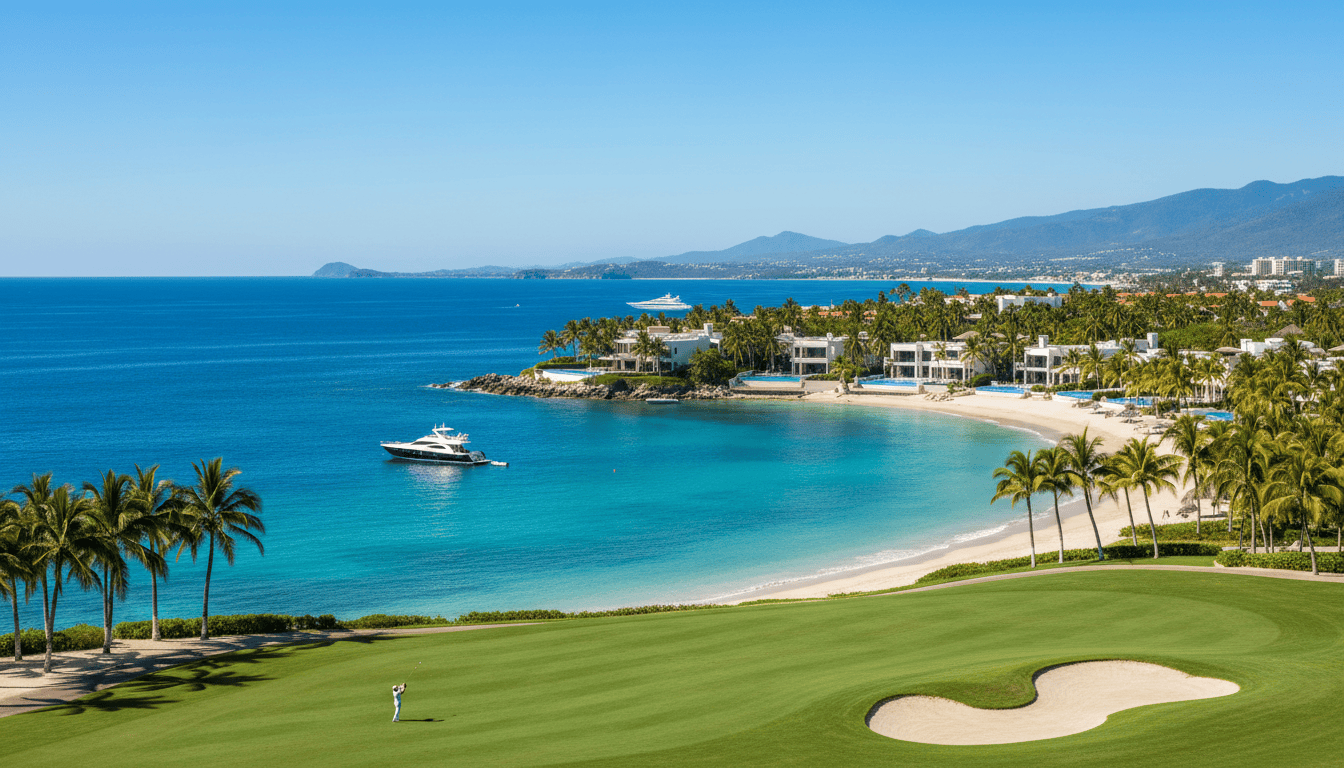
The peninsula has two Jack Nicklaus-designed golf courses, one of which features the world’s only natural island hole – a par-three where the green sits on a small island offshore, accessible only by boat. This is either the most brilliant or most inconvenient golf hole ever conceived, depending on your relationship with the game and your short iron play. Both courses are available to villa guests through various resort arrangements, and the standard is high.
Yoga and wellness programming is woven into the fabric of the place rather than offered as an afterthought. Sunrise sessions on a cliff-top terrace with Pacific views, ayurvedic treatments at resort spas, sound healing sessions – Punta Mita has absorbed the wellness vocabulary of the last decade with something close to sincerity. And the cooking class circuit, which ranges from street food workshops in Puerto Vallarta to more refined sessions with regional chefs, provides genuine insight into Mexican cuisine beyond guacamole. Though the guacamole here is also very good.
For Those Who Prefer Their Holidays With an Adrenaline Edge
The surf is the headline act. Punta Mita’s breaks are world-class, particularly on the Pacific side of the peninsula, and the region draws serious surfers as reliably as it draws the wellness crowd – which sometimes turn out to be the same people. The waves at Playa La Lancha and Playa Anclote offer conditions for different levels of experience, and there is no shortage of excellent instruction available for beginners who want to convert the experience from terrifying to merely challenging. The water temperature is forgiving – rarely below 24°C even in the dry season – which removes at least one layer of excuse.
Scuba diving and snorkelling around the Marietas rewards the effort with sea turtles, manta rays, reef sharks, and an astonishing density of tropical fish. The diving visibility in Banderas Bay is generally excellent from October through May. Kayaking through the mangrove estuaries near the coast is a quieter but no less compelling experience – the ecosystems in these channels are extraordinarily rich, and a good guide will identify species you would otherwise completely miss.
For land-based adventure, the Sierra Madre mountains backing the coastline offer zip-lining, ATV tours, and hiking with views that put the aerial shots of the bay into a context you simply cannot get from sea level. The canopy tours operating in the jungle hills inland have the full infrastructure of helmets and harnesses and guides who’ve done this several thousand times and maintain a specific serenity about it. Day trips to the Nomada hot springs, tucked in the hills behind the coast, complete the cycle of land, air, and water that makes this region one of the more comprehensively active corners of Mexico.
Why Families Actually Work Here – Not Just Survive Here
Family holidays carry a particular pressure: the requirement to simultaneously satisfy a seven-year-old’s need for a pool and a fourteen-year-old’s need to be left alone and two adults who remember when holidays involved sleeping past seven. Punta Mita handles this particular equation better than almost anywhere in Mexico, largely because private villa life removes the negotiation from the equation entirely. When the pool is yours, the breakfast is whenever you decide breakfast is, and the kitchen is stocked to the specifications of actual humans rather than a buffet manager, family travel starts to resemble what you originally hoped it might be.
The calm waters of Banderas Bay mean young children can swim and snorkel safely – no aggressive currents, warm water, plenty of marine life at shallow depths. The major resorts on the peninsula run excellent children’s clubs for those who want structured programming, and day trips to see whales or visit Sayulita’s colourful streets are sufficiently engaging for children of most temperaments and ages. The Marietas day trip, done properly with a naturalist guide, tends to convert even the most screen-resistant teenager into someone briefly interested in a blue-footed booby.
Multi-generational families – the grandparents, the parents, the chaotic middle tier – find that large villas with separate wings, multiple pools, and dedicated staff simply absorb what would otherwise be logistical friction. Nobody has to share a bathroom schedule. Everyone can eat at the same table or not, as the mood dictates. It is, in its quiet way, the luxury that actually matters.
The History and Culture Behind the Postcard
The land that is now Punta Mita has been inhabited for thousands of years – the Huichol people (who call themselves Wixáritari) considered this peninsula and the surrounding region sacred territory, a belief rooted in cosmology rather than sentiment. The Huichol were one of the few indigenous groups in Mexico to largely resist Spanish colonial assimilation, maintaining ceremonial traditions, a complex spiritual practice, and a distinctive art form – the brightly coloured yarn paintings and beadwork known as nierika – that continues to be produced by artisan communities in the region today and is widely available in markets throughout Nayarit and Jalisco.
Puerto Vallarta, which bookends any cultural exploration of the region, wears its colonial history more visibly: the Church of Our Lady of Guadalupe with its distinctive crown-topped tower is the town’s architectural centrepiece and one of the most recognisable sights in western Mexico. The malecón – the seafront promenade – hosts a permanent collection of public sculpture by international and Mexican artists and makes for an unexpectedly engaging cultural walk. The town also has a history of attracting artists and writers, partly the legacy of John Huston filming The Night of the Iguana here in 1963 and partly something about the light, which really does something unusual in the late afternoon.
Dia de los Muertos in late October and early November transforms the entire region – altars, marigolds, candlelight processions, and the particular texture of a celebration that is simultaneously grief and defiance. If timing aligns, it is worth understanding before you arrive: this is not a festival designed for tourists, and the places where it is most authentically observed are the local cemeteries and neighbourhood gatherings rather than any hotel courtyard performance.
Shopping Without Regret: What to Actually Bring Home
The most transportable thing from this part of Mexico, and the most honest souvenir of the region, is a bottle of good mezcal. The markets of Puerto Vallarta and the shops in Sayulita stock an increasingly sophisticated selection of small-batch producers, and a mezcal that costs twelve dollars here will cost fifty in a London cocktail bar (assuming you live somewhere that has a cocktail bar with a considered mezcal list, which in all honesty not everyone does).
Huichol art – the yarn paintings and intricately beaded masks, bowls, and figures – is the region’s most distinctive artisan tradition and worth understanding before buying. The quality varies enormously, from mass-produced tourist approximations to genuine pieces made by Wixáritari artisans that represent real cultural tradition and considerable skill. A good piece is not cheap, and nor should it be. Puerto Vallarta’s Zona Romántica has a number of galleries and shops carrying authenticated work and the knowledge to explain what you’re looking at.
Sayulita’s boutiques lean toward the boho-resort aesthetic – woven bags, embroidered clothing, hand-thrown ceramics – with a quality curve that rewards time spent looking. The town has enough independent retailers to make shopping feel like discovery rather than commerce, which is the best thing shopping can be. For anything that requires serious shipping – large ceramic pieces, furniture, folk art from the broader Mexican tradition – Puerto Vallarta’s centro historico has established dealers accustomed to international buyers.
The Practical Bits, Delivered Without Condescension
The best time to visit Punta Mita is broadly November through April – the dry season, when days are consistently sunny, humidity is relatively low, and the Pacific side is most enjoyable. December and January bring whale watching season into full swing and the most reliably idyllic weather. High season peaks at Christmas and around Semana Santa (Easter week), when the peninsula and Puerto Vallarta fill considerably. If you value quiet and space, the shoulder months of October/November and April/May offer good weather with fewer people and softer pricing.
June through September is the rainy season – afternoon and evening rains are common, though mornings are often beautiful and the landscape turns vivid green. Hurricane risk is real but rarely devastating in this region; still, travel insurance with weather coverage is sensible. The sea temperature remains warm year-round, rarely dipping below 22°C even in the coolest months.
Currency is the Mexican peso. US dollars are accepted across most of the peninsula and in tourist-facing businesses, though pesos will generally get you a better rate at local establishments. Tipping culture is important here – 15 to 20 per cent in restaurants is standard, and villa staff should be tipped separately and generously as a proportion of the property cost. Spanish is the primary language; English is widely spoken in Punta Mita’s hospitality environment, less so in surrounding villages, and any effort with basic Spanish is received with genuine warmth rather than the polite tolerance of, say, Paris.
Safety within the gated Punta Mita peninsula is high – it is private, security-patrolled, and functions essentially as a self-contained resort community. The surrounding areas, including Puerto Vallarta, are generally safe for tourists exercising ordinary awareness, though the US State Department travel advisories for Nayarit state are worth reading before you go. Use reputable transport, avoid travelling at night between cities, and apply the same judgement you would in any unfamiliar urban environment. The region receives millions of visitors annually and serious incidents involving tourists are uncommon.
Why a Private Villa in Punta Mita Renders Every Other Option Slightly Beside the Point
There is a specific frustration that comes with arriving in one of the world’s great outdoor destinations and then spending it in a hotel room with a partial ocean view and a pool shared with forty strangers doing laps at 7am. Punta Mita – with its private peninsula structure, its extraordinary natural setting, and its climate that makes outdoor living genuinely comfortable for the majority of the year – is a destination that does not express itself properly through a hotel stay. It expresses itself through a villa with a terrace that faces the bay, a private pool that nobody else will get into, and a morning coffee in silence that costs nothing extra.
The villa market on and around the peninsula ranges from four-bedroom properties suited to couples travelling with close friends to eight-and ten-bedroom compounds designed for large groups or multi-generational families who need separate space as much as shared space. The best villas come with private staff – a housekeeper, a cook, sometimes a dedicated concierge who can arrange everything from the whale watching boat to a private surf lesson to a table at a restaurant that doesn’t take reservations for people it hasn’t heard of. This is not an amenity in the hotel loyalty programme sense. It is a genuinely different mode of travel.
For remote workers, the peninsula’s better villa properties increasingly offer Starlink-level connectivity alongside dedicated workspace – which means the Pacific horizon can serve as a desktop background in the most literal possible sense. For wellness-focused guests, a private pool, a yoga deck, and proximity to some of the best surf and hiking in Mexico covers most of what a wellness retreat charges considerably more for. And for families, the arithmetic is simply compelling: a six-bedroom villa with private pool, a chef, and enough outdoor space for children to exist at full volume costs, divided by party size, considerably less than six hotel rooms in a resort where none of these things apply.
Browse our collection of private villa rentals in Punta Mita and find the property that makes the Pacific feel like yours.
More Punta Mita Travel Guides
What is the best time to visit Punta Mita?
November through April is the dry season and the most consistently reliable time to visit – warm, sunny, and with low humidity. December through March is peak season, coinciding with whale watching in Banderas Bay, which is exceptional. If you want quieter conditions and softer villa rates, the shoulder months of late October and early May are worth considering. The rainy season runs June through September with afternoon rains that are rarely all-day events, and the landscape becomes impressively green. Hurricane risk exists but is historically low severity in this region.
How do I get to Punta Mita?
The nearest international airport is Puerto Vallarta (PVR – Licenciado Gustavo Díaz Ordaz International Airport), approximately 45 to 60 minutes from Punta Mita by road. Puerto Vallarta receives direct flights from major US cities including Los Angeles, Houston, Dallas, Chicago, New York, and San Francisco, as well as direct seasonal routes from Canadian cities including Toronto and Vancouver. Travellers from the UK and Europe will typically connect through a US hub. Pre-arranged private transfers are recommended – your villa concierge can usually organise these as part of the arrival experience.
Is Punta Mita good for families?
Genuinely yes – and not in the resort brochure sense. The calm waters of Banderas Bay are safe for children to swim and snorkel, whale watching season provides a wildlife experience that engages most ages, and day trips to Sayulita and the Marietas Islands give enough structure to keep different ages interested. The real advantage for families, however, is the private villa model: your own pool, your own kitchen schedule, and space for children to be children without impacting other guests. Multi-generational families particularly benefit from villas with separate wings and dedicated staff.
Why rent a luxury villa in Punta Mita?
Because Punta Mita’s greatest asset – the outdoor life, the privacy, the natural setting – is experienced properly from a private property rather than a hotel corridor. A luxury villa gives you a private pool, outdoor living space calibrated to the climate, and often dedicated staff including a private chef who can source ingredients from local markets. The staff ratio in a well-staffed villa dramatically outperforms any hotel, and the cost divided across a group or family frequently competes with or beats equivalent-quality hotel rooms. The experience is simply a different category of travel.
Are there private villas in Punta Mita suitable for large groups or multi-generational families?
Yes – the Punta Mita villa market includes properties ranging from four bedrooms for intimate groups up to ten bedrooms and beyond for large gatherings. The best large-format villas feature multiple pool areas, separate guest wings for genuine privacy within the group, full indoor-outdoor kitchen and dining infrastructure, and staffing arrangements that scale with the property size. For multi-generational families in particular – where grandparents, parents, and children all need different things from a holiday – these larger villas provide the space to exist together without the friction of shared hotel facilities.
Can I find a luxury villa in Punta Mita with good internet for remote working?
Increasingly yes. The premium villa market in Punta Mita has responded to demand from remote workers and has invested accordingly. A growing number of properties offer Starlink satellite connectivity or equivalent high-speed infrastructure that supports video calls, large file transfers, and the general demands of a functioning work day. Some villas also offer dedicated workspace areas alongside their leisure amenities. It is worth specifying connectivity requirements at the point of enquiry – our team can advise on which properties in the portfolio are best suited to remote working guests.
What makes Punta Mita a good destination for a wellness retreat?
The combination of natural environment, climate, and available activities creates conditions that most purpose-built wellness retreats work hard to approximate. The Pacific surf provides both an intense physical workout and the particular mental reset that comes from sustained engagement with the ocean. Yoga is woven into the fabric of the local hospitality scene – sunrise sessions with bay views are genuinely available, not just advertised. The cuisine, rooted in fresh Pacific seafood, tropical produce, and regional Mexican tradition, supports rather than undermines a health-focused approach. And a private villa with its own pool, outdoor spaces, and the option of a private chef preparing meals to dietary specifications provides the infrastructure for a wellness break on your own terms.


