Quảng Nam Travel Guide: Lanterns, Tailors & Islands
Quảng Nam is a region of central Vietnam centred on the ancient trading port of Hội An, now administratively folded into Da Nang municipality but still culturally and visually its own place. It suits couples, families, remote workers and groups who want beaches, UNESCO ruins and genuinely good food without the scrum of a city break. A private villa works well here because it gives you a quiet base with a pool between the heat of the day and the lantern-lit evenings, plus staff who can arrange everything from tailoring appointments to boat trips.
Quảng Nam at a Glance
- Where: Central Vietnam, the former Quảng Nam Province, now part of Da Nang municipality
- Nearest airport: Da Nang International Airport (DAD), roughly 45 minutes by road to Hội An
- Best time to visit: February to April for dry, mild weather; June to August is hotter and still dry
- Getting around: private driver or car hire, scooter, cyclo in the Old Town, speedboat for the islands
- Ideal for: couples on milestone trips, families wanting privacy, groups of friends, remote workers, wellness-focused travellers
Hội An announces itself before you see it – a smell of simmering pork broth and river damp, the soft rattle of bicycle bells over cobblestones, and at dusk, hundreds of paper lanterns lighting up like a town-wide decision to be photogenic. It is a smell and a sound you don’t quite shake off afterwards, which is either a problem or the entire point, depending on how you feel about silk lanterns following you home in spirit.
This stretch of Vietnam rewards travellers who like their luxury quiet rather than loud. Families find the beaches shallow and the staff endlessly patient with small children; couples find candlelit restaurants and tailors who will make you something extraordinary in forty-eight hours; remote workers find reliable fibre connections and a time zone that, frankly, nobody back home has worked out yet; and wellness guests find early mornings on empty sand and spas that don’t rush you. A villa, rather than a hotel room, lets all of these people have exactly the holiday they came for, under one roof, without negotiating over the thermostat.
Getting to Quảng Nam: The Slow Charm of Getting There
Da Nang International Airport (DAD) is your gateway, serving a healthy number of domestic and international flights with Vietnam Airlines, Vietjet Air and Bamboo Airways among the regulars. From there it’s a smooth, scenic drive of about 45 minutes to Hội An – long enough to watch the landscape shift from airport sprawl to rice paddies, short enough that nobody gets cranky in the back seat. If your villa is further south near Tam Kỳ, the old provincial capital, budget 1.5 to 2 hours via Hội An.
Chu Lai Airport, further south, handles domestic flights only, so it’s not currently useful if you’re arriving from abroad – worth remembering before you book the wrong leg of your itinerary. Phu Bai International Airport in Huế is a workable backup, though at 2.5 to 3 hours from Hội An it’s more “plan B” than “plan A”.
By rail, the nearest stations are Da Nang (about 30km away) and Tam Kỳ (around 50km), both on the North-South Reunification Express; the Da Nang to Tam Kỳ leg takes roughly an hour. For the Cù Lao Chàm islands, Cua Dai Pier near Hội An is the only official departure point – speedboats take 20 to 30 minutes, with one-way fares of 190,000 to 300,000 VND, or a round trip for 500,000 to 600,000 VND. Sailings run through the morning and early afternoon, and the sea occasionally has the last word – boats can be cancelled at short notice in rough weather, which is less an inconvenience than a reminder that the South China Sea doesn’t check your itinerary first.
Where to Eat in Quảng Nam: Noodles, Tailoring Breaks and Long Lunches
Fine Dining in Quảng Nam
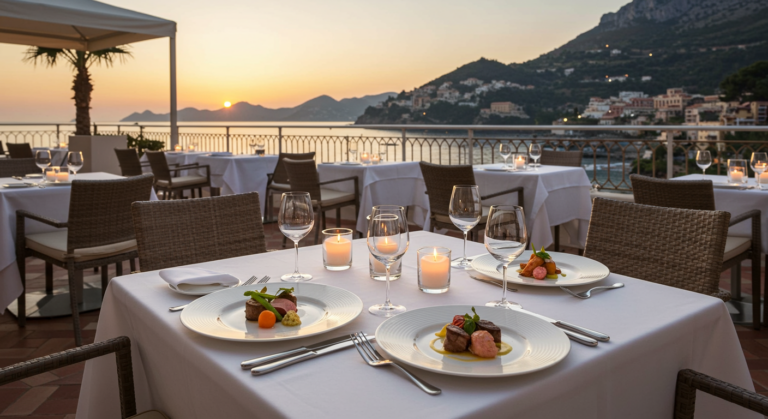
Hội An’s riverside quarter has quietly built a reputation for elegant, candlelit dining rooms where chefs take local ingredients – river prawns, lemongrass, the region’s famously good herbs – and plate them with a confidence that owes more to Paris than to any notion of rustic simplicity. Expect open kitchens, careful wine lists and the kind of unhurried service that assumes you have nowhere else to be, which, on holiday, you don’t.
Where the Locals Eat
The real education happens at plastic stools by the market, where cao lầu – that curious noodle dish found almost nowhere else in Vietnam, made with water traditionally drawn from a specific local well – is served without ceremony and eaten with total devotion. Add white rose dumplings, grilled pork skewers from street carts, and riverside cafes serving strong Vietnamese coffee over ice, and you have a food scene that doesn’t need white tablecloths to be memorable.
Hidden Gems in Quảng Nam
Wander away from the lantern-strung main streets and you’ll find family-run kitchens with no sign in English, serving one or two dishes they’ve perfected over decades. Ask your villa host – a good one will know exactly which alley leads to the best bánh mì in town, and will not tell the guidebooks.
Exploring Quảng Nam: Rivers, Rice Fields and Ruins
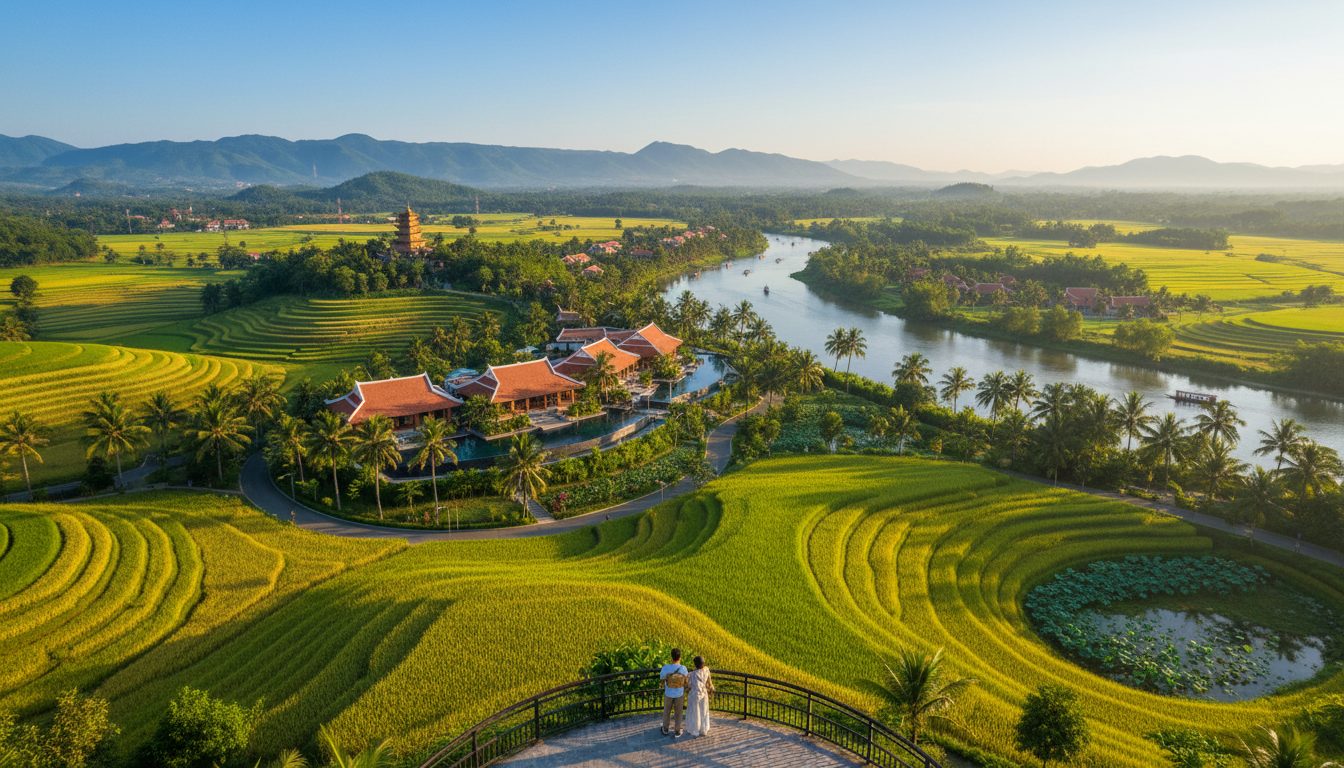
Geographically, Quảng Nam is a study in contrasts folded close together. The coast runs along soft, broad beaches backed by coconut palms; inland, the Thu Bồn River winds through rice paddies and water buffalo country before reaching the ancient port of Hội An, with its yellow facades and covered Japanese bridge. Further inland again, the jungle-wrapped ruins of Mỹ Sơn sit in a valley that feels like someone forgot to tell the twentieth century it had arrived. Offshore, the Cù Lao Chàm archipelago offers a different texture entirely – granite headlands, coral reefs and fishing villages with their own slower rhythm.
It’s a compact region, which is part of its appeal: you can have breakfast by a rice paddy, lunch beside the river and dinner with your toes in the sand, all without a long drive in between.
Things to Do in Quảng Nam: Beyond the Lanterns
Hội An’s Ancient Town is the obvious draw, and deservedly so – wander the pedestrian lanes by day, then return after dark when the lanterns come on and the whole place turns faintly theatrical. A custom-tailored suit or dress, made in 24 to 48 hours, remains one of the area’s genuine curiosities; nowhere else can you walk in needing nothing and walk out needing a second suitcase.
The ruins of Mỹ Sơn, a cluster of red-brick Hindu temples built by the Champa kingdom, reward an early start before the heat and the coach tours arrive. A day trip to the Cù Lao Chàm islands adds snorkelling, quiet beaches and a fishing village that still runs on its own schedule rather than the tourist board’s. Closer to the coast, cycling through the rice paddies of Tra Que village, with its herb gardens, is a gentle counterpoint to the Old Town’s bustle.
Outdoor and Adventure Activities in Quảng Nam: Water, Wheels and the Odd Hill
This is not a region built around adrenaline, and it’s better for it. Snorkelling and diving around Cù Lao Chàm are the main event, with the islands generally open to visitors from February to September and the March to May window offering the clearest water and calmest seas – a 95% on-time boat schedule in that period is as close to a guarantee as the sea offers anyone. Cycling is excellent on the flat roads between rice fields, and kayaking along the Thu Bồn River or through the coconut palm forests near Cẩm Thanh is a quiet highlight few visitors plan for in advance. Beach time, of course, requires no planning at all – just a villa with a short walk to the sand.
Quảng Nam for Families: Shallow Water and Short Tempers Avoided
The beaches here are gentle, the pace is unhurried and the Old Town is small enough that children don’t vanish into it the way they might in a bigger city. Cooking classes, bicycle rides through the countryside and the novelty of a boat trip to the islands all tend to land well with younger travellers. The real advantage, though, is the villa itself: a private pool for the inevitable mid-afternoon meltdown, space for grandparents to nap while teenagers do whatever teenagers do, and staff who can organise a babysitter or a quiet family dinner without anyone needing to leave the property. Hotels rarely offer that combination of privacy and flexibility; a villa does it as a matter of course.
History and Culture of Quảng Nam: Trade Routes and Temple Ruins
Hội An was once one of Southeast Asia’s great trading ports, where Chinese, Japanese and European merchants mixed for centuries – hence the architectural jumble of Chinese assembly halls, Japanese bridges and French shophouses that still defines the Old Town. Further inland, Mỹ Sơn stands as a reminder of the Champa civilisation, a Hindu kingdom that built these brick sanctuaries between the 4th and 13th centuries, long before anyone was selling silk lanterns to tourists. In June 2025, the former Quảng Nam Province was formally absorbed into Da Nang municipality – a bureaucratic shift that has changed very little about how the place looks, smells or feels, which tells you something about how slowly culture actually moves compared to paperwork.
Shopping in Quảng Nam: Silk, Lanterns and the Art of the Fitting
Tailoring is the headline act – Hội An’s reputation for fast, skilled custom clothing is well earned, and a fitting or two between sightseeing stops is practically a local tradition for visitors. Beyond that, the markets and boutiques sell silk lanterns (sturdier than they look, somehow), lacquerware, embroidered textiles and ceramics from nearby craft villages. Pottery from Thanh Hà village, a short cycle from the centre, makes for a more considered souvenir than another lantern you’ll never find room for.
Practical Tips for Visiting Quảng Nam: Small Things Worth Knowing
The currency is Vietnamese đồng; most villas and upscale restaurants accept cards, but small vendors and markets are cash-only, so keep notes handy. English is spoken in tourist areas but patchy elsewhere, and a few polite Vietnamese phrases go further than you’d expect. Tipping isn’t obligatory but is appreciated, particularly for drivers and villa staff. The dry season, February to April, is genuinely the best time to visit Quảng Nam, with temperatures around 23-27°C and low humidity; June to August is hotter, sometimes reaching 34°C, but still dry. October is worth avoiding entirely – near-daily rain and flood risk – and September carries its own typhoon risk, so plan around both if you can.
Luxury Villas in Quảng Nam: The Case for Your Own Front Door
A hotel room, however good, is still someone else’s space with someone else’s schedule. A villa here means a private pool for the hours between sightseeing and dinner, a kitchen if you want one, and often a cook who can turn that morning’s market haul into something better than anything you’d find on a menu. For families and multi-generational groups, the separate wings and shared living spaces solve the eternal problem of wanting to be together and alone at the same time. Remote workers find dependable connectivity and a proper desk rather than a laptop balanced on a hotel pillow. Wellness travellers get quiet mornings, space for yoga by the pool, and none of the ambient noise of a resort schedule. Concierge teams handle the tailoring bookings, the boat transfers to Cù Lao Chàm, the dinner reservations – the logistics, in other words, so you don’t have to. Browse luxury villas in Quảng Nam.
Quảng Nam FAQs
What is the best time to visit Quảng Nam?
February to April is the best time to visit Quảng Nam, with dry weather, low humidity and temperatures around 23-27°C. June to August is also dry but hotter, sometimes reaching 34°C. Avoid October, which brings near-daily rain and flood risk, and be aware September carries typhoon risk too.
How do I get to Quảng Nam?
Fly into Da Nang International Airport (DAD), the main gateway for international and domestic flights, then drive roughly 45 minutes to Hội An or 1.5 to 2 hours to Tam Kỳ. Chu Lai Airport serves domestic flights only, and Phu Bai Airport in Huế is a more distant backup at 2.5 to 3 hours.
Is Quảng Nam good for families?
Yes – the beaches are shallow, the Old Town is compact and manageable with children, and activities like cycling and cooking classes suit younger travellers well. A private villa with a pool adds flexibility that family hotel rooms rarely match.
Why rent a luxury villa in Quảng Nam?
A villa offers privacy, a private pool, and space that no hotel room can replicate, along with staff who can arrange tailoring appointments, island transfers and private dining. It suits couples, families and groups who want their own rhythm rather than a shared resort schedule.
Are there private villas in Quảng Nam suitable for large groups or multi-generational families?
Yes, villas here range from intimate couples’ retreats to larger properties with multiple bedrooms, separate wings and private pools, designed for extended families or groups of friends who want shared spaces as well as privacy. Staff can typically scale catering and services to group size.
Can I find a luxury villa in Quảng Nam with good internet for remote working?
Many villas in the region offer reliable connectivity suitable for video calls and remote work, with some properties offering Starlink or backup connections where local infrastructure is less consistent. A dedicated workspace is worth confirming when booking if this matters to your trip.
What makes Quảng Nam a good destination for a wellness retreat?
The slower pace, quiet beaches and gentle outdoor activities like cycling and kayaking suit a wellness-focused trip well. Villas typically offer private pools, space for yoga or morning stretching, and the kind of calm that’s hard to find in a resort with a packed activity schedule.
Where to stay
Villas in Quảng Nam
A selection from our 7 luxury villas in Quảng Nam.