Salamanca Food & Wine: Jamón, Hornazo & Arribes Wines
Salamanca’s food centres on Castilian staples – cured Iberian ham from nearby Guijuelo, the savoury hornazo pie, and roast meats and stews from the surrounding countryside. The province’s wine comes mainly from the Arribes del Duero region along the Portuguese border, where the native Juan García and Rufete grapes produce lesser-known but distinctive reds. Markets, ham producers and small wine estates around the city make for an easy day or two of eating well without ever reaching the coast.
There is a particular pleasure in eating somewhere the rest of the world hasn’t quite caught on to yet. Salamanca’s food scene doesn’t shout about itself the way San Sebastián’s does, or preen the way Barcelona’s can. It simply gets on with doing a handful of things – curing ham, baking pies, fermenting honest red wine – extremely well, and has done so for centuries without feeling the need to tell anyone. That, if you’re the sort of traveller who’d rather discover a good thing than be sold one, is precisely the point.
Salamanca Cuisine: Castilian Classics With a Local Accent
Salamanca sits squarely in Castilla y León, a region whose cooking was shaped by shepherds, grain farmers and long, dry summers followed by properly cold winters. This is not delicate cuisine. It is the food of people who worked outdoors and needed calories, and it remains refreshingly unapologetic about that fact. Expect roasted meats, hearty stews, cured pork in most of its possible forms, and bread that could double as a doorstop in a pinch (a compliment, in context).
What sets Salamanca’s table apart from, say, Segovia’s or Ávila’s, is its proximity to Extremadura and the dehesa – the oak-studded pastureland where black Iberian pigs roam and feed on acorns each autumn. That single geographic fact explains most of what’s good about eating here. The city itself has absorbed centuries of university life too, which means there’s no shortage of unpretentious taverns where students and professors alike have been arguing over tapas since long before anyone thought to call it “gastronomy.”
For context on the wider region, the Salamanca Travel Guide covers the city’s architecture and history alongside the eating.
Signature Dishes in Salamanca: Hornazo, Farinato and the Ham That Needs No Introduction
If you eat one thing in Salamanca, make it jamón ibérico de Guijuelo. The town of Guijuelo, about an hour south of the city, has been curing ham for so long that “Guijuelo” has become shorthand across Spain for ham of real quality – thin-sliced, deep red, with fat that melts rather than chews. Order it simply, on its own, with good bread. Anything else is a distraction.
Then there’s hornazo, a substantial savoury pie stuffed with pork loin, chorizo, jamón and hard-boiled egg, traditionally eaten on Lunes de Aguas – the Monday after Easter, when students and townsfolk once picnicked by the river Tormes. You’ll find it year-round now in bakeries and tabernas, sold by weight, and it travels well for a day trip.
Farinato, a soft sausage of bread, pork fat and paprika from around Ciudad Rodrigo, is an acquired taste that rewards persistence – usually fried and served alongside eggs. Chanfaina, a rice dish built on lamb offal and blood sausage, is the kind of thing a grandmother somewhere is still doing better than any restaurant, and patatas meneás (or revolconas), mashed potatoes beaten with paprika and bits of pork, turn up as a side to almost everything. None of this is food that photographs elegantly. All of it tastes considerably better than it looks.
Salamanca Wine: Arribes, Rufete and the Sierra’s Quiet Reds
Salamanca is not Rioja, and it would be foolish to pretend otherwise. What it does have, mostly overlooked by anyone not specifically looking, is the DO Arribes – a wine region straddling the border between Salamanca and Zamora provinces along the dramatic river gorges where the Duero marks the frontier with Portugal. The terrain here is steep, the vineyards often terraced, and the resulting reds – built on native Juan García and Rufete grapes – tend to be lighter and more mineral than the big-bodied reds further east in Castilla y León.
In the Sierra de Salamanca, to the south, smaller producers work with Rufete on granite soils at real altitude, making wines with a cooler, more savoury character than the plains below. These are not widely exported wines, and that is precisely their appeal: drink them here, with the local food they were clearly made to accompany, and you’ll understand them far better than any tasting note could explain.
Wine Estates Near Salamanca: Where to Visit
The Arribes region rewards a slow half-day out, ideally with lunch built around the visit rather than squeezed in afterwards. Smaller family-run bodegas in the area typically offer tastings by appointment rather than drop-in visits, so a phone call or email ahead of time saves a wasted drive through some genuinely dramatic gorge scenery. The Sierra de Salamanca producers, working at higher altitude around villages like Mogarraz and Miranda del Castañar, tend to be even smaller operations – often family concerns with a handful of hectares and opinions about Rufete they will happily share at length over a glass.
Ask locally or through the tourist office in Salamanca city for current contact details, as opening days and appointment systems change with the seasons and the harvest. It’s worth the small extra effort of planning ahead: these are working farms first and wineries second, and the people pouring your wine are often the ones who pruned the vines that morning.
Salamanca Food Markets: Mercado Central and Beyond
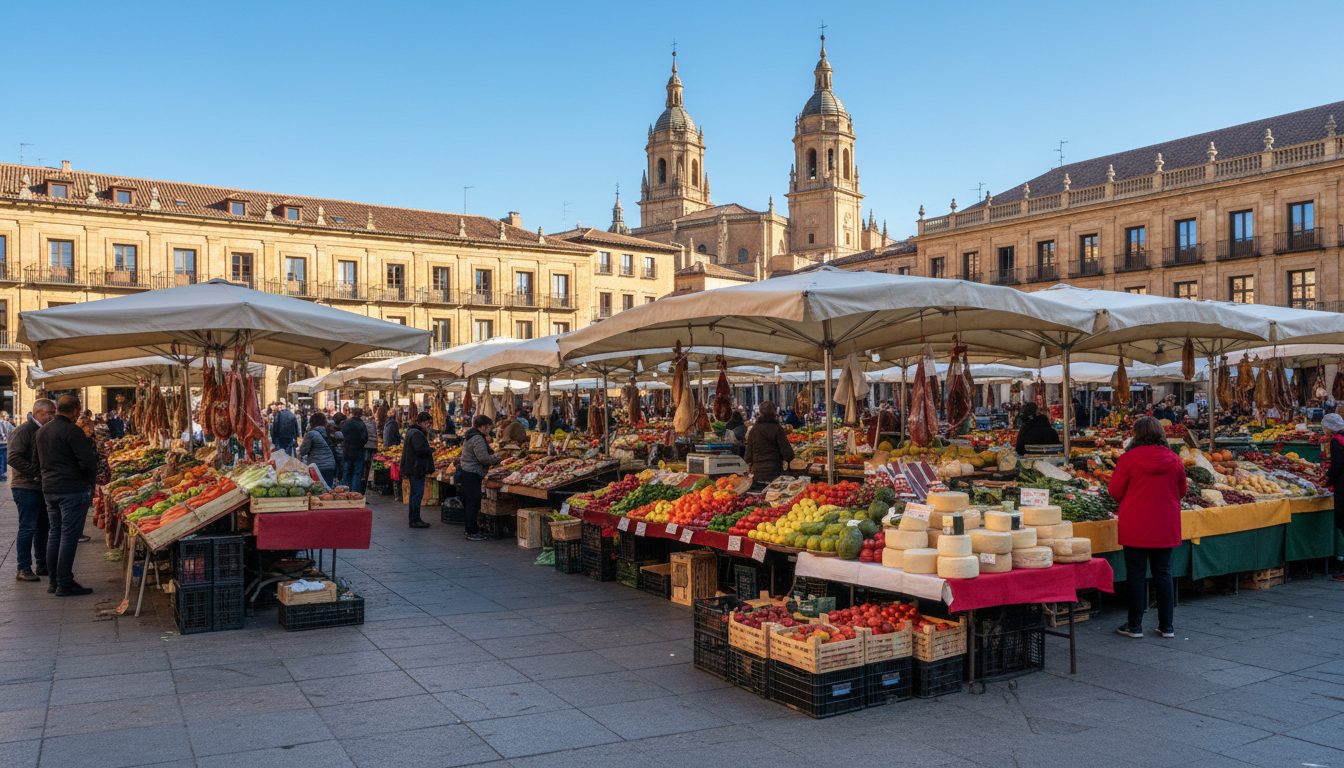
Salamanca’s Mercado Central, tucked beside the Plaza Mayor, is the obvious starting point – a working market rather than a tourist performance, where stallholders sell cheese, cured meats, fruit and vegetables to people who are there to actually buy dinner. Go in the morning, when the produce is freshest and the crowds thinnest, and resist the urge to photograph everything before eating any of it.
Beyond the central market, smaller neighbourhood markets and weekly produce stalls appear around the city on a rotating basis, selling seasonal vegetables, local cheeses (look for queso de Arribes, a goat and sheep’s milk cheese from the border region) and whatever fruit happens to be at its best that week. These are worth seeking out specifically because they haven’t been tidied up for visitors – prices are in euros that make sense, and nobody’s selling you a fridge magnet shaped like a jamón.
Cooking Classes in Salamanca
Hands-on cooking classes in Salamanca tend to focus on the fundamentals that define the region’s food: tapas technique, ham carving and tasting, and the preparation of classic Castilian dishes like hornazo or patatas meneás. A good class will usually begin with a market visit, so you understand what you’re cooking with before you start cooking with it – a far more useful lesson than any amount of recipe-following.
Ham-carving demonstrations in particular are worth seeking out even if you have no intention of carving your own jamón ever again. Watching a professional cortador work a leg of Guijuelo ham into paper-thin slices, at an angle that looks deceptively casual and almost certainly isn’t, is one of those small theatrical pleasures that Spain does better than anywhere else.
Seasonal Specialities in Salamanca: Ham Season, Chestnuts and Almonds
Salamanca’s food calendar runs on the agricultural year rather than the tourist one. Ham production peaks through the autumn and winter months, when the montanera season sees Iberian pigs finishing on acorns in the dehesa before slaughter – the resulting hams then cure for a year or more before reaching a plate. Late autumn also brings chestnuts from the Sierra de Francia, roasted on street corners in the city and used in both sweet and savoury dishes, and the sugared almonds of the same hills make an excellent, portable souvenir.
A word on two things Salamanca is often wrongly credited with. This is not a truffle region in any serious commercial sense – that reputation belongs to other parts of Spain – and it is certainly not an olive oil powerhouse; Castilla y León’s climate simply isn’t built for it, though a handful of small producers in the warmer southern valleys near the Sierra de Francia do grow olives on a modest, artisanal scale. And being landlocked, Salamanca has no genuine seafood tradition of its own – what you’ll find on menus is perfectly good fish brought in fresh from the coast, but it’s not what the kitchens here were built to cook. Eat the ham. Eat the lamb. Save the seafood cravings for somewhere with a harbour.
Best Food Experiences in Salamanca
The single best food experience in Salamanca is also the simplest: a quiet tasca, a plate of Guijuelo ham, a glass of Arribes red, and no particular schedule to keep. Beyond that, a morning at the Mercado Central followed by lunch nearby, a slow afternoon out at a small Arribes bodega, and an evening spent working through a tapas crawl around the streets near the Plaza Mayor will give you a fair account of what the region does well.
Pair a visit to the city’s food scene with a day trip to Guijuelo itself if time allows – it’s an unglamorous working town built entirely around ham production, and all the more interesting for it. Few places make their one claim to fame quite so thoroughly their own.
For travellers planning where to base themselves while exploring all of this, there are villas in Salamanca within easy reach of the markets, bodegas and ham country described above.
Salamanca Food and Wine FAQs
What is Salamanca’s most famous food?
Jamón ibérico de Guijuelo, the cured ham from the town of Guijuelo in Salamanca province, is the region’s best-known food, alongside the savoury hornazo pie traditionally eaten on the Monday after Easter.
Is Salamanca a wine region?
Salamanca province is home to part of the DO Arribes wine region along the Duero gorges, plus smaller producers in the Sierra de Salamanca working with native Rufete and Juan García grapes, though it’s less well known internationally than Spain’s larger wine areas.
When is the best time to visit Salamanca for food and wine?
Autumn and early winter are ideal, coinciding with the ham-curing season, chestnut harvest in the Sierra de Francia, and grape harvest in the Arribes wine region, though good food is available in Salamanca year-round.
Keep reading
More on Salamanca
- Travel guideSalamanca Travel Guide
- RestaurantsBest Restaurants in Salamanca
- FamiliesSalamanca with Kids
Guides nearby in Spain
Where to stay
Villas in Salamanca
A selection from our 31 luxury villas in Salamanca.