
Best Restaurants in Schisma Eloundas: Fine Dining, Local Gems & Where to Eat
Come in late September, when the Aegean light turns the colour of warm honey and the tourist volume drops just enough to feel like you have quietly inherited the place. The sea is still bath-warm. The tamarisk trees along the waterfront are doing their gentle, feathery thing. And the restaurants of Schisma Eloundas – the small, quietly spectacular strip of coast that runs just south of Elounda proper – have settled into that particular rhythm that only arrives once the high-summer circus has packed up and moved on. The chefs are less frantic. The menus have a confidence to them. The wine arrives without you having to flag anyone down three times. This is, in other words, the moment when eating well here becomes not just possible but genuinely memorable.
Schisma Eloundas sits in one of the most privileged dining locations in all of Crete – which is saying something, given that Crete takes its food with the kind of seriousness most countries reserve for constitutional matters. To the west, the Mirabello Bay glitters. Across the water, Spinalonga sits there being dramatically photogenic. And in between, a clutch of restaurants that range from serious fine dining to the sort of taverna where you eat whatever the fisherman brought in that morning and the bill makes you briefly question your sense of what things should cost. In the best possible way.
This guide covers the full spectrum – where to book months ahead, where to simply turn up and point at things, what to order, what to drink, and one or two places the guests who’ve stayed in our villas tend to mention, slightly conspiratorially, as if they’re worried we’ll tell everyone.
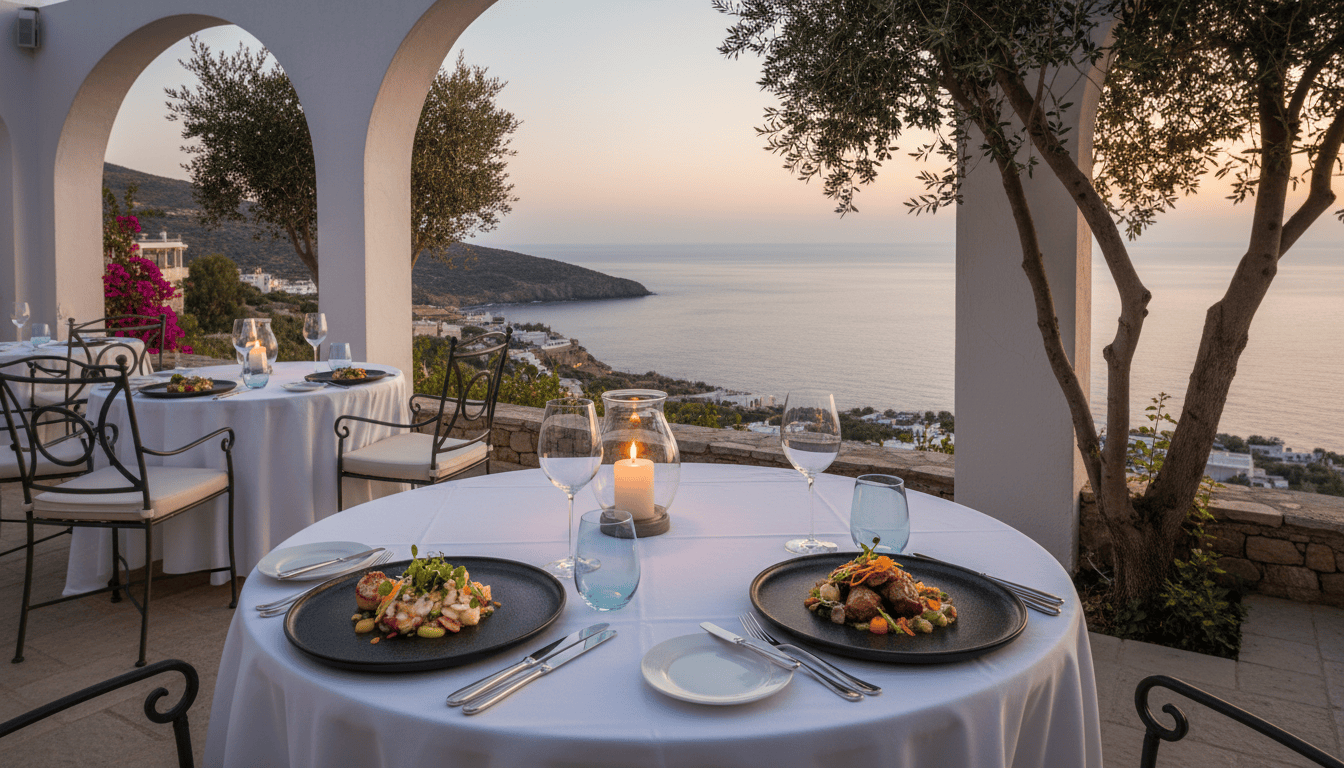
The Fine Dining Scene: Where Serious Cooking Meets Serious Views
The broader Elounda area has long been home to some of the most accomplished cooking in Greece – a country not historically associated with destination fine dining but which has been quietly correcting that impression for some years now. The grand resort hotels that flank the bay – the kind with their own speedboats and a staff-to-guest ratio that borders on the theatrical – have always attracted serious culinary talent, and the restaurants attached to them have filtered a certain standard into the wider area.
Within and immediately around Schisma Eloundas, the fine dining offer is built around a combination of refined Greek contemporary cooking and the kind of Mediterranean-European fusion that, when executed well, feels entirely logical given where you are. Expect menus that know their ingredients – they’re sourced from within Crete with the conviction of people who have actually met their producers. Grilled sea bass arrives with the kind of clarity that tells you it hasn’t touched ice in three days. Dakos, the Cretan barley rusk salad, is reimagined with enough restraint to respect its origins while still feeling like cooking rather than anthropology.
Tasting menus are available at the more ambitious kitchens in the area, and they reward patience. Five or seven courses here, paired with Greek wines selected by someone who clearly thinks the rest of the world is sleeping on Greek viticulture – which it largely is – makes for an evening that competes with anything you’d find in Athens or Thessaloniki. Reservations for these restaurants are not optional. Book before you land. Book before you pack, arguably.
Waterfront Tavernas: The Heart of the Matter
Here is an important truth about eating in Schisma Eloundas: some of the finest meals you will have happen at a plastic-chaired table two feet from the water, with a paper tablecloth that the wind is doing its best to liberate, and a carafe of local wine that costs roughly the same as a bar of chocolate. This is not a compromise. This is the point.
The tavernas along and around the Schisma Eloundas waterfront operate on the logic of whatever was good today. Whole fish, priced by the kilo and brought to the table raw so you can inspect it before it meets the grill, is the central performance. You want red mullet if they have it – barbounia, small and crisp and eaten bones and all if you’re feeling committed. You want the octopus that’s been drying on the line outside since morning, slow-grilled until it achieves that particular quality of tender smokiness that no amount of restaurant technique entirely replicates.
Accompany all of this with tzatziki that actually tastes of cucumber and garlic rather than supermarket approximation, a village salad with proper fat Cretan tomatoes that remind you what tomatoes are supposed to taste like, and fried courgette fritters with a side of strained yoghurt. Then order more bread. You will want more bread. The meal will take two hours and feel like thirty minutes.
Local tavernas here tend to be family-run in the literal sense – not as a marketing point, but because there’s an actual grandmother somewhere in the vicinity who is responsible for certain things and about whom everyone is slightly nervous. These places rarely have websites. Some have menus only in Greek. Neither of these things is a problem.
Beach Clubs and Casual Dining: Lunch as a Lifestyle Choice
Schisma Eloundas and its immediate surrounds have embraced the beach club format with the enthusiasm of a coast that was clearly designed for it. The combination of calm, flat water, reliably brilliant weather from May through October, and a clientele who have the time and inclination to make lunch a four-hour commitment has produced a beach club scene that punches above its weight.
Expect sunbeds that cost rather more than you’d anticipated, cocktails that are engineered with some care, and menus that hover somewhere between serious and relaxed – sashimi alongside grilled calamari, a Caesar salad that’s better than it needs to be, fresh juices and seafood platters arriving at intervals that discourage any plans you might have had for the afternoon.
The better beach clubs along this stretch understand that their food needs to be good enough that people actually notice it, rather than treating it as merely a mechanism for staying upright between drinks. Seafood is reliably the thing to order. Grilled prawns, fresh ceviche, octopus carpaccio – the proximity to the water is not incidental. Pair it with a cold Assyrtiko from Santorini, which has enough acidity to survive the heat and enough character to deserve your attention, and you have a lunch arrangement that would be difficult to improve upon.
A word on timing: arriving at a beach club after 1pm on a summer weekend without a reservation is an experience in optimism. Book ahead. The good ones fill up.
Hidden Gems: The Places the Regulars Come Back For
Every destination with any self-respect has restaurants that don’t advertise, don’t appear reliably on review sites, and maintain their quality precisely because their clientele are loyal enough not to broadcast them too enthusiastically. Schisma Eloundas has these.
They tend to sit slightly back from the waterfront – a street or two inland, or at the end of a road that looks less promising than it turns out to be. They’re identifiable by certain signs: hand-written specials boards, a certain deliberate lack of ambient music, the presence of local families at the next table eating with the focused attention of people who have come somewhere specific for a reason. These are not places of ceremony. They are places of very good food, often quite cheaply priced, with a warmth of service that comes from genuine ownership rather than hospitality training.
The dishes here lean traditional: slow-cooked lamb with lemon and herbs, stifado (the Cretan beef and onion stew that improves with every hour it spends on the heat), kalitsounia – small pastry parcels filled with mizithra cheese or wild greens that vary by season and by whoever made them that morning. Wash everything down with raki, the Cretan firewater that arrives unbidden at the end of a meal as a gesture of goodwill and which it is considered rude to decline. It is also, at that point in the evening, generally quite welcome.
The best way to find these places is to ask. Not TripAdvisor – ask the person running your villa, ask someone at the taverna you’re already at, ask the woman at the bakery. Local knowledge here is freely given and reliable.
Food Markets and Producers: Where the Ingredients Come From
Understanding why the food in Schisma Eloundas tastes the way it does requires a brief consideration of what Crete actually produces. The island is not humble about this, and it shouldn’t be. Cretan olive oil – cold-pressed, early-harvest, the colour of pale gold – is among the finest in the world and is used here with the liberal confidence of people who have a lot of it and know its quality. Local cheeses, particularly graviera and the soft, milky mizithra, appear everywhere and deserve to. Honey from the Cretan highlands, thyme-scented and dense, is the sort of thing you bring home in quantities that cause airline staff to raise an eyebrow.
The weekly markets in the Elounda area are worth your time – not as a photographic exercise in rusticity, but because they are genuinely excellent places to acquire things. Seasonal produce, local herbs, olives of varieties you won’t find elsewhere, cured meats, jars of things preserved with considerable skill. Go early, go hungry, and bring a bag that’s bigger than you think you’ll need. You will fill it.
Several local producers in the area welcome visitors – olive oil estates in particular, where you can taste through the range, understand the harvest process, and buy direct at prices that feel almost impolite given the quality. Your villa team can typically make introductions. These are the sort of afternoons that retrospectively define a holiday more than any single restaurant.
What to Drink: Greek Wine, Raki and Why You Should Pay Attention
Greek wine has been quietly having a moment for a decade, and Crete in particular has been doing interesting things with indigenous grape varieties that most of the wine world still couldn’t name with any confidence. This is changing, and if you want to be ahead of the curve rather than behind it, pay attention to what’s on the wine lists here.
Assyrtiko from Santorini is the easiest entry point – mineral, dry, beautifully structured, and perfectly matched to seafood. But look also for Vidiano, a white grape indigenous to Crete that produces wines of surprising complexity and freshness. Red wine drinkers should seek out Kotsifali and Mandilari, Cretan varieties that the local blends tend to use in combination – the former soft and aromatic, the latter providing structure and colour. Together they make wines that genuinely merit the attention of anyone who takes the subject seriously.
Local wineries in the Lasithi region, which encompasses Elounda and its surrounds, produce bottles that range from entirely serious to entirely drinkable, and often both simultaneously. Ask your restaurant what’s local. They will almost certainly have an opinion.
And then there is raki. Cretan raki – tsikoudia, technically – is not ouzo, and correcting this distinction will earn you immediate goodwill in any establishment. It’s distilled from grape pomace, clear, high-strength, and served cold in small glasses as a welcome gesture, a farewell gesture, or an accompaniment to a small plate of something. Treat it accordingly: sip it, don’t shoot it, and accept every glass that’s offered. Refusing raki in Crete is a minor cultural misstep from which relationships rarely fully recover.
Reservation Tips: How to Actually Get the Table You Want
A few practical considerations, because good intentions without logistics produce mediocre dinners.
For the fine dining restaurants in and around Schisma Eloundas – particularly those attached to the major resort hotels or with any kind of reputation – book at minimum two to four weeks ahead in high season. July and August require more lead time than that. October requires less. If you’re travelling in September, the sweet spot of timing and availability, book as soon as your flights are confirmed.
Many of the better-regarded restaurants here take reservations via email rather than through third-party platforms, which means a brief, polite message directly to the restaurant tends to be both more effective and more appreciated than attempting to navigate an aggregator. State your dietary requirements upfront. Crete is not a difficult place for vegetarians or those avoiding certain ingredients, but the kitchen appreciates the forewarning.
For tavernas and casual spots, turn up early – particularly in high season. 7pm secures you a table at places where 8:30pm means a wait. Greeks eat late; visitors who eat earlier therefore benefit from the scheduling arbitrage. The food is the same. The peace is greater.
If you’re unsure what to book, or simply want someone to handle the whole thing, the team at your villa can usually manage restaurant reservations as part of their service – a detail that sounds small and is, in practice, enormously useful.
Dining from Your Villa: The Private Chef Option
There are evenings when the best restaurant in Schisma Eloundas is wherever you happen to be sitting. Specifically: on a terrace above the bay, with a glass of cold white wine, watching the last light leave Spinalonga while someone who actually knows what they’re doing prepares dinner in your kitchen. This is not a compromise or a convenience – it is, for many guests, the dining experience they remember most vividly from the entire trip.
Staying in a luxury villa in Schisma Eloundas with a private chef option puts the best of the local larder directly on your table. A good villa chef sources from the same suppliers as the restaurants – local fish markets, olive oil producers, farmers with actual farms – and cooks to your preferences, your pace, and your terrace. They’ll do the Cretan classics with the confidence of someone who grew up eating them. They’ll also, if you ask nicely, explain what everything is and where it came from. Dinner as education. Dinner as ceremony. Dinner as the thing you’ll spend the flight home describing to whoever will listen.
For everything else you need to know before you arrive, the Schisma Eloundas Travel Guide covers the destination in full – beaches, boat trips, what to do with your days and how to structure them. The eating, as this guide has hopefully established, will take care of itself.
