Slovenia with Kids: Lakes, Caves & Coastal Towns
Slovenia is a compact, safe and well organised destination for family travel, with short driving distances between lakes, caves, mountains and a modest but charming stretch of Adriatic coast. Families can combine gentle activities like rowing to Bled Island or riding the underground train through Postojna Cave with more active pursuits such as rafting on the Soča River. The country works well for children of any age, from toddlers who will sleep through most of it to teenagers who will finally put the phone down for the white water.
Can a country roughly the size of Wales genuinely deliver mountains, caves, a lake with its own island and a coastline, all within a day’s reach of each other, without anyone having a meltdown in the back seat? It sounds improbable. It is, nonetheless, largely true. Slovenia has a habit of being underestimated – squeezed as it is between Italy, Austria, Hungary and Croatia on the map, and often mentally filed under “somewhere near the others” – but for families it has quietly become one of the more sensible choices in Europe. Nobody is trying to sell you anything twice. The castles are real castles, not reconstructions with a gift shop attached (well, mostly). And the distances are short enough that a bad decision about where to stay for lunch rarely ruins the day. For a broader look at the country beyond the family angle, the Slovenia Travel Guide covers the wider picture.
Slovenia with Kids: How Family-Friendly Is It?
Very, as it happens, though not in the loud, splashy, mascot-in-a-costume way some destinations go about it. Slovenia’s appeal to families is more structural than performative: the roads are good, the driving distances between major sights rarely exceed two hours, and almost everywhere you go there is water to look at, which buys a remarkable amount of goodwill from under-tens.
Crime is low, hospitals are competent, and English is spoken widely enough that ordering ice cream rarely becomes a diplomatic incident. The food leans toward things children will actually eat – dumplings, grilled meat, bread, more dumplings – and portion sizes are generous rather than architectural. What Slovenia lacks is the theme-park infrastructure of some rivals; there is no equivalent of a water park the size of a small town. What it offers instead is scenery doing the entertaining for free, which, depending on your children, is either a triumph or a hard sell around day four.
Best Family Beaches and Activities in Slovenia
Slovenia’s coastline is short – about 46 kilometres – and shared between a handful of towns, of which Piran is the one everyone photographs. Its old town is car-free, which matters enormously with small children who have not yet grasped the concept of looking both ways, and its harbour beaches are more pebble and concrete platform than golden sand, but the water is clean and shallow enough close to shore for paddling. Nearby Portorož has a longer, sandier stretch and a proper seaside-resort feel, useful if your children need somewhere to run in a straight line.
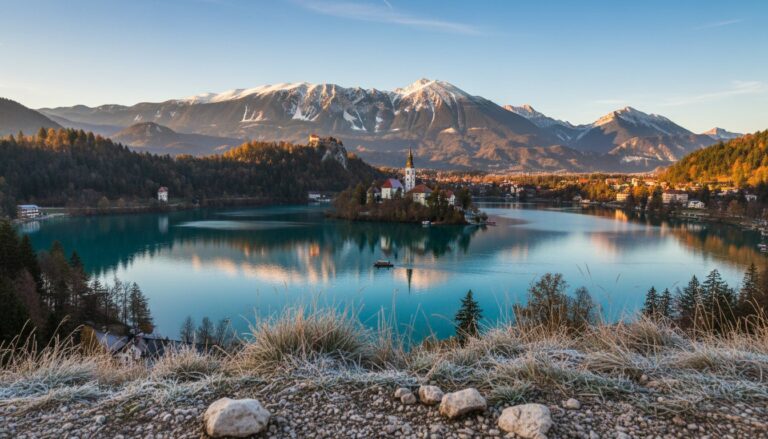
Inland, the “beaches” are lakes rather than sea. Lake Bled’s shoreline has grassy spots for picnicking and a lido-style swimming area, plus the famous rowing boats out to Bled Island, where ringing the church bell for luck is a genuinely good way to spend twenty minutes with a seven-year-old. Lake Bohinj, further into the mountains, is quieter and colder but strikingly clear, with a cable car up to Vogel that turns a simple lake visit into a half-day mountain excursion. For older children and teenagers, the Soča Valley’s turquoise river is the draw – rafting and canyoning outfits operate seasonally for families with children typically from around eight upwards, depending on the activity and water levels.
Child-Friendly Restaurants in Slovenia
Slovenian food is, happily, built for fussy eaters without anyone having to compromise their own meal to accommodate them. Dumplings turn up everywhere – štruklji, rolled and either savoury or sweet, are something close to a national comfort food – and grilled meats, bread and simple pasta dishes are standard enough on menus that children rarely face anything alarming. Along the coast, Istrian influence brings seafood and more olive oil into the picture, and pizza is reliably good and reliably available, which solves most dinner negotiations before they start.
Ljubljana’s open-air riverside food markets, held seasonally, are a good way to let children choose their own lunch from a row of stalls rather than sit through a formal meal, and most restaurants across the country are entirely unbothered by noise, mess or a toddler wandering between tables. Bled’s cream cake – a custard slice known locally as kremna rezina – is the one dessert worth specifically seeking out, not because it is sophisticated, but because it is enormous, cheap and precisely the sort of thing children remember for years.
Things to Do in Slovenia with Kids
Postojna Cave is the headline act, and deservedly so: visitors ride an electric train deep into the karst system before walking through chambers of stalactites that even the most jaded teenager tends to go quiet in front of. It is one of the few European cave systems genuinely built for mass family visits, with good paths, lighting and a manageable walking distance for most children over four or five. Nearby Predjama Castle, built into a cliff face, adds a reasonably dramatic castle fix without much extra driving.
Ljubljana itself rewards a day or two: the castle funicular, the dragon statues on the bridge of the same name, and a riverside that is pedestrianised enough for children to range a little further than usual. Vintgar Gorge, a short walkway on wooden boards above a turquoise river near Bled, is one of the better short family walks in the country – flat, scenic and over before anyone’s legs give out. Triglav National Park offers proper alpine scenery for families who want a longer hike, though its more serious trails are better suited to older children and teenagers.
Rainy-Day Activities in Slovenia with Kids
Slovenia’s weather is Alpine-adjacent, which is a polite way of saying it can turn on you without much warning, particularly in the mountains. Postojna Cave is, conveniently, immune to this entirely – a constant 10°C regardless of what is happening outside, and arguably more atmospheric in the rain than in sunshine. Ljubljana’s museums, including those covering natural history and the city’s own layered past, are compact enough not to exhaust small legs, and several have hands-on sections aimed squarely at children.
Indoor swimming complexes, often attached to the country’s thermal spa towns, are a reliable fallback – Slovenia has more thermal springs than its size suggests, and several resorts welcome day visitors with water slides and pools heated enough to make a wet afternoon feel like a treat rather than a consolation prize. Failing all that, a long lunch indoors watching the rain hit a mountain view is, truthfully, not the worst way to lose an afternoon.
Slovenia with Kids by Age: Toddlers, Juniors and Teens
Slovenia with Toddlers
Toddlers do well here largely because nothing requires much of them. Short walks with a view at the end, boat rides, and ice cream stops cover most of the itinerary without anyone needing stamina they don’t have. Pavements in towns like Bled and Piran are manageable with a pushchair, though cobbles in older town centres will test both the pushchair and your patience in roughly equal measure. Cave visits involve some walking and a fair amount of damp, chilly air, so a toddler who dislikes the dark or the cold may not thank you for Postojna.
Slovenia with Juniors (roughly 6-12)
This is arguably Slovenia’s sweet spot age group. Children old enough to walk a gorge path, row a small boat, or sit still on a cable car, but young enough to be genuinely thrilled by a bell in a church tower or a train through a cave, get the most out of the country’s low-key, outdoorsy pleasures. Swimming in lakes, cycling along flat paths near Bled, and the novelty of a castle built into a cliff all land well with this age bracket.
Slovenia with Teenagers
Teenagers want adrenaline, and the Soča Valley obliges with rafting, canyoning and zip-lining through genuinely spectacular scenery, which has the useful side effect of getting them off their phones for entire hours at a time. Ljubljana’s compact, walkable centre and reasonably lively café culture also give older children somewhere to feel briefly independent without actually being unsupervised, which is about as much as most parents can hope for.
Getting Around Slovenia with Kids
A hire car is, frankly, the sensible option. Slovenia’s size means even a two-hour drive covers a significant chunk of the country, and having your own vehicle removes the need to coordinate nap times with bus timetables. Roads are good, signage is clear, and mountain passes – while occasionally vertiginous – are generally well maintained even where the view out the window is doing its best to distract the driver.
Public transport exists and works, particularly trains between Ljubljana and larger towns, but connections to smaller lakeside or coastal spots can involve more waiting around than most families have patience for. Car seats are a legal requirement and widely available through hire companies, though booking one in advance rather than hoping for the best on arrival is worth the five minutes it takes. Within towns like Ljubljana, Bled and Piran, much of the appeal is that you barely need a car at all once you’ve arrived – they’re built, happily, at the pace of a small child’s legs.
If you are now wondering where to actually stay while doing all this, there is a separate matter of villas in Slovenia worth looking into.
Slovenia Family Holiday FAQs
What is the best time of year to visit Slovenia with kids?
Late May to early September offers the warmest weather for swimming in lakes and the sea, with July and August busiest at Lake Bled and along the coast. June and September are quieter, cooler in the evenings, and generally a more comfortable choice for younger children.
Is Slovenia safe for families with young children?
Yes, Slovenia has low crime rates, reliable healthcare and well-maintained roads, making it one of the more straightforward European countries for family travel. The main hazards are natural rather than social – mountain weather, cold cave temperatures and cobbled old town streets being the most common practical concerns.
How many days do you need in Slovenia with children?
A week allows a relaxed pace covering Lake Bled, Ljubljana and one cave visit, while ten days to two weeks gives room to add the Soča Valley and the coast without constant packing and repacking. Given the country’s small size, even a shorter trip of four or five days can cover the highlights without excessive driving.
Where to stay
Villas in Slovenia
A selection from our 49 luxury villas in Slovenia.