
Vendée Travel Guide: Where to Stay, Eat & Explore in Luxury
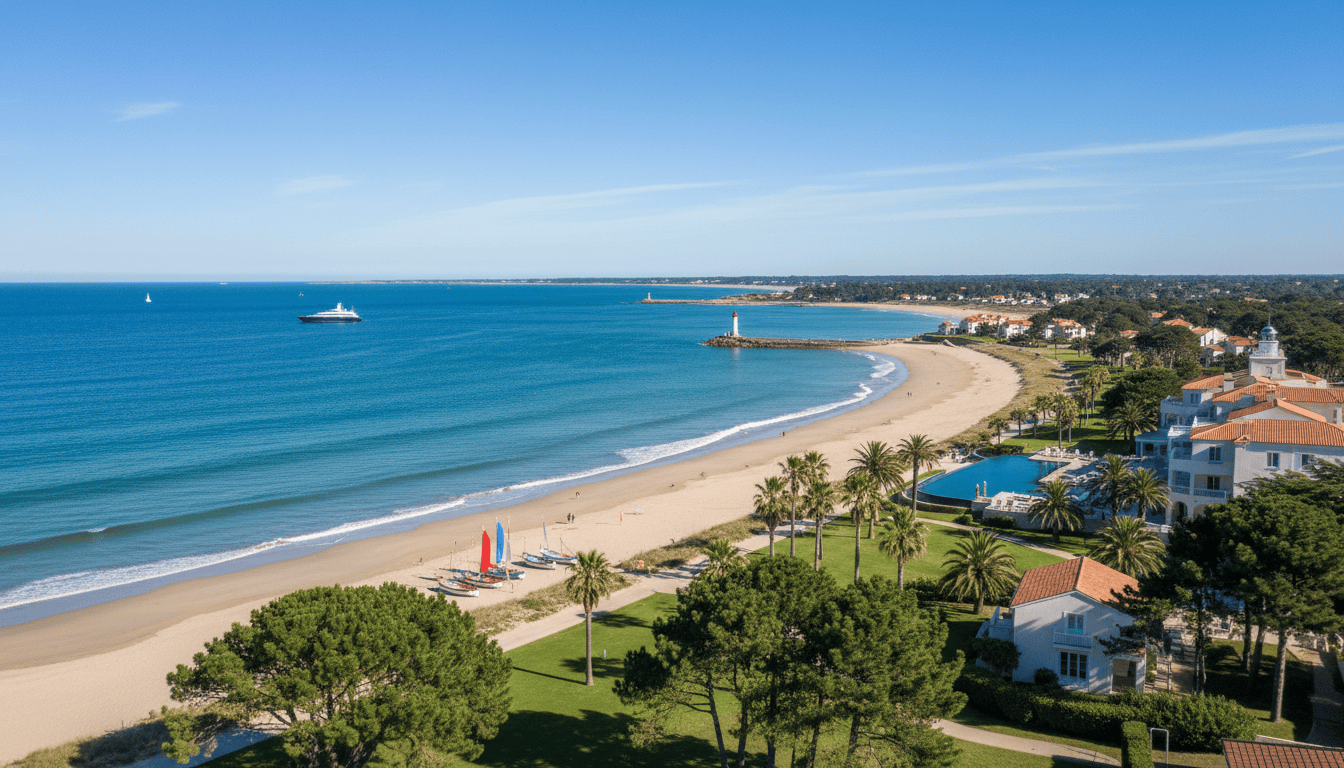
There is a particular quality to Atlantic light at seven in the morning when it hits a Vendée beach before anyone has thought to put shoes on. It arrives sideways, flat and golden, turning the wet sand into something resembling hammered bronze. The air smells of salt and warm pine and something vaguely biscuity that you eventually trace to the brioche being pulled from ovens in the boulangeries behind the dunes. Somewhere nearby, a dog is running in demented circles near the waterline. You are the only human being in sight. This, more than any resort brochure could convey, is the Vendée proposition.
It is a destination that tends to find its people rather than advertise itself to them. Families who have discovered the logic of a private villa with a heated pool – where teenagers can disappear and toddlers can splash without requiring a strategic reserve of pool noodles and anxiety – tend to come back year after year, quietly, telling very few people. Couples marking anniversaries or milestone birthdays arrive looking for something that feels genuinely French rather than internationally smoothed-off, and find it almost immediately. Groups of friends who have outgrown Airbnbs but aren’t quite ready to commit to a hotel discover that a five-bedroom villa with a long dining table and someone to bring the croissants is, in fact, the only sensible answer. And remote workers who have realised that a reliable fibre connection plus an Atlantic view is significantly better for output than an open-plan office have been treating the Vendée as their productive secret for some time now. The wellness-inclined come for the thalassotherapy centres, the cycling trails, the extraordinary quality of doing very little on a beach that doesn’t require elbowing anyone for space.
Getting Here Is Considerably Easier Than the French Countryside Makes It Sound
The Vendée sits in the Pays de la Loire region on France’s Atlantic coast, roughly halfway between Nantes to the north and La Rochelle to the south – two facts that are more useful than they might initially appear, because both cities have excellent airports. Nantes Atlantique is the primary gateway, handling direct flights from London, Birmingham, Bristol, Edinburgh and a handful of other United Kingdom and northern European cities. La Rochelle – La Pallice airport handles fewer routes but can be ideal depending on where in the Vendée you’re based. Fly-drive is unquestionably the right approach. The department is spread out in the most agreeable way possible, and having a car means the difference between experiencing Vendée and merely glimpsing it through a shuttle-bus window.
From Nantes, you’re looking at around an hour to the northern Vendée, slightly more to the southern coast. From La Rochelle, the southern beaches are particularly accessible. The roads are good, the signs are reasonably logical, and the roundabouts decorated with floral arrangements of unnerving ambition. For those coming from Paris, TGV to Nantes takes around two hours, followed by a hire car from the station. Those arriving from elsewhere in Europe can also consider the drive – the Vendée is a natural stopping point on the route south towards Spain, and many families load up the car and treat the journey as part of the holiday. Once you’re here, the most important tool is a mental gear-change towards a pace of life that is slower, warmer and considerably better for the blood pressure than whatever you left behind.
Where to Eat in Vendée: Oysters, Cognac and the Art of the Long Lunch
Fine Dining
The Vendée’s restaurant scene is perhaps the most underestimated aspect of the region. It operates quietly, without the Michelin fanfare of Burgundy or the self-congratulation of Paris, but the quality is consistently serious. The Atlantic coast delivers extraordinary seafood – langoustines, sole, sea bass – and the local chefs tend to treat them with the restraint they deserve: butter, a little white wine, a lemon and the good sense to stop there. Around the Marais Poitevin and the bocage interior, duck, rabbit and free-range pork appear on menus with the kind of quiet confidence that comes from sourcing everything within thirty kilometres. The wine lists increasingly feature bottles from nearby Loire Valley appellations – Muscadet with the oysters being less a recommendation than a requirement. For those seeking genuinely elevated dining, the larger towns of La Roche-sur-Yon, Saint-Jean-de-Monts and Les Sables-d’Olonne house restaurants with serious kitchens and fixed-price menus that represent the kind of value that makes French dining feel like it’s operating on different economic principles from everywhere else.
Where the Locals Eat
The market in Fontenay-le-Comte on a Saturday morning is the kind of place that reminds you why people move to France and never quite explain why convincingly to their friends back home. Stalls stacked with tomatoes still warm from the vine, local chèvre in every conceivable state of maturity, oysters served from the back of a van by someone who clearly considers this arrangement perfectly normal. The coastal beach shacks – cabanes – that operate along the southern coast serve plateaux de fruits de mer on paper tablecloths at eye-watering speed, and are exactly as good as they sound. In summer, the weekly night markets in villages across the department are a ritual: tables outside, musicians of mixed quality, and the collective understanding that you are not leaving before ten o’clock.
Hidden Gems Worth Seeking Out
The most rewarding eating in Vendée often happens in villages where the restaurant has no website, a handwritten chalkboard menu, and a chef who has cooked the same four dishes for twenty years because four is precisely the right number. The bocage interior – the tangle of hedgerows and lanes that covers the eastern part of the department – hides small auberges that fill up on Sundays with local families working through four-course lunches with the seriousness of people who consider this a civic duty. Oyster producers along the Baie de Bourgneuf often sell directly from the farm – turning up at the right door at the right time can result in tasting sessions that cost almost nothing and taste like the sea at its very best. Ask your villa manager. They will know which door.
The Landscape, Which Has Been Quietly Remarkable All Along
The Vendée is three entirely different places in one department, which is either very convenient or moderately confusing depending on how you approach it. The Atlantic coast stretches for over 200 kilometres, delivering fine sandy beaches – some of them truly vast and backed by fragrant pine forests – that rank among the finest in France. Saint-Jean-de-Monts, Saint-Gilles-Croix-de-Vie and the Île de Noirmoutier (connected to the mainland by a causeway that disappears at high tide in a manner that causes predictable annual drama) are the coastal anchors, each with their own character.
Move inland and the bocage takes over – that ancient agricultural landscape of sunken lanes, streams and thick hedgerows that has a softness to it entirely at odds with the exposed Atlantic coast. It is cycling and walking country of the most pleasurable variety. Further south and east, the Marais Poitevin – the Green Venice – is one of those places that has to be seen in a flat-bottomed boat to be properly understood. The network of canals, draped in duckweed and overhung with poplars, moves at a pace that makes the Mediterranean coast look harried by comparison. Taking a boat through the Marais on a warm afternoon is not exactly doing nothing, but it is as close as you can get while still technically being somewhere.
Things to Do That Will Actually Fill Your Days (Without Trying)
The Vendée has the rare quality of destinations where the activities find you rather than requiring effort to locate. The coastline is primed for water sports of every variety – surfing on the Atlantic swells near Saint-Gilles-Croix-de-Vie, sailing from the marina at Les Sables-d’Olonne, paddleboarding through glassy lagoons when the wind drops. Further inland, cycling networks cover the department with a thoroughness that makes other French regions look like amateurs. The Vendée is one of France’s great cycling departments – over 2,000 kilometres of marked routes ranging from flat coastal rides to more assertive forays through the bocage.
The Puy du Fou theme park deserves special mention not because it resembles any theme park you’ve previously encountered, but because it genuinely does not. It is an extraordinary theatrical experience built around French history, with night spectacles and gladiatorial shows staged at a scale that makes you question your assumptions about what a spectacle can be. It wins travel awards with such regularity that the ceremony presumably has a dedicated shelf reserved. Beyond that: wine cave visits in the Fiefs Vendéens appellations, pottery workshops in small village ateliers, horse riding through the bocage lanes, kayaking the canal networks of the Marais Poitevin, and the annual Vendée Globe round-the-world yacht race start in Les Sables-d’Olonne every four years, which is best described as a small city temporarily losing its mind in the most festive possible way.
Adventure on the Atlantic: For Those Who Consider Relaxing Insufficient
The Atlantic coast is genuinely one of western France’s finest surfing destinations, and the Vendée section of it is both less crowded and less aggressively cool than the famous breaks further south near Biarritz. Saint-Gilles-Croix-de-Vie and the beaches around Saint-Jean-de-Monts receive consistent Atlantic swells that reward beginners and intermediates without punishing them. Surf schools operate throughout the summer with instructors of genuine patience. For the more experienced, the exposed headlands in the south of the coast generate conditions that command respect.
Kitesurfing and windsurfing thrive along the Baie de Bourgneuf, where the winds arrive with satisfying regularity. Sailors are well catered for – Les Sables-d’Olonne is one of France’s most active sailing ports, and hiring a vessel for a day’s coastal exploration is entirely straightforward. Cyclists seeking something beyond a pleasant pedal will find the bocage routes offer a genuine workout – rolling hills, hedgerow tunnels and lanes that don’t always appear where maps suggest they should. Rock climbing exists in the Puy du Fou region. Deep-sea fishing charters operate from several coastal ports. And for those who consider all of the above insufficient, the Marais Poitevin delivers canoe and kayak routes that manage to feel like adventure while travelling at approximately the speed of a relaxed conversation.
Why Families Come Back Every Summer (And Don’t Tell Anyone)
There is a particular form of family holiday logic that reveals itself to parents around the third summer of making reservations at child-friendly hotels: the ratio of supervised stress to actual enjoyment is simply wrong. The private villa with a pool in Vendée solves this in one move. Children – of almost any age – can exist freely within the property without a single risk assessment being required. Teenagers have their own space. Babies can nap without the ambient noise of a hotel corridor. Parents can have a glass of wine at eleven in the morning without attracting judgement from anyone except themselves.
Beyond the villa gate, Vendée is exceptionally well set up for families. The beaches are broad, the Atlantic waves are engaging without being terrifying, and the Puy du Fou provides the kind of spectacular day out that children remember significantly longer than any carefully curated cultural experience. The cycling infrastructure is genuinely family-friendly – wide, car-free paths that connect resorts mean even young children can ride without drama. The Marais Poitevin boat trips are universally loved by children who have never previously considered canals interesting. And the markets, night markets, creperies and ice cream vendors that punctuate every coastal town mean that keeping everyone fed and briefly happy is never more than five minutes away.
History Here Is Not Behind Glass
The Vendée carries one of France’s most complex and largely under-discussed histories. The region was the heartland of the counter-revolutionary uprising known as the Vendée War of 1793-1796, a brutal conflict between the largely royalist and Catholic local population and the Republican forces of the Revolution. It is not a period that features prominently in the standard French history tourist circuit, which perhaps makes engaging with it here feel more genuine. The Memorial de Vendée near Les Lucs-sur-Boulogne handles the subject with the seriousness it deserves – it is thoughtfully curated, quietly affecting, and essential context for understanding the department’s particular character, which includes a self-containedness and independence of spirit that persists to this day.
The architectural legacy is rich: abbeys, medieval villages, the walled town of Vouvant with its Mélusine tower, the Renaissance château at Apremont. The Île de Noirmoutier has its own medieval castle and a salt-harvesting tradition – fleur de sel produced in the island’s salt marshes is among the finest in France and makes an impeccable thing to bring home. Local festivals celebrate everything from the vendange to traditional maritime culture. The weekly markets aren’t just shopping opportunities; they are, in the best French tradition, civic events – the point at which a community briefly acknowledges itself. Arriving at one as a visitor rather than a tourist is a distinction that takes about forty minutes to achieve and no particular effort at all.
Shopping: What to Buy and What to Leave Behind
The Vendée is not a shopping destination in the way that Paris or Lyon might be described as shopping destinations, and this is entirely to its credit. What it offers instead is a series of genuinely local products that you will not find replicated in an airport gift shop. The fleur de sel and sel gris from the salt marshes of the Île de Noirmoutier and the Baie de Bourgneuf are the obvious starting point – the hand-harvested grey salt in particular has a mineral depth that makes any other salt seem to be operating at a lower level of ambition. Local charcuterie, artisan jams made from fruit grown in the bocage, and Vendéen brioche – the region’s contribution to the canon of French baking, enriched with butter and rum – are all worth packing carefully.
Pottery workshops in the bocage produce hand-thrown pieces that are actually things you want in your house rather than things you feel obliged to bring back. The antiques markets in Fontenay-le-Comte and La Roche-sur-Yon attract serious dealers and curious visitors in roughly equal measure. Along the coast, the work of local artists – many of whom settled here specifically for the quality of the Atlantic light – is sold in small galleries in Saint-Gilles-Croix-de-Vie and Les Sables-d’Olonne. The rule of thumb is simple: if it comes from here and you can carry it, buy it. If it is a miniature lighthouse wearing a striped top, perhaps leave it where it stands.
Before You Go: The Practical Realities, Kept Mercifully Brief
Currency is the euro, which applies throughout France and will not require any adjustment. French is the language, spoken at a pace that varies from leisurely to deeply committed depending on the individual. English is widely understood in tourist areas, less so in the deeper bocage, where a phrase book and a willingness to mime will take you further than you might expect. Tipping is not obligatory in French restaurants – a service charge is included in the bill – but leaving a few coins for genuinely good service is entirely in the spirit of things and will be received with quiet appreciation rather than expectation.
The best time to visit for a luxury villa holiday in Vendée is late May through to mid-September, with June and September offering the particular combination of good weather, reduced crowds and the sense that you are experiencing the place rather than queuing for it. July and August are busy – this is the French school holiday season and the department fills rapidly, particularly along the coast. The weather is genuinely warm and often very warm throughout the summer, with temperatures regularly in the mid-to-upper twenties Celsius. The beaches, even in August, are large enough to absorb the crowds with more grace than most Mediterranean alternatives. Safety is not a concern – the Vendée is, by any reasonable measure, one of the most relaxed and low-risk destinations in France. Bring sun cream, bring an appetite, and arrive without too fixed a plan.
Why a Private Villa in Vendée Makes Every Other Option Feel Slightly Beside the Point
The luxury villa in Vendée has become the accommodation of choice for a specific kind of traveller: one who has stayed in enough excellent hotels to know that what they actually want is the hotel’s quality without the hotel’s compromises. The lobby. The breakfast room. The sense that you are sharing a property with a significant number of people whose schedules may not align with yours in any meaningful way.
A private villa here operates on entirely different logic. The pool is yours. The terrace is yours. The kitchen – often equipped to professional standard in the better properties – allows for long dinners that begin when you want them to begin and end when the conversation runs out, which in the Vendée tends to be quite late. For families, the spatial freedom is transformative: children have room to exist without managing their volume, grandparents have their own wing, and the question of what to do with a wet swimsuit is never again someone else’s problem. For groups of friends, the communal space of a villa produces the kind of holiday that actually creates memories rather than simply costing money.
The better luxury villas in Vendée offer considerably more than four walls and a pool. Private chefs can be arranged for evenings when cooking feels like ambition rather than pleasure. Concierge services can source the best table in Les Sables-d’Olonne or organise a private sailing charter before you’ve finished your coffee. Wellness amenities – outdoor pools, hot tubs, home gyms, treatment rooms – are increasingly standard in the premium category, making it possible to design a genuinely restorative week without leaving the property more than you choose to. For remote workers, the best properties now offer fibre broadband and dedicated workspace that makes the question of productivity genuinely moot. You can work. You simply don’t have to feel bad about where you’re working from.
The combination of privacy, scale, service and setting that a luxury villa delivers here is, in short, simply the best way to experience this part of France. Browse our full collection of luxury holiday villas in Vendée and find the property that fits the trip you actually want to take.
More Vendée Travel Guides
What is the best time to visit Vendée?
Late May through to mid-September is the ideal window for a luxury villa holiday in Vendée, with June and September widely regarded as the sweet spot. The weather is reliably warm, the beaches are manageable, and the restaurants are operating at full capacity without the compressed busyness of the peak July-August period. If you’re travelling with children during school holidays, July and August are unavoidable – but the Vendée’s beaches are large enough to handle the summer influx better than most comparable coastal destinations in France.
How do I get to Vendée?
The primary gateway is Nantes Atlantique airport, which receives direct flights from multiple UK cities including London, Bristol, Birmingham and Edinburgh, as well as connections across northern Europe. La Rochelle airport to the south is useful for those staying in the southern Vendée. A hire car is strongly recommended – the department is spread out and having your own transport is the difference between experiencing Vendée properly and experiencing a small section of it. From Nantes, most Vendée destinations are between 45 minutes and 90 minutes by car. TGV from Paris to Nantes takes approximately two hours, with hire car connections available from the station.
Is Vendée good for families?
The Vendée is genuinely excellent for families, and not in the qualified, asterisked way that some destinations claim to be. The beaches are broad and the Atlantic waves are engaging for children without being hazardous. The Puy du Fou – a remarkable historical theatre park rather than a conventional theme park – consistently rates as one of France’s top family attractions. Cycling infrastructure across the department is family-friendly, with wide car-free paths connecting resorts. The Marais Poitevin boat trips are universally popular with children. And a private villa with a pool removes the logistical friction of family travel at a stroke – children have space, adults have peace, and everyone shares the same property at their own pace.
Why rent a luxury villa in Vendée?
A private luxury villa in Vendée gives you something that even the best hotel cannot: the property is entirely yours. Private pool, private terrace, private kitchen for the meals you want to cook, private dining space for the meals you want to arrange with a chef. The staff-to-guest ratio in a villa setting – where concierge, chef and housekeeping services can be arranged specifically for your party – is fundamentally different from a hotel environment. For families, the space means children can exist freely without volume management. For couples, the privacy creates an atmosphere that a boutique hotel, however lovely, simply cannot replicate. For groups, the communal spaces of a well-chosen villa produce the kind of shared holiday that people actually reference years later.
Are there private villas in Vendée suitable for large groups or multi-generational families?
Yes – the Vendée villa market includes a strong selection of larger properties specifically suited to multi-generational families and groups. These range from spacious five and six-bedroom properties with separate wings for different generations, through to larger estate-style villas with multiple guest houses or cottages on the same grounds. Private heated pools, large outdoor dining terraces and generous interior living spaces are standard features in the premium category. Concierge services and private chef arrangements can be made to suit groups of varying sizes. The key advantage is that larger parties can travel together while retaining the privacy of separate sleeping and living spaces – an arrangement that significantly reduces the interpersonal negotiations that large group holidays sometimes generate.
Can I find a luxury villa in Vendée with good internet for remote working?
Increasingly, yes. Fibre broadband is now widely available across the Vendée, and premium villa properties in the area typically offer high-speed connectivity as standard. Some more rural properties have adopted Starlink satellite internet for locations where terrestrial broadband infrastructure is less reliable, providing consistent high-speed connections regardless of location. If remote working connectivity is a priority, it is worth specifying this at the point of enquiry so the property can confirm speeds and arrangements in advance. Many luxury villas also offer dedicated workspace or study areas that allow for productive working hours alongside the genuine pleasure of a holiday in the rest of the day.
What makes Vendée a good destination for a wellness retreat?
The Vendée combines several elements that make it genuinely well-suited to a wellness-focused stay. The pace of life is unhurried in a way that feels genuine rather than curated. The outdoor environment – Atlantic beaches, pine forests, the Marais Poitevin waterways, hundreds of kilometres of cycling and walking routes – provides a natural framework for physical reset. Thalassotherapy centres along the coast offer seawater-based treatments that have a long tradition in this part of France. And luxury villa amenities in the premium category increasingly include heated outdoor pools, hot tubs, home gyms and treatment rooms that make it possible to build a meaningful wellness programme without leaving the property. The quality of the local food – fresh Atlantic seafood, organic produce from the bocage, excellent Loire Valley wines taken in moderation – provides the kind of natural nutrition that wellness retreats elsewhere charge considerable fees to approximate.


