Moon Sanctuary Saint Lucia | 1-Bedroom Resort in Mamin
Holiday Home Rental Description
Two guests arrive at Moon Sanctuary Saint Lucia expecting a villa. Instead, they discover an architectural statement that dissolves the boundary between interior and landscape. Perched 600 metres above the Caribbean on the Anse Chastanet estate in Soufrière, this singular retreat commands views of the UNESCO-listed Pitons that most visitors only glimpse from boat tours—here, they dominate the horizon at eye level from your bed, your bath, your infinity pool.
Inside Moon Sanctuary Saint Lucia
Moon Sanctuary Saint Lucia sleeps 2 guests across 1 bedroom and 1 bathroom, occupying 1,600 to 1,950 square feet of meticulously considered space. The property feels larger than its footprint suggests because architect Nick Troubetzkoy—celebrated for sustainable luxury design—removed what most resorts insist on keeping: walls.
The bedroom dominates the western exposure of the sanctuary. A king-size bed dressed in crisp linens faces the Pitons directly; waking here means opening your eyes to one of the Caribbean’s most photographed geological formations. Oversized recliners flank a low platform, positioned for the kind of slow morning that makes clock time irrelevant. You’ll find a fridge, electric kettle, and coffee machine within arm’s reach, plus a mosquito net suspended overhead—a practical acknowledgment that you’re sleeping suspended between civilization and rainforest.
The bathroom ascends via three shallow steps to an open-air platform (privacy maintained through elevation and vegetation). A walk-in rainfall shower occupies one corner; a double vanity with high-end bath products and soft robes faces the other. The couples’ soaking tub—a raised whirlpool large enough for two—sits at the platform’s edge, positioned so you can warm yourself in bubbling mineral water while the Pitons watch.
The dining zone occupies the sanctuary’s centre: a compact table suitable for two, or four with careful arrangement, positioned so meals occur under the open ceiling. A working desk sits nearby, equipped with Wi-Fi and an electronic safe—concessions to the digital world that guests can activate or ignore entirely. The sofa grouping—a statement sectional with recliners deep enough to sink into—anchors the living area, though “living area” understates the function: this is where you spend 90% of your time, because the boundary between inside and outside has been deliberately erased.
Temperature regulation comes via ceiling fans and the natural cross-breeze that funnels through the 4th-wall opening. The property intentionally omits television and radio, forcing an immersion into natural rhythms. Some guests experience this as liberation. Others bring books they never open.
Outdoor Spaces and Living
The infinity pool—approximately 650 square feet—constitutes the property’s most distinctive feature. Edge-less water extends from interior flagstone to the infinite Caribbean beyond, creating an optical illusion of pool merging into sea. At sunset, the water reflects the Pitons in shades of rose and amber. In early morning, it mirrors cloud formations moving inland from Dominica (visible 18 kilometres to the north). The pool maintains heated temperature year-round.
Beyond the pool lies a narrow terrace of natural stone. Here, a low wall of stacked local volcanic rock defines the sanctuary’s perimeter without blocking sight lines. Loungers placed at strategic intervals face either the Pitons to the south or the Caribbean sweep to the west. The terrace itself measures approximately 200 square metres, enough for a small ceremony, insufficient for a party—intentional insularity built into the site plan.
The approach to Moon Sanctuary follows a bridge-style walkway that signals transition: from the main resort infrastructure (29 other sanctuaries scattered across the 600-acre estate) into absolute seclusion. The vegetation immediately surrounding the sanctuary comprises native palms, flowering plants maintained by the estate’s horticultural team, and mature trees that provide morning shade and evening wind breaks. No manicured lawn; instead, natural ground cover and strategic plantings that ensure privacy without the aesthetic cost of walls.
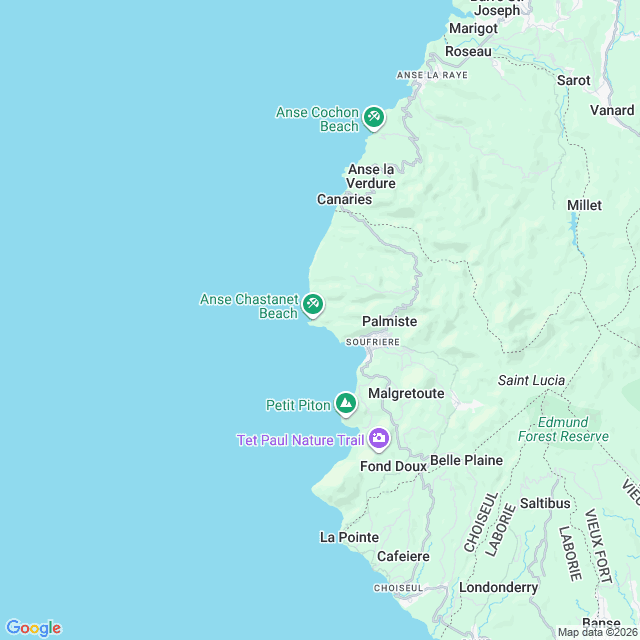
Mountain views encompass the forested slopes rising behind the Pitons. Sea views span from Soufrière village (directly below, 3 kilometres away) to the arc of beach at Anse Chastanet (1.5 kilometres southwest). The sanctuary’s elevation means afternoon light arrives late and lingers; dawn arrives earlier than at sea level, waking you with birdsong and the smell of moisture rising from the forest floor.
Location: Soufrière and The Pitons
Soufrière occupies a unique position in Caribbean geography and psychology. Once St. Lucia’s capital, this 300-year-old settlement sits in the shadow of the Pitons—two volcanic peaks rising 740 metres from sea to summit in under a kilometre horizontal distance. The town comprises colonial-era architecture, colourful wooden shophouses, and a working waterfront where fishing boats share space with tourist vessels. The atmosphere feels lived-in rather than curated, a distinction that matters.
Moon Sanctuary sits 3 kilometres uphill from Soufrière town centre, accessible by a 10-minute shuttle from the main resort or a 15-minute car ride from the town. This positioning provides access to local life without exposure to tourist congestion. The nearest supermarket—Simply Groceries—operates 2 kilometres away in town, stocked adequately for self-catering, though most sanctuary guests arrange meal preparation through the resort’s chef service.
Specific sites worth visiting: The Soufrière Sulphur Springs (5 kilometres south) remain the world’s only drive-in volcano, accessible by rental car. The landscape appears lunar—mud pots belching steam, mineral-rich pools reaching 40 degrees Celsius, the air thick with sulphur. Diamond Falls Botanical Gardens (2 kilometres east) occupies the former Soufrière Estate plantation, featuring mineral baths unchanged since 1784 and pathways winding through tropical specimens. The Rabot Estate (7 kilometres north) operates as Hotel Chocolat’s sourcing origin point, offering the “Bean to Bar” experience where visitors learn chocolate production and craft their own bars—a worthwhile 3-hour diversion.
Sugar Beach, the Caribbean’s widest accessible sand beach, lies 4 kilometres south along the coastal road—a 10-minute drive suitable for swimming, snorkelling, or sunset drinks at the beachfront bar. Anse Chastanet Beach, directly below the sanctuary, provides a smaller, less crowded alternative with dive operators offering reef tours and wreck dives.
The Jade Mountain Club—exclusive to sanctuary guests—sits 1 kilometre from Moon Sanctuary, accessible by footpath or shuttle. The open-air restaurant commands Pitons views from a rooftop terrace; the menu rotates daily based on Caribbean sourcing. Reservations essential; the kitchen operates at capacity most evenings.
Saint Lucia’s cultural calendar shapes visitation patterns. Carnival runs through July, with street parades, calypso competitions, and a 3-week energy that transforms the entire island. The St. Lucia Jazz Festival occurs in May across multiple venues, with international acts and local performers sharing stages. The Gros Islet Friday Night Street Party (40 kilometres north, 50-minute drive) operates year-round, with local vendors, live soca and reggae, and an atmosphere that blurs the line between block party and cultural institution.
Best travel periods: December to March offers dry weather, trade winds, and reliably calm seas—the winter season, when European and North American visitors arrive in volume. Prices peak during this window. June to November brings the Atlantic hurricane season, though St. Lucia sits outside the principal hurricane belt, experiencing instead occasional tropical showers and dramatic afternoon cloudbursts. These months offer lower prices, fewer crowds, and a particular intensity to the light—the clarity after rain passes is photographic.
When planning your visit to this Caribbean sanctuary, explore our luxury villas in Saint Lucia, browse our villas in Soufrière, and discover our full collection in the Caribbean. For deeper destination inspiration, read our Caribbean travel guide featuring Soufrière & The Pitons.
Who This Villa Suits Best
Moon Sanctuary Saint Lucia functions optimally for romantic partnerships—the 2-guest capacity, couples’ soaking tub, and architecture designed around intimate dinners point toward this use case. Honeymooners comprise the majority of bookings; the property handles anniversaries with equal grace.
Solo travellers occasionally book, valuing the privacy and the permission to disappear into reading, writing, or meditation for entire days. The Wi-Fi remains reliable for remote work, though the deliberate lack of office infrastructure suggests the accommodation expects guests to prioritize disconnection.
Small families with children aged 10 and above find the property workable—one parent and one child could comfortably occupy the king bed with a rollaway if required. However, the open-plan design and pool edges without barriers create safety considerations for toddlers. The sanctuary’s isolation means parents cannot easily access childcare or emergency medical services; guests requiring this infrastructure should book instead within the main resort.
Professionals booking consecutive nights for a working retreat appreciate the desk setup and stable Wi-Fi, provided they can accept that the environment encourages rest rather than productivity. The Pitons view tends to interrupt concentration.
Practical Information
Moon Sanctuary Saint Lucia accommodates a maximum of 2 guests across 1 bedroom with 1 bathroom. The property does not include separate annexes, sofa beds, or expandable sleeping arrangements.
Hewanorra International Airport (UVF) lies 65 kilometres south, a 90-minute transfer by rental car or pre-arranged shuttle (approximately USD 80–120 depending on time of day). George F. L. Charles Airport (SLU) operates 20 kilometres north near Castries, reducing transfer time to 35–45 minutes; however, this airport handles regional turboprops rather than international jets.
Check-in occurs at the main Jade Mountain resort, 1 kilometre away. The concierge coordinates transfer to Moon Sanctuary, provides orientation to the sanctuary systems (pool temperature, water pressure, Wi-Fi password), and distributes the “firefly” communication device—a two-way radio allowing 24-hour contact with the Major Domos (butler service) for any need from restaurant reservations to emergency medical response.
Included in rental rates: heated pool maintenance, Wi-Fi internet access, linens and towels, pool towels, ceiling fan operation, basic kitchenette provisions (coffee, tea, sugar), bathroom amenities, mosquito netting, in-room safe, ironing facilities, and complimentary parking. Optional services (charged separately): chef meal preparation, butler housekeeping, spa treatments, yoga instruction, and excursion arrangements through the concierge.
Electricity operates on 220-volt AC (50 Hz); North American appliances require voltage conversion. Mobile phone coverage reaches the sanctuary through local providers Digicel and Flow; international roaming typically costs USD 5–8 per day. The sanctuary’s elevation occasionally creates temporary satellite internet latency during tropical weather; hardline Wi-Fi proves more reliable.
Frequently Asked Questions about Moon Sanctuary Saint Lucia
How many guests does Moon Sanctuary Saint Lucia sleep?
Moon Sanctuary Saint Lucia accommodates a maximum of 2 guests. The property contains 1 bedroom with 1 king-size bed and 1 bathroom. No sofa beds, rollaway beds, or separate sleeping quarters exist, making this property unsuitable for groups or families requiring multiple beds.
What is the nearest airport to Moon Sanctuary Saint Lucia?
Hewanorra International Airport (UVF) sits 65 kilometres south and requires approximately 90 minutes by car. George F. L. Charles Airport (SLU) operates 20 kilometres north near Castries with a 35–45 minute transfer. UVF handles international flights from North America, Europe, and the region; SLU accommodates regional turboprop service from neighbouring islands.
What is the best time of year to rent Moon Sanctuary Saint Lucia?
December through March offers reliable dry weather, trade winds, and calm seas—peak season with corresponding pricing. May hosts the St. Lucia Jazz Festival, attracting music enthusiasts. June through November brings Atlantic hurricane season rains (St. Lucia sits outside the principal hurricane belt); however, tropical showers clear quickly, revealing extraordinary atmospheric clarity and significantly reduced crowds. This window offers the best value for budget-conscious guests and photographers seeking dramatic light.
Is Moon Sanctuary Saint Lucia suitable for families with children?
Moon Sanctuary works moderately well for families with children aged 10 and older. The property offers no separate children’s beds or nursery facilities. The infinity pool lacks safety barriers; parents must provide constant supervision. The sanctuary’s remote location means limited access to childcare services or paediatrician care. Families requiring these amenities should consider accommodation within the main Jade Mountain resort, which provides more infrastructure and shorter emergency response times.
What is included in the rental price at Moon Sanctuary Saint Lucia?
Rental rates include heated pool maintenance, Wi-Fi internet, linens and towels, pool towels, electricity for ceiling fans and appliances, basic kitchenette supplies (coffee and tea), high-end bathroom amenities, mosquito netting, electronic in-room safe, ironing facilities, and complimentary parking. Meals, butler service, spa treatments, and yoga instruction are available as optional add-ons charged separately.
What restaurants and shops are near Moon Sanctuary Saint Lucia?
The Jade Mountain Club restaurant (1 kilometre away, accessible by footpath) operates exclusively for sanctuary guests; the rooftop terrace commands Pitons views, and the kitchen sources daily Caribbean ingredients. Simply Groceries supermarket operates in Soufrière town centre (2 kilometres away) for self-catering supplies. Soufrière town offers several casual seafood spots and casual dining; none rival the calibre of the Jade Mountain Club. Most sanctuary guests arrange in-villa chef service through the concierge for breakfast and dinner, using the kitchenette for light lunch preparation.