
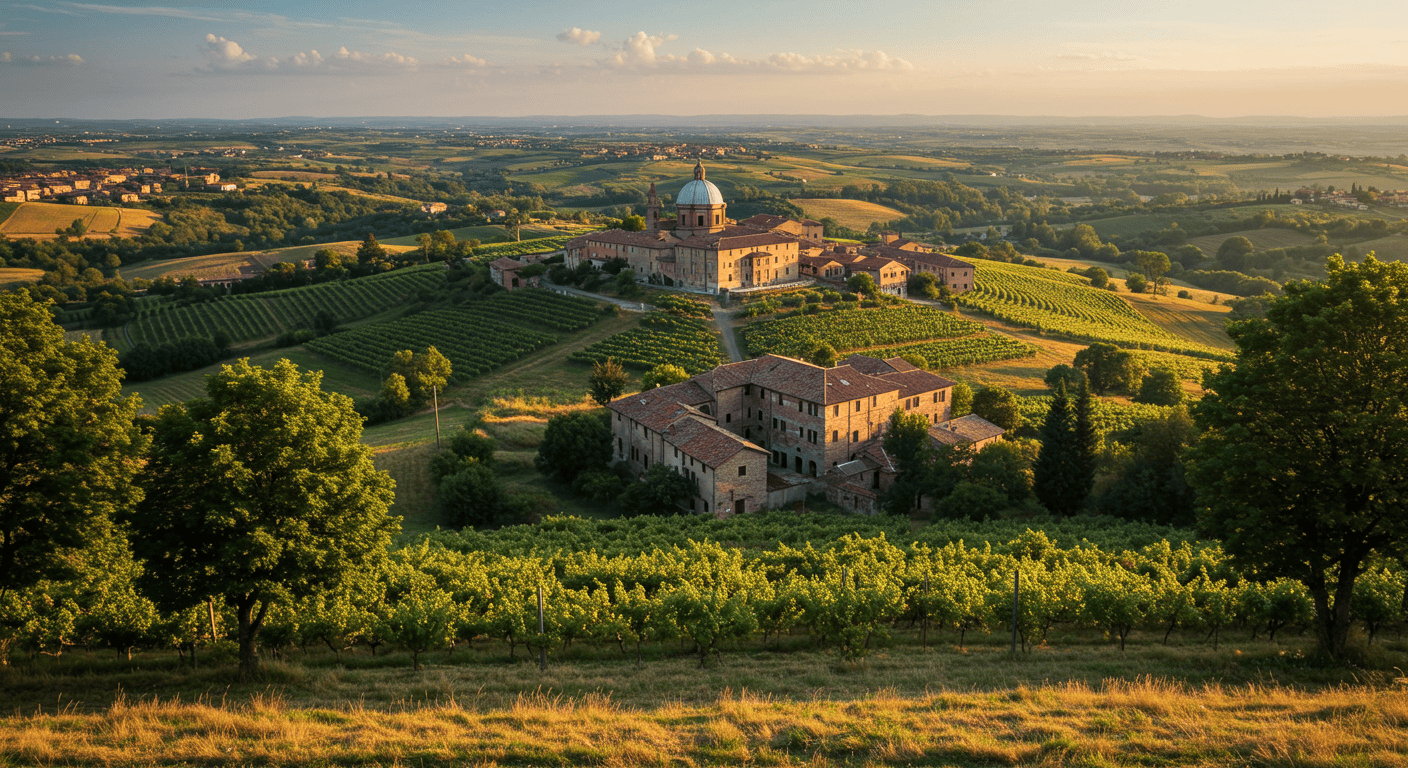
Emilia-Romagna Travel Guide: Where to Stay, Eat & Explore in Luxury
France gets the credit. Tuscany gets the Instagram posts. But Emilia-Romagna gets the dinner. This long, landlocked corridor of northern Italy – stretching from the Adriatic coast in the east to the foothills of the Apennines in the west – is the place where Italy’s greatest culinary achievements were quietly, methodically perfected over centuries, without any particular interest in your opinion of them. Parmigiano-Reggiano. Prosciutto di Parma. Mortadella. Bolognese ragù, which bears almost no resemblance to what the rest of the world has been serving up for decades. This is the region that feeds Europe’s most food-obsessed continent, and it does so with a kind of serene, unfussy confidence that is either deeply admirable or slightly intimidating, depending on how you feel about being judged by a 70-year-old nonna for eating pasta incorrectly.
Emilia-Romagna rewards a particular kind of traveller – one who would rather spend an afternoon in a Parmesan producer’s cave than rush between three UNESCO sites before lunch. Couples marking a significant birthday or anniversary find something almost ceremonial about it: the region has a slowness, a deliberateness, that makes milestones feel properly observed rather than merely photographed. Families seeking privacy – particularly those who’ve grown weary of hotel lobbies and other people’s children – discover in its countryside villas a rare kind of peace, with space for grandparents and teenagers to coexist without anyone having to pretend they’re enjoying it. Groups of friends who take food seriously (and there’s always one in every group who takes it very seriously indeed) find the region an embarrassment of riches – in the most literal sense. Remote workers who’ve discovered they can do their best thinking somewhere beautiful will find excellent connectivity in many of the region’s better-equipped properties, while wellness-focused guests drawn by thermal spas, hiking trails and the intoxicating simplicity of eating extraordinarily well will wonder, not for the first time, why they ever thought a juice cleanse was a good idea.
Getting Here: Easier Than You’d Think, Better Than You’d Hope
Bologna Guglielmo Marconi Airport is the natural gateway for most of the region, and it punches well above its size. Direct services connect it to a solid range of European cities – London, Amsterdam, Paris, Zurich among them – and the journey into central Bologna takes around 20 minutes by the Marconi Express rail link, which is efficient enough to feel almost Swiss. For the Adriatic coast, Rimini Federico Fellini Airport offers an additional option, with seasonal routes expanding considerably in summer. Milan’s airports – Malpensa and Linate – are viable for those arriving from further afield or connecting internationally, with Bologna roughly two hours south by train on the high-speed line that also serves Florence and Rome.
Once you’re here, the calculus shifts. The region rewards driving. The autostrada network is extensive, but the real pleasure lies in the secondary roads that unspool between vineyard and bell tower, connecting Parma to Reggio Emilia to Modena in a way that no train timetable can quite replicate. Car hire from Bologna airport is straightforward, and if you’re staying in a rural villa – as you should be – it’s essentially non-negotiable. Italian drivers are exactly as advertised. You’ll adjust quickly.
The Table is the Point: Eating in Emilia-Romagna
Fine Dining
Modena holds a place in global gastronomy somewhat out of proportion to its modest size, and the reason is Osteria Francescana. Massimo Bottura’s three-Michelin-star restaurant has twice been named the world’s best, and a meal there remains one of those rare experiences where the hype is not only justified but barely adequate. Dishes like “Five Ages of Parmigiano Reggiano” or “Oops! I Dropped the Lemon Tart” – that second one is exactly what it sounds like, and exactly what it isn’t – represent a kind of culinary intelligence that doesn’t often make it this far north of Naples without dilution. Reservations open months in advance; plan accordingly, or be philosophical about it.
Beyond Francescana, the region’s Michelin-starred landscape is genuinely impressive. Il Trigabolo in Argenta and La Frasca in the Bertinoro hills represent the more classically rooted end of the spectrum, where technique serves tradition rather than subverting it. In Bologna, the dining scene is layered and serious: Dal Corsaro and Pappagallo have long histories, but newer addresses like Oltre and Scaccomatto demonstrate that the city’s appetite for innovation is entirely intact.
Where the Locals Eat
The real action in Bologna happens in the Quadrilatero, the ancient market district east of Piazza Maggiore where butchers, cheese sellers and pasta makers have operated from the same addresses for generations. This is where you buy your lunch before you’ve decided what it is – a wedge of aged Parmigiano here, a paper cone of mortadella there, possibly a glass of Lambrusco at a counter that hasn’t been renovated since 1987 and is all the better for it. The trattorie that cluster around the university quarter – Bologna’s academic population keeps prices somewhere in the vicinity of honest – offer ragù the way it’s supposed to taste, on tagliatelle wide enough to be structural, for prices that feel almost accusingly reasonable.
In Parma, the aperitivo culture runs deep. Turn up at any respectable bar between six and eight and you will find that a glass of Franciacorta comes accompanied by more food than most British restaurants serve as a main course. Nobody mentions this to tourists, which is either generosity or strategy.
Hidden Gems Worth Seeking Out
The Colli Bolognesi – the hills south of Bologna – harbour a number of small family-run agriturismi that serve food made almost entirely from what they grow, rear or age on the premises. These aren’t restaurants in any formal sense; you eat what you’re given, at the time you’re given it, and the results are frequently extraordinary. The surrounding wine production here – Pignoletto in particular – is criminally underrated and priced accordingly. Further south in the Apennines, the villages around Brisighella offer trattorie where the printed menu is more of a suggestion than a commitment, and where turning up at 1.30pm on a Tuesday and asking for advice is the correct approach.
A Region in Chapters: Exploring the Landscape
Emilia-Romagna is long – nearly 300 kilometres from the Adriatic to the Ligurian border – and it divides itself usefully into distinct registers. The Via Emilia, the ancient Roman road from which the region takes half its name, runs like a spine through the northern plain connecting Piacenza, Parma, Reggio Emilia, Modena and Bologna in a chain of cities each convinced, not entirely without reason, that it is the most important. The cities are walkable, the distances between them are sensible, and the whole arrangement feels almost suspiciously convenient.
North of the Via Emilia, the Po Delta stretches into wetland territory of surprising beauty – migratory birds in extraordinary numbers, flat water the colour of pewter at dusk, a landscape that feels more Nordic than Mediterranean and is completely unlike anywhere else in Italy. South, the land lifts into the Apennines with gathering seriousness, reaching forested ridgelines and medieval hill villages that have been watching armies march through for two thousand years with studied indifference. The Adriatic coast – from Comacchio down through Ravenna and Rimini – adds a third dimension: seaside Italy in its full, cheerful, slightly chaotic expression, summer beach clubs lined up with military precision, the air carrying equal quantities of sunscreen and espresso.
Ravenna, often visited as an afterthought, should be a primary destination. Its Byzantine mosaics – in the Mausoleum of Galla Placidia, in the Basilica of San Vitale – are among the most extraordinary things created by human hands in the whole of the peninsula. They are also genuinely, unexpectedly beautiful in a way that photographs do not prepare you for.
What to Do When You’re Not Eating (Which Is a Valid Question)
The honest answer is: not much, but in the best possible way. Emilia-Romagna is not primarily an activities destination in the way that coastal resorts package activities to fill the days. It rewards an exploratory pace – city mornings, long lunches, afternoon drives, aperitivo at six. That said, the options are far wider than the region’s food reputation suggests.
The motor valley is a genuine cultural phenomenon. Ferrari, Lamborghini, Pagani, Maserati and Ducati all have their roots here, within a relatively compact radius around Modena. The Ferrari Museum in Maranello and the Lamborghini Museum in Sant’Agata Bolognese are properly immersive rather than merely promotional, and driving experiences on the test tracks can be arranged through specialist operators for those who’ve always wanted to know what happens when you remove the speed limiter. The answer is: everything happens very quickly.
Wine tours through the Colli Piacentini, the Colli di Parma and the Colli Bolognesi can be designed with considerable precision – visiting producers, walking vineyards, tasting in cellars where the ambient temperature hasn’t changed since the building was constructed. Traditional balsamic vinegar production in Modena and Reggio Emilia is another world – the acetaie (vinegar lofts) where Aceto Balsamico Tradizionale ages for a minimum of twelve years in successive barrels of diminishing size are peculiar, evocative places, smelling of nothing so much as concentrated time.
For cultural day trips, Ferrara – one of the best-preserved Renaissance cities in Europe – sits just north of Bologna and receives a fraction of the attention it deserves. Its Este castle, medieval walls and grid of Renaissance streets are in near-immaculate condition, and on a quiet morning in spring or autumn, it has an atmosphere of almost startling serenity.
The Active Option: Hills, Bikes and High-Speed Corners
Cycling in Emilia-Romagna is serious business. The region has produced more Tour de France contenders per square kilometre than arguably anywhere outside France itself, and the road cycling culture reflects this in the quality of its routes and the respect extended to cyclists by drivers – which is, at minimum, more than you’d receive in most cities. The Apennine climbs south of Bologna and Modena are genuinely challenging – the kind of ascents that separate enthusiastic amateurs from people who’ve been training since February – but the rewards at the top involve both views and the particular satisfaction of having earned lunch. Road bikes can be hired, guided tours arranged, and the cycling infrastructure in cities like Ferrara and Parma is comprehensive enough for leisurely urban exploration.
Hiking in the Apennines spans everything from gentle half-day walks through chestnut forest to multi-day ridge routes along the Alta Via dei Parchi, a long-distance trail that traverses the regional national parks. Wildlife here includes deer, wild boar and – for those who know where to look – wolves, which have recolonised the higher elevations over the past two decades with quiet but unmistakeable success.
The Adriatic coast offers water sports from May through September: windsurfing and kitesurfing around Lidi di Comacchio, sailing out of Rimini and Riccione, and stand-up paddleboarding in the calmer waters of the lagoons. Skiing in winter is available in the Cimone range, the highest Apennine peaks in the region, a day-trip distance from Bologna for those who’ve exhausted the museums and want cold air and a different kind of mountain restaurant.
Taking the Kids: Why This Works Better Than You Might Expect
Italy with children is always good. Italy with children and a private villa is transformatively good. The anxiety of hotel restaurant dinners, of keeping small people quiet in shared spaces, of negotiating between the needs of a four-year-old and the interests of a grandparent, dissolves when you have a private kitchen, a private pool and a garden that doesn’t belong to anyone else. Emilia-Romagna in particular suits families who want to use a base – rather than constantly move between it – exploring outward and returning to the same familiar space each evening.
Practically: children are genuinely welcomed in Italian restaurants, not merely tolerated in the way they sometimes are in the United Kingdom. The food is almost universally accessible – pasta with simple sauces, fresh bread, gelato at every turn. The motor valley museums operate at a pitch that captivates children of about eight upwards with an efficiency that would embarrass most national museums. The Adriatic beach resorts are set up for family summer holidays with an infrastructure bordering on the military – pedalo hire, beach games, shallow warm water, lidos with full catering. Families considering a luxury holiday in Emilia-Romagna will find the region much more child-friendly than its culinary reputation suggests.
Twenty Centuries in Twelve Cities: History and Culture
Emilia-Romagna’s history is layered in a way that rewards curiosity without demanding it. The Romans built the Via Emilia in 187 BC as a military road through newly conquered territory, and its ghost runs straight through the modern region in the form of the SS9, roughly replicating the original alignment. The cities that grew along it each developed distinct identities under successive rulers – the Este in Ferrara, the Farnese in Parma, the Bentivoglio in Bologna – resulting in a concentration of Renaissance architecture, civic art and ducal ambition that gives almost every city centre its own coherent visual personality.
Bologna’s Two Towers – the Asinelli and the Garisenda – lean over the medieval city centre with a kind of companionable instability that has been alarming visitors since the twelfth century. The porticoes for which Bologna is famous – over 38 kilometres of covered walkways, recently listed as a UNESCO World Heritage site – give the city a particular urban quality, allowing passage between buildings in all weathers without quite being inside or outside, which is philosophically interesting and practically excellent in August.
Parma’s Baptistery and Cathedral contain frescoes by Correggio and Antelami that rank among the most sophisticated religious art in northern Italy, and the Galleria Nazionale in the Palazzo della Pilotta holds a collection of comparable depth that receives a small fraction of the tourist traffic of Florence’s Uffizi. This is either a cultural injustice or a considerable advantage, depending on which side of the velvet rope you’re standing on.
Ravenna’s mosaics, already mentioned, bear repetition. The gold ground tesserae of the sixth-century basilicas glow with a quality of light that is entirely their own – not reflective in the way modern materials reflect, but somehow internally lit, as if the gold is generating rather than receiving illumination. It is genuinely strange and genuinely beautiful, and it makes the works in every other medium nearby look temporarily ordinary.
The region’s festivals are worth planning around: the Verdi Festival in Parma each autumn is the year’s most serious operatic event outside Salzburg and Bayreuth; the Ravenna Festival in June and July draws performers of international standing to venues whose acoustic qualities were established before the amplifier was invented; and the Modena food festivals – particularly those centred on the Acetaia season – turn balsamic vinegar into something approaching a civic religion, which it effectively already is.
What to Bring Home: Shopping That Requires Luggage Rethinking
The answer to what to buy in Emilia-Romagna is almost entirely edible, and the logistics require planning. A wheel of genuine Parmigiano-Reggiano aged 36 months weighs approximately 40 kilograms and is therefore, regrettably, impractical. The good news is that vacuum-packed wedges travel beautifully, and the difference between Parmigiano bought at source – from a caseificio (dairy) in the production zone, ideally one that will let you taste three different ages before committing – and the supermarket equivalent at home is the difference between a revelation and a condiment.
Culatello di Zibello – the great cured meat of the Po plain, more elusive and more expensive than Parma ham, produced in limited quantities from pigs raised in the fog-wrapped lowlands north of Parma – is available in specialist salumerie in Parma and Soragna and will reorganise your understanding of what cured pork can be. Traditional balsamic vinegar of Modena (not to be confused with the commercially produced variety, which is a different product entirely) comes in small bottles that travel easily and cost enough to indicate that the contents are serious. They are.
For non-edible souvenirs: Parma has a genuinely good independent retail scene around Via Cavour and the streets east of the Duomo – small boutiques carrying Italian craft goods, ceramics and clothing that haven’t been manufactured for the tourist market. Bologna’s Quadrilatero and the streets around Via d’Azeglio offer similar browsing pleasures. The antique markets of Ferrara and Faenza – the latter a city that gave its name to faïence pottery and still produces it with real skill – reward a morning of unhurried exploration.
A Few Things Worth Knowing Before You Go
The currency is the euro and credit cards are accepted almost everywhere, though cash remains useful in rural agriturismi and smaller market transactions. Tipping is not the obligation it is in the United States; rounding up or leaving a few euros on the table at a restaurant is perfectly appropriate and will be received with genuine, unperformative warmth.
The best time to visit depends on what you’re after. Spring – April through June – offers the region at its most quietly beautiful: moderate temperatures, wildflowers in the Apennine meadows, truffle season in the hills, and restaurant reservations that don’t require strategic advance planning. September and October are arguably finer still – harvests in progress, the light turning golden, mornings with enough chill to make a second coffee feel earned. July and August bring the Adriatic coast to life and are ideal for families, but the cities can be hot enough to require adjustment. Winter has its own pleasures: Parma and Modena in December, with the mist rising from the Po plain, feel like places that have been properly lived in for a long time, which of course they have.
Dress modestly for churches – which here means shoulders covered and knees below the hem, rather than the theatrical cover-up negotiations that occur in more tourist-saturated parts of Italy. The locals dress well. Not extravagantly, but with attention. Nobody will say anything if you don’t, but you’ll notice. Learn ten words of Italian; the response in goodwill is disproportionate to the effort involved. The formalities matter here – buongiorno when you enter a shop, grazie and prego in their correct contexts, and the understanding that dinner before eight is something only children and tourists do, and that the distinction is not always flattering.
The Villa Proposition: Why a Private Property Changes Everything
There is a version of Emilia-Romagna that involves boutique hotels in historic city centres – and those hotels are genuinely excellent. But the version that makes people seriously consider coming back involves a private villa in the Colli Bolognesi, or a converted farmhouse in the Parma hills, or a country property within reach of Modena’s motor valley, with a pool that belongs to no one but you and a kitchen large enough to do justice to what you’ve been buying at the local market all week.
The space argument is straightforward. A group of eight or ten people sharing a villa has room to be together and room to be apart – a distinction that becomes increasingly important by day three of any holiday, however much you like each other. Multi-generational families find in a private property the particular peace of different rhythms coexisting without friction: grandparents on the terrace at seven, teenagers in bed at noon, children in the pool all afternoon, everyone at the same table for dinner. It is a civilised arrangement that no hotel, however well-run, can quite replicate.
For couples on a significant trip – an anniversary, a milestone birthday, a deliberate deceleration – the intimacy of a private property is a different thing entirely from a hotel room, however beautifully appointed. To cook (or have a private chef cook) in a kitchen that’s yours for the week, to take breakfast in a garden where no other guests are performing their own version of a continental morning, to swim in a pool that doesn’t require timing your laps around other people’s children: these are not trivial pleasures.
Many of the better luxury villas in Emilia-Romagna now come equipped with connectivity that supports serious remote work – fibre broadband and in some properties Starlink – making the region viable for those who work and travel simultaneously. A well-designed villa study or dedicated workspace, combined with a morning commute of twelve steps to a table with a view of vine rows, represents a working arrangement that requires genuinely little justification. Wellness amenities in the better properties run to private gyms, outdoor pools, hot tubs and proximity to the region’s thermal spa tradition – the spa towns of the Apennines are close enough to reach in an hour. The infrastructure for restoration, in every sense, is there.
The region’s food culture also makes the villa kitchen argument uniquely compelling here. To visit a Parmigiano producer in the morning, buy culatello at a salumeria in the afternoon and then serve both – properly, unhurriedly, with a glass of chilled Pignoletto at sunset – in your own private space is to inhabit the region rather than visit it. Which is, in the end, the point.
Explore our collection of private villa rentals in Emilia-Romagna and find the property that makes all of the above possible.
More Emilia-Romagna Travel Guides
What is the best time to visit Emilia-Romagna?
Spring (April to June) and early autumn (September to October) offer the most rewarding conditions. Temperatures are moderate, crowds are manageable and the seasonal food calendar – truffles, harvests, festival season – is at its most interesting. July and August are best suited to the Adriatic coast and families who want beach weather. Winter in the cities is atmospheric and underrated, particularly around the Christmas markets in Parma and Modena.
How do I get to Emilia-Romagna?
Bologna Guglielmo Marconi Airport is the primary gateway, with direct flights from across Europe and connections via Rome and Milan from further afield. The Marconi Express rail link connects the airport to Bologna city centre in around 20 minutes. Rimini Federico Fellini Airport serves the Adriatic coast with expanded seasonal routes in summer. High-speed trains connect Bologna to Milan (just over an hour), Florence (35 minutes) and Rome (just over two hours), making the region accessible from multiple entry points. A hire car is strongly recommended for exploring the countryside and smaller towns.
Is Emilia-Romagna good for families?
Genuinely excellent, though perhaps not in the ways you’d expect. The motor valley museums captivate car-obsessed children of school age; the Adriatic beach resorts are purpose-built for summer family holidays; and the cities are safe, walkable and extremely tolerant of children in restaurants. The real advantage for families, however, is a private villa: space for different generations to coexist without friction, a private pool, a kitchen for feeding small people at sensible hours, and a garden that belongs entirely to you. The food is accessible and of extraordinary quality, which is something children may not fully appreciate until they’re adults, at which point they’ll be grateful.
Why rent a luxury villa in Emilia-Romagna?
A private villa allows you to inhabit the region rather than just visit it – to cook with what you’ve bought at local markets, to eat dinner at your own table rather than at someone else’s schedule, and to have a private pool and terrace entirely to yourself. The staff-to-guest ratio in a well-appointed villa – particularly one with a private chef or concierge service – far exceeds anything a hotel can offer at the same price point. For groups, couples and families alike, the privacy, space and freedom fundamentally change the quality of the experience.
Are there private villas in Emilia-Romagna suitable for large groups or multi-generational families?
Yes. The region’s rural villa stock includes substantial converted farmhouses and country properties with multiple bedrooms, separate wings or annexes, private pools and generous outdoor entertaining space – well suited to groups of eight, ten or more. Multi-generational families benefit particularly from the layout flexibility: separate living areas allow different age groups their own space without the group losing its coherence. Many larger properties also offer staff options including private chefs, housekeeping and concierge services, which makes the logistics of feeding and entertaining a large group considerably more relaxed.
Can I find a luxury villa in Emilia-Romagna with good internet for remote working?
Increasingly, yes. Many of the better-equipped properties in the region now offer fibre broadband, and Starlink connectivity is available in a growing number of rural villas where fixed-line infrastructure has historically been patchy. If reliable connectivity is a priority, it’s worth specifying this at the point of enquiry so that the property can be verified before booking. A good villa concierge service can also help arrange a dedicated workspace setup if required. The combination of fast internet, a quiet study or terrace, and extraordinary food within reach makes Emilia-Romagna a genuinely compelling remote working destination.
What makes Emilia-Romagna a good destination for a wellness retreat?
Several things working together. The pace of life in the region – unhurried, focused on quality rather than quantity of experience – is inherently restorative. The Apennine hill country offers serious hiking and cycling in clean air through forested landscapes. The thermal spa tradition is long-established: spa towns including Salsomaggiore Terme and Riolo Terme are within easy reach of the main villa areas and offer treatments rooted in the region’s natural mineral waters. At villa level, private pools, outdoor spaces, and proximity to some of the best food in the world – fresh, seasonal, prepared with skill – provide a standard of physical and mental restoration that most dedicated wellness resorts would struggle to match.


