Best Time to Visit Brittany: Tides, Crêpes & Pink Granite
The best time to visit Brittany is late May through September, when daytime temperatures reach 18-22°C (64-72°F) and the region’s festivals and coastal towns are in full swing. June and September offer the best balance of reliable weather and manageable crowds, while July and August are the busiest and most expensive months. Winter is mild by French standards but wet and windy, with many seasonal restaurants and smaller attractions closed outside the main towns.
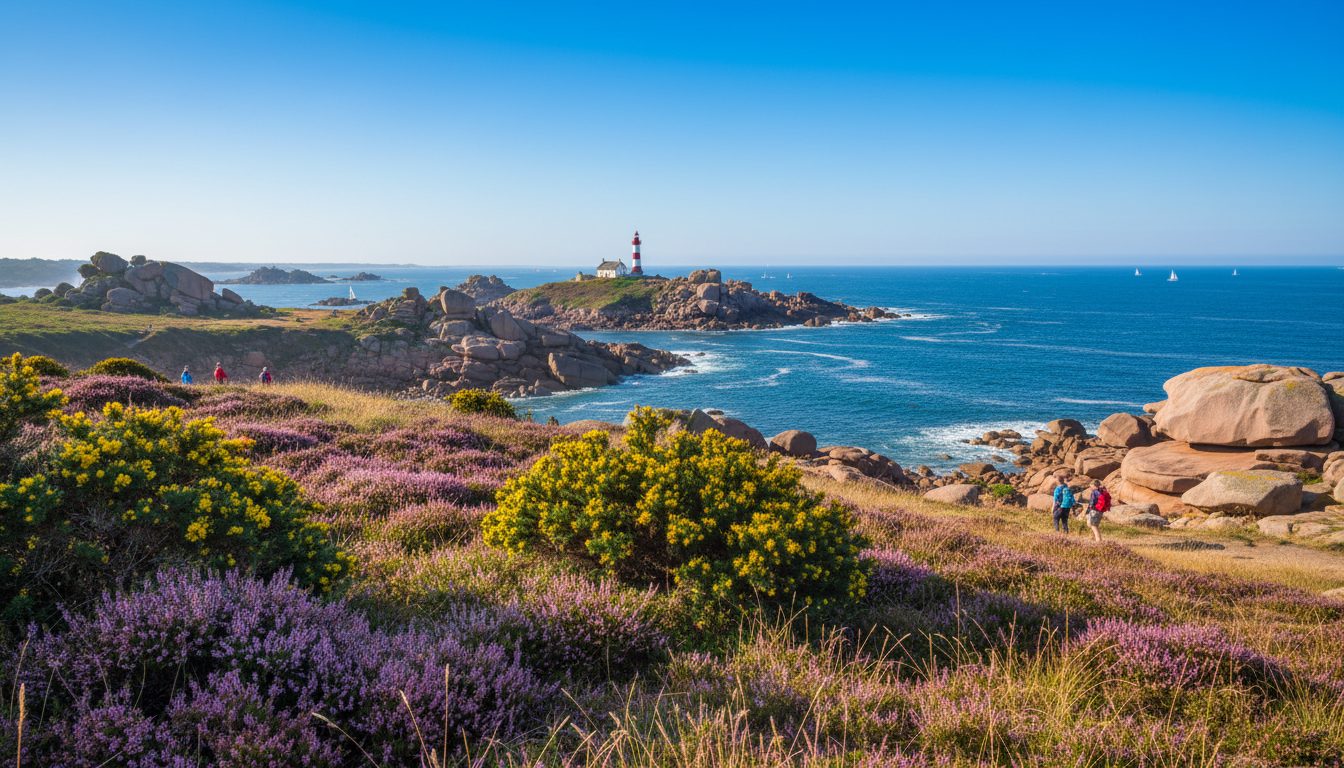
There is a particular moment, usually around seven in the morning at Ploumanac’h on the Pink Granite Coast, when the tide has pulled back so far that the pink boulders look stranded on a beach that didn’t exist an hour earlier. A fisherman will be checking pots among the rocks as though this enormous geological joke were entirely unremarkable. Give it four hours and the sea will have reclaimed the lot. This, more than any brochure photograph, is Brittany: a place where the weather and the water rearrange the furniture daily, and where “four seasons in one day” is less a cliché than a weather forecast.
That changeability is the single most important thing to understand before picking your dates. Brittany sits exposed to the Atlantic, which means mild winters, cool summers compared to the south of France, and a genuine chance of sideways rain in any month including August. None of this makes it a bad destination – it makes it one you plan with slightly more care than, say, Provence. This guide breaks the year down season by season so you can match your trip to what you actually want from it, whether that’s crêpe-eating in a near-empty Saint-Malo or sailing the Golfe du Morbihan in a flotilla of a thousand boats. For the wider picture of what the region offers beyond its calendar, the Brittany Travel Guide covers the ground in full.
Best Time to Visit Brittany: At a Glance
- Best overall: Late May to mid-September for warmth and festivals
- Best for value and quiet: June and September
- Best for swimming: Late July to early September, when the sea finally warms up
- Best for festivals: July and August (music, Celtic culture, sailing)
- Best for oysters and seafood: September to December
- Cheapest and quietest: November to March
Brittany in Spring (March to May): Weather, Crowds and Blossom
Spring in Brittany arrives in fits and starts. March still feels wintry, with temperatures of 6-11°C (43-52°F) and rain a near-daily companion, particularly in Finistère on the western tip. By May, though, things have genuinely turned: daytime highs reach 13-16°C (55-61°F), hedgerows along the coastal paths fill with wild flowers, and the light has that clear, scrubbed-clean quality that photographers chase.
Crowds are light through April and only start building in late May, largely around the Golfe du Morbihan when the biennial sailing festival takes over the gulf in odd-numbered years, filling Vannes and the surrounding ports with traditional rigged boats. Prices for accommodation remain reasonable, restaurants reopen after their winter break, and the coastal footpaths – the GR34, which traces almost the entire Breton coastline – are at their most pleasant before the July heat and the July crowds arrive together. Spring suits walkers, cyclists and anyone who would rather have Carnac’s standing stones mostly to themselves.
Brittany in Summer (June to August): Festivals, Beaches and Peak Crowds
This is Brittany at its most sociable and its most expensive. June is arguably the sweet spot within summer: temperatures of 14-19°C (57-66°F), longer daylight hours, and crowds that haven’t yet reached their August peak. July and August bring the warmest weather of the year, 16-21°C (61-70°F) on land and sea temperatures finally climbing to a swimmable 17-19°C, plus the region’s biggest events. The Festival Interceltique de Lorient fills the town with Celtic music and bagpipes for ten days in August, while the Vieilles Charrues festival near Carhaix draws enormous crowds for several days of music in July.
The flip side is real: coastal towns like Saint-Malo, Dinard and Concarneau get properly busy, parking becomes a competitive sport, and villa and hotel prices rise accordingly. Book well ahead if travelling in August, particularly around the festival dates. Summer suits families, festival-goers and anyone prioritising reliable beach weather over elbow room. It does not suit anyone with a low tolerance for queues at the crêperie.
Brittany in Autumn (September to November): Oysters, Storms and Quiet Coves
September is, for many regulars, the best month of all. The sea has had all summer to warm up, temperatures sit at a comfortable 14-19°C (57-66°F), the school-holiday crowds have gone home, and the oyster beds at Cancale are approaching their best. October brings a noticeable cooling, 11-15°C (52-59°F), and the first proper Atlantic storms, which locals treat as entertainment and visitors tend to find either thrilling or alarming depending on temperament.
By November the weather has turned genuinely autumnal – 7-11°C (45-52°F), shorter days, more rain – but this is also when Saint-Malo hosts the start of the Route du Rhum, a transatlantic sailing race that briefly fills the walled town with sailors, support crews and a surprising amount of noise. Many smaller restaurants and seasonal attractions begin closing from late October through to Easter, so check ahead if travelling off the main towns. Autumn suits food-focused travellers, photographers who like drama in their skies, and anyone who finds a stormy harbour more interesting than a crowded beach.
Brittany in Winter (December to February): Mild, Wet and Wonderfully Empty
Winter here is mild rather than cold – think 4-9°C (39-48°F) rather than snow – but it is reliably wet and often windy, with Finistère bearing the brunt of Atlantic fronts. Daylight is short, the sea is a uniform grey, and a good number of smaller hotels, restaurants and seasonal attractions close their doors until spring. Saint-Malo, Vannes and the larger towns stay open and functioning, but the smaller coastal villages can feel genuinely shut.
What winter offers in return is solitude, at prices to match. The Pink Granite Coast without a single other visitor on it is a different experience to the same stretch in August, and a bowl of cotriade fish stew tastes better after a walk in proper weather. Christmas markets appear in towns such as Rennes and Quimper. Winter suits travellers who prize atmosphere and value over swimming weather, and who have packed, without exception, a decent waterproof.
Shoulder Season in Brittany: Why May, June and September Win
If pressed to pick a single window, most seasoned visitors land on late May through June, or the whole of September. The logic is straightforward: temperatures are comfortable (13-19°C / 55-66°F depending on the exact week), the worst of the crowds haven’t arrived or have already left, accommodation prices sit well below the August peak, and the region’s restaurants and attractions are fully open and unhurried. The light is also better for photography than the flatter, haze-heavy light of high summer.
These shoulder months are particularly good for anyone wanting to combine beach time with serious walking or cycling, since the coastal paths are far more comfortable without summer’s heat. Sailing enthusiasts should note that the Golfe du Morbihan’s major sailing festival runs in late May on its odd-year cycle, giving shoulder season a genuine event to build a trip around rather than just favourable statistics.
Off-Season in Brittany: The Case for Winter
There is a reasonable argument for visiting Brittany precisely when nobody tells you to. Winter rates for accommodation drop noticeably, the region’s walled towns and fishing ports regain the proportions they were built for, and restaurants that remain open tend to be the ones locals actually use rather than those catering to the summer trade. The weather will not cooperate consistently, and you should expect at least one day of being driven indoors by horizontal rain – but a fire, a plate of galettes and a glass of local cider go a long way toward making that an asset rather than a complaint. Off-season Brittany suits independent travellers, food lovers and anyone who has already done the crowded version and would like to see what’s underneath it.
For anyone weighing up where to base themselves once the dates are settled, a look at villas in Brittany is a sensible next step.
Brittany Weather and Seasons FAQs
Is Brittany warmer or cooler than the rest of France?
Brittany is generally cooler and wetter than inland or southern France, thanks to its Atlantic exposure. Summers rarely get as hot as in Provence or the Rhône valley, and winters are milder than central France, though rain and wind are more frequent year-round.
When is the sea warm enough to swim in Brittany?
Sea temperatures peak in late August and early September at around 17-19°C, having spent most of the summer catching up to air temperature. Hardier swimmers go in from June, but most visitors wait until mid-July onward for comfortable conditions.
Does it rain a lot in Brittany, even in summer?
Yes, rain is possible in any month, including July and August, though summer showers tend to be shorter and interspersed with sunshine. Western Finistère sees more rainfall overall than the eastern side of the region around Rennes and Saint-Malo.
Keep reading
More on Brittany
- Travel guideBrittany Travel Guide
- RestaurantsBest Restaurants in Brittany
- Food & wineBrittany Food & Wine
- FamiliesBrittany with Kids
Guides to places in Brittany
Where to stay
Villas in Brittany
A selection from our 107 luxury villas in Brittany.