
Audrix Travel Guide: Where to Stay, Eat & Explore in Luxury
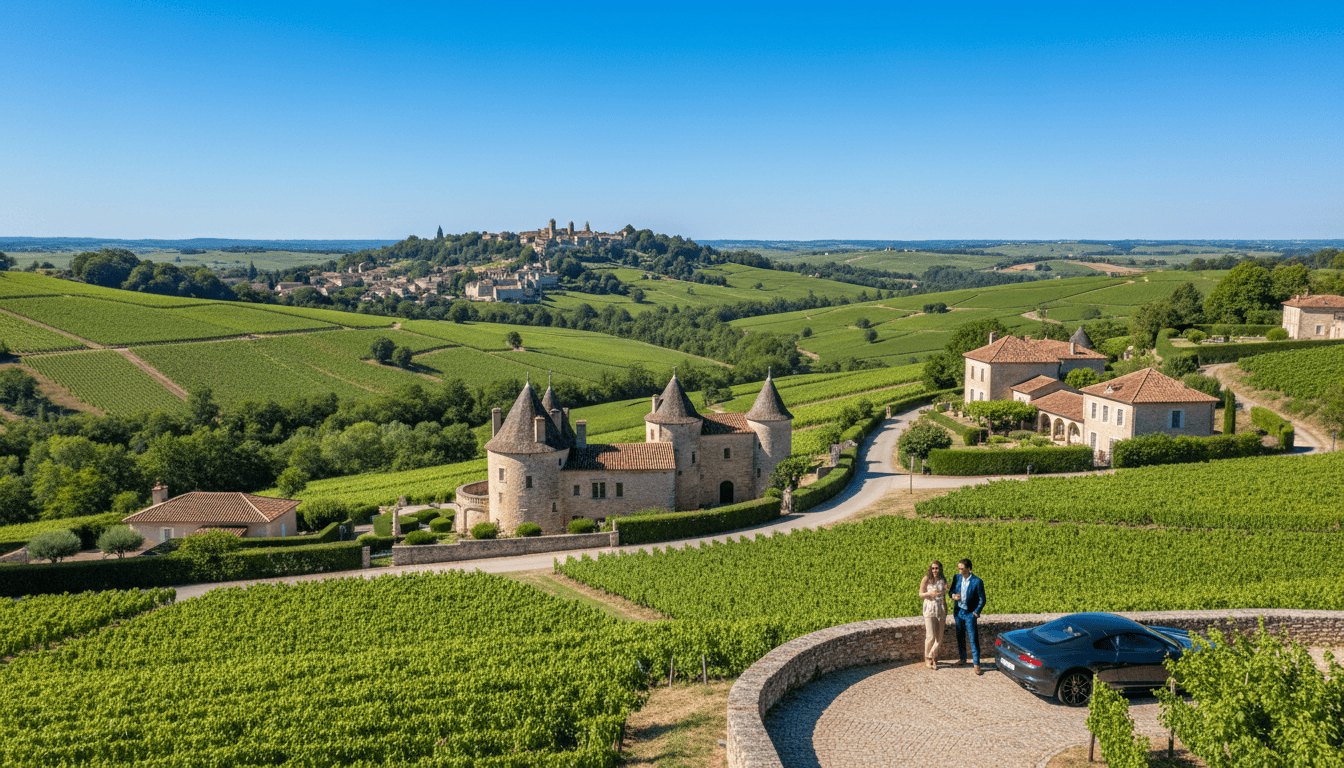
The morning light arrives slowly here, as if it too is reluctant to disturb the quiet. You’re sitting on the terrace of your stone-walled villa in the Périgord Noir, coffee in hand, a valley of oak and walnut trees dropping away below you in shades of green that painters have been attempting – and largely failing – to reproduce for centuries. A church bell sounds somewhere in the village. A tractor moves across the ridge in the middle distance. Nobody is trying to sell you anything. Nobody is playing music from a Bluetooth speaker. The bread you picked up from the boulangerie in Le Bugue is still warm. This, without any fanfare whatsoever, is what a genuinely good day feels like.
Audrix is a commune in the Dordogne department of south-west France, and it is the kind of place that attracts a particular kind of traveller – one who has already done the obvious things and is now looking for something more considered. Couples celebrating significant anniversaries arrive for the privacy, the slow pace, and the particular pleasure of spending a week somewhere that rewards walking rather than queuing. Families with younger children who need space, a private pool, and the ability to eat at seven o’clock without anyone tutting, find that a luxury villa in Audrix delivers exactly that. Groups of friends renting a large house together discover that this corner of the Dordogne has enough to fill a fortnight without once feeling rushed. Remote workers who’ve discovered that a laptop functions just as well with a view of the Vézère valley as it does facing a partition wall have also been making their way here in growing numbers. And wellness-focused guests who want long walks, excellent food, minimal noise, and the kind of sleep that only comes with genuine darkness – they come too, and they come back.
Getting Yourself Here – and Why the Journey Is Already Part of It
The nearest international airports to Audrix are Bergerac (Dordogne Périgord Airport), roughly 40 kilometres to the west, and Bordeaux-Mérignac, approximately 120 kilometres further. Bergerac is the more convenient of the two for most visitors, with direct flights operating from several UK airports including Stansted, Bristol, and Gatwick – particularly through Ryanair and Blue Islands, with seasonal routes making summer access genuinely straightforward. Bordeaux offers considerably more frequency and year-round connections from across Europe, and the drive south through the Entre-Deux-Mers wine country is, frankly, not a hardship.
From either airport, hiring a car is not optional – it’s essential. Audrix is a village in the truest sense: a church, a handful of houses, some extraordinary views, and no public transport to speak of. A car is what allows you to drive to Sarlat for dinner, to Beynac for a riverbank picnic, or to the market in Le Bugue on a Tuesday morning without coordinating logistics that belong in a military operation. The roads are small, occasionally vertiginous, and largely delightful. Budget thirty minutes from Bergerac airport, ninety from Bordeaux, and rather more if you keep stopping to take photographs of things you’ve already photographed twice.
Eating in the Dordogne: Where Foie Gras Is Not a Novelty, It’s Just Tuesday
Fine Dining
The Dordogne is one of France’s great eating regions, and the area around Audrix draws on a culinary tradition that runs deep – foie gras, confit duck, truffles from the Périgord Noir, walnuts pressed into oil that makes every salad feel slightly celebratory. The nearest village of real culinary weight is Les Eyzies, a short drive away, which has long punched above its size for restaurants. The town of Sarlat-la-Canéda, approximately twenty minutes east, is the regional capital of good living, and its restaurant scene – especially around the old town – delivers the kind of food that makes you reconsider your return flight. Look for establishments with seasonal menus built around local truffle, duck, and stone-fruit; this is emphatically not the moment for dietary conservatism.
Le Bugue, the nearest market town to Audrix, has its own quiet constellation of good tables – nothing that makes international best-of lists, but the sort of unpretentious French restaurant where the set menu is three courses, costs less than you’d expect, and leaves you unable to move. The wine list will be local and largely excellent. Order Bergerac rouge rather than defaulting to Bordeaux; you’ll be pleased you did, and your wallet will also be pleased.
Where the Locals Eat
Le Bugue market on Tuesday mornings is mandatory. It is not the largest market in the Dordogne – that distinction belongs to Sarlat on Saturday – but it has a density of good produce that rewards slow browsing. Local farmers bring walnut oil, aged cheeses, seasonal vegetables, and charcuterie boards that would make a London deli weep. Stock up for the villa kitchen. This is one of the overlooked joys of a self-catering luxury villa holiday – the ability to cook something spectacular at home from ingredients you bought that morning, glass of wine in hand, nobody watching.
For a more casual evening out, the villages and small towns around Audrix support a reliable circuit of ferme-auberges – farm restaurants, essentially, where you eat what’s been made that day from what’s been grown next door. Menus are limited, tables are shared, and the experience sits somewhere between a very good dinner and a genuine privilege. Book ahead. They fill up because they should.
Hidden Gems Worth Seeking Out
The truffle markets at Sainte-Alvère, held on Monday mornings through the winter season, are among the most authentic agricultural experiences in the region – and almost entirely unvisited by anyone who isn’t already in the know. The Cave Coopérative at Monbazillac, just outside Bergerac, produces a sweet wine that pairs devastatingly well with foie gras and is sold at prices that suggest the entire operation hasn’t quite realised it’s become fashionable again. And if you encounter a walnut press operating in September or October – a moulin à huile – stop and ask if you can watch. The answer is almost always yes, and the result is an education in why French cooking tastes the way it does.
The Périgord Noir: A Landscape That Earns Its Reputation
Audrix sits within the Périgord Noir – the southernmost of the Dordogne’s four colour-coded regions, named for the density of its oak and truffle-producing woodland rather than anything meteorological. The landscape is genuinely distinctive: limestone plateaux cut through by river valleys, cliffs that drop sharply to the Vézère and Dordogne rivers, and a quality of light that changes hour by hour in ways that explain why this region has attracted painters, writers, and people who’ve simply run out of good excuses not to move here.
The Vézère valley, which lies within easy reach of Audrix, is a UNESCO World Heritage Site – one of the most significant prehistoric landscapes on earth, home to the decorated caves of the Lascaux complex, the rock shelters of Les Eyzies, and more Paleolithic history per square kilometre than almost anywhere else in the world. The Dordogne river itself, broader and more pastoral, offers a different kind of beauty: medieval châteaux reflected in slow water, canoe hire points, and market towns built from the same golden limestone as the cliffs above them.
Sarlat-la-Canéda is the obvious regional centrepiece – a medieval town so comprehensively preserved that it has been used as a film set more than once, and where the Saturday market transforms narrow streets into something that smells extraordinary and moves very slowly. Worth the twenty-minute drive, worth arriving early, and worth lingering over lunch before driving back through the walnut groves.
What to Do All Day Without Once Feeling Guilty About It
The single most productive activity in Audrix is doing less than you usually would. The destination exercises a quiet gravitational pull towards unhurried mornings, long lunches, and afternoons that dissolve into early evenings without quite meaning to. This is a virtue, not a design flaw. That said, the area is not short of things to actually do.
Canoeing the Dordogne river is one of the region’s great simple pleasures – launching from Vitrac or Cénac-et-Saint-Julien and drifting downstream past Château de Castelnaud and Château des Milandes, stopping where the bank looks inviting, arriving somewhere for a cold drink in a state of uncomplicated satisfaction. The Lascaux caves complex at Montignac – specifically Lascaux IV, the most recent and most technically sophisticated reproduction – is among the most genuinely affecting archaeological experiences in France; the original cave is sealed to prevent further deterioration, but the replica is rendered with such precision that the distinction feels academic once you’re inside.
Local cycling routes thread through walnut orchards and past limestone villages with a frequency that rewards two wheels. The Via Vélo des Rois follows the Dordogne river through terrain that is largely flat beside the water and rather less flat if you venture uphill, which the views occasionally make compulsory. Les Eyzies is worth an afternoon for the Musée National de Préhistoire alone – a remarkable collection housed in a cliff-face building that is itself a kind of exhibit.
For Those Who Prefer Their Holidays to Come with a Heart Rate
Hiking in the Périgord Noir is seriously good. The GR36 long-distance trail passes through the wider area, and there are shorter marked circuits – balisage orange – starting from several nearby villages that cover limestone plateaux, river viewpoints, and woodland paths where the silence is interrupted only by woodpeckers and the distant sound of someone else having a better time than they expected to. The terrain around Audrix itself offers elevated views of the surrounding valleys that reward the modest effort required to reach them.
Cycling for the more committed – including road cycling on quiet departmental roads with gradients that build character – has become increasingly popular in the Dordogne. Mountain biking trails exist around several local forest areas, and rental outlets in Les Eyzies and Sarlat can equip you to a reasonable standard. Rock climbing operates around the limestone cliffs of the Vézère valley, with guided sessions available for those who prefer their vertical experiences supervised by someone who knows which holds are reliable.
Kayaking and white-water canoeing exist at the more energetic end of the river activity spectrum, with faster sections upstream near Argentat if the leisurely float past châteaux feels insufficiently athletic. Hot air ballooning over the Dordogne valley is available through several operators and produces the kind of photographs that make everyone who stayed on the ground deeply envious. It is one of the very few experiences that genuinely delivers what the brochure promises.
Bringing Children to a Place That Doesn’t Know It’s Child-Friendly (and Is Therefore Perfect)
Audrix does not have a soft play centre. It does not have a waterpark. What it does have is the particular form of magic that happens when children have a private pool, a large garden, space to roam safely, and adults who’ve stopped checking their phones because there’s nothing that needs checking. Families in luxury villas here report – consistently – that children acclimatise to the pace within about eighteen hours and then start expressing opinions about cheese.
The Lascaux caves are one of Europe’s great experiences for children old enough to understand what they’re seeing – which is earlier than most parents expect. The prehistoric landscape of the Vézère valley has a way of making history feel urgent rather than dusty. Le Thot, a smaller prehistoric site near Montignac with living animals from the Palaeolithic period (or at least close analogues), is particularly effective for younger visitors. Canoeing the Dordogne is manageable from about age six with calm water conditions, and most hire operators will advise honestly about suitability.
The privacy of a villa also solves a problem that families staying in hotels know well: the problem of other guests. Children can eat when they’re hungry rather than when the restaurant turns over tables. Babies can sleep in their own room rather than in the wardrobe. Teenagers can have their own space and therefore, by some mysterious alchemy, become nicer to be around. The pool is available at six in the morning if someone insists on it. Nobody will mind.
Prehistory, Châteaux, and a Region That Has Been Civilised for Longer Than Most
The Périgord Noir’s claim to historical significance is not modest. The Vézère valley alone contains over two hundred prehistoric sites, fifteen of which were collectively recognised as a UNESCO World Heritage Site in 1979. The cave paintings at Lascaux – discovered in 1940 by four teenagers and a dog, which remains one of the more extraordinary accidents in archaeological history – date to approximately 17,000 years ago and represent one of humanity’s earliest and most sophisticated acts of art-making.
The medieval period layered its own ambitions onto this ancient landscape. The Hundred Years’ War between England and France was largely fought over the Dordogne region, and its physical legacy is everywhere: Château de Beynac, clinging to its cliff above the river, and Château de Castelnaud directly opposite, were rival fortresses held by opposing sides for much of the fourteenth and fifteenth centuries. Standing on the ramparts of either and looking across the water at the other puts the longevity of that particular argument into helpful perspective.
Sarlat’s medieval architecture – largely intact because the town’s economy stagnated during the post-revolutionary period and nothing was therefore demolished to build something more modern – offers one of the most concentrated collections of fifteenth and sixteenth-century buildings in France. The cathedral, the Lanterne des Morts (a mysterious twelfth-century tower whose precise function is still debated by people who enjoy debating such things), and the organic tangle of streets between them are best explored on foot, early morning, before the market crowds arrive.
What to Bring Home (That Isn’t a Fridge Magnet)
The Dordogne’s artisan food economy is the obvious starting point for anyone who shops with a cool bag. Walnut oil from a local press, truffle products from the markets at Sainte-Alvère or Sarlat, aged duck confit in sealed jars, and jars of foie gras that survive the journey home if transported with reasonable care – these are the things that allow the holiday to extend its influence for another week after you’ve returned to reality. They also make significantly better gifts than anything sold in airport departures.
Pottery from local artisan workshops appears in and around the villages near Les Eyzies and Beynac, much of it influenced by the region’s prehistoric aesthetic. Textile workshops producing linen and cotton goods – tablecloths, napkins, cushion covers – are worth seeking out in the smaller markets, where prices are still set by people who make the things rather than by people who’ve noticed that tourists buy them. Antique markets in Sarlat and Périgueux carry the occasional genuine find among the decorative noise, but require patience and a willingness to handle a lot of things that are definitely not genuine finds before arriving at one that is.
The Practical Stuff – Stripped of Bureaucratic Language
France uses the euro. English is spoken with varying degrees of enthusiasm throughout the tourist infrastructure of the Dordogne, and considerably less so in the market towns and rural communes, which is itself a reason to attempt French rather than assuming assistance will arrive in your own language. A few words go a long way; the locals notice, and they respond accordingly.
Tipping is not obligatory in France in the way it is culturally enforced elsewhere. Rounding up the bill or leaving a few euros for genuinely good service is appropriate and appreciated; elaborate calculations are not expected. The service compris notation on menus means service is included.
The best time to visit Audrix and the wider Dordogne is May through June, or September through October. July and August are the peak tourist months, when Sarlat’s medieval lanes can feel less like a medieval town and more like a medieval town that has been extensively photographed. The shoulder seasons deliver the same landscape and better conditions: milder temperatures for walking and cycling, quieter roads, restaurant tables available without a week’s advance notice, and a general sense that you’re experiencing the place as it actually is rather than as it performs for visitors. Winter has its own austere quality – truffle season peaks in January and February, the caves are accessible without crowds, and the light on the limestone does something remarkable – but it is genuinely quiet, and some restaurants operate reduced hours.
Healthcare in France is excellent. EU citizens should carry a European Health Insurance Card; non-EU visitors should ensure adequate travel insurance. The emergency number is 15 for medical, 17 for police, 18 for fire. Roads are good; speed cameras are frequent; French driving customs are confident and occasionally creative at roundabouts.
Why a Private Villa in Audrix Is Not a Luxury – It’s the Only Logical Choice
There are hotels within reach of Audrix. Some of them are very good. But a hotel positions you as a guest in someone else’s environment, subject to their breakfast hours, their pool schedule, their neighbour in room 14 who rises at six and has strong feelings about morning television. A private villa in Audrix does something entirely different: it makes the holiday yours, from the first morning to the last.
The villas available in and around Audrix range from intimate retreats for two – stone farmhouses with terraces and private pools looking out over the Périgord valley – to large, generously proportioned properties with multiple bedrooms, separate living wings, and the kind of kitchen that makes a serious cook slightly overexcited. For multi-generational families – grandparents, parents, and children sharing a property – the space works in a way that hotel corridors simply cannot replicate. Different generations can occupy their own corners of the house while still sharing meals, a pool, and an evening on the terrace that costs nothing and is worth everything.
For remote workers, the calculus is straightforward. A well-connected villa in the Dordogne – many now have fibre or Starlink-grade connectivity – offers the same working conditions as anywhere else, with the additional benefit of a view that makes the working day feel considerably less punitive. Logging off at six o’clock and swimming in a private pool is a more effective meeting of the work-life balance than any wellness programme a corporate consultancy has ever designed.
Wellness-focused guests find that the combination of outdoor activity, exceptional food, clean air, genuine quiet, and the particular mental reset that happens when ambient noise disappears entirely does more in a week than most urban spa programmes manage in a month. Several villas in the area offer private hot tubs, outdoor yoga terraces, and massage services that can be arranged on request – though the most restorative thing the Périgord Noir offers is simply the permission to do nothing faster than the landscape does it.
Concierge services attached to premium villas can arrange private truffle hunts with a local forager, dinner prepared in the villa by a local chef using market ingredients, canoeing itineraries, wine tours, and transfers to and from the airport that remove the only genuinely inconvenient part of arriving. The staff-to-guest ratio in a private villa is a ratio that hotels cannot approach at any price point, because the house is yours.
Explore our full collection of private villa rentals in Audrix and find the property that turns this quietly extraordinary corner of France into your own.
More Audrix Travel Guides
What is the best time to visit Audrix?
May to June and September to October offer the best combination of weather, accessibility, and atmosphere. The summer months of July and August are busiest – particularly around Sarlat and the major cave sites – with higher prices and fuller roads. Spring brings wildflowers and mild walking temperatures; autumn delivers truffle season, harvest markets, and a particular quality of afternoon light. Winter is quiet and genuine, with truffle markets and uncrowded caves for those who don’t mind shorter days and a slower-moving local world.
How do I get to Audrix?
The nearest airport is Bergerac (Dordogne Périgord Airport), approximately 40 kilometres west of Audrix, with direct flights from several UK airports and seasonal European connections. Bordeaux-Mérignac airport, around 120 kilometres away, offers year-round international connections and a scenic drive through the wine country. A hire car is essential from either airport – Audrix is a rural commune with no public transport links, and the freedom of a car is what makes the wider region properly accessible. The drive from Bergerac takes around thirty minutes; from Bordeaux, allow ninety.
Is Audrix good for families?
Audrix is excellent for families, particularly those who value privacy, space, and a natural environment over organised entertainment. The prehistoric cave sites of the Vézère valley – Lascaux IV especially – are among the most genuinely engaging child-friendly cultural experiences in France. Canoeing the Dordogne river is suitable from around age six. Private villa rentals in the area typically offer pools, enclosed gardens, and the kind of unpressured space where children settle quickly and adults relax properly. The absence of crowds, resort noise, and regimented mealtimes is, for most families, the whole point.
Why rent a luxury villa in Audrix?
A private villa in Audrix gives you complete ownership of the experience in a way that hotel accommodation cannot. You set the schedule, use the pool when you want it, cook with market produce when the mood takes you, and occupy a space that feels like a home rather than a service transaction. For families, the space and privacy are transformative. For couples, the seclusion is the point. Staff and concierge services available through premium properties – including private chefs, airport transfers, and local experience curation – provide the luxury layer without the visibility of a hotel lobby. The guest-to-staff ratio in a private villa is fundamentally different from any hotel at any price.
Are there private villas in Audrix suitable for large groups or multi-generational families?
Yes. The villa inventory in and around Audrix includes larger properties designed for groups of ten or more, with multiple bedroom wings that provide genuine privacy for different generations or friend groups sharing a single property. Many have multiple living areas, large outdoor dining terraces, private pools, and kitchen facilities that support the kind of communal cooking that large groups tend to gravitate towards. Separate annexes or gîte-style outbuildings attached to the main property are common in this part of France, making it possible for grandparents or teenage contingents to have their own front door while remaining part of the same holiday.
Can I find a luxury villa in Audrix with good internet for remote working?
Connectivity in rural France has improved significantly, and many premium villa properties in the Dordogne now offer fibre broadband or Starlink satellite connections capable of supporting video calls, file transfers, and the general demands of remote working. It is worth confirming connection speeds directly when booking – our team can advise on which properties are best equipped for remote workers. Most well-appointed villas have dedicated workspace areas or the kind of terrace setup that makes a laptop and a reliable connection feel considerably more civilised than an office. The Dordogne time zone (CET) also suits UK and European colleagues without disruption.
What makes Audrix a good destination for a wellness retreat?
Audrix offers the foundational conditions of genuine wellness: clean air, minimal noise, exceptional food produced with real ingredients, an outdoor landscape that invites daily walking and cycling, and a pace of life that makes slowing down feel natural rather than enforced. Many villa properties in the area include private pools, hot tubs, and outdoor spaces suited to yoga or morning stretching. In-villa massage can typically be arranged through concierge services. The truffle and walnut-rich local cuisine is genuinely nourishing. And the particular quality of sleep that comes from a stone-walled farmhouse in the Périgord, with no ambient light and no ambient noise, is the kind that no urban spa programme has yet managed to bottle.


