Salamanca with Kids: Frogs, Chocolate & Cloisters
Salamanca is a compact, walkable university city in western Spain, well suited to families with children of most ages thanks to its traffic-light old town, abundance of ice cream and chocolate shops, and sandstone monuments that double as treasure hunts. It has no beach, being some way inland, but makes up for it with parks, a riverside promenade along the Tormes and genuinely child-interesting history. Most sights are within a twenty-minute walk of each other, which matters a great deal when one of your party is six and has opinions about shoes.
Early evening is when Salamanca gives itself away. The swifts start screaming around the cathedral towers, the sandstone walls turn the colour of warm honey, and somewhere nearby a churrería is doing something extremely good with hot oil and chocolate. It is, frankly, a smell that should be bottled and sold to anyone who has ever had to bribe a tired child into walking another hundred metres. Salamanca has been doing this – looking glorious while smelling of fried dough – for roughly eight hundred years, and it has got rather good at it.
This is a university town, which sounds like a warning for families but isn’t. It means wide pedestrian streets, students who are generally too preoccupied with exams to mind small children barrelling past, and a civic habit of putting things at eye level for people who like to look up – including, famously, a small stone frog carved into the facade of the old university that generations of students have claimed brings luck (and exam success) if you spot it unaided. Your children will find it in four seconds. You will still be looking twenty minutes later.
Salamanca with Kids: Why It Works So Well
Salamanca’s great advantage for families is its size. It is a small, dense old town built largely from the same warm sandstone, which means almost everything worth seeing – the Plaza Mayor, the two cathedrals, the university, the Roman bridge – sits within easy pram-pushing distance of one another. You are not, as in Madrid or Seville, facing a metro journey every time someone wants a toilet or an ice cream.
It also helps that Spanish culture is, by broad reputation, unusually forgiving of children in public spaces. Restaurants do not flinch at a toddler meltdown the way they might elsewhere; the Plaza Mayor fills with local families every evening, children chasing pigeons while grandparents hold court on the terraces, and nobody bats an eyelid. It is one of the few European squares where a four-year-old running in circles is simply part of the furniture.
The flip side is honesty time: Salamanca is inland, flat on cobbles in places and steep in others, and in high summer the stone really does radiate heat back at you by mid-afternoon, which is unkind to small children and worse for buggies. Spring and autumn suit families considerably better than July and August.
Beaches and Outdoor Activities for Families in Salamanca
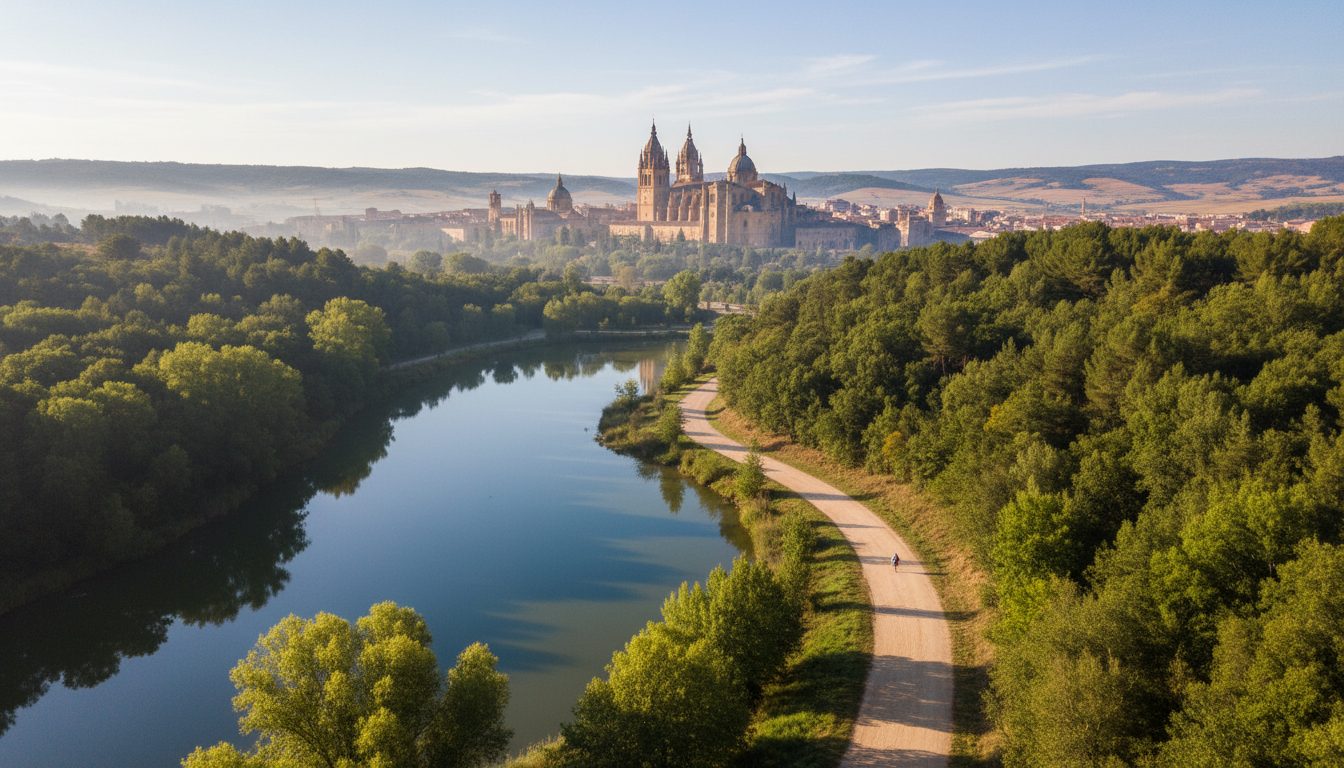
Let’s deal with the obvious question first: there is no beach in Salamanca. The city sits on the banks of the River Tormes, a good hour’s drive from the Atlantic and considerably more from the Mediterranean, so anyone picturing sandcastles should adjust expectations now. What it offers instead is a genuinely attractive riverside – the Tormes runs beneath the Roman bridge in a wide, slow curve, with grassy banks on the far side where families picnic, children paddle in the shallows on hot days, and the view back across the water to the cathedral towers is one of the better free sights in Spain.
Within the old town, the Huerta de Calixto y Melibea – a walled garden built into the old city walls, famously associated with the story of La Celestina – gives younger children space to run without traffic to worry about, along with shaded benches for parents who have been doing rather a lot of standing around admiring architecture. The Parque de los Jesuitas, a little further out, has more conventional play equipment and open grass, useful on days when everyone has had quite enough culture for one morning. Families based for longer stretches sometimes make day trips to nearby reservoirs for swimming in summer, since the city itself offers river views rather than river swimming within its centre.
Child-Friendly Restaurants in Salamanca
Salamanca eats late by northern European standards and early by Spanish ones, which works nicely for families trying to split the difference. The old town’s countless bars and bodegas serve tapas and raciones designed for sharing, which suits children who want to try four things and commit to none of them. Look for places around the Plaza Mayor and the surrounding streets offering jamón, Castilian cheeses, patatas bravas and simple grilled meats – the kind of unfussy plates that satisfy a hungry nine-year-old without requiring a separate “kids’ menu” at all.
Chocolatería-style cafés scattered through the centre do a brisk trade in churros con chocolate, thick enough to stand a spoon in, and most double as reliable breakfast stops before a day of sightseeing. Gelaterias and heladerías are plentiful enough that choosing one becomes its own small daily negotiation. For slightly older children happy to sit still a little longer, the terrace restaurants lining the Plaza Mayor itself are unbeatable for people-watching, if a touch pricier than eating a street or two back – the premium is for the view, not the food, and everyone involved knows it.
Things to Do in Salamanca with Kids
The Plaza Mayor is the obvious starting point and a genuinely good one – a vast eighteenth-century square enclosed on all sides, with arcades to shelter in and enough space for children to burn off energy while adults admire the symmetry. From there, the university quarter rewards slow exploration: beyond the frog on the main facade, children enjoy the hunt for other carved details on the old buildings, a kind of open-air spot-the-difference that predates every phone app designed to do the same thing.
The two cathedrals – Old and New, built side by side across several centuries because medieval Salamanca apparently never met a building project it didn’t want to extend – are worth the entrance fee partly for the architecture and partly for a modern oddity: a small astronaut, added during 1990s restoration work as a stonemason’s signature joke, carved among the traditional figures on the New Cathedral’s main door. Children delight in finding it far more than they delight in the Gothic vaulting, and that is entirely fine.
The Casa Lis, a striking Art Nouveau and Art Deco house turned museum, holds a collection of dolls, toys and decorative glass that tends to go down better with children than its grown-up reputation suggests – not every museum in Spain is built around armour and saints. The Museo de la Ciencia, Salamanca’s science museum, offers hands-on exhibits and a planetarium, making it a useful half-day stop for juniors and teens alike, particularly when the weather turns.
Rainy Day Activities in Salamanca with Kids
Castilian weather is not tropical, and an afternoon downpour can arrive without much warning, particularly outside summer. The Museo de la Ciencia is the obvious shelter, with enough interactive exhibits to occupy several hours regardless of weather. Casa Lis works equally well indoors, and its stained glass and toy collections hold attention longer than a wet afternoon usually allows.
Both cathedrals provide vast covered spaces to wander, and the climbable tower route – the Ieronimus – lets older children burn energy on the stairs while rewarding everyone with views over the rooftops once the rain clears. Failing all that, there is no shame in retreating to a café for an extended round of hot chocolate and people-watching through a steamed-up window. Some of the best Salamanca memories happen exactly there.
Salamanca with Kids by Age
Salamanca with Toddlers
Buggies cope reasonably well with the main pedestrian routes through the old town, though cobbles in the side streets can turn a gentle stroll into something closer to a massage chair experience. Pack accordingly. The walled garden and riverside paths offer flat, shaded relief, and most cafés are relaxed about prams parked at the table. Nap schedules are easily built around the Spanish midday lull, when the heat (and the crowds) peak anyway.
Salamanca with Juniors
This is arguably Salamanca’s sweet spot age group. Children of six to twelve are old enough to enjoy the frog hunt, the astronaut hunt and the general treasure-map feel of the old town, and young enough to still find chocolate con churros genuinely thrilling rather than merely acceptable. The science museum and planetarium suit this age particularly well, and most will happily climb the cathedral tower given half a reason to.
Salamanca with Teens
Teenagers tend to respond well to Salamanca’s status as a living university town rather than a museum piece – there are students everywhere, a proper café culture, and enough independence to let an older child wander a few streets alone to buy pastries while parents linger over coffee. The macabre or unusual details (the astronaut, the skull-and-crossbones motifs on certain university buildings, stories of student pranks across the centuries) tend to land well with an audience that has recently discovered irony.
Getting Around Salamanca with Kids
Salamanca’s old town is pedestrianised and small enough that walking is, for most families, simply the best option. Cars are more hindrance than help once you’re inside the centre, and parking near the Plaza Mayor ranges from difficult to theoretical. If you’re staying further out, local buses connect efficiently to the centre, and taxis are reasonably priced for tired-legs emergencies.
The main practical challenge is the cobblestones – charming underfoot, less charming under buggy wheels – so a sturdy, all-terrain pram or a decent child carrier for younger ones is worth the luggage space. Everything of interest to families sits within the same compact core covered in our Salamanca Travel Guide, so once you’ve found your feet on day one, the rest of the trip tends to organise itself.
For families weighing up where to base themselves, here is a straightforward note on villas in Salamanca.
Salamanca Family Holiday FAQs
Is Salamanca suitable for young children?
Yes. The old town is largely pedestrianised, flat in its main thoroughfares, and local attitudes toward children in cafés and restaurants are relaxed. The main obstacles are cobblestones and summer heat, both manageable with the right footwear and timing.
How many days do you need in Salamanca with kids?
Two to three full days covers the main sights, including the Plaza Mayor, both cathedrals, the university quarter and either the science museum or Casa Lis, without rushing children through them. Longer stays suit families who want to add day trips to the surrounding Castilian countryside.
What is the best time of year to visit Salamanca with children?
Spring and autumn offer the most comfortable temperatures for walking and sightseeing with children. Summer can be intensely hot in the afternoons, while winter is cold but generally dry, with the old town’s stone buildings holding a particular quiet charm under grey skies.
Keep reading
More on Salamanca
- Travel guideSalamanca Travel Guide
- RestaurantsBest Restaurants in Salamanca
- Food & wineSalamanca Food & Wine
Guides nearby in Spain
Where to stay
Villas in Salamanca
A selection from our 31 luxury villas in Salamanca.