Best Time to Visit South East England: White Cliffs & Vineyards
The best time to visit South East England is late spring (May to June) or early autumn (September), when temperatures sit between 15-20°C (59-68°F), rainfall is lower than in midsummer, and the coastal towns and gardens are noticeably quieter. Summer (July-August) brings the warmest weather, the fullest car parks and the highest prices, while winter (December-February) is mild by national standards, inexpensive, and suited to travellers who don’t mind the occasional grey afternoon.
There is a particular fortnight in late May when the Kent hop gardens are a fresh, almost electric green, the cow parsley is thigh-high along every B-road, and the whole region seems to have been given a quick coat of paint overnight. This is the thing nobody tells you about South East England: it has no bad season exactly, just seasons with different moods, and knowing which mood you want is most of the battle. The South East England Travel Guide covers the where and the what; this one is about the when.
Best Time to Visit South East England: At a Glance
Spring (March-May): 8-16°C (46-61°F), gardens at their best, moderate crowds. Summer (June-August): 15-23°C (59-73°F), warmest and busiest, book ahead. Autumn (September-November): 10-18°C (50-64°F), harvest season, excellent value shoulder months. Winter (December-February): 4-9°C (39-48°F), quiet, cheap, atmospheric on the coast.
South East England in Spring (March to May)
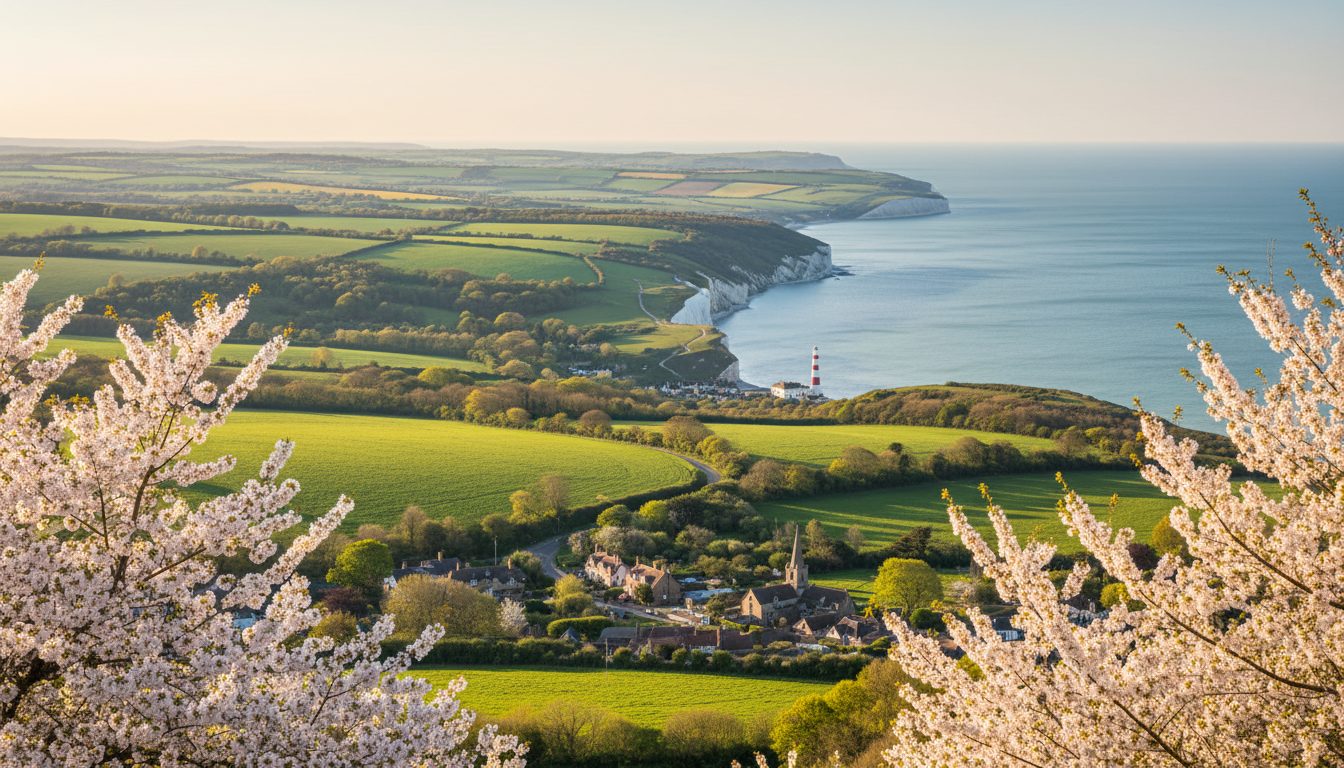
Spring arrives in South East England the way most English things arrive – tentatively, with the occasional false start. March can still deliver a sharp frost; by May the region has generally made up its mind. Daytime temperatures climb from a brisk 8-10°C (46-50°F) in early March to a genuinely pleasant 15-18°C (59-64°F) by late May, and daylight stretches out by the week. This is the season the great Kent and Sussex gardens exist for: the woodland gardens around the Weald put on a rhododendron and bluebell display that makes the winter wait feel entirely deliberate, as if someone had planned it that way all along.
Crowds are moderate – half-term weeks in April bring a spike of families to the coast and castles, but outside those windows the South Downs paths and Kent orchard lanes are yours to wander with minimal company. Prices sit comfortably below peak summer rates. Lambing season is in full swing on the Downs, blossom covers the orchards of Kent by mid-April, and the sea is still far too cold for anyone sensible to swim in it, whatever the brochures imply. Spring suits walkers, garden enthusiasts and anyone who would rather photograph a view than queue for it.
South East England in Summer (June to August)
Summer is when South East England performs at its loudest and, weather permitting, its best. Temperatures run from a reliable 18°C (64°F) in June to the mid-20s°C (mid-70s°F) at the height of July and August, with occasional heatwave days pushing past 30°C (86°F) that catch the infrastructure slightly off guard – this is not a region built around air conditioning. The coast, from the shingle beaches east of Hastings to the seaside piers further along, fills up fast, and the historic towns of Canterbury and Rye see their heaviest foot traffic of the year.
Book accommodation and restaurant tables well ahead for July and August weekends; prices at the coast rise accordingly, and parking in popular spots becomes a small daily negotiation. Long summer evenings suit outdoor opera and theatre in country house gardens, open-air cinema nights, and the region’s sparkling wine producers hosting vineyard tours as the vines fill out under long days of sun. Families dominate the school holidays from late July; couples and older travellers often find June the better month, with the light nearly as long and the crowds considerably thinner.
South East England in Autumn (September to November)
September is, by general consensus among people who actually live here, the best-kept secret of the South East England calendar. The sea has had all summer to warm up, so it is at its most swimmable just as everyone else has gone home; temperatures hold at a mild 16-18°C (61-64°F), and the hop gardens and orchards turn into the genuine business end of the year, with apple and hop harvests bringing a flurry of autumn food festivals and farm open days across Kent. October brings the first proper chill and some spectacular colour through the Weald’s woodland, while November tips firmly into short, cool days around 8-10°C (46-50°F) and the first real rain of the season.
Crowds thin dramatically after the first week of September, and accommodation prices drop with them, making this arguably the strongest value window of the year alongside spring. Harvest festivals, half-term crowds in late October, and a scattering of fireworks displays around the 5th of November give autumn its own rhythm. This season suits food-focused travellers, photographers chasing autumn colour, and anyone who would rather have a beach to themselves than share it with a thousand other towels.
South East England in Winter (December to February)
Winter here is rarely dramatic and often damp – this is not a region of deep snow, more a region of persistent drizzle punctuated by surprisingly crisp, bright days that make the white cliffs along the coast look almost too clean to be real. Temperatures hover between 4-9°C (39-48°F), daylight is short, and several smaller seasonal attractions close or reduce their hours between November and March, so it pays to check before setting out on a long drive for a single garden or house.
What winter lacks in warmth it makes up for in quiet and value: hotel and cottage rates fall to their lowest point of the year, market towns put on Christmas markets and light trails through December, and coastal walks along the cliffs or Downs are often empty but for dog walkers and the occasional hardy soul doing a New Year’s Day swim, apparently for fun. This season suits budget travellers, those chasing a quieter, moodier version of the coast, and anyone who finds a roaring pub fire a perfectly acceptable substitute for sunshine.
Best Time to Visit South East England for Festivals and Events
The festival calendar in South East England runs almost continuously, but clusters in two main bursts. Late spring and early summer bring garden festivals, country house opera seasons and motoring events across the Downs, timed to coincide with the best of the long evenings. Early autumn brings the harvest festivals proper – hop and apple celebrations across the Kent orchards, vineyard harvest tours as the Sussex sparkling wine estates bring in their grapes, and county shows that mix livestock judging with genuinely excellent local food stalls.
Christmas and the weeks either side of it bring markets, light trails and carol services in cathedral towns, while summer’s coastal towns run their own calendar of regattas, seafront festivals and open-air cinema nights. If a specific event is the reason for the trip, it is worth checking exact dates well ahead, since many move by a week or two year to year depending on harvest timing or the tide table.
Shoulder Season in South East England: Why It Works
Late May to mid-June and the whole of September are the shoulder windows worth building a trip around. Weather is close to summer standard without the summer price tag or the summer traffic; gardens, vineyards and orchards are at a genuinely interesting stage rather than simply looking tidy; and the region’s restaurants and attractions are operating at full capacity rather than the reduced winter hours. Locals will quietly admit these are their own favourite months, which in a region this popular with day-trippers from London is roughly the highest compliment available.
The Case for Off-Season South East England
Travelling in deep winter means accepting shorter days and a real chance of rain, but it buys a version of South East England that most visitors never see: empty cliff-top paths, log fires in centuries-old pubs with no queue for a table, and market towns that feel lived-in rather than performed for tourists. Prices on everything from parking to afternoon tea drop noticeably, and the region’s historic buildings and cathedrals are at their most atmospheric under grey winter light. It is not a season for sunbathing, but it is a very good season for anyone who actually wants to see the place rather than simply photograph it.
Whatever month you choose, it helps to know where you’ll be based – here is more on villas in South East England.
South East England Weather and Seasons FAQs
What is the rainiest month in South East England?
October and November tend to bring the most consistent rainfall, though showers can occur in any month. Summer rain is usually shorter and heavier, often clearing within the day, while autumn and winter rain tends to settle in for longer stretches.
Is South East England warm enough to swim in the sea?
The sea is swimmable from June through September, with water temperatures peaking around 17-19°C (63-66°F) in late August and September, after the sun has had all summer to warm it. Outside those months, swimming is possible but firmly for the committed.
Do South East England’s attractions stay open all year?
Major cathedrals, towns and coastal walks are open year-round, but many gardens, smaller historic houses and seasonal attractions reduce their hours or close entirely between November and March. It is worth checking specific opening times before planning a winter visit around a single attraction.
Keep reading
More on South East England
Guides nearby in England
Where to stay
Villas in South East England
A selection from our 18 luxury villas in South East England.