
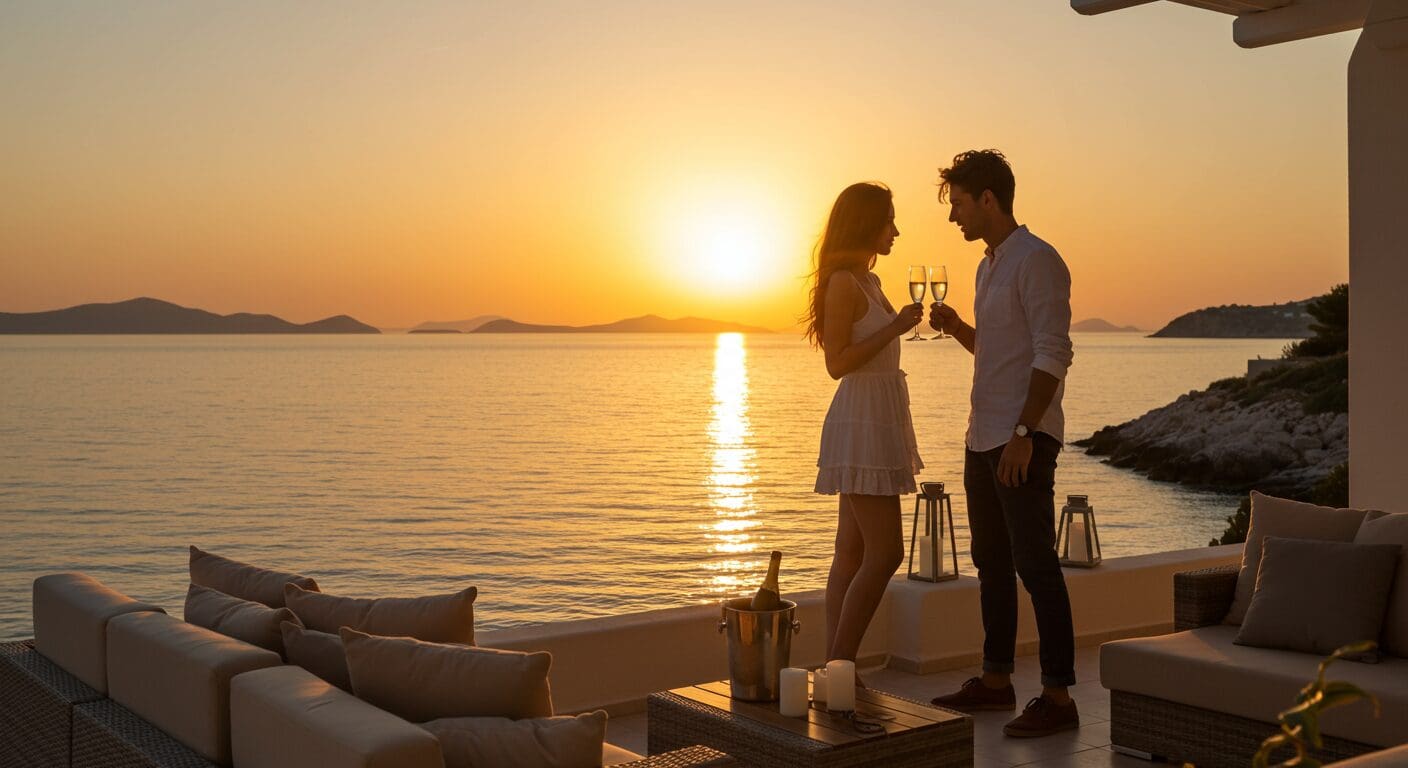
Romantic Grad Dubrovnik: The Ultimate Couples & Honeymoon Guide
Romantic Grad Dubrovnik: The Ultimate Couples & Honeymoon Guide
You wake before the crowds do – which, in Dubrovnik, requires genuine commitment to the concept. The light coming through the shutters is the particular gold of early Adriatic morning, the kind that painters have been chasing for centuries without quite catching it. From the terrace, the old city’s limestone rooftops glow like heated copper, the sea beyond them an improbable shade of blue that makes you briefly question whether you’ve wandered into a screensaver. You drink coffee. You say very little. You have nowhere to be until dinner. By the time the day-trippers are queuing at the Pile Gate, you are already on a private boat, sliding south past cliffs that drop straight into clear water, your person beside you, the mainland falling quietly away. This is what Dubrovnik does to you when you give it the chance.
Why Grad Dubrovnik Is Exceptional for Couples
There is a version of Dubrovnik that belongs to everyone – the cruise passengers, the Game of Thrones pilgrims, the teenagers photographing their feet against the Stradun. And then there is the version that belongs to people who arrive in the evening, who stay inside the walls, who know to order the grilled fish rather than the laminated menu. For couples, that second version is extraordinary.
Grad Dubrovnik – the historic old city itself, a UNESCO World Heritage Site ringed by medieval walls that drop straight into the sea – operates at a scale that is almost perversely romantic. The streets are too narrow for cars. The architecture demands you walk slowly. The Adriatic is never more than a few minutes in any direction, and at night, when the light dims to something amber and warm, the city that seemed overcrowded at noon becomes very nearly private. There are restaurants tucked into courtyard corners that feel like they exist only for the two of you. There are viewpoints where the city spreads out below and the appropriate response is simply to stand there in silence. This is a destination that rewards couples who choose to go slow – and punishes, gently, those who don’t.
It also helps that the region surrounding Grad Dubrovnik offers exceptional range: private sailing through the Elaphiti Islands, wine estates on the Pelješac Peninsula, spa retreats in the hills above the city. The romantic infrastructure here is thorough. For a full overview of the destination, the Grad Dubrovnik Travel Guide covers the practical ground in detail.
The Most Romantic Settings in the Old City
Start with the walls. The famous 2km circuit of Dubrovnik’s city walls is, in most practical senses, a tourist attraction – and during the height of summer, it feels exactly like one. Go at opening time, or late in the afternoon when the light starts doing interesting things to the Adriatic. At either end of the day, the walls become something else entirely: a promenade above a sea that turns from turquoise to deep navy, the terracotta-roofed city below you, the islands visible on the horizon. It is the kind of view that people describe badly in text messages home.
Deeper inside the walls, seek out the side streets that run perpendicular to the Stradun – the main limestone thoroughfare that gets the foot traffic, the photographs, the gelato queues. The alleyways behind and above it are quieter, lined with worn stone steps, iron-railed balconies, and the odd cat who has clearly been here longer than either of you. The neighbourhood of Prijeko, just north of the Stradun, has a particular quality in the evenings: lit windows, distant music, the smell of whatever is being grilled somewhere close. It is atmospheric in a way that requires no effort from you whatsoever.
For something with altitude, the cable car up to Mount Srđ delivers one of the great views in the Adriatic – the entire walled city laid out below, the Elaphiti Islands dotting the sea beyond, the Croatian coastline extending in both directions. The restaurant at the top is decent. The view is worth considerably more than the cable car ticket. Arriving just before sunset and watching the light change over the city is, if you are the sort of couple that uses the word transcendent, the moment to use it.
Romantic Dining in Grad Dubrovnik
Dubrovnik has a complicated dining reputation – and some of it is deserved. There are restaurants on the main tourist drag that charge considerably too much for considerably too little, banking on the fact that you are unlikely to come back. The good news is that the genuinely excellent restaurants are not hard to find if you know what you’re looking for: small, locally run, with menus that change with the season and kitchens that take the Adriatic seafood seriously.
For a special dinner, look to the restaurants carved into cliff faces and old stone buildings above the water – the kind of table where the sea is directly beneath you and the city glows behind, and you become briefly convinced that life is arranged well after all. Grilled fish – sea bass, bream, whatever has come in that morning – prepared simply with local olive oil, lemon, and Dalmatian herbs, is what you should be ordering. Croatian oysters, drawn from the clean waters of Mali Ston just up the coast, are an exceptional start. Pair them with Pošip, the white wine of the Korčula island vineyards, which is dry, mineral, and entirely correct with seafood.
The Pelješac reds – Dingač and Postup, made from the Plavac Mali grape – are worth knowing for when dinner runs into a second bottle. Rich, warm, faintly rustic: they taste exactly like the landscape they come from. A sommelier at any serious restaurant in the old city will steer you well.
Couples Activities: Sailing, Spas and More
The obvious activity for couples in Dubrovnik is also the correct one: get on a boat. Private sailing charters operating out of the old city harbour will take you through the Elaphiti Islands – Koločep, Lopud, Šipan – on a half-day or full-day basis, with stops for swimming in coves that the larger tour boats can’t reach. This is not a complicated pleasure. Clear water, a boat to yourselves, a cooler with local wine, nobody else around. The Adriatic does the rest.
For those who prefer their water in a heated pool with someone applying expensive oils to their shoulders, the spa facilities around Dubrovnik are extensive. Several of the larger hotels on the Lapad and Babin Kuk peninsulas – just outside the walls – offer spa days and couples treatments that don’t require a room booking. Inside the walls, smaller wellness spaces offer treatments using local ingredients: lavender and rosemary from the Dalmatian hinterland, sea salt, local honey. These are not medical-grade procedures. They are simply very pleasant ways to spend a few hours.
Wine tasting excursions to the Pelješac Peninsula are worth the half-day drive north. The vineyards there – many of them family operations that have been farming the same steep coastal slopes for generations – offer tastings with views across the sea to Korčula. Combine it with lunch at a local konoba – a traditional Dalmatian tavern – where the food is agricultural and generous and the wine is whatever was bottled last year. It is not a sophisticated experience, in the sense that it doesn’t try to be. It is, however, a very good one.
Cooking classes in and around the old city offer couples a structured activity that produces, at minimum, a meal. Hands-on classes focusing on Croatian cuisine – pasticada (slow-braised beef with prunes and wine), fresh pasta with black truffle, seafood risotto – are available through local operators and typically include a market visit, which is worth the early start. There is something to be said for eating dinner you’ve made yourself. There is also something to be said for the fact that someone else washes up.
Where to Stay: The Most Romantic Areas
For couples, the question of where to stay in Dubrovnik is less about finding somewhere tolerable and more about choosing between genuinely excellent options with different characters. Inside the walls – Grad Dubrovnik proper – you have the advantage of waking up inside a medieval city, which is an experience that doesn’t age quickly. The streets outside your door are the same ones Ragusian merchants walked in the fifteenth century, and at night, when the day visitors have gone, the whole city is very quiet and very beautiful. The trade-off is that you are, in peak season, sharing those streets with significant numbers of people during daylight hours.
The area immediately surrounding the old city – the streets and residential districts that step up the hillside above the walls – offers a quieter alternative, still within easy walking distance of everything, with private villas and apartments that provide the space and privacy that hotels inside the walls can’t always match. This is where couples who want a proper base – a kitchen for breakfast, a terrace for evening wine, a plunge pool – tend to end up.
Further out, the Lapad Peninsula offers a more relaxed atmosphere, greener and less crowded, with beaches and waterfront restaurants, and an easy bus connection to the old city. Good for longer stays, particularly for honeymooners who want to balance days of active sightseeing with days of doing genuinely nothing.
Proposal-Worthy Spots in Dubrovnik
Dubrovnik has, presumably, seen more proposals than it can count at this point. The city does not discriminate – it provides excellent backdrops regardless of whether you’ve rehearsed a speech. That said, some locations do more work than others.
The viewpoint at Fort Lovrijenac – the freestanding fortress that sits on a rock west of the Pile Gate, above the sea – offers an outlook that combines medieval drama with Adriatic scale in a way that is hard to argue with. The small harbour of Sv. Jakov, a short walk east of the old city along the coastal path, is less visited and correspondingly more private: a modest church above a clear bay, the city visible to the west, the Adriatic in every other direction.
Sunset from the walls remains the classic option, and it is classic for coherent reasons. The light at that hour does things to the city that make it nearly impossible to say no. The cable car summit at Mount Srđ, with the entire old city spread out below, is worth considering for couples who appreciate a sense of scale. And if you have access to a private boat – which, via a charter, you do – a proposal on the water at dusk, with the walled city behind you, is the sort of thing that gets told at dinner parties for years. Probably accurately.
Anniversary and Honeymoon Considerations
For anniversaries, Dubrovnik rewards a degree of ritual. Book the best restaurant table you can find – outside, looking at the sea or the walls, with a wine list that takes the local producers seriously. Walk the walls in the morning before the crowds arrive. Take a boat out for the afternoon. Eat oysters. Watch the sunset from somewhere elevated. This is not a complicated programme. It is, however, a very satisfying one.
For honeymooners, the key question is how long you have and what you want from it. Dubrovnik itself is best experienced over at least five days – long enough to get past the initial wave of sightseeing and into the slower rhythm that the city actually rewards. Add two or three days on one of the nearby islands – Korčula and Hvar are both within reach, with excellent food, beaches, and a distinctly different pace – and you have a honeymoon that covers architectural romance, island ease, and enough sea to last the year.
Honeymooners with a reasonable budget should consider the Dubrovnik Summer Festival period (July and August) carefully before booking. The city is magnificent, the prices reflect this, and the crowds reflect it further. June and September are broadly superior months for couples: warm enough for swimming, present enough in terms of restaurants and activities being open, and substantially less crowded. Early October, when the light goes golden and the city belongs mostly to people who live in it, is arguably the most romantic time to visit. The water is still swimmable. Almost nobody will tell you this, which is part of the point.
Your Base: A Private Villa in Grad Dubrovnik
Hotels in Dubrovnik are perfectly capable. They have concierges and breakfast buffets and efficiently helpful staff. But for couples – and particularly for honeymooners – there is something that hotels struggle to provide: actual privacy. The sense that a space is yours, that you don’t share it with a corridor of other guests, that dinner on the terrace doesn’t require a reservation and a dress code, that the morning can unfold at whatever speed you choose.
A private villa in Grad Dubrovnik resolves this entirely. A terrace with a sea view that belongs to you alone. A kitchen for the mornings when you’d rather not put on shoes before coffee. A pool, if the villa provides one, which the private options in this part of Dalmatia frequently do. Space to be a couple, rather than guests among other guests.
For the best in curated private properties, a luxury private villa in Grad Dubrovnik is the ultimate romantic base – and the most considered way to experience this city at its best.
When is the best time for a romantic trip to Grad Dubrovnik?
June, September, and early October offer the ideal balance for couples. The weather is warm and reliably sunny, swimming is excellent, restaurants and activities are fully operational, and the crowds that characterise July and August are significantly reduced. Early October in particular gives you the city at its most relaxed and atmospheric – the light changes quality, the pace slows, and you see Dubrovnik in something closer to its natural state. If your schedule requires a summer visit, go early July rather than August, and stay inside the walls to make the most of the city before the day-trippers arrive each morning.
What are the most romantic day trips from Grad Dubrovnik for couples?
A private sailing charter to the Elaphiti Islands – Koločep, Lopud, and Šipan – is the most reliably romantic option: quiet coves, clear water, and no schedule beyond your own. The Pelješac Peninsula is excellent for a half-day wine tasting trip combined with lunch at a family-run konoba. Korčula, with its beautiful walled old town and excellent local wine scene, makes a compelling full-day excursion by fast ferry. For couples who prefer landscape to sea, the Konavle Valley south of Dubrovnik – rural, unhurried, and largely undiscovered by mainstream tourism – offers a completely different character from the coast.
Is a private villa or a hotel better for a honeymoon in Dubrovnik?
For most honeymooners, a private villa will deliver the better experience. Hotels in Dubrovnik range from competent to genuinely excellent, but they cannot replicate the privacy, space, and flexibility of a well-chosen private property. A villa outside – or with direct access to – the old city walls gives you a private terrace, your own pool in many cases, a kitchen for leisurely mornings, and the sense that the city is yours to explore rather than a backdrop you’re sharing with several hundred other guests. This is particularly valuable in high season, when Dubrovnik’s hotel density can make even excellent properties feel busier than you’d like on your honeymoon.


