
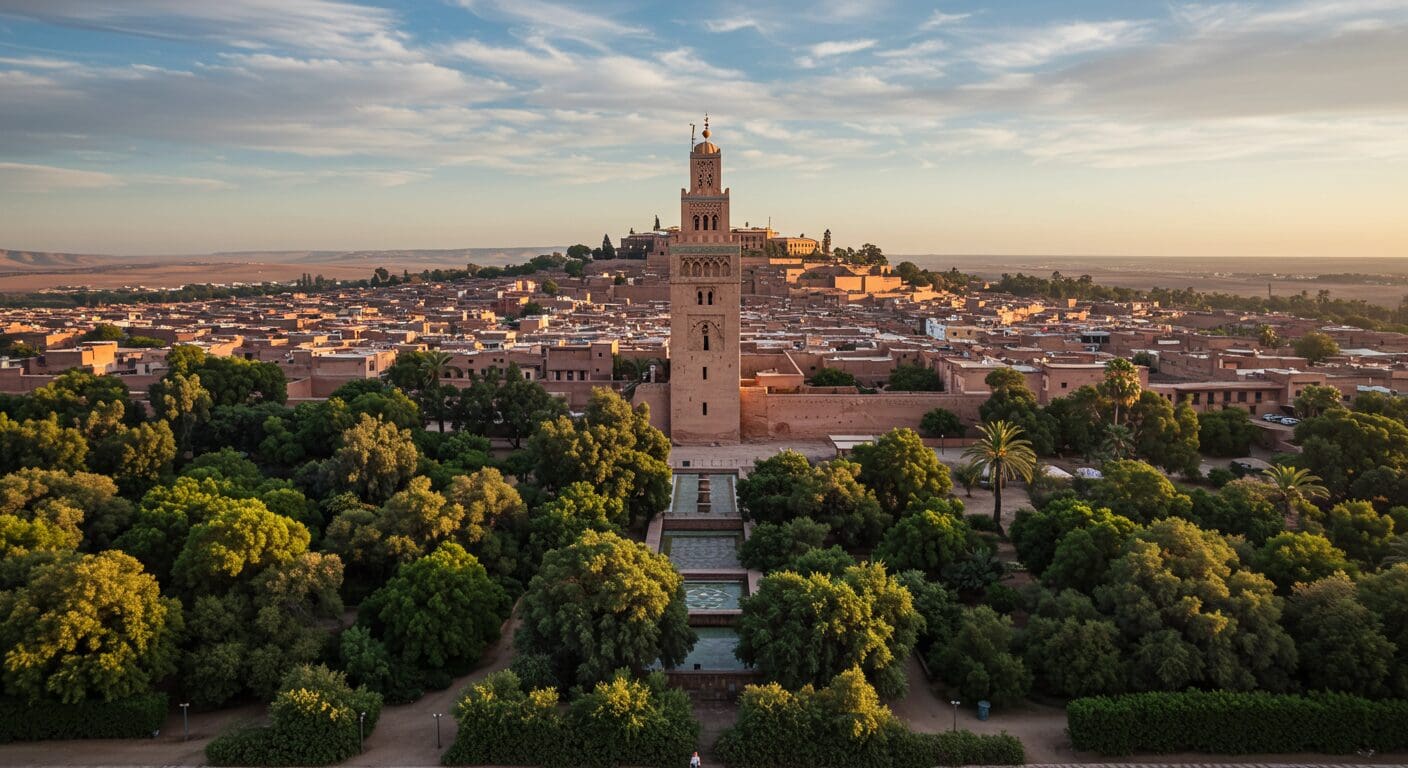
Marrakesh Travel Guide: Where to Stay, Eat & Explore in Luxury
There are cities that seduce you slowly, over days, and there are cities that grab you by the collar the moment you step outside the airport. Marrakesh is emphatically the latter. Other destinations offer atmosphere. Other places have history, spice markets, rooftop restaurants, ancient architecture. But nowhere else on earth compresses quite so much sensory information into quite so small a space, then somehow makes it feel not overwhelming but intoxicating. The smell of cumin and cedar, the call to prayer threading through the heat, the chaos of the Djemaa el-Fna resolving itself – if you stand still long enough – into something that begins to resemble a kind of order. Paris has light. New York has energy. Marrakesh has something harder to name: a quality of aliveness that other cities spend entire marketing budgets pretending they have.
The city rewards almost every kind of traveller, which sounds like something a tourist board would say, but in Marrakesh’s case happens to be true. Couples marking a significant anniversary find it intoxicating – all candlelit courtyards and private plunge pools. Families seeking genuine privacy away from the crowded corridors of beach hotels discover that a walled riad or palatial villa with its own pool is a revelation: children contained, adults actually relaxing. Groups of friends tend to arrive thinking they’ll do the souks and leave three days later having reorganised their entire relationship with time. Wellness-focused travellers come for the hammams, the yoga retreats, and the silence that exists inside a high-walled Medina house even when the city outside is at full pitch. And remote workers – increasingly numerous, occasionally conspicuous with their standing desks and oat milk requests – find Marrakesh’s combination of fast connectivity, long evenings and visual stimulation considerably more productive than sitting in a co-working space in London. This is a luxury holiday in Marrakesh destination that manages the difficult trick of being everything to everyone without losing an ounce of its own identity.
Getting Here Is Easier Than You Think (and That’s Half the Point)
Marrakesh Menara Airport sits just four kilometres from the city centre, which is one of those small logistical facts that has enormous practical implications. You clear arrivals, step outside into air that smells immediately and unmistakably of somewhere entirely unlike home, and within fifteen minutes you can be in the Medina. There are direct flights from London, Manchester, Paris, Amsterdam, Madrid and a growing number of other European cities, with journey times from the United Kingdom typically sitting around three to three and a half hours. That is, to be clear, shorter than the train from London to Edinburgh, and considerably more rewarding at the destination end.
Pre-arranging a private transfer is highly recommended, not because the alternatives are dangerous or particularly unpleasant, but because arriving at a beautiful riad or villa via a comfortable, air-conditioned car with someone who knows where they’re going sets a tone. Marrakesh taxis are abundant and cheap; the app Careem functions reliably and removes the need for price negotiations that can begin the trip on a somewhat combative note. Once in the city, most of the Medina is best navigated on foot – partly because the streets are too narrow for anything wider than a moped, and partly because getting slightly lost in the souks is, despite what your anxiety tells you in the moment, actually one of the great travel experiences. For day trips to the Atlas Mountains or beyond, hiring a driver for the day is sensible and surprisingly affordable.
Eating in Marrakesh: From Palace Feasts to Rooftop Tables Worth Climbing For
Fine Dining
The Marrakesh restaurant scene has evolved considerably in recent years, and what once meant a choice between a tourist-facing tagine or a very serious French restaurant has become something far more interesting. Dar Yacout remains the grand dame of Medina dining – a palatial riad designed by the legendary Bill Willis, where a fixed-price, multi-course Moroccan diffa (feast) is served in a sequence of magnificent salons and courtyards. The stained glass throws coloured light across carved plasterwork. The vaulted ceilings make you feel pleasantly insignificant. It was doing glamour before glamour was particularly fashionable in these latitudes, and it has not softened with age.
For something sharper and more contemporary, +61 in the Gueliz neighbourhood – the brainchild of Australian chef Cassie Karinsky – brings a Sydney sensibility to Moroccan ingredients with real intelligence. Ranked among the world’s 50 best restaurants in the Middle East and North Africa, it uses organic, market-fresh produce in dishes that play with herb and spice combinations in ways that feel both unfamiliar and immediately right. The flavours are punchy without being aggressive. The room is bright, modern, and rather easier on the senses than the Medina’s more theatrical dining rooms – which is sometimes exactly what you need.
Where the Locals Eat
Nomad, on a rooftop in the Medina’s Derb Djedid quarter, has become something of a Marrakesh institution, which in lesser restaurants would be a warning sign. In Nomad’s case the reputation is genuinely earned. The menu is modern Moroccan – familiar enough to orientate you, creative enough to hold your attention. The courgette and feta fritters are lighter than they sound. The spiced lamb burger with aubergine is the kind of dish you mentally file away for later recreation at home and then never quite manage. The orange cake is the orange cake. Order it. The candlelit terrace at dusk is as good as this sort of thing gets.
For Lebanese food at a quality that would surprise even Beirut, Naranj delivers lunches that are consistently praised by those who find it – the kefta, in particular, has acquired a small but passionate following. The rooftop is airy and unshowy, the design minimalist by Marrakesh’s maximalist standards, and it is precisely the sort of place you want to find yourself at 1pm when the souks have temporarily defeated you.
Hidden Gems Worth Seeking Out
The question of where the locals eat is, in Marrakesh, a slightly complicated one, given that many locals eat at home and the concept of a neighbourhood bistro looks rather different here than it does in Lyon. But the Djemaa el-Fna food stalls – operational every evening as the square transforms into something between a carnival and a collective fever dream – offer a genuinely local experience for those who approach with appropriate curiosity and a willingness to be ushered firmly into a seat by someone who will not take no for an answer.
Then there is Pepe Nero, a riad restaurant that commits entirely to the unlikely but successful marriage of Moroccan and Italian cooking. The saffron risotto is the star. The setting, around the riad’s pool, is as good-looking as it sounds. It is the sort of combination that should not work and emphatically does. Book ahead.
The Geography of the Red City: Medina, Palmeraie, and the Atlas Beyond
Marrakesh divides neatly – if anything about this city can be called neat – into distinct zones, each with its own logic and its own personality. The Medina is the ancient walled heart of the city, a dense labyrinth of souks, mosques, riads and palaces that has been doing much the same thing for roughly a thousand years and shows no particular intention of changing. Its streets follow no grid. Its alleyways resolve into dead ends. It is, architecturally and experientially, one of the most extraordinary urban environments on earth.
The Gueliz neighbourhood, the French-built new town just beyond the Medina walls, offers a quieter counterpoint: wide boulevards, independent restaurants, galleries and boutiques. It is where you go when the Medina’s intensity requires brief intermission. The Palmeraie – a vast palm grove to the north of the city that was substantially more palm-y before development arrived – is where many of the city’s grandest luxury villas and boutique resorts are located, offering space, calm and privacy that the Medina, for all its charms, cannot quite provide.
And then there are the Atlas Mountains, visible from the city on clear days like a painted backdrop you half expect to be folded away at dusk. They are, in fact, very real, and very accessible – the Ourika Valley is an hour’s drive, the ski resort of Oukaimeden not much further. Beyond the Atlas lies the edge of the Sahara, which is a long day’s drive but an unforgettable one. The city’s position at the foot of Africa’s greatest mountain range and at the gateway to its greatest desert gives Marrakesh a geographical drama that few urban environments can match.
Things to Do in Marrakesh: The Full Picture
The best things to do in Marrakesh divide usefully between the structured and the improvisational. On the structured side: the Bahia Palace and the Saadian Tombs, both of which reward an hour of slow looking and both of which are frequently rushed in favour of the souks. The Jardin Majorelle – acquired by Yves Saint Laurent in 1980 and now one of the most visited gardens in Morocco – is genuinely beautiful and genuinely crowded. Arrive at opening time. The deep YSL blue of the villa against the tropical planting is worth the queues, just about.
The Musée Yves Saint Laurent Marrakech, which opened in 2017 immediately adjacent to the garden, is an elegant permanent collection that traces Saint Laurent’s relationship with the city that shaped the second half of his aesthetic life. It is handsomely designed and less mobbed than the garden next door. The cooking class circuit is well-established and worth a morning – visiting a souk market with a local chef before preparing a meal in a traditional riad kitchen covers history, commerce and cuisine in a single, very enjoyable session.
And then there is the traditional hammam, which everyone intends to do and some people, inexplicably, talk themselves out of. Do not talk yourself out of it. A hammam is part bathhouse, part therapy, part cultural ritual that Moroccans have been refining for centuries. The process – black soap applied, steam opened, the world scrubbed gently but thoroughly off your skin by an attendant who takes their work seriously – is deeply relaxing in a way that a hotel spa’s ‘Moroccan-inspired treatment’ approximates but does not replicate. Hammam Mouassine is one of the most welcoming for first-timers. Go twice if you can.
For Those Who Like Their Relaxation to Come With an Elevation Profile
The Atlas Mountains are not decorative. They are serious mountains – Toubkal, at 4,167 metres, is the highest peak in North Africa and a legitimate trekking objective for those in reasonable condition. The classic two-day ascent via the village of Imlil involves spending a night in a mountain refuge and waking to views that thoroughly justify the aching legs. Guided trekking companies in Marrakesh are well-established and reliable.
For those who prefer speed to altitude, the roads through the Atlas offer some of the most dramatic road cycling in this part of the world – challenging gradients, minimal traffic, and mountain scenery that does not ask permission to impress. Mountain biking trails extend around the Ourika Valley and the Palmeraie, graded for ability levels ranging from gentle to inadvisable. Horse riding through the olive groves and traditional villages outside the city remains one of the more peaceful ways to see a Marrakesh that most visitors miss entirely.
Quad biking across the semi-arid plains beyond the Palmeraie is popular, photogenic and slightly mad in the best possible way. Hot air ballooning over the Atlas foothills at dawn – the Marrakesh plains glowing below, the mountains pink in the early light – is the kind of experience that sounds like travel-brochure hyperbole until you are actually doing it, at which point it simply renders you quietly speechless for twenty minutes.
Marrakesh with Children: Harder Than It Sounds, Better Than You’d Expect
Let us be honest: the Medina with small children requires some mental preparation. The streets are narrow, the mopeds are insistent, and the sensory volume is set quite high. But the rewards on the other side of that adjustment are considerable, and families who come to Marrakesh properly equipped – meaning: with a private villa rather than a hotel room, with a plan that balances exploration and recovery, and with a willingness to let the city set some of the agenda – tend to leave with the kind of travel memories that actually stick.
The Djemaa el-Fna at dusk is theatre of the highest order for children of almost any age. Snake charmers, acrobats, storytellers, fire dancers – it is simultaneously a UNESCO cultural heritage site and the world’s most elaborate street performance. The horse-drawn calèches that circle the square are an excellent introduction to the city for younger travellers who need their sightseeing delivered at a gentle pace. Cooking classes are available in family-friendly formats. The camel rides in the Palmeraie are roughly three minutes long and will be talked about for three years.
The private pool advantage is significant. A villa with a walled garden and its own pool – and Marrakesh villas frequently have both – means that the children have somewhere to decompress, and the adults can sit with something cold and congratulate themselves on the decision. This is the difference, in practical terms, between a family holiday and a family ordeal.
A City Older Than Its Own Legend: History, Architecture and Living Culture
Marrakesh was founded in 1070 by the Almoravids, which makes it older than most of Europe‘s great capitals and considerably better preserved than many of them. The ochre-red walls of the Medina – the colour comes from the local sandstone and gives the city its Red City nickname – have watched a parade of dynasties pass through: Almoravid, Almohad, Saadian, Alaouite. Each left something. The Koutoubia Mosque, built in the twelfth century, remains the defining silhouette of the city’s skyline, its minaret visible from virtually everywhere and lit at night with a simplicity that puts many more fussy illumination schemes to shame.
The Saadian Tombs, sealed by a jealous Sultan in the seventeenth century and not rediscovered until 1917, are extraordinary: intricate chambers of carved cedar and stucco where sixty-six royals rest in a silence that feels earned. The Bahia Palace, built for a nineteenth-century Grand Vizier with considerable ambition and even more tile budget, spreads across eight hectares of rooms, galleries and gardens and represents the highwater mark of Moroccan decorative arts.
The living culture sits alongside all of this with remarkable ease. Traditional crafts – leatherwork, zellige tilework, brass lantern-making, carpet weaving – are not museum pieces but working industries. The tanneries in the leather quarter are one of the city’s most extraordinary sights: a medieval production line visible from above, the vats of dye arranged like an enormous artist’s palette. It smells, it must be said, exactly as you might expect a centuries-old tannery to smell. Take the mint they hand you at the entrance. Use it.
Shopping in Marrakesh: The Art of the Negotiation and the Joy of the Find
The souks of the Medina are organised by trade in a system that has persisted for centuries: spice merchants in one quarter, leather workers in another, carpet sellers in a third, lantern makers somewhere in the middle of all of them. The organisation is more logical than it appears to a first-time visitor who has lost their bearings somewhere between the babouche slippers and the argan oil. The key insight is that this is a place designed for browsing, not for efficiency, and the moment you accept that, it becomes considerably more enjoyable.
Negotiation is expected and not aggressive – it is more like a conversation with a commercial subtext, and most experienced traders would be mildly offended if you accepted their first price without at least a token counter-offer. A good starting point is roughly sixty percent of the opening ask, though the quality and rarity of what you’re buying affects the arithmetic considerably. For those who find the whole process exhausting, the fixed-price boutiques in Gueliz and around the Mellah offer a less theatrical alternative and often excellent curation.
What to bring home: argan oil (genuine, cold-pressed, from a cooperative rather than a souvenir stall), handmade leather goods, Moroccan pottery, a good carpet if you have both the budget and the luggage allowance, and – for the kitchen – a bag of ras el hanout from a proper spice merchant who will assemble it fresh. The saffron is good. The rose water is excellent. The zellige tile fragment you buy thinking you will do something creative with it at home will, in all probability, sit very nicely in a bowl on a shelf, which is also fine.
Before You Go: The Practical Marrakesh Briefing
The best time to visit Marrakesh is spring (March to May) or autumn (September to November), when temperatures are warm rather than genuinely challenging and the city’s gardens and landscapes are at their most appealing. Summer – June through August – is hot in the way that only a city surrounded by desert can be hot, and while the evenings cool and the riads and villas stay manageable, the midday hours are best spent horizontally. Winter is mild by day and surprisingly cool at night, which suits those who dislike crowds; Christmas and New Year in Marrakesh has become quietly fashionable among those who have found themselves underwhelmed by yet another cold, grey December in the United Kingdom.
The currency is the Moroccan Dirham (MAD), and cash remains important for souks, hammams and smaller establishments, though cards are increasingly accepted in restaurants and hotels. The language is Moroccan Arabic (Darija), but French is widely spoken and English increasingly so, particularly in tourist-facing businesses. A working knowledge of a few Arabic phrases – shukran (thank you), la shukran (no thank you, which you will use more than you might expect) – is appreciated and occasionally rewarded.
Tipping is customary: ten percent in restaurants, a few dirhams for guides and hammam attendants, a similar amount for anyone who helps with directions, which happens more often than you might expect and is generally offered with genuine goodwill. Dress modestly in the Medina, particularly women: covered shoulders and below-the-knee hemlines are respectful and practically wise. The city is safe for tourists; the usual urban common sense applies. Morocco is a Muslim country and Ramadan, while a fascinating cultural experience, does change the rhythm of eating and drinking considerably – worth researching in advance if your dates overlap.
Why a Private Villa Is Simply the Better Argument
Hotels in Marrakesh range from excellent to extraordinary. Some of the finest properties in the world sit within the Medina walls or on the Palmeraie’s palm-lined streets. And yet. A hotel, however beautiful, involves a lobby, a reception queue, a minibar priced for people who have given up caring, and the persistent low-level awareness that four hundred other people are having slightly similar experiences in the rooms around you.
A luxury villa in Marrakesh is a different argument entirely. A walled riad or Palmeraie estate gives you a property that is entirely yours – its courtyard, its pool, its kitchen garden, its rooftop terrace under the stars. For families, this means space that genuinely works: separate bedrooms, a pool that no one else is sharing, a kitchen for when the children have run out of patience with restaurant timing. For groups of friends, it means the kind of dinner around a long table with the right music and no surrounding tables to disturb that is simply unavailable in any hotel of any price. For couples, it means a level of privacy and personalisation that a hotel suite, however luxurious, cannot replicate.
The staff arrangements that come with many villa rentals – a housekeeper, a private chef, a concierge who can arrange everything from hammam bookings to Atlas Mountain treks to a private calèche tour of the Medina at dusk – mean that the logistics of the luxury holiday in Marrakesh are handled without the guest needing to manage any of them. For remote workers, many villas now offer reliable high-speed connectivity, proper workspace and the kind of quiet that actually enables concentration, combined with a backdrop that makes the after-work hours feel like reward rather than routine. For wellness-focused guests, private pools, gardens designed for morning yoga and access to the city’s hammam culture from a base of genuine tranquility creates something that no spa hotel can quite replicate, however many towel swans they deploy.
The riad form itself – a property built inward around a courtyard, the street facade offering nothing away – is a philosophy of hospitality made architectural. Everything faces inward. Everything is for the people inside. It is, quietly, the anti-hotel. Browse our collection of private villa rentals in Marrakesh and find the one that makes the city yours.
More Marrakesh Travel Guides
- Best Restaurants in Marrakesh: Fine Dining, Local Gems & Where to Eat
- Marrakesh Food & Wine Guide: Local Cuisine, Markets & Wine Estates
- Marrakesh with Kids: The Ultimate Family Holiday Guide
- Best Time to Visit Marrakesh: Month by Month Weather, Crowds & Tips
- Marrakesh Luxury Itinerary: The Perfect 7-Day Guide
- Romantic Marrakesh: The Ultimate Couples & Honeymoon Guide
What is the best time to visit Marrakesh?
Spring (March to May) and autumn (September to November) are the sweet spots – warm, manageable and sociable without the full intensity of high summer. July and August are genuinely hot, often exceeding 38°C in the middle of the day, though riads and villas with pools and shaded courtyards cope well. Winter is mild and pleasantly uncrowded, with December particularly popular among travellers from northern Europe escaping the cold. Ramadan, which moves through the calendar year on a lunar cycle, transforms the city’s rhythms in ways worth understanding before you book.
How do I get to Marrakesh?
Marrakesh Menara Airport (RAK) is four kilometres from the city centre – one of the shortest airport-to-centre distances of any major travel destination. Direct flights operate from London Gatwick, London Heathrow, Manchester, Paris Charles de Gaulle, Amsterdam Schiphol, Madrid and many other European cities, with journey times from the UK typically around three to three and a half hours. Pre-booking a private airport transfer is recommended for a smooth arrival, particularly if you are heading to a riad in the Medina, where navigating the final stretch by car requires local knowledge.
Is Marrakesh good for families?
Yes, genuinely – with some preparation. The Medina requires patience with young children given its narrow, busy streets, but the rewards are significant: the Djemaa el-Fna evening spectacle, camel rides in the Palmeraie, cooking classes and the Jardin Majorelle are all child-friendly highlights. The most important practical decision for a family visit is accommodation: a private villa with walled garden and pool changes the entire experience, giving children space to decompress and adults the ability to actually relax. A hotel room, however well-appointed, does not offer the same.
Why rent a luxury villa in Marrakesh?
Because the riad model – inward-facing, private, designed around a courtyard that belongs entirely to you – is essentially the original luxury villa concept, and Marrakesh does it better than almost anywhere. A private villa gives you space, a pool you never have to share, a staff-to-guest ratio that no hotel matches, and a level of privacy that makes the stay feel genuinely personal rather than pleasantly managed. Add private chef options, concierge services that can arrange anything from hammam appointments to Atlas Mountain excursions, and the ability to eat breakfast in your courtyard at whatever hour suits you, and the argument against hotels writes itself.
Are there private villas in Marrakesh suitable for large groups or multi-generational families?
Absolutely. Marrakesh’s villa landscape includes properties ranging from intimate four-bedroom riads in the Medina to expansive Palmeraie estates with eight or more bedrooms, multiple private pools, separate guest wings, outdoor dining terraces and full household staff. Multi-generational groups in particular benefit from the villa format: grandparents have quiet sitting rooms and ground-floor suites; children have a pool and garden; parents have somewhere to sit in between. Many larger properties offer dedicated entertainment spaces, home cinemas and gardens large enough that different generations can occupy different corners of the property simultaneously without negotiation.
Can I find a luxury villa in Marrakesh with good internet for remote working?
Yes – connectivity has improved significantly across Marrakesh’s premium villa market, and many properties now offer fibre broadband or Starlink satellite internet capable of supporting video calls, large file transfers and the general demands of remote working. It is worth confirming upload and download speeds with the property directly when booking if reliable connectivity is a priority. The practical rhythm of working from a Marrakesh villa – morning calls done, afternoons in the souks or by the pool, evenings at a rooftop restaurant – is, it is fair to say, somewhat more agreeable than the average office experience.
What makes Marrakesh a good destination for a wellness retreat?
Several things converge. The traditional hammam culture – one of the oldest and most effective forms of therapeutic bathing in the world – is embedded in the city’s daily life and accessible at every level of formality. The Atlas Mountains offer hiking, fresh air and altitude that genuinely clear the head. The pace of life inside a walled Medina property – particularly one with a courtyard garden, pool and no lobby to navigate – naturally slows to something more restorative. Many luxury villas offer yoga spaces, private spa treatment rooms and gardens designed for stillness. And the food – fresh, vegetable-forward, spiced with ingredients that read like an apothecary list – is an incidental but meaningful part of any wellness experience here.

