
Best Restaurants in Marrakesh: Fine Dining, Local Gems & Where to Eat
There is a city in Morocco where dinner is not a meal but a sequence of events – where the route to your table might take you through a lantern-lit courtyard, up a spiral staircase, across a rooftop with the Atlas Mountains sitting dark and distant on the horizon, and past a man pouring mint tea from an implausible height. That city is Marrakesh, and it does something to people. They arrive intending to spend two nights and start googling flights home from a rooftop somewhere on day four. The food has something to do with it. A great deal to do with it, actually.
What makes eating in Marrakesh so singular is the collision of worlds happening quietly on the plate. Ancient spice-trade flavours meet modern technique. A centuries-old Moroccan diffa is served in a riad that hasn’t changed since the 1970s. A chef with a restaurant ranked among the best in the Middle East sources her produce from a market two streets away. The city has always absorbed outside influence and returned it as something entirely its own. The dining scene is no different.
This guide covers the best restaurants in Marrakesh across every register – from grand palace dining to a plastic-stool lunch that will rearrange your priorities – along with what to drink, what to order, and how to actually get a table somewhere worth sitting at.
The Fine Dining Scene: Marrakesh After Dark
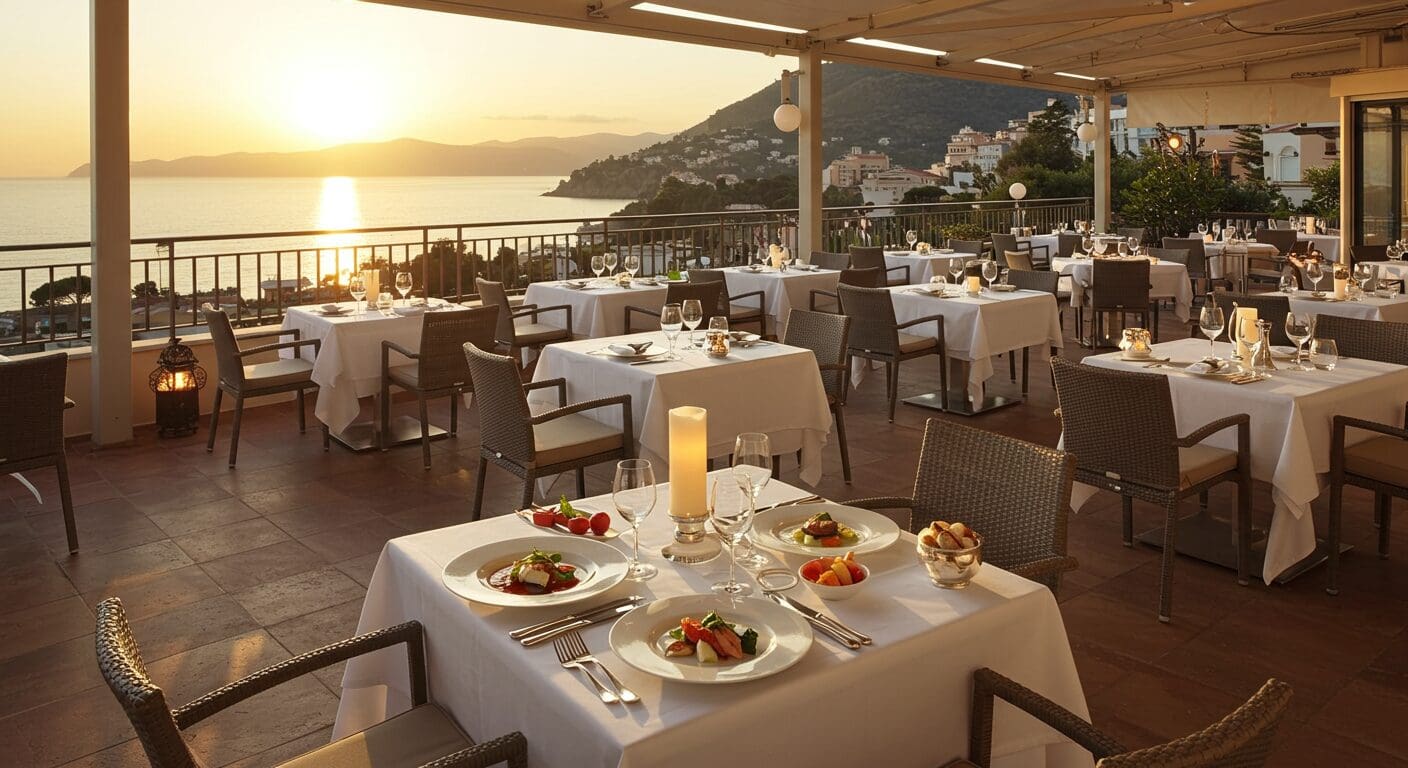
Marrakesh doesn’t yet have Michelin stars – the guide doesn’t currently cover Morocco – but to suggest this means the city lacks serious, world-class dining would be to entirely misread the room. Several of its restaurants operate at a level that would attract considerable attention in Paris or London. The difference is that here, the setting is half the experience, and the setting is rather extraordinary.
Dar Yacout is the gold standard of old Marrakesh dining – a palace restaurant set in a colossal riad designed by the legendary American interiors architect Bill Willis, whose fingerprints are on some of the most beautiful rooms in the city. Arriving at Dar Yacout at dusk, when the stained glass catches what’s left of the light and the carved plasterwork throws shadows across vaulted brick ceilings, is one of those experiences that makes you forgive every flight delay you’ve ever endured. The food follows the tradition of the Moroccan diffa – a fixed-price, multi-course feast that moves through salads, pastilla, tagines, couscous and pastry in a sequence that has been refined over decades. It was one of the first medina addresses to offer this format, and twenty-odd years on it has lost none of its glamour. This is occasion dining, unapologetically. Wear something that matches the room.
La Maison Arabe, a short walk from Djemaa el-Fna in Derb Assehbi, occupies a different kind of prestige – historical rather than theatrical. It is home to what are widely considered the first restaurants in Marrakesh, and they remain open to non-residents of the riad-hotel. The cooking here is classical Moroccan at a high standard, executed with a care that keeps it consistently rated among the best places to eat in the entire city. The kind of place that regulars return to not because it surprises them, but because it never disappoints.
For those whose fine dining tastes run more contemporary, +61 (Plus Sixty-One) in the Gueliz neighbourhood is where Marrakesh’s dining scene reveals its other face. Australian-Moroccan chef Cassie Karinsky runs a bright, modern restaurant built around organic, market-fresh ingredients and a Medi-Moroccan fusion philosophy that sounds like a concept but tastes like a revelation. The herb and spice combinations are subtle enough to reward attention – this isn’t food that announces itself loudly, but the flavour depth is considerable. +61 ranks at number 46 on The World’s 50 Best Restaurants in the Middle East and North Africa, which is the kind of credential that tends to make reservations scarce. Book early. Book very early.
Local Gems: Where Marrakesh Actually Eats
The best meal you eat in Marrakesh might well cost very little. It might be eaten standing up. It might arrive on a plate that has clearly been in active service since before you were born. This is not a city that keeps its good eating behind velvet ropes.
Nomad, overlooking Place des Épices in the heart of the medina, has become something of a Marrakesh institution without quite losing the sense of discovery that made it worth finding in the first place. The candlelit rooftop terrace alone is reason enough to visit – it sits above the spice square with an ease that feels effortless and absolutely isn’t. The cuisine is modern Moroccan: familiar in its foundations, refreshed in its execution, and designed for people who love the flavours of the country but want to see what a kitchen with proper ambition can do with them. The courgette and feta fritters are precisely as good as everyone says. The Nomad spiced lamb burger with aubergine is better than it sounds, which is already quite good. Order the orange cake. This is not optional.
For something entirely different – Lebanese rather than Moroccan – Naranj on Rue Riad Zitoun el Jdid consistently stops people in their tracks. The kefta in particular attracts the sort of reverent language that Moroccan food writers usually reserve for a great tagine: perfectly seasoned, flawlessly cooked, the kind of thing you think about on the flight home. The rooftop and the minimalist, airy design make it an excellent lunch option when the medina’s sensory intensity starts to accumulate. The food is clean and direct in a way that feels particularly welcome mid-afternoon.
Beyond these named addresses, the medina rewards wanderers who eat on instinct. Derb Dabachi and the streets around the tanneries have small, plainly furnished local restaurants serving harira soup, merguez sandwiches and slow-cooked lamb that no review has ever adequately captured because they change, move, and occasionally disappear between editions. Ask your riad host. They know things that aren’t on the internet.
Djemaa el-Fna and the Food Markets
At some point, every visitor to Marrakesh ends up at Djemaa el-Fna at night, surrounded by smoke, noise, acrobats, snake charmers, and approximately four hundred people who are equally confused about which direction they came from. The food stalls that take over the square after dark are part of the theatre, and the food is – genuinely – worth eating. The stalls are numbered, which helps both with navigation and with the friendly but persistent invitations to sit down that begin approximately fifteen metres from the square. Stall 14 and its neighbours are consistently well-regarded for grilled meats and seafood. Brochettes, merguez, sheep’s head (adventurous spirits only), snail soup in small clay bowls, fresh-squeezed orange juice from the vendors along the perimeter – this is street food at its most vivid and most Marrakshi.
The souks in the morning offer a different kind of edible Marrakesh. The spice stalls in and around Place des Épices are where you understand why Moroccan cooking tastes the way it does – the ras el hanout here is blended fresh, the preserved lemons are translucent and fragrant, the argan oil comes in bottles that look almost modest given how labour-intensive the stuff is to produce. The olive market near Bab Agnaou is worth a detour: dozens of varieties, marinated in everything from chermoula to harissa, sold in quantities that make you briefly consider whether you could get a very large jar through airport security. You cannot.
What to Order: Dishes That Define Marrakesh
A brief field guide to eating well, for the uninitiated and the returning alike.
Pastilla – The pigeon (or chicken) pie wrapped in warqa pastry, dusted with icing sugar and cinnamon. Sweet, savoury, crispy, rich. It should not work. It absolutely works.
Tagine – Specifically: lamb with prunes and almonds, or chicken with preserved lemon and green olives. Not the watery tourist version. The real thing, slow-cooked until the meat offers no resistance whatsoever.
Harira – The tomato and lentil soup, eaten at breakfast or as a precursor to everything else. Particularly restorative after a long evening at Djemaa el-Fna.
Mechoui – Whole slow-roasted lamb, carved at the table or in the market, eaten with cumin salt and flatbread. This is not a dish for the faint-hearted or the underhungry.
Basteeya au lait – A dessert version of pastilla filled with cream and almonds. Not widely available. Worth specifically seeking out.
Msemen – The square, layered flatbread, best eaten warm from a street vendor with honey and argan oil. This is technically breakfast. Nobody observes this rule strictly.
What to Drink: Wine, Tea and Everything Else
Morocco produces wine – more of it, and better, than most people expect. The Meknes region to the north is the most significant wine-growing area, producing reds from Grenache and Syrah that carry a particular warmth, and some respectable rosés that suit the climate of a Marrakesh terrace rather well. The Moroccan wine industry has improved substantially in recent years, and the better restaurants carry serious cellars. Gris de Boulaouane, a pale rosé that sits somewhere between grey and pink, is the local classic and arguably better matched to Moroccan spicing than any red.
For the non-alcoholic experience – which is entirely valid and rather well-served here – mint tea is obviously central to the culture, poured with ceremony from the traditional brass teapots and sweet enough to make your teeth hum. Freshly squeezed orange juice, available everywhere and startlingly good, is the unofficial soft drink of the city. Jus d’avocat – avocado milk blended with sugar and orange blossom water – is thick, cold and oddly addictive.
Alcohol is available in most restaurants at the higher end, less consistently at neighbourhood places. Dar Yacout, La Maison Arabe, Nomad and +61 all carry well-considered drinks lists. If wine at dinner matters to you, it’s worth checking before you book.
Casual Dining and Where to Lunch
Marrakesh in the middle of the day is hot and slightly relentless, and the best thing to do between approximately noon and three is find shade, food, and no particular reason to move. The rooftop restaurants are well-suited to this – Nomad’s terrace, Naranj’s airy upper floor, and the growing number of informal lunch spots on the edges of the souks that serve simple plates of salad, kefta and flatbread for very reasonable sums. Gueliz, the modern French-era neighbourhood to the west, offers a slightly different pace – café terraces, good coffee, and the kind of all-day eating culture borrowed from across the Mediterranean.
The Palmeraie area, where many of the city’s larger villa properties are located, has its own complement of lunch spots and pool-restaurants attached to the larger hotels and clubs – these tend toward international menus with Moroccan touches and are generally more relaxed in both dress code and atmosphere than the medina equivalents. Good for a long, unhurried afternoon. Ideally with something cold and Moroccan in a glass.
Reservation Tips: Getting a Table in Marrakesh
The honest advice is: book ahead, particularly for dinner, particularly in high season (October to April), and particularly at Dar Yacout and +61, which operate at capacity on most evenings. Many medina restaurants can be booked directly through their websites or via WhatsApp – a channel that Marrakesh has embraced with considerable enthusiasm. Your riad or villa concierge will often have relationships with the better restaurants and can occasionally secure tables that aren’t visible online. Use this resource. It is what they are there for.
Walk-ins work perfectly well at Nomad for lunch, less reliably for dinner. Naranj is more accommodating than its reputation might suggest. The Djemaa el-Fna stalls require no reservation, obviously, though a degree of cheerful assertiveness about which stall you’re sitting at can be useful.
A note on timing: Moroccans eat late. Restaurants that look empty at 7:30pm are often full by 9pm. If arriving early feels culturally discordant, it is, slightly. But no one will actually say anything.
The Final Word on Eating in Marrakesh
The best restaurants in Marrakesh – fine dining and local gems alike – share a quality that is harder to manufacture than technique or setting: they feel entirely and specifically of this place. You could not transplant Dar Yacout to Dubai or Nomad to Lisbon and have it mean the same thing. The food is inseparable from the city, the spice trade, the architecture, the light, and the particular quality of an evening that starts with mint tea and ends, somehow, at midnight in a square full of fire-eaters. This is what good eating here actually is – not just what’s on the plate, but everything around it.
For those who want to experience the full breadth of Marrakesh’s culinary world at their own pace and on their own terms, staying in a luxury villa in Marrakesh offers something the hotels cannot quite match – particularly those with a private chef option, which allows the produce of the souks to travel directly from market to your kitchen, prepared by someone who knows exactly what to do with preserved lemon and a lamb shoulder. It is, genuinely, one of the better ways to eat in Morocco. For everything else you need to plan a trip to this extraordinary city, the Marrakesh Travel Guide covers the full picture.


