Best Restaurants in Los Cabos: Fine Dining, Local Gems & Where to Eat
Best Restaurants in Los Cabos: Fine Dining, Local Gems & Where to Eat
Here is what most guides about eating in Los Cabos will not tell you: the taco stand at the back of the San José del Cabo mercado, the one with the hand-painted sign and three plastic chairs, will almost certainly be the meal you remember longest. Not the one with the ocean view and the leather menu. Both have their place – and this guide will give you both, in full – but it is worth arriving in Los Cabos with that hierarchy in mind. This is a destination where the best restaurants in Los Cabos span the full register, from a Michelin-starred cliff-edge experience to a farm where the radishes were pulled from the ground approximately forty minutes before they reached your plate. The trick is knowing where to eat and when to resist the gravitational pull of whichever resort pool bar has its hooks in you. Shall we begin.
The Fine Dining Scene: Where Los Cabos Earned Its Michelin Stars
Los Cabos spent a long time being underestimated as a serious food destination. It was the place you went for good weather, cold Pacificos and fresh fish, which is not nothing – but the assumption was that genuine culinary ambition lived elsewhere in Mexico. The Michelin Guide, when it finally turned its attention to the Baja peninsula, disagreed rather emphatically.
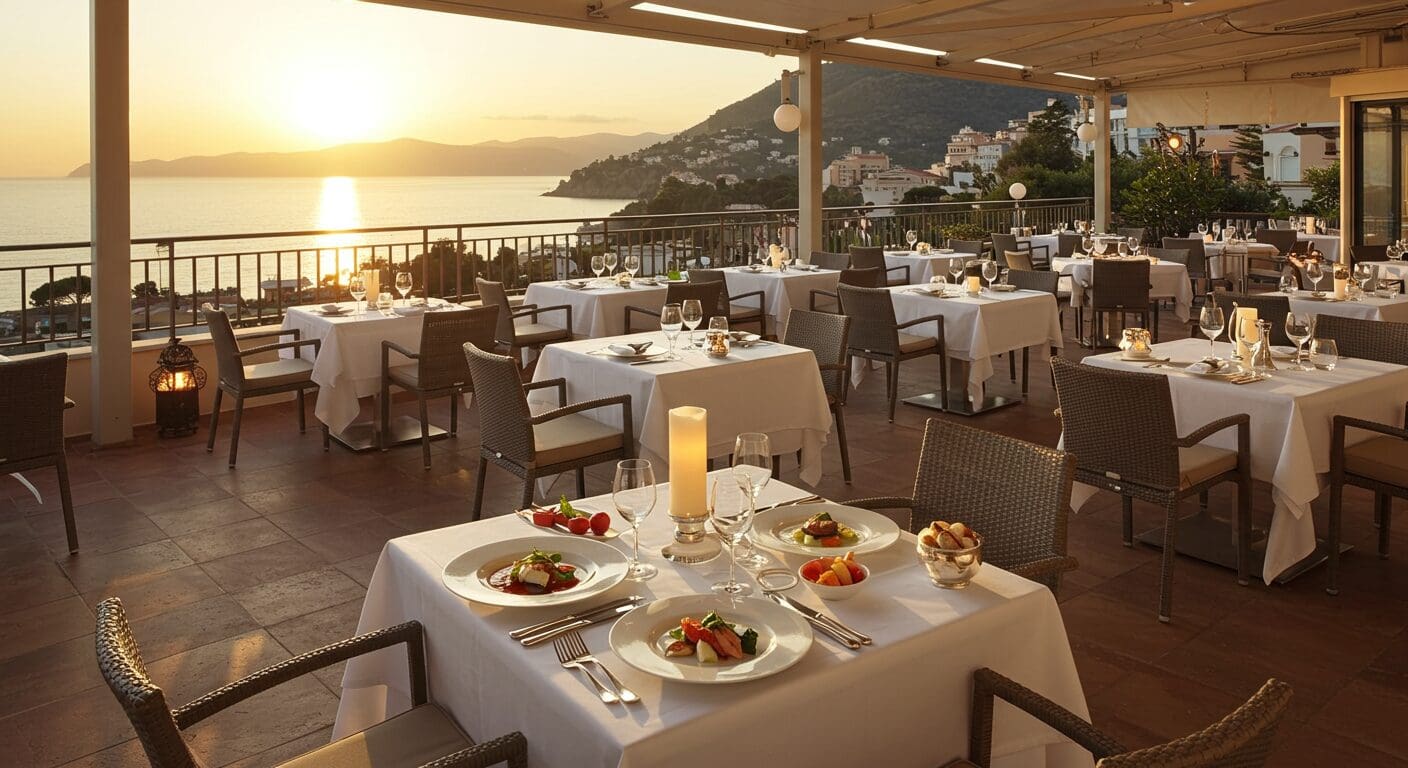
The headline act is Cocina de Autor at Grand Velas Los Cabos, the sole restaurant in the destination to hold a Michelin star in both 2024 and 2025. Chefs Sidney Schutte and Francisco Sixtos have built a multi-course tasting menu that takes Mexican soul and runs it through a global filter without losing the plot – scallops with miso butter sit alongside wagyu with smoked parmesan, and somehow the whole thing feels coherent rather than chaotic. The setting is elegant, the ocean views are the kind that make you put down your wine glass just to look, and the service operates at a level where your water glass is refilled before you have noticed it needed refilling. This is, by any measure, world-class fine dining.
The second Michelin star in the Los Cabos conversation belongs to Comal at Chileno Bay Resort and Residences, part of the Auberge Resorts Collection. Executive Chef Yvan Mucharraz leads the kitchen with a programme built around live-fire cooking, fresh ceviches and a menu that reads as contemporary Mexican but tastes like something more elemental – wood smoke, citrus, char, the sea. The open-air setting keeps the atmosphere from tipping into reverence, which is exactly right. Chileno Bay itself is one of the most sheltered and swimmable bays on the East Cape side of the corridor, so the temptation to simply eat, drink, and stay is considerable. Reservations are essential and should be made well ahead of arrival, particularly in high season.
For those who want the fine dining experience with a genuinely theatrical setting, El Farallon at the Waldorf Astoria Los Cabos Pedregal occupies a position carved into the cliffside above the Pacific, the kind of location that makes you briefly question whether architecture has gone too far and then immediately conclude that no, actually, this is precisely how far it should go. The menu is built around a fresh fish market presentation – a blackboard, a selection of what came in that morning, yellowtail and parrotfish among the regulars – and the simplicity of the format is disarming given the grandeur of the surroundings. The restaurant also hosts residencies with Michelin-starred chefs throughout the year, which is worth tracking if your dates allow for planning.
Farm-to-Table and the Green Star Generation
If the cliff-edge seafood temples represent one strand of the Los Cabos dining story, the farm-to-table movement represents another – quieter, earthier, and in some ways more interesting for what it says about where this destination is heading.
Flora’s Field Kitchen at Flora Farms is the best known of these, and for good reason. Spread across 25 acres in the foothills of the Sierra de la Laguna, this is a working farm that also happens to serve some of the most honest, ingredient-driven food in Baja California Sur. The Michelin Guide awarded it both a Green Star for sustainable gastronomy and a Bib Gourmand distinction – an unusual double that tells you something about the kitchen’s priorities. Everything on the plate grew nearby. The weekend brunch is particularly beloved, and the fresh carrot juice margarita is either a brilliant idea or an acquired taste depending entirely on how you feel about carrot juice. It is, for the record, a brilliant idea.
In the same philosophical territory sits Acre Restaurant in Ánimas Bajas, San José del Cabo – a Michelin Green Star holder with a sustainable farm programme that underpins a menu directed by culinary lead Arturo Rivero. Dining at Acre feels like eating in a garden that has been styled by someone who reads both agricultural journals and design magazines. The palm-canopy setting is genuinely unlike anything else in the region, and the food – contemporary Mexican with strong Asian influences, serious bar craft, casual energy – rewards the short drive from the main corridor emphatically. If you visit Los Cabos and do not go to Acre, we will not say you made a mistake, but we will think it.
Hidden Gems and Local Eating: Beyond the Resort Corridor
The Tourist Corridor between Cabo San Lucas and San José del Cabo is where most of the Michelin stars, the beach clubs, and the resort restaurants live. It is also, if you are not careful, where you can spend an entire week without ever eating anywhere that feels remotely Mexican. This would be a tragedy.
San José del Cabo’s historic town centre has a genuinely thriving local restaurant scene concentrated around the main plaza and the gallery district. Here you will find small, owner-run kitchens serving Baja-style fish tacos, caldo de mariscos (a seafood broth of considerable intensity), and aguachile – raw shrimp cured in lime juice and dressed with chilli and cucumber, which is the thing to order if you order nothing else in this town. The quality of the aguachile in Los Cabos is, honestly, unreasonable. It sets a standard that will ruin you for versions eaten elsewhere.
The Mercado Orgánico in San José is worth a Saturday morning visit both for the produce and for the prepared food stalls, which represent some of the best-value eating in the destination. Street-level taquerias in Cabo San Lucas are concentrated around the marina area and, more authentically, in the residential streets slightly north of the tourist centre. Follow the smell, look for the lengthiest queue of local families, and order whatever is written on the board rather than whatever is translated in the menu. The translation is never an improvement.
Beach Clubs and Casual Dining: Eating Well Without the Formality
Los Cabos has elevated the beach club lunch into something of an art form, partly because the setting demands it – you cannot eat badly with that much Pacific Ocean in your eyeline without it feeling like a moral failure – and partly because competition among the properties on the corridor has driven the food quality up considerably.
The better beach club experiences tend to be attached to the major resort hotels, where kitchen standards are consistent and the ceviche arrives cold and properly acidic rather than warm and approximate. Look for properties along the Chileno Bay and Santa Maria Bay stretch if you want swimmable water alongside your food, since the surf on the Pacific side makes eating within earshot of it more of an existential than a culinary experience.
For casual dining that earns its relaxed reputation, the palapa-roofed restaurants along the San José del Cabo estuary offer good grilled fish, cold beer and the particular satisfaction of eating somewhere that has looked exactly the same for thirty years. The fishing boats are visible from most tables. This is not a coincidence.
What to Drink: Mezcal, Wine and the Baja Question
Any serious account of eating in Los Cabos has to address the drinking, because the two are substantially entwined here. Mezcal is the obvious starting point – smoky, complex, and available in a range of quality levels that starts at “perfectly serviceable” and ends at “something worth sitting with slowly.” The fine dining restaurants generally have thoughtful mezcal lists; the beach clubs will make you a mezcal margarita that is either the correct decision or a reason to slow down, depending on the time of day.
Baja California, as a wine-producing region centred around the Valle de Guadalupe, has been quietly excellent for longer than most people outside Mexico realise. Bottles from producers like Monte Xanic, L.A. Cetto and Vena Cava appear regularly on the better restaurant wine lists in Los Cabos, and ordering them rather than the imported options is both the economically sensible and the gastronomically interesting choice. The food in this region was built around these wines, whether or not either party knew it at the time.
Cerveza, obviously, is non-negotiable. Pacifico is the local choice and the correct one. There is nothing wrong with this.
Reservation Tips and Practical Notes for Eating Well
The practical reality of dining in Los Cabos at the Michelin-starred level is that reservations at Cocina de Autor and Comal should be secured before you board the plane. High season – roughly November through April – sees both restaurants booked weeks out, and the assumption that you can walk in or sort it on arrival is an optimism that the maître d’ will gently but definitively correct.
Flora’s Field Kitchen operates on a different cadence – the farm setting and slightly more relaxed atmosphere mean that last-minute bookings are sometimes possible midweek, though weekend brunch slots disappear quickly. Acre is similar in this regard, though its rising profile means the buffer is shrinking.
El Farallon at the Waldorf Astoria benefits from the hotel concierge infrastructure, meaning that guests staying at the property will find the booking process considerably smoother. If you are not staying there, call directly, be polite about it, and ask about early or late seatings, which tend to have more availability than the prime 7:30pm window.
For the San José del Cabo restaurant scene and the more casual local spots, the etiquette is simpler: arrive, wait if necessary, and order the aguachile. The wait is never as long as you fear, and the food, consistently, is worth it.
How to Build Your Dining Week in Los Cabos
The most satisfying approach to eating well in Los Cabos is to resist the temptation to anchor yourself entirely in one register. Michelin-starred tasting menus two nights running will leave you simultaneously overindulged and somehow under-nourished – the kind of dining that is brilliant in individual doses and exhausting as a sustained programme. The pleasure of a destination like this is the range.
A well-constructed week of eating here might look something like this: one evening at Cocina de Autor, one at Comal, one at El Farallon for the cliff-edge theatre of it, a Saturday morning at Flora Farms for the brunch and the farm walk, an afternoon at Acre for a long lunch that extends into early evening without anyone feeling the need to rush you, and the remaining meals spent in San José del Cabo eating aguachile, caldo de mariscos and fish tacos at places that do not have a website. This is, roughly speaking, a perfect food itinerary. Adjust for personal enthusiasm and metabolic capacity.
The question of where to base yourself while doing all of this is worth considering carefully. A luxury villa in Los Cabos gives you something the hotels cannot quite match: a private chef option that brings the farm-to-table philosophy directly to your kitchen, a wine cellar stocked to your preferences before arrival, and a dining table where the conversation can run as long as it needs to without a second seating hovering politely in the wings. Many of the best villas on the corridor work with private chefs who know the local producers, the fish market schedule and the proper ratio of lime to chilli in an aguachile. This is not nothing. For broader context on planning your time in the region – beaches, activities, getting around – the full Los Cabos Travel Guide covers the ground comprehensively.
Does Los Cabos have any Michelin-starred restaurants?
Yes – Los Cabos has two Michelin One Star restaurants as of 2025: Cocina de Autor at Grand Velas Los Cabos, and Comal at Chileno Bay Resort and Residences (Auberge Resorts Collection). Additionally, both Flora’s Field Kitchen at Flora Farms and Acre Restaurant hold Michelin Green Stars for their commitment to sustainable gastronomy, with Flora Farms also recognised with a Bib Gourmand distinction for outstanding value.
How far in advance should I book restaurants in Los Cabos?
For fine dining at Michelin-starred restaurants like Cocina de Autor and Comal, reservations should ideally be made four to six weeks in advance during high season (November through April). El Farallon at the Waldorf Astoria is best booked through the hotel concierge. More casual spots like Acre and Flora’s Field Kitchen have greater flexibility midweek, though weekend brunch at Flora Farms fills quickly. For local restaurants and taquerias in San José del Cabo, no reservation is generally required.
What dishes should I make sure to eat in Los Cabos?
Aguachile – raw shrimp cured in lime juice with chilli and cucumber – is the dish most associated with Baja California Sur and the one most worth seeking out in its best local form. Fresh fish tacos, caldo de mariscos (seafood broth), and ceviche are essential eating. For drinks, look for mezcal from a thoughtful list, Baja California wines from Valle de Guadalupe producers, and a cold Pacifico cerveza alongside anything pulled from the sea that morning.