Cabo San Lucas Travel Guide: Where to Stay, Eat & Explore in Luxury
Most first-time visitors to Cabo San Lucas arrive expecting a spring break postcard: tequila shots at noon, jet skis, the kind of beach bar that plays the same six songs on rotation until someone cries. And yes, that Cabo exists. It is alive and well and wearing a neon vest. But it occupies perhaps ten percent of what the southern tip of the Baja California Peninsula actually offers – and the other ninety percent, the part where the Sea of Cortez meets the Pacific in a collision of impossibly blue water, where desert cactus grows to the edge of white sand, where world-class chefs are doing genuinely interesting things with local catch and homegrown produce, that part tends to surprise people. Pleasantly. Sometimes profoundly. The trick is knowing which Cabo you came for – and then knowing where to find it.
This is a destination that works across an unusually wide range of travellers, which is either its great strength or a source of mild existential confusion, depending on your perspective. Couples marking milestone anniversaries find the clifftop sunsets and private infinity pools quietly perfect. Families seeking real privacy – the kind that hotels, however grand, simply cannot provide – discover that a villa with its own pool and staff means children can be children and adults can be adults, occasionally simultaneously. Groups of friends, the sort who want a shared house rather than adjacent hotel rooms, find Cabo’s rental market quietly excellent. Remote workers seeking reliable connectivity alongside reliable sunshine have quietly colonised certain hillside villas for months at a time. And wellness-focused travellers, drawn by the desert air, the warm sea, and the particular quality of light at six in the morning, find the pace here far more restorative than the neon-vest contingent would suggest.
The Approach: Getting to the End of the World (Which Is Easier Than It Sounds)
Cabo San Lucas sits at the very tip of the Baja California Peninsula – a long, thin finger of land pointing south from the United States border into the Pacific. Geographically dramatic. Logistically, rather straightforward. Los Cabos International Airport (SJD) sits roughly 45 minutes north of Cabo San Lucas itself, between the town and its slightly more sedate neighbour San José del Cabo. It receives direct flights from most major American cities – Los Angeles, Dallas, Houston, New York, Chicago – as well as connections from Canada and, increasingly, Europe. From London, you’re looking at a connection through the US; from Madrid, Aeromexico offers connections through Mexico City that aren’t as punishing as they sound.
From the airport to your villa, the sensible move is a pre-arranged private transfer. Taxis are available and official, but if you’ve just landed after a long-haul flight and you’re about to discover a private pool is waiting for you, a cool air-conditioned car that someone else has organised seems like the correct priority. The drive south along the Transpeninsular Highway is, unexpectedly, rather lovely – desert scrub, pale mountains, the occasional osprey on a telephone pole.
Getting around once you’re there depends heavily on your appetite for independence. Cabo San Lucas town is walkable in the centre. The Corridor – the stretch of resort-lined coast between Cabo and San José – really requires a car or a good relationship with your villa’s concierge. Rideshare apps work reasonably well in the main areas, and rental cars are widely available if you want the freedom to explore further. A word of advice: drive during daylight hours when you’re first finding your bearings. The roads are fine. It’s just that desert dusk arrives with considerable speed.
The Table Is Set: Eating and Drinking in Cabo San Lucas
Fine Dining
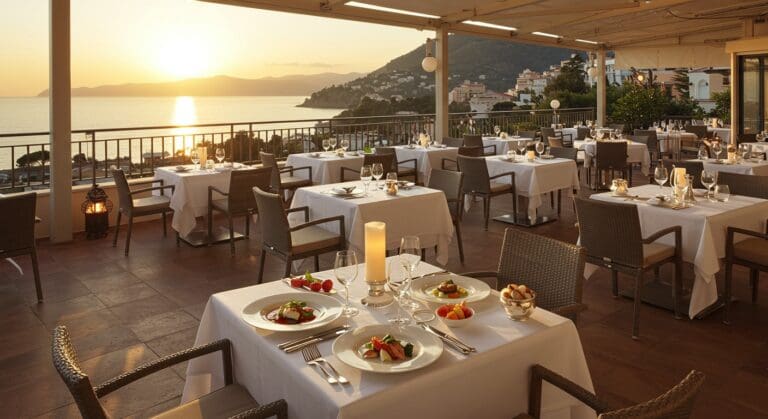
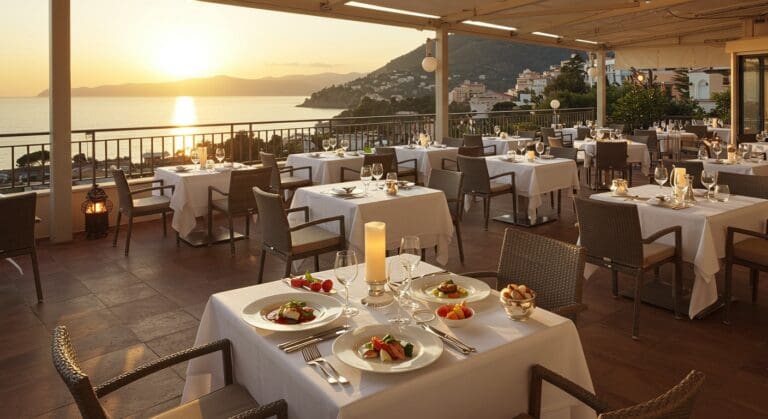
The serious food scene in Cabo San Lucas is better than its reputation suggests and, in one or two cases, better than almost anywhere in Mexico. Start with Sunset Monalisa, if only because the setting demands it – a clifftop perch above El Arco, the famous rock formation where the two seas meet, with views that do genuine violence to your ability to concentrate on the menu. Entrées run between thirty and fifty dollars, live violin appears on weekends, and the golden hour here is not a metaphor; the light at around six-thirty in the evening is the kind that makes everyone at the table look like a better version of themselves. Come for the view, stay because the food turns out to be worthy of it.
Manta at The Cape, the culinary centrepiece of The Cape hotel designed by Chef Enrique Olvera – the man behind Pujol in Mexico City, which requires no further introduction to anyone who follows food seriously – is the reservation you should make before you book your flights. The name does double duty: the manta ray as an emblem of the kitchen’s devotion to seafood, and manta as the Spanish word for blanket, signalling Olvera’s characteristic insistence that food should feel like comfort even when it is technically brilliant. It does. It is.
El Huerto takes an entirely different approach and is remarkable for it. Set on grounds that genuinely resemble a Baja California hacienda – gardens, orchards, fruit trees, the smell of something good growing nearby – the menu changes to reflect what is actually being harvested on site on any given day. The cooking blends Baja California produce with Mediterranean and Asian influences in a way that sounds like a pitch deck and tastes like someone just really knows what they’re doing. The cocktail menu and wine list are both taken seriously. This is somewhere to come when you want a long evening rather than a quick dinner.
Where the Locals Eat
Los Tres Gallos, tucked into downtown Cabo about five minutes from the marina, is the kind of place that gets described as romantic without becoming insufferable about it. A courtyard strung with warm lights, bougainvillea in full drama, a live mariachi band that manages to feel joyful rather than obligatory. The menu works the classics with intelligence – bone marrow tacos and hominy-infused pozole among them – and the whole thing operates at a pitch of warm, slightly festive energy that is very hard not to enjoy. Go without a reservation on a Tuesday and you’ll wait. Go with one and you’ll wonder why you ever eat indoors.
On El Médano Beach, Tres Sirenas – the latest venture from celebrated restaurateur Edith Jiménez – defines what good Baja dining should feel like: fresh seafood, lively service, live music from around seven each evening, and the sense that every night here is a small occasion. It’s the kind of place where you order one more round without quite meaning to. Founded by someone who clearly loves Cabo in the way that produces excellent restaurants rather than mediocre ones, it’s worth building an evening around.
Hidden Gems Worth Seeking Out
The fish taco stands along the road between Cabo San Lucas and San José del Cabo are not hidden exactly – locals know them perfectly well – but they don’t appear in most luxury travel guides because they involve plastic chairs and no view of the sea. This is their loss. A fresh fish taco made with that morning’s catch, a squeeze of lime, some proper salsa, costs less than two dollars and will recalibrate your entire understanding of what the cuisine here can be. The Corridor’s resort restaurants are excellent. These stands are the other half of the education.
The morning mercado scene in San José del Cabo’s historic centre is worth making the drive for at least once – local produce, prepared food, the particular pleasantly chaotic energy of a working market rather than a curated one. Good coffee exists if you find the right corner. It often requires asking.
Land, Sea and the Space Between: Understanding the Geography of Los Cabos
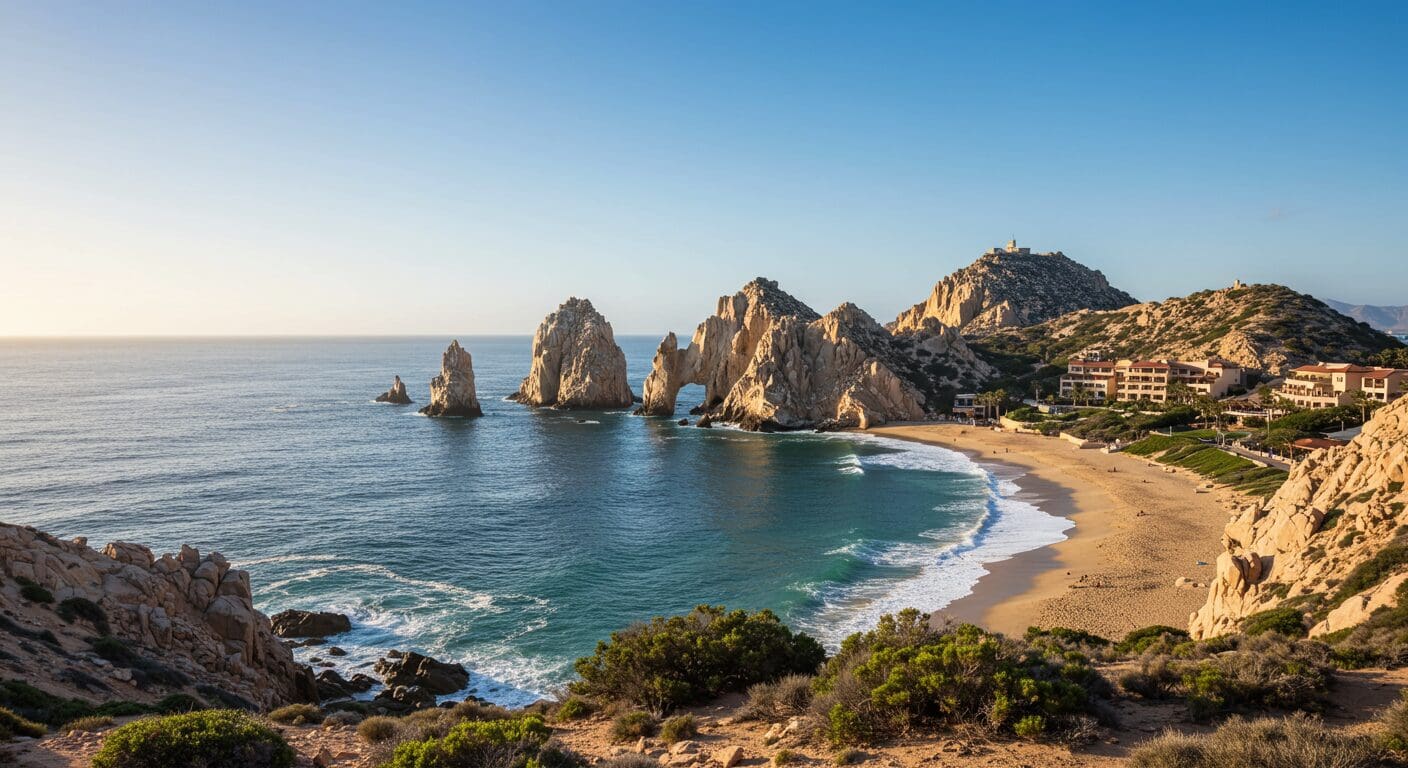
The single most useful thing to understand about this part of Baja California is that you are standing at the confluence of two distinct bodies of water. To the east, the Sea of Cortez – calmer, warmer, better for swimming and snorkelling, teeming with marine life of a variety that prompted Jacques Cousteau to describe it as the world’s aquarium, a quote that has been repeated so many times in this part of Mexico that it deserves a small statue. To the west, the Pacific Ocean – wilder, colder, producing the kind of swells that serious surfers travel specifically to find. Between them, El Arco: a naturally formed arch of rock at Land’s End where the two seas collide in a manner that is genuinely worth watching from a boat.
The Corridor, that twenty-mile strip of coast connecting Cabo San Lucas to San José del Cabo, is where most of the resort development sits – carefully landscaped, well-maintained, and home to many of the area’s best private villa properties with their clifftop or beachfront positions. San José del Cabo itself, by contrast, retains its colonial town centre and art district with some dignity, its Thursday evening gallery walks drawing a crowd that tends to arrive with wine rather than a selfie stick. The interior of the peninsula, heading north, becomes genuine desert – arroyos, cacti that stand twelve feet tall, a landscape that feels ancient and unhurried in ways the marina emphatically does not.
The desert-meets-sea dynamic here is not just photogenic; it fundamentally shapes the climate, the cuisine, the activities, and the particular quality of the air in the early morning when the temperature is perfect and the light is low and even confirmed non-runners briefly consider jogging. Briefly.
How to Fill the Days: The Best Things to Do in Cabo San Lucas
The best things to do in Cabo San Lucas distribute themselves across an unexpectedly wide range, from the genuinely athletic to the unapologetically horizontal. Start, if the season allows, with whale watching. Between December and April, grey whales and humpbacks make their annual migration through these waters, and the experience of watching a forty-tonne animal breach at close range from a private charter boat is the kind of thing that makes you reassess your relationship with the word “large.” January through March offers the additional possibility of spotting calves – baby whales, which are only slightly smaller than a bus and considerably more endearing. Private luxury charters provide the full experience without the group-tour dynamic of standing wedged against strangers at the bow.
Glass-bottom boat trips to El Arco are the other non-negotiable, particularly at the right tide when the passage through the arch is possible. The boat tours depart from the marina throughout the day, last roughly an hour, and give you the El Arco shot from every conceivable angle. It’s worth doing early in the morning before the light becomes harsh and the number of boats multiplies significantly.
The Thursday evening art walk in San José del Cabo’s gallery district – running from around five to nine from November through June – is one of the area’s genuinely lovely customs: galleries open their doors, wine appears, and the colonial streets take on a warmth that has nothing to do with ambient temperature. It’s an evening out that feels effortless and is, quietly, rather good.
For those inclined toward something more active, the options spread in every direction: paddleboarding in the calm waters of the Sea of Cortez side, guided hiking in the Sierra de la Laguna mountains behind the town, deep-sea fishing for marlin and dorado (Cabo has long considered itself the world’s marlin capital, a claim contested by approximately no one), sunset sailing, and sea kayaking around the rock formations at Land’s End. The concierge at a good villa will organise most of these before breakfast. This is not a small advantage.
Blue Water and Desert Trails: Adventure in Both Directions
The adventure credentials of Cabo San Lucas run deeper than the party brochures suggest. Scuba diving here is genuinely world-class – the Cabo Pulmo National Marine Park, a short drive up the Sea of Cortez coast, is one of the best-preserved coral reef systems in North America and a UNESCO World Heritage Site that rewards the effort of getting there. Closer to town, dive sites like Pelican Rock and The Blowhole offer encounters with sea lions, rays, and the occasional hammerhead shark passing through on their own business. Water temperatures are warm enough for comfortable diving for most of the year, peaking in summer and autumn.
Surfing on the Pacific side produces some of the most consistent swells in Mexico, particularly at Monuments Beach and Zippers, both accessible along the Corridor. The breaks suit intermediate and advanced surfers more than beginners, which is either excellent news or useful information depending on your experience level. Lessons are available. Pride is optional.
ATVing through the desert is a local institution – guided tours head into the arroyos and up into the hills behind town, through landscapes that feel completely disconnected from the resort coast below. For those preferring their adventure at higher altitude, the Sierra de la Laguna biosphere reserve offers multi-day hiking trails through pine-oak forest to a summit that rises above 2,000 metres – a fact that surprises most visitors, who did not pack a fleece. Kitesurfing draws a dedicated community to the East Cape and the calmer Corridor beaches; conditions here can be exceptional, particularly between November and March when the northern winds pick up with reliable enthusiasm.
Cabo with Children: Actually Considerably Easier Than You Think
The received wisdom that Cabo San Lucas is primarily a party destination is worth interrogating when you’re travelling with children, because the reality is considerably more accommodating. The Sea of Cortez beaches – calmer, warmer, and gentler in their wave action than the Pacific side – are genuinely excellent for families with young children who want to be in the water without incident. El Médano Beach, the main public beach in town, has shallow clear water, beach clubs with proper facilities, and the kind of immediate accessibility that makes a morning at the beach feel effortless rather than logistically taxing.
The real advantage for families, though, is a private villa. It sounds obvious stated plainly, but the practical difference between a luxury hotel room and a four-bedroom villa with its own pool, private chef, and a garden where children can exist at full volume without consequences is the difference between a holiday and a genuinely relaxing holiday. Those are different things. At a private villa, mealtimes happen when your family is ready for them, pool time doesn’t require booking, and the general infrastructure of the trip bends around your children rather than the other way around.
Whale watching tours run family-friendly options that are among the most genuinely memorable experiences any child can have. The glass-bottom boat to El Arco requires nothing of children except attention, which most manage for the duration. The aquarium in downtown Cabo San Lucas, while modest by international standards, does the job for a slow morning. And the particular quality of a Cabo evening – warm air, easy outdoor dining, the informal pace of beachside restaurants – means that the transition between afternoon swim and dinner is mercifully uncomplicated. Travelling with children in Cabo is not the ordeal that other destinations occasionally make it.
History in the Desert: Culture, Art and the Baja Soul
Cabo San Lucas proper is not an ancient city. It was a small fishing settlement for most of its existence – visited occasionally by pirates and, later, by American sportfishing boats – and its transformation into a resort destination has been rapid enough that the town has not had much time to develop the kind of layered historical identity that, say, Mexico City carries in every cobblestone. This is not a criticism. It is just context.
The deeper history of the Baja California Peninsula belongs to the Pericú people, who lived here for thousands of years and left cave paintings in the mountains north of La Paz that are extraordinary by any measure – UNESCO-listed rock art at sites like Cueva del Ratón and the Sierra de San Francisco murals, accessible by guided tour for those willing to invest the journey. The Spanish mission system arrived in the eighteenth century and you can trace its path through the peninsula’s interior towns, each with its own adobe church and plaza.
San José del Cabo, twenty minutes up the Corridor, carries more of this historical weight. Its colonial centre – the Jesuit mission church, the shaded main plaza, the streets lined with preserved architecture – provides a genuine counterpoint to Cabo’s resort energy. The Thursday art walk is an expression of an active contemporary art scene that has grown up around a community of Mexican and international artists who discovered the light here years ago and stayed. The Dia de los Muertos celebrations each November are vivid, moving, and not even slightly aimed at tourists, which makes them worth making an effort to find.
The fishing culture that predates the resort development still exists in the early mornings at the marina, where the working pangas head out before most visitors have considered breakfast. Watch from the dock and you are watching something genuinely old.
What to Bring Home: Shopping in Cabo San Lucas
The souvenir shops along the marina are best navigated quickly and without eye contact. They sell things. You will recognise the things. None of them are the things you will be glad to have bought.
The genuinely good shopping in Cabo concentrates in a few specific places. The San José del Cabo art district has galleries selling work from established and emerging Mexican artists – paintings, ceramics, and blown glass from Jalisco that is worth shipping home rather than packing. The Thursday art walk is an excellent introduction; the galleries are open throughout the week for the less spontaneous shopper.
For textiles, the artisanal markets in San José carry hand-woven fabrics, embroidered clothing, and Talavera ceramics from Puebla that make considered gifts. Vanilla from Veracruz, Oaxacan mezcal (distinctly different from the tequila Cabo is better known for and worth the exploration), and Baja California olive oil – a product the peninsula does rather well given the climate – are all excellent things to bring home and explain to people.
Puerto Paraíso Mall in Cabo San Lucas handles the international luxury brand requirements – it stocks what you’d expect, sells it at prices that are occasionally competitive with duty-free, and provides air conditioning, which is not nothing in July. For jewellery, several independent jewellers around the marina specialise in silver work and pieces incorporating local black coral and abalone, both of which are specific to the region and not available at the souvenir stands. These require a little more looking but reward the effort.
The Practical Brief: Everything You Need Before You Go
The best time to visit Cabo San Lucas depends significantly on what you’re there for. November through April is the classic season: temperatures between 22 and 28 degrees Celsius, minimal rainfall, low humidity, and the whale migration running through the deeper winter months. Whale watching, outdoor dining, and comfortable exploration all peak here. May through July marks the shoulder season – quieter, slightly warmer, excellent value – with temperatures climbing into the low thirties. August through October is the technical hurricane season; storms are not frequent but they do occur, and humidity rises substantially. That said, September and October produce the warmest sea temperatures and the best diving visibility, and many experienced Cabo visitors consider the risk worthwhile. July and August are domestic high season, with Mexican families and American visitors coinciding to fill the better beaches. If you want the place relatively to yourself, November and early December, post-shoulder and pre-Christmas, is the sweet spot most people miss.
The currency is the Mexican peso; US dollars are accepted almost everywhere in Cabo, often with a slightly unfavourable exchange rate applied without announcement. Having pesos for small transactions – tacos, markets, tips – is worth the effort at the airport ATM on arrival. Tipping is expected and important: fifteen to twenty percent in restaurants, fifty to one hundred pesos per day for housekeeping, similar for drivers. It is not optional in the way that it sometimes is in Europe.
Spanish is the language; in Cabo’s tourist infrastructure, English is widely spoken. A few phrases in Spanish will be met with genuine warmth rather than mere tolerance. Safety in the main tourist areas of Cabo San Lucas and the Corridor is generally good; the standard advice about not wandering unfamiliar areas alone at night applies here as it does everywhere. Tap water is not drinkable; bottled or purified water is universally available. Travel insurance is not optional.
The dress code, such as it is, ranges from beach casual to smart casual for most fine dining; a couple of restaurants lean toward the dressy end of casual in the evenings, but nobody is sending anyone home to change. Sunscreen of serious SPF – the kind that people from the United Kingdom routinely underestimate – is essential from March through October and advisable year-round. The Baja sun is not making suggestions.
Why a Private Villa Changes Everything About a Cabo Holiday
There is a particular luxury that no hotel, however large the suite and however attentive the butler, can quite replicate: the feeling that the place you are staying is entirely yours. No lobby. No breakfast queue. No negotiating pool chairs at seven in the morning with the methodical towel-placement operation that is, sadly, a universal feature of resort hotels. A private luxury villa in Cabo San Lucas removes all of this and replaces it with something considerably better.
The villa properties here range from smaller clifftop retreats with two or three bedrooms and a private infinity pool, to serious multi-bedroom compounds with full household staff, private chefs, home cinemas, gym facilities, and the kind of outdoor entertaining spaces that make you understand why people buy houses in Cabo rather than just visit. For families, the privacy and space are genuinely transformative – children have room to exist, adults have room to breathe, and the absence of the performative togetherness that hotels occasionally demand means everyone is more relaxed. For couples on milestone trips, a villa with a plunge pool on a private terrace above the sea is the kind of setting that makes everything else in life temporarily seem slightly insufficient by comparison.
For groups of friends – and Cabo attracts a serious number of friend groups, particularly for significant birthdays and milestone celebrations – a shared villa creates a quality of shared experience that adjacent hotel rooms simply cannot. Gathering for a sunset on a private terrace, a private chef producing Baja cuisine in a kitchen that is actually your kitchen for the week, is a fundamentally different experience from meeting in a hotel restaurant at a time someone else has decided is convenient.
For remote workers, the better villa properties in Los Cabos now come equipped with genuinely fast internet – fibre connections, in some cases Starlink, with dedicated workspace that allows you to be properly productive rather than squinting at a laptop in the corner of a hotel room. The time zone alignment with US East and West Coast business hours is a practical advantage that remote workers based in Europe or the United Kingdom should weigh accordingly.
Wellness amenities in the villa tier here are genuine rather than gestural. Private pools designed for morning swimming rather than decoration. Outdoor yoga platforms with sea views. In-villa spa treatments that can be arranged through your concierge. The desert air and the quality of the mornings do the rest. Cabo at its best is not the destination the neon-vest crowd found first. It is something quieter, more considered, and considerably harder to leave than any travel guide can adequately communicate.
Browse our full collection of luxury holiday villas in Cabo San Lucas and find the property that makes this particular version of Cabo yours.
More Cabo San Lucas Travel Guides
What is the best time to visit Cabo San Lucas?
November through April is the most reliably comfortable season – dry, warm (22-28°C), with low humidity and the grey whale migration running from December through April. January to March is the peak of whale watching season. For fewer crowds and excellent value, early November and early December offer near-ideal conditions that most visitors miss. Avoid August and September if you are sensitive to heat and humidity; those months carry the highest hurricane risk, though they also offer the warmest water temperatures and best dive visibility.
How do I get to Cabo San Lucas?
Los Cabos International Airport (SJD) is the gateway, located approximately 45 minutes north of Cabo San Lucas itself. Direct flights operate from most major US cities including Los Angeles, Dallas, Houston, New York and Chicago. From Canada, direct seasonal routes run from several major airports. From Europe, connections typically route through the United States or Mexico City. A pre-arranged private transfer from the airport to your villa is the most comfortable option and can be organised through your villa concierge. The drive south along the peninsula is genuinely scenic.
Is Cabo San Lucas good for families?
More so than its reputation suggests. The Sea of Cortez beaches – calmer, warmer and gentler than the Pacific side – are excellent for children. Whale watching from December to April is an experience that leaves a lasting impression on younger travellers. The real advantage for families, though, is renting a private villa: the combination of a dedicated pool, household staff, private chef options, and space for children to exist at volume makes for a fundamentally more relaxed family holiday than any hotel arrangement. The informal, outdoor-oriented pace of Cabo evenings suits families with children of most ages.
Why rent a luxury villa in Cabo San Lucas?
Privacy, space, and the absence of compromise. A private villa means your own pool, your own schedule, your own kitchen and – in the better properties – your own staff. Private chefs who produce Baja cuisine to order, concierge services that arrange whale watching charters and dinner reservations before you’ve had your morning coffee, and the fundamental advantage of a space that is entirely yours for the duration. For families, groups of friends, and couples on significant trips, the villa experience in Cabo San Lucas is materially different from, and materially better than, the hotel alternative.
Are there private villas in Cabo San Lucas suitable for large groups or multi-generational families?
Yes, and the villa inventory here runs to genuinely large properties. Multi-bedroom estates with six, eight, or more bedrooms are available, many configured with separate guest wings or casitas that provide privacy within the group while sharing communal spaces – pools, outdoor entertaining areas, dining terraces. Full household staff arrangements, including private chefs, housekeeping, and dedicated concierge services, mean that large groups can travel without anyone being responsible for the logistics. Multi-generational families particularly benefit from villas where grandparents have quiet, ground-floor accommodation while younger family members have their own space.
Can I find a luxury villa in Cabo San Lucas with good internet for remote working?
Increasingly, yes. The better villa properties in the Los Cabos area now offer fibre broadband connections with speeds adequate for video conferencing and serious professional use; a growing number have installed Starlink satellite connectivity, which delivers reliable performance even in more remote hillside or desert-edge locations. If reliable connectivity is a priority, specify this when enquiring about a property and request confirmation of upload and download speeds. The time zone alignment with US East and West Coast hours makes Cabo a practical base for remote workers on American schedules; for those working European hours, the seven to eight hour difference requires some adaptation.
What makes Cabo San Lucas a good destination for a wellness retreat?
The combination of desert air, warm sea, and quality of morning light creates conditions that are genuinely conducive to rest and recovery rather than merely adjacent to it. Private villas with dedicated pools allow for daily swimming as practice rather than leisure. In-villa spa treatments – massages, bodywork, holistic therapies – can be arranged through most villa concierge services. The Sierra de la Laguna mountains provide hiking in genuine wilderness. The Sea of Cortez offers paddleboarding and kayaking in calm, clear water. And the pace of Cabo, once you step back from the marina strip, is unhurried in a way that actively encourages the body to slow down. Sunrise yoga on a clifftop terrace above the Pacific is less of a cliché when it is actually your terrace.