Blato Travel Guide: Where to Stay, Eat & Explore in Luxury
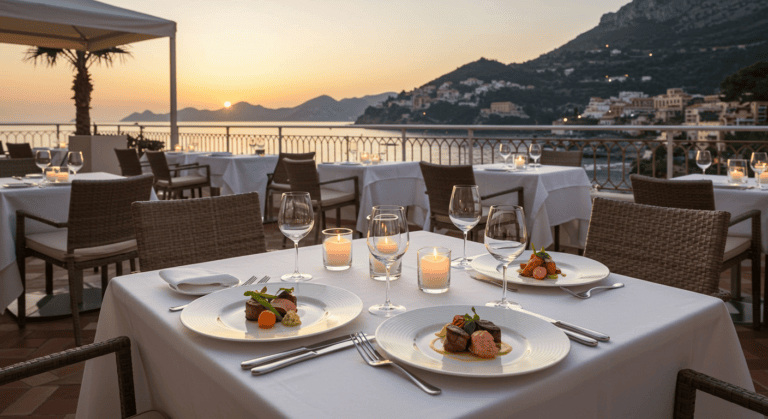
The morning starts slowly, which is the point. Coffee appears on the terrace without you quite remembering asking for it. Below, the Adriatic is doing that thing it does in July – somewhere between turquoise and a colour that doesn’t have a name in English. The village of Blato spreads quietly below you, all honey-stone and terracotta, the kind of place where the church bell marks the hour and the hour doesn’t particularly matter. You have nowhere to be. A private pool glitters. The olive trees are doing very little, very convincingly. By eleven you might walk down to the market. By noon you might not. This is Korčula’s interior at its most honest – unfussed, unhurried, and entirely, quietly extraordinary.
Blato is not the Blato of Instagram captions or rushed itineraries. It’s the kind of destination that rewards a certain type of traveller: couples marking a milestone anniversary who want beauty without performance; families who’ve discovered that a private villa with a pool makes everyone – children included – considerably better company; groups of friends who need space to actually spread out rather than queue for shared bathrooms; remote workers who’ve realised that a morning of emails looks rather different when the window frames the Dalmatian hills; and wellness-focused guests who understand that proper restoration requires both absence of noise and presence of olive oil. Blato, on the island of Korčula, quietly serves all of them. It does so without making a fuss about it.
How to Reach Blato Without the Chaos of Peak-Season Croatia
Getting to Blato is, in itself, a small lesson in the art of arrival. The journey is the overture. Most international travellers fly into Split Airport on the mainland – one of the best-connected airports in the Adriatic, served by flights from across Europe including regular services from the United Kingdom. From Split, a car ferry to Vela Luka takes around two and a half hours – which is either a minor inconvenience or one of the most pleasant crossings in the Mediterranean, depending on whether you’ve thought to bring a good book and a cold beer. Vela Luka sits at the western tip of Korčula Island, and Blato is a short drive inland, around 15 kilometres east.
Dubrovnik Airport is the other realistic option, and some travellers prefer it – particularly those arriving from London or other major hubs with direct summer services. From Dubrovnik, the journey involves a ferry from Orebić to Dominče (near Korčula Town) and then a drive across the island. It takes longer but offers a different kind of scenic compensation. Car hire is strongly recommended – not least because a luxury holiday in Blato becomes considerably more enjoyable when you can set your own pace rather than wait for the twice-daily bus. Once on the island, the roads are good, the distances small, and the driving – once you’ve adjusted to the occasional tractor and the rather philosophical approach to overtaking – is genuinely pleasant.
What to Eat and Where – Blato’s Table Is Quieter Than It Should Be
Fine Dining
Blato doesn’t operate on the same glossy register as Hvar or Dubrovnik when it comes to formal dining, and this, it turns out, is entirely to its advantage. The food is grounded in the Dalmatian interior tradition – slow-cooked lamb under the peka (a bell-shaped cast iron lid, buried in embers, producing results that could make a grown adult emotional), grilled fish so fresh it still seems surprised, and house wines from the Korčula interior that deserve considerably more international attention than they receive. The island’s own Pošip grape produces a white wine of real distinction – dry, aromatic, and honest in the way that only wines from small-production vineyards tend to be. Several restaurants in and around Blato offer fixed menus built around local produce; look for places advertising peka in advance, since it requires ordering ahead and is worth every minute of the wait.
Where the Locals Eat
The social life of Blato orbits, as it has for centuries, around the town’s main avenue – the Korzo – where locals conduct the evening promenade with a seriousness of purpose that tourists find baffling until they join in and find it entirely logical. Konobas – family-run taverns – are the backbone of eating well here. These are not dressed-up affairs with leather menus and amuse-bouches. They are places where grandmother’s recipe is the selling point, where the grappa arrives without asking, and where the bill, when it comes, makes you briefly reconsider your life choices back home. Lamb, black risotto made with squid ink, fresh grilled sea bass, hand-rolled pasta with local truffles if you’re lucky – this is the curriculum. Follow it.
Hidden Gems Worth Seeking Out
The real discoveries around Blato tend to involve someone local pointing you somewhere with minimal further explanation. A winery just outside the village where the owner may or may not appear, pour you three things, and explain the soil with the intensity of someone who has thought about nothing else for thirty years. A farmhouse terrace where lunch is whatever was picked that morning and the price is whatever seems fair. The market in Blato on a weekday morning, where the produce is real and the transactions are conducted in a mixture of Croatian, Italian, and collective goodwill. The olive oil. The honey. The lavender. All of it worth bringing home in quantities that will make airport security regard you with new wariness.
The Island Revealed – Korčula’s Landscape Beyond the Postcard
Blato sits in the fertile valley at the island’s western heart – away from the tourist concentrations of Korčula Town to the east, insulated from the summer noise that descends on the coastal resorts. The island itself is long and thin, running roughly east to west, fringed with pine forests that come down to coves of exceptional clarity. The interior around Blato is agricultural in the best sense – vineyards, olive groves, dry-stone walls, the geometry of the Mediterranean as it existed before mass tourism decided everything needed a cocktail bar.
The landscape rewards driving – slowly, with windows open. Vela Luka, the port town, is worth an afternoon: less touristic than Korčula Town, genuinely lived-in, with a waterfront where the fishing boats tie up alongside the ferries and nobody is pretending anything. Korčula Town itself, at the eastern end of the island, is one of the best-preserved medieval towns in the entire Adriatic – a miniature Dubrovnik that has somehow retained its soul, with narrow marble lanes, a cathedral, and the house where Marco Polo may or may not have been born (Korčula maintains this claim with cheerful defiance in the face of Venetian counter-argument). The drive between Blato and Korčula Town, through the spine of the island, takes forty minutes and is worth doing at least twice – once in each direction, since the light behaves differently.
Off the coast, the smaller islands of the Korčula archipelago – Osjak, Proizd, Gubešić among others – are accessible by small boat and offer swimming in water of the kind that makes you want to be a better person. Proizd in particular has something of a reputation among those who know it as among the finest swimming spots in the Adriatic. The kind of reputation spread quietly, among people who don’t want it to appear in travel guides.
Things to Do in Blato – The Full Range of a Day Well Spent
The fundamental activity in Blato is decompression – and it would be wrong to undersell this as a legitimate pursuit. But there is plenty for those who require more structure. The town itself has a quietly impressive cultural infrastructure for its size: the Arneri Palace houses a museum of local history and ethnography; the Baroque church of All Saints (Svih Svetih) anchors the Korzo with appropriate gravity; and the spring festival of Kumpanija – a centuries-old ceremonial sword dance performed by local brotherhoods – is one of the most distinctive cultural events in Croatia, listed as UNESCO intangible cultural heritage. If you happen to be visiting around Easter, this alone justifies the trip.
Day trips from Blato are numerous and excellent. Korčula Town warrants a full day rather than an afternoon. The Pelješac Peninsula, a short ferry crossing away, is home to some of Croatia’s finest red wine country – the Dingač and Postup appellations – as well as oyster farms in Mali Ston where you can eat from the water with the directness of someone who has earned it. Hvar is accessible by ferry and fast boat – glamorous, beautiful, and considerably busier than anywhere around Blato, which after a few days of island quiet feels like arriving in Manhattan. The comparison is instructive in both directions.
Adventure on the Water and in the Hills – Korčula’s Active Side
The waters around Korčula are among the best in the Adriatic for sailing, and the island is a regular stop on the charter yacht circuit that runs up and down the Dalmatian coast. Renting a boat from Vela Luka – skippered or bareboat, depending on qualification and ambition – opens up the small islands and hidden coves that are simply inaccessible from shore. A day at anchor off Proizd or Osjak, with swimming, lunch, and the kind of silence that reminds you what silence actually sounds like, is one of the more restorative experiences available in this part of the world.
Diving is well catered for in this region – the underwater landscape around Korčula includes walls, wrecks and caves, with visibility that frequently exceeds 30 metres. Several dive operators on the island offer PADI certification courses as well as guided dives for all levels. Sea kayaking has become increasingly popular as a way of exploring the coastline at a pace that actually allows you to look at it. The interior of the island offers genuine hiking terrain – the ridge that runs along the island’s spine gives views in both directions that require no further description. Cyclists will find routes ranging from gentle valley rides to more demanding climbs; the roads are quiet enough, outside the main coastal strip, that this remains genuinely enjoyable rather than defensive sport.
Blato with Children – Why the Best Family Holiday Is One Nobody Orchestrates
The case for Blato as a family destination rests on a simple proposition: the holiday that requires the least logistical effort from parents produces the happiest children, and by extension, the happiest parents. A private villa with a pool removes approximately seventy percent of the negotiation that defines a conventional family holiday. The children have water. The adults have shade and a glass of something cold. The peka is ordered for tomorrow evening. Everyone, for once, is on the same side.
Beyond the villa, Korčula Island is well suited to families in the practical sense: beaches and coves with calm, shallow water that genuinely is safe for younger swimmers; boat trips that hold the attention of children who find cultural walking tours a form of punishment; markets and local interactions that provide a gentle geography lesson for anyone paying attention; and a general pace of life that allows for the kind of unscheduled, unstructured afternoon that children consistently rank above any planned activity. The island has no waterparks. It has no organised children’s entertainment programmes. It has the sea, the boats, the olive trees, and the evening promenade. In retrospect, most families find this is more than enough.
History Written in Stone – Blato’s Long and Layered Past
Blato has been inhabited since before recorded history has much useful to say about it. The Illyrians were here. Then the Greeks. Then Rome, in its methodical way, left roads and administrative order. The Slavic migrations of the early medieval period reshaped the population; Venice controlled the island for centuries and left its architectural fingerprints all over the Dalmatian coast – the limestone facades, the loggia, the insistence on the civic square as the centre of daily life. The Arneri family, one of the island’s noble dynasties, built the baroque palace that now serves as a cultural centre and museum, which is as Dalmatian a trajectory as one could wish for.
The Kumpanija sword dance tradition, which Blato maintains alongside the villages of Čara, Pupnat, Smokvica and Žrnovo, dates to the 15th or 16th century and was originally a form of military drill that evolved into ceremonial performance. Watching it is an unexpectedly moving experience – not because it is performed for tourists (it emphatically is not) but because it exists in direct, unbroken continuity with the people who have always lived here. The UNESCO recognition in 2014 placed it among the world’s significant intangible cultural heritage. The Blatans themselves seem to regard this with quiet satisfaction and carry on regardless.
What to Buy and What’s Actually Worth Bringing Home
The shopping in Blato is not a destination activity. There are no luxury boutiques, no concept stores, no carefully curated artisan markets staged for the benefit of arriving visitors. What there is, instead, is considerably more useful: the actual products of the place, available at the market, from producers, and from small shops along the Korzo, at prices that reflect the fact that they haven’t been inflated to match a tourist’s expectation of what a souvenir should cost.
The olive oil from the Korčula interior is outstanding – cold-pressed, intensely flavoured, and available directly from producers. Korčula’s wines, particularly the white Pošip and the red Grk (a grape variety grown almost exclusively on nearby Korčula and the island of Lastovo), are worth acquiring in quantity. The lavender products that appear across Dalmatia are here too – soaps, sachets, oils – and while lavender has become something of a regional cliché, the quality from family producers is genuinely good. Local honey, local spirits (the grape brandy known as loza and various herb-infused variations), hand-made lace from Dalmatian craftswomen, and ceramics in the regional tradition are all available and all worth considering. Pack an extra bag. You were warned.
What You Actually Need to Know Before You Go
Croatia uses the euro, having adopted it in January 2023, which removes one traditional layer of confusion. Credit cards are accepted widely in restaurants and shops, though smaller markets and producers may still prefer cash – carrying some is sensible. The official language is Croatian; English is spoken well in most tourism contexts, Italian reasonably well given historical proximity, and German well enough that you can communicate your way through most situations. Tipping is not obligatory but is standard practice in restaurants – rounding up the bill or leaving 10-15% is appropriate and appreciated.
The best time to visit for a luxury holiday in Blato is, broadly, May through June and September through October. These shoulder months offer warm temperatures (20-28°C), full sun, and substantially fewer visitors than July and August, which are peak season in the fullest sense – ferries booked, restaurants busy, and the particular atmosphere of a place accommodating more people than it would naturally choose to. July and August are still perfectly viable – particularly in a private villa where the crowds are irrelevant – but they require more forward planning and command higher prices. The sea is at its warmest in August and September, which is worth factoring in for swimming-centric holidays. The island is mild year-round but essentially closes for meaningful tourism from November through April – winters are quiet, cool, and suited only to those who find the offseason version of a Mediterranean place more interesting than the summer one. Some people do. They’re usually right.
The Case for a Private Villa in Blato – And Why Hotels Don’t Quite Cover It
A luxury villa in Blato is not an upgrade on the hotel experience. It is a fundamentally different proposition. A hotel gives you a room, a pool you share with forty strangers, a breakfast room with a schedule, and the particular social dynamics of a lobby. A villa gives you an entire property – typically with private pool, multiple terraces, a kitchen stocked to your preferences, and the kind of privacy that makes it possible to actually relax rather than perform relaxation in public.
For families, the arithmetic is straightforward: children can move freely, adults can exist without managing them constantly, and the private pool means the question “can we go swimming?” is answered affirmatively at eight in the morning without requiring anyone to drive anywhere. For groups of friends, having multiple bedrooms and communal spaces that don’t require booking ahead is simply civilised. For couples – particularly those on milestone trips where the honeymoon-suite dynamic feels slightly staged – a whole villa with a private terrace and uninterrupted views represents a different category of romantic entirely.
The remote working dimension deserves a mention that would have seemed eccentric five years ago and is now simply practical: the best luxury villas in Blato increasingly come with high-speed internet and in some cases Starlink connectivity, which makes the island’s quiet interior an entirely viable base for professionals who need to maintain a degree of work engagement while doing something restorative with the rest of their hours. The combination of good connectivity and a private pool is, it turns out, a very effective argument for actually taking the holiday.
Wellness amenities vary by property but frequently include outdoor kitchens, gym equipment, yoga terraces, and – above all – the kind of unstructured time that is the real prerequisite for any meaningful restoration. Excellence Luxury Villas holds properties across Korčula Island to match different party sizes, preferences and budgets: intimate retreats for two, larger multi-bedroom villas for families or groups, and everything in between. Browse our full collection of luxury villas in Blato with private pool and find the version of this island that fits yours.
More Blato Travel Guides
What is the best time to visit Blato?
May, June, September and early October are the sweet spot: warm and sunny, the sea swimmable, the island pleasantly busy without the full pressure of peak summer. July and August are the most popular months and bring the warmest temperatures but also the largest crowds and highest prices. For those renting a private villa – where the pool is your own and the surrounding infrastructure matters less – high summer is entirely manageable with advance planning. The shoulder months offer better value, more space, and an atmosphere that feels closer to the island’s own pace of life.
How do I get to Blato?
The most common route is to fly into Split Airport on the Croatian mainland, then take a car ferry from Split to Vela Luka on the western tip of Korčula Island – a crossing of roughly two and a half hours. Blato is approximately 15 kilometres east of Vela Luka. Dubrovnik Airport is an alternative, with onward travel by car and ferry via the Pelješac Peninsula to Korčula. Car hire is strongly recommended once on the island; it opens up the coastline and interior in a way that public transport simply cannot. Most European carriers fly to both Split and Dubrovnik throughout the summer season, with direct flights available from numerous UK and European cities.
Is Blato good for families?
It is exceptionally well suited to families who want a relaxed, low-effort holiday rather than a programme of organised activities. The island has calm, clear coves ideal for children, boat trips that engage younger travellers, and a safe, quiet town environment. The strongest argument for families, however, is the private villa: a property with its own pool means children have immediate access to water without anyone needing to organise anything, and adults have genuine space to rest. Blato itself is a small, safe town where the evening promenade and the market provide gentle, natural entertainment. There are no theme parks. There is the Adriatic. Most families find this is the better option.
Why rent a luxury villa in Blato?
A private villa delivers what a hotel fundamentally cannot: complete privacy, space for everyone in your party to coexist without compromise, and a pool that belongs to you rather than to forty other guests. In a destination as naturally unhurried as Blato, having a private terrace, a well-equipped kitchen and a property that operates on your schedule rather than a hotel’s amplifies everything that makes the island worth coming to. Staff options – including private chefs, concierge services and in-villa housekeeping – are available across many properties, making the experience genuinely effortless rather than merely comfortable. The ratio of space to cost, particularly compared to equivalent luxury hotels, is consistently compelling.
Are there private villas in Blato suitable for large groups or multi-generational families?
Yes. The villa inventory around Blato and the broader Korčula Island includes properties ranging from intimate two-bedroom retreats to large multi-bedroom villas designed to accommodate extended families or groups of friends travelling together. The best properties for larger groups feature separate bedroom wings or annexes that provide genuine privacy within a shared space, alongside communal living and dining areas, private pools, and outdoor kitchens. Many also offer optional staffing – private chefs, villa managers and housekeeping – which transforms the logistics of a large-group holiday entirely. Multi-generational families in particular benefit from properties where grandparents, parents and children each have distinct space without anyone having to compromise.
Can I find a luxury villa in Blato with good internet for remote working?
Increasingly, yes. High-speed fibre broadband has reached many parts of Korčula Island, and a growing number of premium villa properties have invested in Starlink or equivalent satellite internet to ensure consistent, fast connectivity regardless of location. When searching for a villa as a remote working base, it is worth confirming connection speeds and whether dedicated workspace or desk areas are available within the property. Many guests now structure a working week around mornings at the desk and afternoons entirely otherwise – a rhythm that the Blato pace of life accommodates rather naturally. Excellence Luxury Villas can advise on specific properties with verified connectivity for remote working requirements.
What makes Blato a good destination for a wellness retreat?
Blato offers the foundational conditions for genuine wellness in a way that organised retreat centres sometimes struggle to replicate: clean air, extraordinary light, quiet, excellent food from local producers, and a pace of life that slows you down whether you intend it to or not. The outdoor activities – swimming, hiking, sailing, kayaking – provide natural movement without the need for a gym schedule. The local diet, built around olive oil, fresh fish, vegetables and good wine in moderate quantities, is Mediterranean in the literal and most beneficial sense. Private villas frequently include pools, outdoor yoga or meditation spaces, and gardens; some larger properties include fully equipped gyms. Combine that infrastructure with the absence of noise and the presence of the Adriatic, and a wellness stay in Blato becomes almost self-organising.