
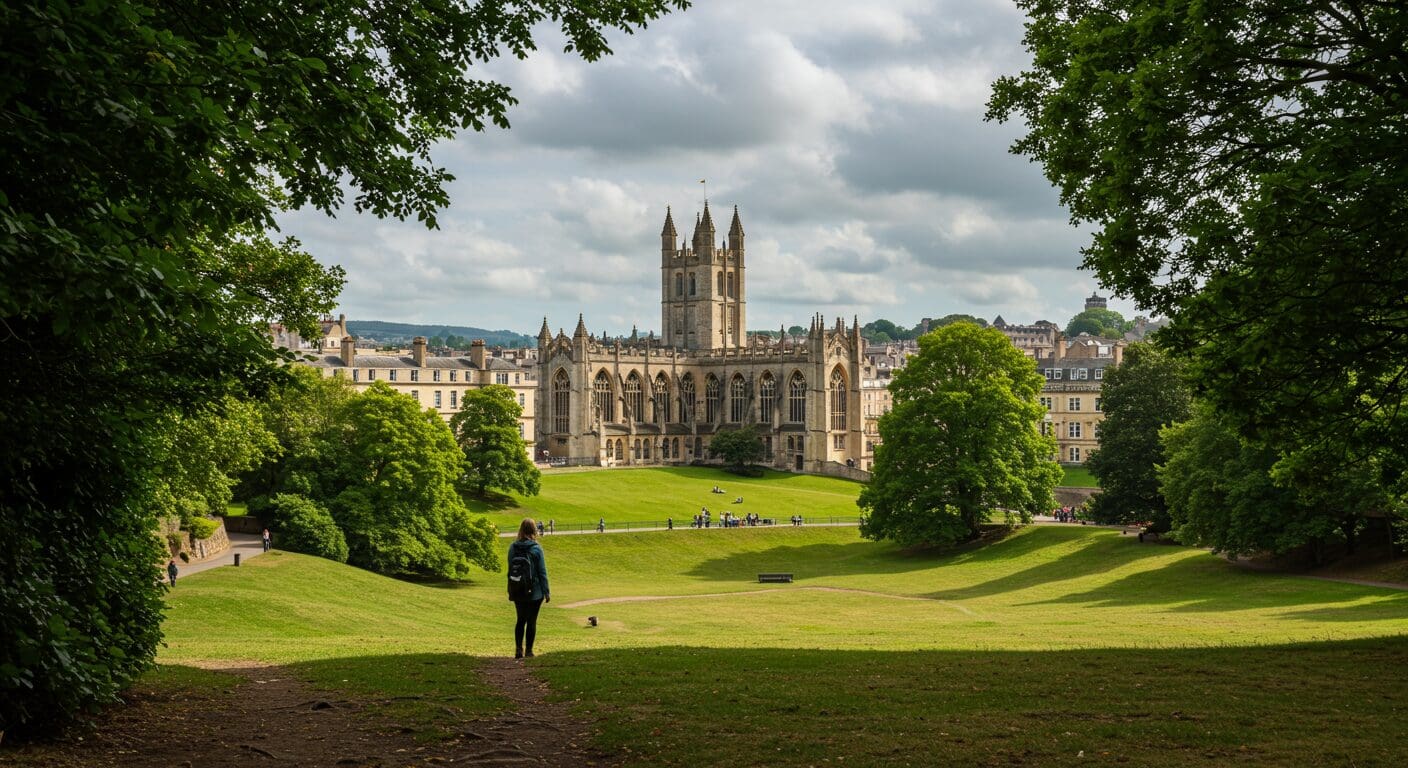
Bath Travel Guide: Where to Stay, Eat & Explore in Luxury
What if the most restorative place in England wasn’t a converted farmhouse in the Cotswolds or a cliff-top retreat on the Cornish coast, but a Georgian city of such architectural coherence and human scale that simply walking its streets feels like a form of therapy? Bath is that city. It is compact enough to navigate on foot, grand enough to feel like a genuine occasion, and layered with enough history, food culture, and sheer physical beauty to reward visitors who arrive expecting a weekend and end up rearranging their lives around a week. The Romans figured this out roughly two thousand years ago. Georgians built an entire city around the idea. The rest of us are just catching up.
The question of who Bath is for turns out to have a pleasingly long answer. Couples celebrating a milestone – a significant anniversary, a honeymoon, a belated escape from the ordinary – find it has exactly the right mixture of romance and substance; there is enough here to fill days without the frenetic energy of a city that demands to be conquered. Families seeking genuine privacy, with children who can roam freely in walled gardens rather than hotel corridors, discover that the surrounding Somerset countryside delivers on every promise the brochures make. Groups of friends looking for somewhere with serious restaurants, serious wine lists, and Georgian drawing rooms large enough for everyone to gather in without negotiating who gets the sofa discover Bath is quietly ideal. Remote workers who have tired of laptop-on-a-kitchen-table improvisation find that many of the finer properties here come with fast, reliable connectivity and the kind of dedicated workspace that makes a Monday morning feel considerably less terrible. And wellness-focused guests – those who come specifically to be near the thermal waters, to walk the hills, to eat well and sleep better – find that Bath has been in that business since the Romans arrived with their underfloor heating and their very reasonable attitude to communal bathing.
Getting to Bath Without the Faff: Arrival, Airports and Getting Around
Bath sits in the southwest of United Kingdom with a level of geographical confidence that suggests it always knew it would be important. The nearest major airport is Bristol, roughly twelve miles away – a journey of under thirty minutes by road in reasonable traffic, which in the West Country is not always a guarantee but is more often than not a reasonable expectation. From Bristol Airport, taxis and private transfers make the most obvious sense for anyone arriving with luggage of the luxury variety. Direct trains from London Paddington to Bath Spa take approximately ninety minutes, which is frankly quicker than many European city breaks and considerably more civilised than most. The train journey itself, approaching Bath from the east through the Box Tunnel and then suddenly into the Avon valley with the city spread below, is one of those arrivals that makes people reach instinctively for their camera.
Heathrow connects to Paddington in around twenty minutes via the Elizabeth Line, making Bath genuinely accessible for international arrivals without the extended suffering that once characterised cross-London transfers. Birmingham Airport is also an option for those arriving from international hubs and heading north-first, though Bristol or Heathrow will suit most. Once in Bath, the honest advice is to park the car and forget about it. The city centre is best explored on foot – distances are deceptively short, hills are deceptively steep, and the reward for climbing any of them is a view that will clarify why the Georgians were so determined to build here. For the surrounding countryside, a car becomes useful again; the Somerset Levels, the Mendip Hills, and the Cotswolds are all within comfortable striking distance.
Where to Eat in Bath: From Michelin Stars to Nepalese Mountain Cooking
Fine Dining
Bath’s food scene has matured considerably in recent years, and the flagship of that transformation is The Olive Tree. Found below the Queensberry Hotel on Russell Street, it has held a Michelin Star since 2018 and carries four AA rosettes – making it the only restaurant in Somerset to have achieved that particular distinction. Executive Chef Chris Cleghorn is the quiet force behind it, a chef who has built serious relationships with local suppliers and treats seasonality not as a marketing concept but as an actual constraint he works within with evident pleasure. The cooking is rooted in British produce with a precision and ambition that earns every accolade without making the room feel like a test. Booking well in advance is not merely advised; it is, at this level, simply good manners.
OAK – formerly Acorn – occupies a cosy Georgian room fitted with mustard and cream panelled walls, dried Somerset flowers, and soft lighting that makes everyone look their best (a detail not to be underestimated). The restaurant has evolved from its incarnation as Acorn into something slightly more relaxed without sacrificing any of its culinary ambition. The menu is fully vegetarian, which sounds like a limitation until the panko-crusted arancini with aubergine arrive, or the homemade sourdough cavatelli tossed with heritage tomatoes, or the chickpeas in a creamy, smoky vegan pine nut sauce that manages to be both deeply satisfying and not at all heavy. OAK is the kind of restaurant that makes meat-eaters pause and wonder what exactly they’ve been missing.
Where the Locals Eat
Sotto Sotto has the kind of enduring local reputation that can’t be manufactured. It is a refined Italian restaurant offering homemade pastas and exceptional hospitality in an atmosphere warm enough that you find yourself lingering well past what you’d planned. It books up well in advance, particularly at weekends, which is either an inconvenience or the most reliable indicator of quality available, depending on how you choose to look at it. The advice is to book the moment your travel dates are confirmed rather than the evening before, when you will discover that everyone else had the same idea three weeks ago.
For something that defies easy category, Yak Yeti Yak has been feeding Bath with authentic Nepalese cooking for over twenty years from its spot in the heart of the city. The walls are covered in jungle art; yak bells contribute to the ambiance in a way that sounds eccentric but works entirely. The menu draws on Indian, Thai, and Tibetan influences, all freshly cooked, and the overall effect is of a meal that feels genuinely transportive – which is no small achievement for a landlocked English city with a notable absence of Himalayan altitude.
Hidden Gems Worth Seeking Out
Upstairs at Landrace is the kind of place that requires a little local knowledge to find – which is, of course, exactly the point. The acclaimed Landrace Bakery on Walcot Street came first, establishing its reputation for serious bread with the kind of devotion that borders on the monastic. Then came the restaurant above: two dining rooms of genuine charm, with Chef Rob Sachdev running a kitchen that produces seasonal sharing plates of quiet brilliance. The cheddar fritters are the obvious opening move, ideally alongside something from the natural and biodynamic wine list, which takes genuine risks and is better for it. Save room for dessert, which is where the bakery’s patisserie skills move centre stage. It is, in the best possible sense, a neighbourhood restaurant that the neighbourhood deserves.
Bath and Beyond: The Landscape That Surrounds It
Bath does not exist in isolation, which is part of what makes it such a rewarding base. The city sits in the valley of the River Avon, surrounded on most sides by hills – the Cotswolds to the northeast, the Mendip Hills to the south, and the broader expanse of Somerset stretching westward toward the coast. The geography means that within twenty minutes of leaving the city centre you can be on high ground with views that stretch improbably far, or in a village that appears to have made a private arrangement with the nineteenth century.
The Cotswolds are an obvious day trip and entirely earn their reputation, though the villages of Lacock, Bradford-on-Avon, and Corsham are arguably more interesting for being slightly less photographed. Wells, to the south, has a cathedral that should not be missed and a market square that retains the feeling of genuine civic life. Glastonbury is nearby, with its tor, its abbey ruins, and its particular atmosphere of enthusiastic mysticism that one receives in the spirit intended. The Somerset Levels offer something entirely different again: flat, ancient, waterlogged landscape of extraordinary character, particularly at dawn or dusk when the light does things that painters have been attempting to capture for centuries. The coast at Weston-super-Mare is within an hour; the more interesting coastline around Clevedon and Portishead, with views across the Bristol Channel, is closer still.
Closer to Bath itself, the American Museum at Claverton Manor is an unexpectedly absorbing institution – United States folk art and decorative arts installed in a Georgian manor house above the city with views over the valley. It is the kind of place that takes a surprised afternoon and occasionally an entire one. The Prior Park Landscape Garden, managed by the National Trust and perched on a hillside above the city, offers one of the most considered views of Bath in existence: a Palladian bridge reflected in a lake, the city visible below, and the sense that whoever designed this knew precisely what they were doing.
Things to Do in Bath That You’ll Actually Remember
The Roman Baths sit at the centre of Bath in every sense – geographically, historically, and in terms of what most visitors will find genuinely affecting. The baths themselves are extraordinary: a vast complex of pools, temples, and engineering that remained in continuous use for centuries and still carries the weight of that history in every stone. The sacred spring produces roughly a million litres of naturally hot water every day, at a consistent 45 degrees Celsius, which it has been doing for approximately ten thousand years. You cannot bathe in it – the Roman Baths are a museum, and the water is not what you might call hygienic by modern standards – but you can stand at the edge of the Great Bath and feel the particular quiet that descends when something is genuinely ancient.
For the actual bathing, Thermae Bath Spa is the answer – and it is a very good answer. The only day spa in the United Kingdom where you can bathe in natural thermal spring water, Thermae brings the experience into the twenty-first century with treatments, relaxation spaces, steam rooms, and, most memorably, a rooftop pool with 360-degree views over the city’s skyline. Bathing in hot spring water on a rooftop with Bath’s Georgian crescents arranged below you is not an experience that requires much elaboration. It is the kind of thing that improves virtually any morning and makes the afternoon considerably more philosophical.
The Jane Austen Centre on Gay Street is a gentle and affectionate tribute to the author who lived in Bath and was, by most accounts, somewhat ambivalent about the place – a detail the centre handles with admirable honesty. The Fashion Museum, currently relocating to new premises in the Guildhall Market, holds one of the world’s most significant collections of historic dress. Bath Abbey, which anchors the city centre with considerable authority, is worth more than a passing glance: the fan vaulting inside is among the finest in England, and the west front’s carved angels ascending and descending ladders make for one of the more distinctive facades in English ecclesiastical architecture.
Active Pursuits: Walking, Cycling and Getting Agreeably Lost
Bath rewards the physically inclined with terrain that is varied enough to satisfy without being punishing enough to ruin a holiday. The Cotswold Way long-distance walking trail ends in Bath, which means you can walk into the city from the north with the particular satisfaction of someone who has completed something, or simply pick up sections of it for day walks through beech woodland and over open limestone escarpment. The Two Tunnels Greenway is a cycling route of particular character – a circular 23-mile off-road trail that passes through two Victorian railway tunnels, including the Combe Down Tunnel at 1.7 miles the longest cycling tunnel in the United Kingdom. It is simultaneously a feat of Victorian engineering and a slightly unusual way to spend forty minutes.
The River Avon provides flat, accessible cycling and walking along its towpath, connecting Bath to Bradford-on-Avon along the Kennet and Avon Canal – a route of genuine charm, passing narrowboats, lock-keepers’ cottages, and the occasional heron standing in the water with the air of something that has been doing this since before canal boats existed. Wild swimming has found enthusiastic adherents along various stretches of the river, though water temperatures in the United Kingdom require a certain quality of enthusiasm that not all visitors will possess. For those who prefer their water heated, Thermae provides the more civilised alternative.
Golf courses in the surrounding area are numerous and varied, ranging from the scenic to the genuinely testing. Horse riding through the Somerset countryside can be arranged through local stables. Kayaking and paddleboarding on the Avon are increasingly popular and provide a perspective on the city that foot traffic does not. The hills above Bath – Bathampton Down, Claverton Down, Beechen Cliff – offer walks of varying ambition with the shared reward of views that make the effort feel proportionate.
Bath with Children: Why It Works Better Than You’d Expect
Bath has the slightly undeserved reputation of being a place for adults: romantic weekends, spa retreats, literary pilgrimages. In practice, it works very well for families, partly because the city is compact and walkable, partly because its attractions span an unusually wide age range, and partly because the surrounding countryside provides exactly the kind of space and freedom that children need and hotel rooms categorically cannot provide.
The Roman Baths genuinely engage children in a way that many heritage sites fail to manage, largely because the scale of the engineering is viscerally impressive rather than abstractly historical – the sight of actual Roman lead pipes, still roughly where they were installed, tends to land rather well with a certain age group. The interactive elements have been thoughtfully developed, and the audio guide’s children’s version is more entertaining than most. Thermae Bath Spa, for older children and teenagers, is an obvious draw. The Prior Park Landscape Garden’s Palladian bridge, ducks, and sweeping hillside are simple pleasures of the best kind.
The real advantage for families, however, is the villa. Private outdoor space, a pool of their own, bedrooms that allow everyone to decompress at the end of an active day without competing for the bathroom, a kitchen capable of accommodating the dietary preferences of six people with widely varying opinions on what constitutes an acceptable dinner – these are things that no hotel, however well-appointed, can replicate. The ability to stay in rather than go out, to picnic in a walled garden, to let children be genuinely free without the anxiety of public space – these are the quiet luxuries that make a family holiday feel like a genuine rest rather than an exercise in logistics management.
History, Architecture and the Georgians Who Changed Everything
Bath is, depending on how you count it, approximately two thousand years old – though the settlement the Romans established around the sacred spring of Sulis Minerva was the first to give it shape and purpose. The Saxons called it Hat Bathu. The Normans built an abbey. Successive generations added to, neglected, and occasionally demolished what came before. None of this explains Bath as it looks today, which is almost entirely a Georgian creation of breathtaking consistency.
In the early eighteenth century, Bath was a modest spa town of no particular architectural distinction. By the end of it, it was a masterpiece of urban planning: John Wood the Elder and John Wood the Younger, working in partnership across the generations, created the Circus, the Royal Crescent, and a sequence of streets, squares, and crescents in local honey-coloured Bath stone that together constitute perhaps the most coherent example of Georgian urban design anywhere in the world. The Royal Crescent – thirty houses arranged in a perfect sweeping arc, facing a wide ha-ha and the city below – is one of those places where the accumulated reputation turns out to be entirely merited. The sense of civic ambition made physical, of a city that decided to be beautiful and then organised itself accordingly, is difficult to shake.
Bath’s World Heritage status, awarded by UNESCO in 1987, reflects this achievement. The designation covers the entire city centre and the surrounding landscape – not just individual buildings, but the relationship between them, the street widths, the roofline, the stone. Walking Milsom Street, Great Pulteney Street, or the Gravel Walk (where Jane Austen occasionally took the air) is to walk through an argument for beauty as a public good that was won a long time ago and remains entirely persuasive.
The festivals are worth knowing about. The Bath Festival, held in late May and early June, brings literature, music, and ideas to venues across the city with a programme ambitious enough to compete with events in cities three times the size. Bath Film Festival runs in the autumn. The Christmas Market transforms the area around the Abbey into something that manages to be genuinely atmospheric rather than merely commercially festive, which is a harder trick than it sounds.
Shopping in Bath: Independent Shops, Antiques and Things Worth Bringing Home
Bath is a remarkably good shopping city, which surprises visitors who expect little beyond chain stores and tourist trinkets. The independent shops are concentrated in particular areas: Walcot Street, known locally as Bath’s “artisan quarter,” is the place for antiques, vintage clothing, galleries, and the kind of shops that occupy their premises with a sense of purpose. The Circus Antiques Market and dealers along nearby streets attract serious collectors; the quality and range are notably high for a city of Bath’s size.
Milsom Street and its surrounds offer the more conventional luxury retail experience – quality jewellers, independent fashion, homeware of considered taste. The Guildhall Market, one of the oldest indoor markets in England, provides a more eclectic proposition: books, records, local food producers, and a quality of randomness that rewards a slow hour’s browsing. Pulteney Bridge, one of only a handful of bridges in the world with shops built across its full span, has a handful of independent retailers worth investigating alongside the view.
What to bring home from Bath is, at its best, something made locally or with genuine Somerset provenance: cheese from a local producer (Montgomery’s cheddar, made in North Cadbury, is one of England’s finest); honey from a local beekeeper; ceramics from one of several independent makers with studios in the city; a book from one of Bath’s genuinely good independent bookshops, which have survived and in some cases thrived where others have not. The tendency to buy a miniature Roman helmet is understandable and perhaps unavoidable if travelling with children.
Practical Matters: What You Actually Need to Know Before You Go
Bath operates on British currency – pounds sterling – and broadly British customs, which means tipping is appreciated but not compulsory at the levels expected in North America: ten to fifteen percent in restaurants is generous; rounding up a taxi fare is entirely acceptable; tipping in bars is uncommon unless table service has been genuinely exceptional. The language is English, spoken with a West Country accent of varying intensity depending on how far from the city centre you travel.
The best time to visit Bath is a question with several honest answers. Summer – June through August – brings the warmest weather, the longest days, and the largest crowds. The city handles visitors well, but popular sites like the Roman Baths and Thermae Bath Spa will be notably busier, and advance booking for restaurants becomes more important. Spring and early autumn are arguably the finest seasons: the light in April and May has a quality that suits the Bath stone particularly well, the gardens are at their best, and the crowds have not yet reached peak density. October brings beautiful autumn colour to the surrounding hills and a quieter city. Winter is surprisingly rewarding – the Christmas Market is genuinely good, the city’s interior life comes to the fore, and hotel and villa rates drop accordingly.
Bath is a very safe city by any reasonable measure. The centre is compact enough that orientation is relatively straightforward, and the general culture of the place – polite, unhurried, slightly self-aware – makes it a comfortable environment for solo travellers, families, and groups alike. Weather, being English, requires the usual contingency: a layer for the evening even in summer, waterproof footwear if walking the hills. The city’s hills are real and should be treated with appropriate respect by anyone for whom steep gradients are a concern.
Why a Luxury Villa in Bath Is the Right Way to Experience It
There is a particular kind of Bath experience that hotels, however excellent, cannot deliver: the one where you have an entire Georgian townhouse to yourselves, with a private garden, a kitchen you actually want to cook in, and the freedom to operate on your own schedule rather than the hotel’s. This is what a luxury villa in Bath provides, and once you’ve experienced it, the appeal of a standard room with a view of the car park becomes somewhat theoretical.
For groups of friends or multi-generational families – three generations gathered for a landmark birthday, say, or a group of eight who have been trying to organise a reunion for three years – a private villa makes logistical and financial sense as well as experiential sense. The cost per head when shared across a larger group frequently compares favourably with hotel alternatives, while the quality of the experience is categorically different. There is a drawing room large enough for everyone to gather in. There are bedrooms with actual walls between them. There is a kitchen where a private chef can prepare dinner while the guests are still negotiating whether to have a second glass. These things matter.
For couples on milestone trips, the privacy and space of a well-appointed villa creates an atmosphere that no hotel corridor can replicate. For wellness-focused guests, many of Bath’s finer properties come with pool access, gym facilities, and the quiet seclusion that makes actual rest – rather than performed relaxation – genuinely possible. For remote workers who have accepted that the office is now wherever the laptop is, the combination of reliable high-speed connectivity, dedicated workspace, and a setting that makes the working day feel proportionate to the living day is a considerable draw. Some properties now offer Starlink or equivalent connectivity, which resolves the rural bandwidth question once and for all.
The surrounding Somerset countryside, within easy reach of the city, offers larger properties with greater outdoor space – walled gardens, terraces with valley views, heated pools that make the English summer considerably more persuasive than it might otherwise appear. The concierge arrangements available through a quality villa rental company can handle everything from restaurant reservations to private transfers to sourcing a private chef for a special occasion, which reduces the administrative overhead of a holiday to something approaching zero.
Browse our collection of luxury villas in Bath with private pool and find the one that fits your group, your occasion, and your entirely reasonable expectation of what a holiday should feel like.
More Bath Travel Guides
What is the best time to visit Bath?
Spring (April to June) and early autumn (September to October) offer the finest balance of good weather, manageable crowds, and the kind of light that makes Bath’s honey-coloured stone look its best. Summer is busiest and warmest, with longer days ideal for exploring the surrounding countryside. Winter is underrated – the Christmas Market is genuinely atmospheric, rates are lower, and the city has a pleasing quietness that suits its character. Whatever the season, book restaurants and Thermae Bath Spa well in advance.
How do I get to Bath?
By train from London Paddington, Bath Spa station is approximately ninety minutes away – one of the more civilised connections in the country. Bristol Airport is the nearest major airport, roughly twelve miles from the city centre and around thirty minutes by road. Private transfers from Bristol Airport are the most convenient option for villa guests arriving with luggage. Heathrow connects to Paddington via the Elizabeth Line in around twenty minutes, making Bath genuinely accessible for international arrivals. Once in Bath, the city centre is best navigated on foot; a hire car is useful for exploring the surrounding Somerset and Cotswold countryside.
Is Bath good for families?
Yes, and more so than its reputation might suggest. The Roman Baths engage children of most ages with genuine historical drama rather than abstract heritage. The Prior Park Landscape Garden, the American Museum at Claverton Manor, and the natural thermal waters at Thermae Bath Spa (for older children and teenagers) all add up to a varied programme. The surrounding Somerset countryside provides outdoor space that the city centre itself cannot always offer. The real advantage for families is a private villa: outdoor space, a private pool, bedrooms that allow everyone to decompress, and a kitchen that removes the nightly restaurant negotiation from the equation entirely.
Why rent a luxury villa in Bath?
A luxury villa delivers what no hotel can: genuine privacy, space proportionate to the size of your group, a kitchen capable of serious cooking, and a rhythm entirely your own. For couples, it means seclusion and atmosphere without the proximity of other guests. For groups and families, the space – separate bedrooms, private gardens, a pool of your own – transforms a holiday from a logistical exercise into an actual rest. Concierge services through Excellence Luxury Villas can handle restaurant reservations, private transfers, and private chef arrangements, reducing the administrative overhead of a holiday to something very close to zero.
Are there private villas in Bath suitable for large groups or multi-generational families?
Yes. The Bath area and surrounding Somerset countryside has a range of properties capable of accommodating larger groups comfortably – from substantial Georgian townhouses in the city to country houses with multiple wings, private grounds, and heated pools within easy driving distance. Properties with five, six, or more bedrooms, separate living areas, and private outdoor space are available and suit multi-generational gatherings where different generations need their own space without being in separate hotels. Concierge staff, housekeeping, and private chef services can be arranged to match the occasion.
Can I find a luxury villa in Bath with good internet for remote working?
Increasingly, yes. Many premium villa properties in and around Bath offer high-speed broadband as standard, and a growing number of rural properties have installed Starlink or equivalent satellite connectivity that resolves the rural bandwidth concern entirely. For dedicated remote workers, it is worth specifying connectivity requirements at the point of enquiry so that the right property can be matched to your needs. Many villas also offer dedicated workspace separate from the main living areas – a meaningful distinction from working at the kitchen table.
What makes Bath a good destination for a wellness retreat?
Bath has been a wellness destination for two thousand years, which gives it a certain authority on the subject. Thermae Bath Spa, the only venue in the United Kingdom offering bathing in natural thermal spring waters, provides the obvious centrepiece – with treatments, a rooftop pool, and relaxation spaces of genuine quality. Beyond the spa, the surrounding hills offer walking and cycling routes of real restorative value. The pace of the city itself – unhurried, human-scaled, beautiful without being overwhelming – is conducive to the kind of decompression that more frenetic destinations actively prevent. A private villa with a heated pool, a well-equipped kitchen for healthy cooking, and the seclusion to actually sleep properly completes the picture.


