
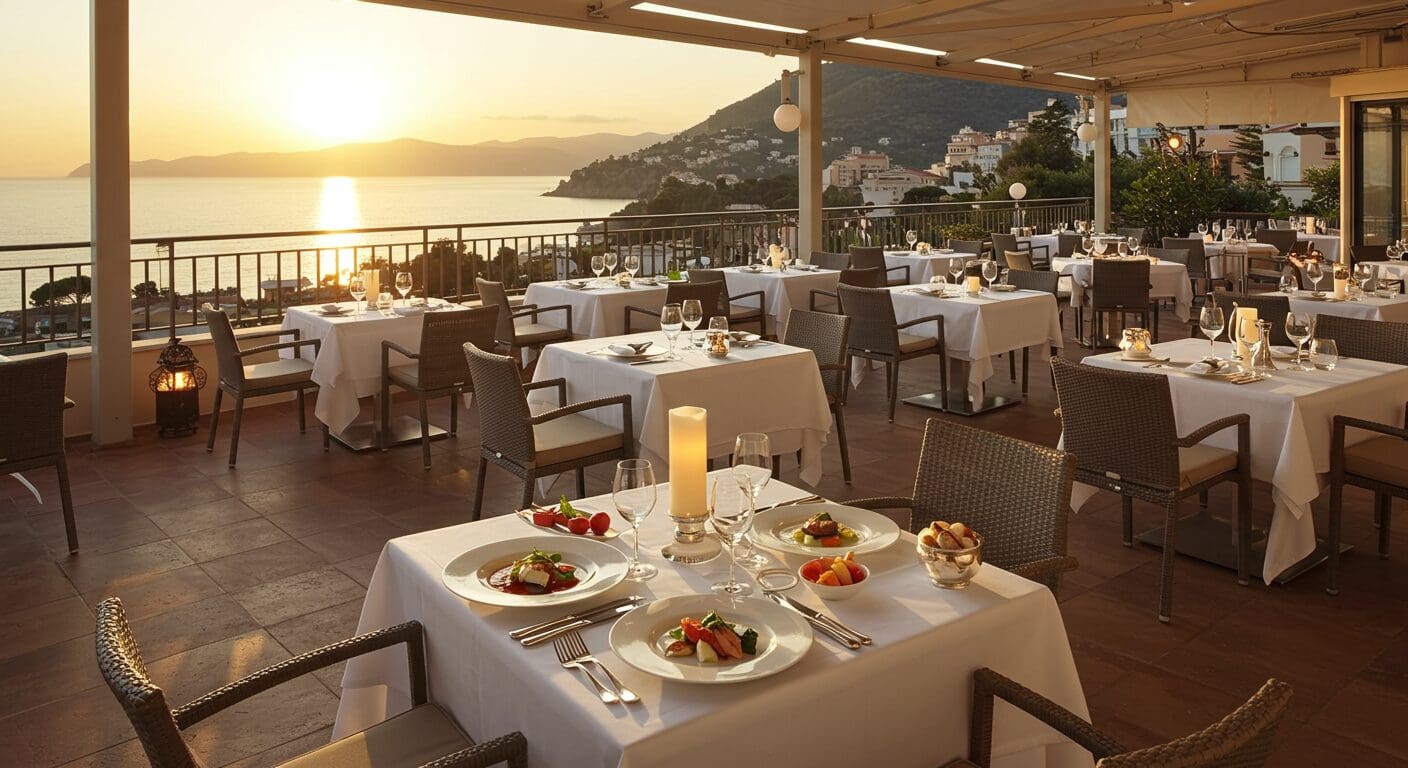
Best Restaurants in Benissa: Fine Dining, Local Gems & Where to Eat
Come to Benissa in late September and you will understand something that most people miss entirely. The summer crowds have retreated, the light has turned from white-hot to amber, and the restaurants that spent July and August performing for tourists are now cooking for themselves again. The terrace tables fill with Spanish families rather than sunburned visitors consulting Google Maps. The rice dishes take on a deeper, more considered quality. The wine pours a little more freely. This is when Benissa – this quietly assured medieval town tucked above the Costa Blanca coastline – shows you what it actually is: a place with a genuine food culture, rooted in the land and sea around it, and not especially interested in explaining itself to anyone.
Finding the best restaurants in Benissa requires a different kind of effort than flicking through a hotel concierge list. The town rewards those who walk the old stone streets, peer into doorways, and follow the smell of sofrito drifting from somewhere indeterminate. But for those who prefer a head start – which is entirely reasonable – here is where to eat, what to order, and how to do it properly.
The Fine Dining Scene: Elevated Eating Around Benissa
Benissa itself is not a town with Michelin stars hanging above its doorways. But what surrounds it – and what draws from it – is a dining scene of genuine distinction, and the distinction is hard-won rather than marketing-assisted.
Orobianco is the name that serious food travellers mention first. Perched with spectacular views over Calpe and the dramatic limestone monolith of the Peñón de Ifach, this is a restaurant of true elegance led by chef Paolo Casagrande, whose approach centres on clarity of flavour and the kind of ingredient pairings that seem obvious only after you have eaten them. Italian-inflected Mediterranean cooking, executed at a level that explains why it has attracted widespread recognition as one of the most refined dining experiences in the wider Benissa area. The view, for what it is worth, does not hurt. Book well in advance. This is the sort of place where improvisation is not rewarded.
Casa Bernardi operates on similarly elevated ground, though its atmosphere is warmer and more enveloping. Ferdinando Bernardi and his team have built something genuinely rare: an Italian restaurant in Spain that does not feel like a category error. The setting – surrounded by gardens and old carob, olive and almond trees, with views reaching to the Mediterranean – has the kind of quiet grandeur that money cannot manufacture. The cooking is rooted in Italian tradition without being nostalgic about it, and TheFork users have consistently placed it among the most Michelin-noted restaurants near Benissa. It is the sort of place where you arrive for dinner and find yourself, somewhat contentedly, still there at midnight.
Local Gems: Where Benissa Actually Eats
Casa Cantó is the kind of restaurant that takes you a moment to fully appreciate. From the outside, it is unshowy – the sort of traditional Spanish place that does not feel the need to perform. Then you find your table, and the valley opens up through the panoramic window: a sweep of landscape that ends, somewhere in the middle distance, with the unmistakable silhouette of the Peñón de Ifach. It is rather good. The menu leans into what this coastline does best – rice dishes of real depth and freshly caught fish treated with the respect they deserve. Casa Cantó appears consistently across review platforms as one of the top restaurants in Benissa, and not by accident.
El Rall, down in La Cala de La Fustera near the beach, is a different proposition – refined Mediterranean cooking that manages to be both sophisticated and relaxed, which is a harder trick than it sounds. The terrace offers both sun and shade, the service is attentive without being theatrical, and the grilled onion with anchovy – a dish that sounds deceptively simple – is the sort of thing you think about on the drive home. Rated 8.8 on TheFork, it has developed a devoted following among people who know the difference between a restaurant that is popular and one that is actually good. Here it happens to be both.
For anyone inclined to explore beyond the obvious, the older streets of Benissa’s medieval centre contain small family-run restaurants where the menu del día changes daily, the bread arrives without ceremony, and nobody is trying to curate an experience. These are the places worth finding on foot, ideally on a Tuesday when the market has just finished and the kitchen is making something with whatever looked best that morning.
Beach Clubs and Casual Coastal Dining
Benissa’s coastline is a series of small coves and rocky inlets rather than a single long beach, which means its casual dining scene has a pleasingly scattered quality. You have to seek it out, and that seeking is part of the pleasure.
Mandala Beach Bar and Restaurant sits above this category in terms of reputation – over 1,200 reviews on TripAdvisor and a consistent ranking in the top ten of Benissa’s restaurants. The terrace overlooks the sea in the way that terrace views are supposed to, and the menu is built around honest coastal ingredients: tapas done properly, and an arroz a banda that reminds you why rice dishes became the defining food of this stretch of coastline in the first place. Arroz a banda – rice cooked in fish stock, served with alioli – is one of those dishes that rewards patience and punishes shortcuts. At Mandala, it gets the attention it deserves.
Along the smaller coves, particularly around Les Bassetes and Cala Fustera, there are chiringuito-style spots where the cooking is simple, the tables are close to the water, and the measure of a good lunch is whether you feel sufficiently content to stay for another glass of something cold. These places do not take reservations and do not need to. They fill up because they are there and the sea is there and both facts seem sufficient.
What to Order: Dishes That Define This Corner of the Costa Blanca
The Costa Blanca is rice country, and Benissa sits squarely within that tradition. Arroz a banda is the essential order – ask about it before you decide, because it varies considerably between kitchens, and the best versions are the ones where the cook is quietly proud of theirs. Paella, despite what most visitors assume, is not the dominant rice dish here; it is one of several, and often not the most interesting one.
Fresh fish from the Calpe fish market – just a short drive along the coast – appears on menus throughout the area. Red mullet, sea bass, bream, and dorada are all worth ordering grilled rather than complicated. The local anchovies are exceptional, whether marinated in vinegar as boquerones en vinagre or preserved in salt as anchovas – the kind of thing that makes you reconsider your feelings about the entire anchovy category.
For meat, look for locally sourced lamb and, in season, game dishes that reflect the agricultural interior. The Benissa hinterland produces excellent olive oil and almonds, both of which find their way into the cooking in ways that are quietly fundamental rather than decoratively listed on menus.
Start with a glass of local white wine from the Marina Alta denomination – crisp, mineral, with enough acidity to work well with seafood. The rosado from this region is also worth investigation, particularly over a long lunch when the sun is high and nobody is in any hurry. Finish, if you are inclined, with a local mistela – a sweet fortified wine made from Muscat grapes that is particular to this corner of Valencia and very easy to drink too much of, entirely inadvertently.
Food Markets and Artisan Producers
Benissa’s weekly market takes place in the town centre and is one of those markets that has not yet been recalibrated for the tourist economy – which is to say it is genuinely useful rather than decorative. Local farmers sell vegetables, fruit, honey, and almonds alongside the usual clothing and household goods. For food travellers, the produce stalls are the point. Look for blood oranges in winter, figs in late summer, and local almonds and dried fruits year-round.
The market in nearby Calpe, just along the coast, is larger and has a strong fish section that reflects the significance of Calpe’s working harbour. It is worth making the short drive for the spectacle alone – the Calpe fish auction (the lonja) is an authentic piece of working maritime culture that operates entirely on its own terms and is not even slightly interested in being photogenic. It is, however, quite photogenic.
For fine local products – oils, wines, preserved fish, and artisan cheeses from the interior – several small delicatessens in Benissa’s old town stock regional produce well worth investigating before you head back to your villa with a car boot full of things that may or may not survive the journey home.
Reservation Tips and Practical Guidance
The restaurants with serious reputations – Orobianco and Casa Bernardi particularly – require advance booking at any time of year and considerably more than advance booking in July and August. A week ahead is a minimum. Two weeks is more realistic. Three weeks is sensible. Improvising will not end well.
Casa Cantó and El Rall are easier to secure at shorter notice outside peak season, but in summer they fill reliably on weekends. Thursday to Saturday evenings are the most competitive; Sunday lunch in Spain is an institution and tables go early.
Spaniards eat late. This is not a travel writer’s observation – it is simply true. Dinner before nine o’clock in the evening will find you eating largely alone among other tourists. If you sit down at nine-thirty, the room fills around you. By ten, it is lively. By eleven, perfectly normal. Adjust accordingly, or don’t, but know what you are choosing.
Many restaurants in the Benissa area take Monday as their closing day; some close for a full day mid-week as well. Check before you go. There are few things more deflating than arriving at a darkened restaurant in a good mood on a Monday evening.
Staying Well: The Villa Approach to Eating in Benissa
There is, of course, another way to approach eating in Benissa entirely. Staying in a luxury villa in Benissa with a private chef option means that some of the finest meals of your trip need never involve a restaurant at all. A private chef who knows the Calpe fish market and the local producers can bring the best of this coastline directly to your table – whether that is a langoustine rice cooked in the villa kitchen, a spread of local charcuterie and cheese arranged on the terrace at sunset, or a proper paella for ten people around the pool that no restaurant could replicate in the same way, simply because it is yours. The flexibility to eat extraordinarily well at home, and then walk to El Rall for lunch, is one of the quiet pleasures of villa life on the Costa Blanca.
For everything else you need to know about this corner of Spain – the coves, the old town, the walks, the history – the full Benissa Travel Guide is the logical next step.


