Dalaman Travel Guide: Where to Stay, Eat & Explore in Luxury
First-time visitors to Dalaman make the same mistake. They land at the airport, blink in the heat, and assume they’ve already arrived somewhere. They haven’t. Dalaman itself – the town around the airport – is largely functional, a place of ring roads and tyre shops and the quiet dignity of somewhere that exists primarily to serve somewhere else. The real Dalaman – the Dalaman worth crossing a continent for – is the landscape it unlocks: pine-forested mountains tumbling into turquoise coves, ancient Lycian ruins standing in olive groves that have watched empires come and go, and a coastline so varied and so persistently beautiful that you’ll find yourself running out of adjectives sometime around day three. The mistake isn’t coming here. The mistake is assuming the airport is the destination.
Which brings us to who actually thrives here. Families seeking genuine privacy – not the negotiated kind you get in a resort where someone else’s children are always in the pool – find Dalaman transformative. So do couples on milestone trips who want history, heat, and the luxury of doing absolutely nothing in beautiful surroundings, and doing it well. Groups of friends who’ve reached the age where a holiday needs a long table, a good wine situation, and nobody having to share a bathroom find it ideal. Remote workers who need reliable connectivity alongside the kind of scenery that makes staring at a screen feel genuinely criminal will find more here than they expected. And wellness-focused guests seeking something more restorative than a spa weekend – real rest, real outdoor movement, real food – discover that this corner of Turkey has been doing slow living long before it was branded as such.
The Approach Worth Understanding: Getting to Dalaman and Getting Around
Dalaman Airport is served by direct flights from across the European network – the United Kingdom is particularly well connected, with year-round direct routes from London, Manchester, Birmingham, Bristol, and beyond. Turkish Airlines also operates connections via Istanbul for those arriving from further afield, including the United States. The airport itself is mercifully compact by modern standards – you are through and into a transfer vehicle far sooner than Heathrow has accustomed you to expect.
Private airport transfers are strongly recommended and, in the context of a luxury holiday in Dalaman, entirely reasonable – both in cost and in the quality of first impression they create. Air-conditioned, punctual, and with a driver who actually knows where the villa is. Taxis are available but the pricing can be creative; agree the fare before you get in. Car hire is genuinely useful if you plan to explore independently, and the roads throughout the region are better than received wisdom suggests – though driving through mountain passes after dark calls for appropriate levels of confidence and perhaps a second coffee.
Distances here are important to understand. Fethiye is roughly 45 minutes east. Göcek is 25 minutes. Marmaris sits to the west, around an hour away. Kayaköy, Ölüdeniz, and the Turquoise Coast’s showpiece anchorages are all accessible as day trips with a car, or by boat if you’ve made suitably good decisions about your accommodation.
Where to Eat in Dalaman: From Treetop Tables to the Best Kebab You’ll Have All Year
Fine Dining
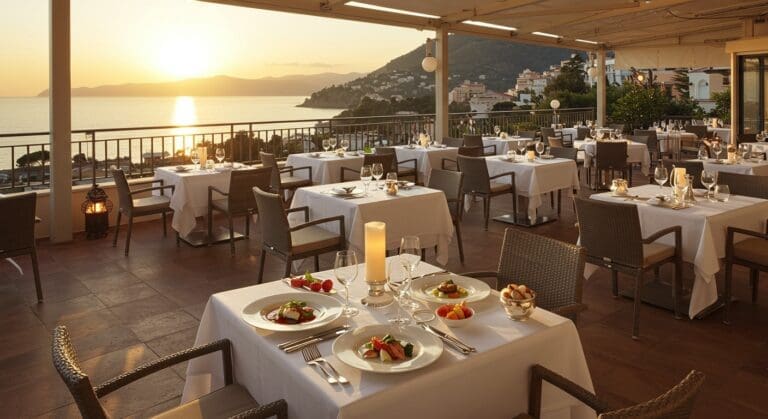
Fine dining in the conventional metropolitan sense isn’t really Dalaman’s register, and you should be grateful for that. What it offers instead is something more interesting: exceptionally good food in settings that most fine dining restaurants would pay an architect a considerable sum to replicate, and can’t. The cooking here is rooted in the Turkish meze tradition – abundant, generous, technically accomplished in its own way, and honest in a manner that Michelin-starred cooking sometimes forgets to be. Freshness is not a selling point here; it is simply the baseline.
Agora Restaurant sits at the top of the rankings for good reason. Rated number one of 368 places to eat in Dalaman, it is the kind of outdoor dining experience that makes you understand why people fall in love with Turkey specifically – open until 1AM, with freshly cooked kebabs, notably good Adana, and an atmosphere that is convivial without being loud. It manages the difficult trick of feeling authentic and reliable at the same time.
Where the Locals Eat
Akkaya Garden Restaurant is something else entirely – and it deserves more words than a single restaurant entry normally warrants. Set in a valley among pine trees, with waterfalls, ponds, wildlife wandering the grounds, and a 10,000 square metre open area that makes the idea of indoor dining seem faintly absurd, it offers seating in what it calls “stork’s nest” perches in the trees – elevated platforms for groups of four to eight, dining among the canopy. Reviewers consistently describe it as a perfect evening. They are not wrong. The staff are warm in a way that feels unrehearsed, and the food – traditional Turkish, well-executed, abundant – matches the setting rather than being overshadowed by it. Go at dusk. Book ahead.
Nar Pub Cafe Restaurant, ranked third in Dalaman, delivers something different: a lively, central atmosphere with consistently good cooking and the kind of crowd that suggests the locals haven’t been pushed out yet. It’s the place you end up on your second or third night when you’ve found your bearings and want somewhere unpretentious and reliably good.
Hidden Gems Worth Seeking Out
Yaman Et Kasap is the kind of place that rewards the mildly obsessive. A butcher with a restaurant attached – and not in a novelty sense. You choose your cut from an impressive selection of beef, lamb, and poultry, and it goes directly to the grill. Sides of peppers, yogurt, fried aubergine, rice, and fresh bread complete the picture. One reviewer ate here on their last day in Turkey and declared it the best meal of fourteen days. That is a substantial claim. It also appears to be true.
Dalaman Anne Lezzetleri – locally known as D.A.L Kafe Restoran – looks from the outside like somewhere you might walk past without a second thought. This would be a mistake. Reviewers call it the most delicious meal of their entire trip to Turkey, noting that it surpasses restaurants in Fethiye that receive far more attention. Home-cooked, full of flavour, excellent vegetarian options, traditional Turkish breakfast, and prices that make the whole experience feel slightly illegal. It is the restaurant equivalent of finding a first edition in a charity shop. Go quietly, and don’t tell too many people.
A Region That Rewards Curiosity: Exploring the Dalaman Area
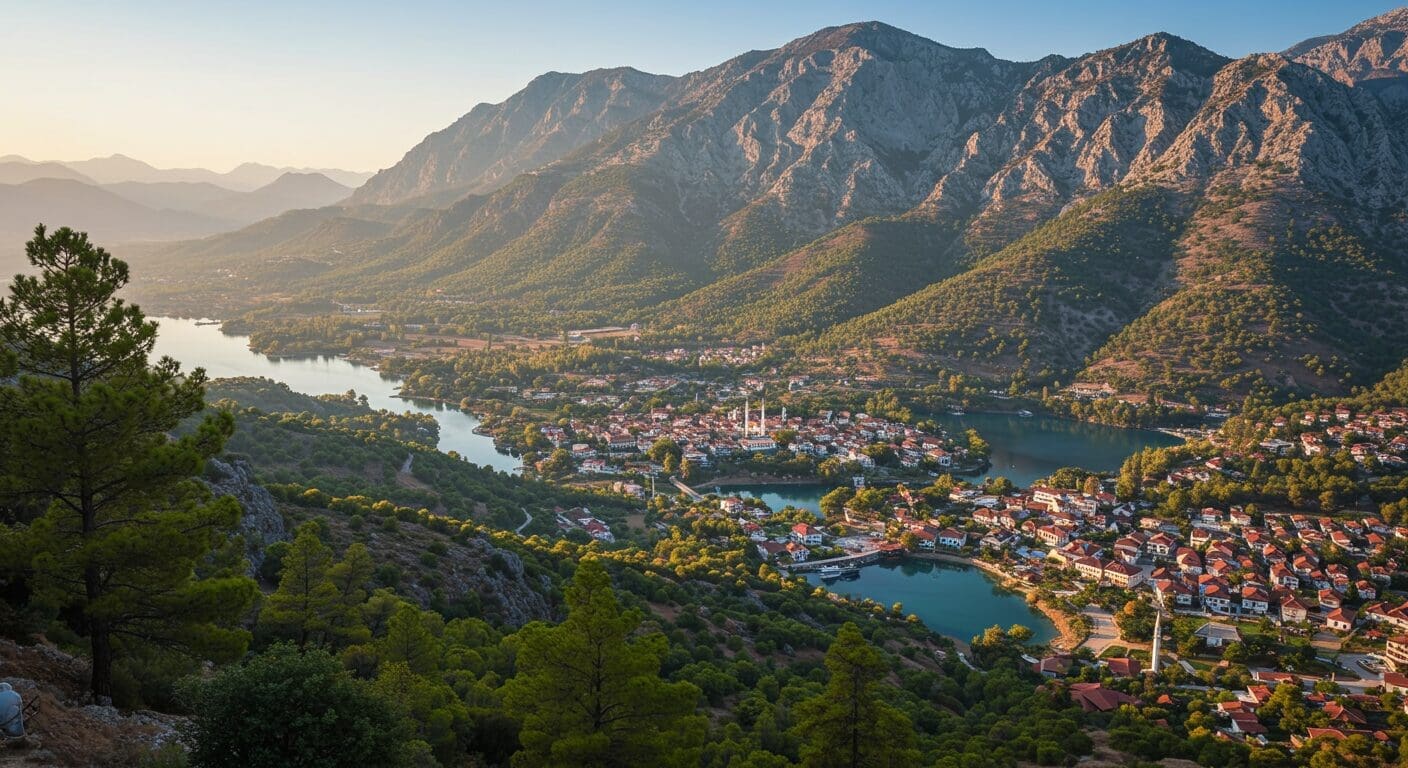
The geography of the Dalaman region does most of the work itself. You are standing at the meeting point of the Taurus Mountains and the Aegean-Mediterranean coastline – a dramatic piece of geological theatre that produces, as a byproduct, some of the most varied and rewarding landscapes in Turkey. Pine forests rise steeply from the water. Ancient riverbeds push through valley floors. And everywhere, particularly as you move along the Turquoise Coast, that improbable blue-green water that looks like someone’s adjusted the saturation settings and forgot to turn it back.
Göcek, twenty-five minutes north, is the place you go when you want to understand what a genuinely beautiful small harbour looks like before the yachting crowd arrives and after it leaves. During the day it is animated, civilised, and entirely pleasant. Its six marinas host some of the most impressive private sailing vessels in the eastern Mediterranean – the kind of boats that make you reassess your life choices in a philosophical rather than envious way. Fethiye, further east, is larger and louder but rewards a longer look: a proper working town wrapped around an ancient Lycian harbour, with a covered bazaar, excellent fish market, and the strange dignity of Lycian rock tombs carved into the cliff face above the modern rooftops.
Kayaköy – the ghost village – is one of those places that demands quiet. An entire town abandoned in the 1923 population exchange between Greece and Turkey, it sits in the hills above Fethiye in various states of beautiful and mournful ruin. Hundreds of stone houses, churches, and civic buildings reclaimed slowly by vegetation. It is not cheerful. It is, however, genuinely moving in a way that most tourist attractions carefully avoid being.
Ölüdeniz needs no introduction but deserves an honest one. The Blue Lagoon is real, the photographs are accurate, and the crowds in high summer are also real. Go early. Go in May or October. Go by boat if you can. It rewards the effort you make to see it properly.
What to Do When You’ve Finished Doing Nothing: Activities Around Dalaman
The activities available in and around Dalaman are broad enough to satisfy people who want to do everything and those who have come specifically to do as little as possible. Boat trips are the essential experience of the Turquoise Coast – whether a chartered gulet for a week of island-hopping, or a day trip out to Butterfly Valley, the Twelve Islands, or the sea caves near Ölüdeniz. The water here is warm from June through October, clear in a way that makes snorkelling an activity rather than a gesture, and remarkably uncrowded once you leave the main beaches behind.
The Saklıkent Gorge – the longest canyon in Turkey and one of the deepest in Europe – is forty minutes from Dalaman and consistently underestimated. You walk along wooden walkways suspended over a rushing glacial river before wading into the gorge itself, cold water around your knees, sheer canyon walls rising hundreds of metres above. It is spectacular, occasionally slightly alarming, and completely free of artifice. The restaurant at the gorge entrance, improbably positioned over the water on platforms, serves trout. Eat it.
Thermal springs at Sultaniye, near Köyceğiz Lake, offer something different – sulphurous mud baths and natural hot springs that have been used for therapeutic purposes since antiquity. The lake itself is vast, serene, and home to caretta caretta loggerhead sea turtles, which lends even a simple boat crossing a certain gravity.
Day trips to the ancient Lycian cities of Kaunos and Tlos are worth the effort for those who want their history walked rather than read. Kaunos, accessible by boat or a short crossing from Dalyan, sits above the extraordinary rock tombs that have become the defining image of the region. Dalyan also provides access to İztuzu Beach – one of the most important nesting sites for loggerhead turtles in the Mediterranean and, consequently, one of the most carefully protected.
Adventure in Extremis: What the Brave (and the Brave-Adjacent) Do Here
Paragliding over Babadağ Mountain above Ölüdeniz is the area’s signature adrenaline experience, and it deserves its reputation. Babadağ rises to 1,969 metres, which puts the tandem flight – you and an instructor, attached at the harness, doing your best to look calm – among the highest commercial paragliding launches in the world. The descent takes somewhere between twenty-five and forty-five minutes depending on conditions, and the view across the Blue Lagoon and the Turquoise Coast during those minutes is, objectively, worth whatever mild terror preceded take-off. The landing on the beach at Ölüdeniz is satisfyingly theatrical.
Diving around the region reveals a coastline that is as interesting below the surface as above it. Ancient amphorae rest on the seabed near Göcek, and the visibility in the Aegean-Mediterranean waters reaches thirty metres on good days. Dive schools operate across the area catering to complete beginners through to advanced open-water divers.
White-water rafting on the Dalaman River is genuinely exciting rather than sanitised adventure tourism – the river runs fast through mountain gorges and the rapids are legitimate. Sea kayaking around the coastline offers a more contemplative alternative: paddling into sea caves and around headlands inaccessible by larger boats, at whatever pace suits you. Hiking trails through the pine forests above Göcek and across the Lycian Way – which runs, in sections, through this region – range from gentle morning walks to serious multi-day treks. The terrain is varied enough that it doesn’t much matter which level you operate at.
Why Families Keep Coming Back: Dalaman with Children
Dalaman is one of those destinations where travelling with children improves the experience rather than complicating it – which is a more selective category than most travel writing admits. Turkish culture is demonstrably, genuinely welcoming to families in a way that doesn’t feel performed. Children are welcomed in restaurants, included in social life, and treated as people rather than a logistical problem to be managed. This matters, particularly by day six of a holiday in a destination where some cultures’ tolerance is beginning to fray at the edges.
The practical infrastructure for families is also quietly excellent. The calm, enclosed waters of Göcek Bay are ideal for younger swimmers. Boat trips can be structured around snorkelling, swimming stops, and the kind of fishing that children find compelling and adults find meditative. The Saklıkent Gorge – slightly wet, slightly cold, with the dramatic backdrop of canyon walls – is the kind of experience that children describe in school essays for the next three years. The turtle beaches at İztuzu carry the additional benefit of genuine ecological significance: children who understand why a beach is protected tend to treat nature more carefully afterwards. This is, optimistically, worth something.
Where a luxury villa in Dalaman particularly transforms a family holiday is in the architecture of the day itself. A private pool means no arguments about sunbeds, no negotiating with strangers for space, and no explaining why that particular child is doing that particular thing to the water. A villa kitchen means eating when hunger dictates rather than when the restaurant’s reservation system permits. The ratio of adults to children in your group is yours to manage. These are not small things.
Older Than It Looks: History, Culture, and the Weight of Lycian Civilisation
The Dalaman region sits at the heart of ancient Lycia – one of the most distinctive civilisations of the ancient Mediterranean world, whose culture, language, and architectural conventions were unlike anything else in the ancient Near East. The Lycians built their tombs into cliff faces, high above the living, in a tradition that has left the coastline studded with extraordinary funerary monuments that have outlasted almost everything else they built. The rock tombs above Fethiye, carved to resemble the facades of wooden Lycian houses in loving stone detail, are among the most arresting sights in the region.
Kaunos, near Dalyan, adds a river settlement of genuine complexity – theatre, baths, acropolis, temples – to the standard Lycian tomb repertoire. The ancient city of Tlos, in the mountains above the Eşen plain, layers Lycian, Hellenistic, Roman, and Ottoman history with the casual disregard for chronology that genuinely old places permit themselves.
Modern Turkish culture in this region is warm, unhurried, and characterised by a hospitality tradition – çay offered everywhere, conversations that extend well beyond commercial necessity – that visitors consistently cite as transformative. The weekly markets in Fethiye and the surrounding towns are part social institution, part culinary education: olives pressed and sold on the same morning, cheeses and spices in quantities that suggest the whole town is preparing for something, clothing and household goods arranged with the optimism of someone who genuinely believes today is the day someone needs a replacement pressure cooker.
Ramadan, if your visit coincides with it, is worth understanding in advance and experiencing with genuine curiosity. The evening breaking of the fast – iftar – transforms restaurants and public spaces in ways that are both moving and festive. The timing shifts each year according to the lunar calendar; local knowledge or a quick check before travel will tell you whether it overlaps with your dates.
What to Bring Home That Isn’t a Fridge Magnet: Shopping in Dalaman
The markets are the starting point, and Fethiye’s Tuesday market is the best in the region – a genuine working market where locals shop alongside visitors, which keeps the pricing honest and the atmosphere untheatrical. Produce first: olive oil pressed locally and sold in unlabelled bottles that will be the best olive oil in your kitchen for the next six months. Dried herbs and spices – oregano, sumac, za’atar – in quantities and at prices that make the supermarket equivalent feel like a confidence trick. Leather goods are worth investigating at the covered bazaar in Fethiye, where the quality varies enormously and the negotiation is expected rather than awkward.
Turkish ceramics – hand-painted Iznik-style tiles and plates – are available throughout the region, from the genuinely handcrafted to the industrially produced. The difference is visible on close inspection and worth caring about. Kilims and woven textiles make excellent purchases if you have the luggage allowance and the wall space; the better pieces are found in the quieter shops rather than the ones with the most theatrical frontage.
Natural products are a particularly good category here: olive oil soap, rose water, fig preserves, and local honey, all of which travel well and serve as evidence that you actually engaged with the place rather than just photographed it.
The Things Nobody Tells You Until It’s Too Late: Practical Information for Dalaman
The best time to visit Dalaman, if you want the full spectrum of the destination without the full spectrum of its July crowds, is May, June, or September. Temperatures in May and June are in the high twenties – warm enough for the sea, not so warm that doing anything between noon and four requires genuine courage. September extends the season with warm water, lower prices than peak summer, and the useful fact that most European families have returned to school. July and August are hot – genuinely, operationally hot, the kind of heat that reorganises your day around shade and water – but the sea is perfect and the atmosphere is at its most animated.
The currency is the Turkish Lira. Exchange rates fluctuate, and Turkey has gone through a period of significant inflation, but the practical effect for visitors with euros or sterling is that costs remain very reasonable by Western European standards. Credit cards are accepted at hotels, larger restaurants, and most shops; cash is useful for markets and smaller establishments. ATMs are widely available.
Tipping is standard in restaurants – around ten percent is customary and genuinely appreciated. For transfers and guides, a small tip is conventional and noticed. Nobody will be rude about its absence, but Turkish hospitality deserves reciprocation.
The language is Turkish, and while tourist areas are well served by English speakers, any attempt at Turkish – a greeting, a thank you, even a brave attempt at the menu – is received with warmth out of all proportion to the linguistic effort involved. Merhaba (hello), teşekkür ederim (thank you), and lütfen (please) will carry you a surprising distance.
Safety in the Dalaman region is not a serious concern for most visitors. The area is accustomed to international tourism, the infrastructure is well-managed, and petty crime is not a significant issue. Standard common sense – don’t leave valuables visible in hire cars, be aware in crowded markets – applies as it does everywhere. Travel insurance is non-negotiable; the state hospitals are functional but private clinics are preferable for anything beyond the very minor, and they are generally excellent.
The Case for a Private Villa: How Luxury Villas in Dalaman Change Everything
There is a version of Dalaman that you experience through a resort hotel, and it is perfectly pleasant. There is another version that you experience through a luxury villa, and it is something categorically different – not because of the thread count, though the thread count is fine, but because of what privacy, space, and genuine autonomy do to a holiday’s texture.
A private villa in Dalaman means your own pool, which sounds like a minor luxury until you’ve spent a morning watching the Mediterranean from it without another soul in sight and realised that this is actually the experience you came for. It means a kitchen, or a chef if you want one, which transforms the rhythm of the day entirely – a long lunch that runs into the afternoon without anyone clearing your table, a breakfast that starts whenever you’ve decided it starts. It means a terrace for dinner that no restaurant can replicate, because the view is yours and the candles are yours and nobody is waiting for the table.
For families and groups, the arithmetic is obvious: five bedrooms, three families, one shared space that belongs entirely to you. Multi-generational parties – grandparents who want shade and stillness, teenagers who want Wi-Fi and water, middle-aged parents who want both and are getting neither – find the villa format resolves most of the structural tensions before they become arguments. Separate wings, multiple terraces, and the ability to be together or apart on your own terms is what a villa provides that no hotel can.
For remote workers, the combination of fast connectivity – increasingly including Starlink at premium properties – with a workspace that looks out over pine forests or turquoise water makes the working day bearable in a way that no home office has ever managed. The meeting-to-swim-to-meeting rhythm is, empirically, more sustainable than open-plan offices would have you believe.
Wellness guests find that a villa with a private pool, outdoor yoga terrace, and proximity to both sea swimming and mountain hiking provides more genuine restoration than any structured spa programme. You set the pace. Turkey does the rest.
Excellence Luxury Villas offers an extensive portfolio of private villa rentals in Dalaman, from intimate retreats for couples to large-scale properties accommodating groups and multi-generational families – each selected for the quality of its setting, its amenities, and its ability to make this remarkable corner of Turkey feel entirely your own.
More Dalaman Travel Guides
What is the best time to visit Dalaman?
May, June, and September offer the best balance of warm temperatures, calm seas, and manageable crowds. July and August are hotter and busier – peak season in full swing – but the sea is at its warmest and the region is at its most animated. April and October are increasingly popular for those who prefer quiet exploration over beach holidays, with mild temperatures and far fewer other visitors. Winter is warm by northern European standards but quieter, with some restaurants and businesses closed in the more resort-focused areas.
How do I get to Dalaman?
Dalaman Airport (DLM) serves the region directly, with year-round and seasonal direct flights from across the United Kingdom – including London Gatwick, London Heathrow, Manchester, Birmingham, Bristol, and Edinburgh – as well as connections from major European cities. Turkish Airlines operates connections via Istanbul Atatürk for those travelling from further afield. Private airport transfers to villas and hotels in the region typically take between 25 minutes (to Göcek) and 90 minutes (to more distant parts of the Turquoise Coast). Car hire is available at the airport and recommended for independent exploration of the region.
Is Dalaman good for families?
Genuinely, yes – and not just in the brochure sense. Turkish culture is warmly and authentically welcoming to children, the Göcek Bay waters are calm enough for younger swimmers, and the range of activities – gorge walking, turtle beach visits, boat trips, snorkelling – suits mixed-age groups well. A private villa with its own pool transforms the logistics of a family holiday entirely: your own timetable, your own space, your own kitchen. Multi-generational families in particular find the villa format resolves most of the structural tensions that resort holidays create.
Why rent a luxury villa in Dalaman?
A private luxury villa delivers what no hotel can: genuine privacy, a pool that belongs entirely to your group, the freedom to eat when you want and sleep when you want and exist entirely on your own terms. In the Dalaman context specifically, it also gives you the best of all settings – typically a hillside or coastal position with views across the pine forests or the sea, often with staff or concierge options, and always with the kind of space that makes a ten-day holiday feel genuinely restorative rather than just a change of location. The villa-to-hotel ratio on a luxury holiday here is not a close contest.
Are there private villas in Dalaman suitable for large groups or multi-generational families?
Yes – the Dalaman region has an excellent range of larger villa properties, from five-bedroom houses accommodating two or three families through to substantial estate-scale properties sleeping twelve or more. The best large-group villas in the region typically feature multiple terraces, private pools (occasionally more than one), separate bedroom wings for privacy between family units, and indoor-outdoor living spaces designed around communal dining. Some properties include dedicated staff quarters, daily housekeeping, and the option to arrange a private chef. The villa format is arguably at its most compelling for groups of eight or more.
Can I find a luxury villa in Dalaman with good internet for remote working?
Increasingly, yes. Premium villa properties in the Dalaman region are investing in high-speed broadband and, at the higher end of the market, Starlink satellite connectivity – which delivers reliable, fast internet even in more remote hillside or coastal settings. When searching for a villa suited to remote working, it is worth confirming connection speeds with the property directly or through your booking agent, and establishing whether there is a dedicated workspace or covered outdoor terrace suitable for video calls. The combination of strong connectivity, beautiful surroundings, and the autonomy of villa living makes Dalaman a practical and increasingly popular choice for working travellers.
What makes Dalaman a good destination for a wellness retreat?
The combination of outdoor landscape, clean air, warm sea, and the fundamentally unhurried pace of life in this part of Turkey creates conditions for genuine restoration that structured spa programmes often fail to replicate. Practically speaking: the pine forests offer excellent hiking, the sea is warm and clear for swimming from June through October, and the thermal springs at Sultaniye provide naturally therapeutic bathing in a genuinely extraordinary setting. At the villa level, properties with private pools, outdoor yoga terraces, and proximity to both sea and mountain provide the infrastructure for a self-directed wellness stay. The food – abundant, fresh, plant-forward in the Turkish meze tradition – does the rest.