
Dorset Travel Guide: Where to Stay, Eat & Explore in Luxury
There is a particular quality to the light in Dorset in late September, when the summer crowds have finally conceded defeat and gone home, and the county exhales. The chalk downs turn a deep tawny gold. The sea at Lulworth, freed from its seasonal obligation to host six thousand paddleboarders, goes very still and very clear. The villages along the Jurassic Coast resume their normal lives. A proper England reasserts itself – one that smells of woodsmoke and wet grass and salt air, and asks very little of you in return except to pay attention. Autumn is, by some distance, the best kept secret in Dorset travel. But June has its advocates too, and February, unexpectedly, has its wild stripped-back romance. The truth is that Dorset rewards visits at almost any point in the calendar. It is one of those rare places that doesn’t rely on sunshine to make its case.
The question of who Dorset is actually for turns out to have a rather long answer. Families seeking genuine privacy – the kind that isn’t available at a hotel where the corridor is twenty feet from your children’s room – find here exactly what they’re looking for: space, outdoor access, and the particular peace of a county that takes children seriously without turning every beach into a theme park. Couples celebrating milestone moments gravitate toward the coast’s more secluded corners, where the combination of extraordinary scenery, outstanding food and real quiet makes anniversaries and honeymoons feel genuinely earned rather than simply expensive. Groups of friends, often reuniting after years of being scattered across various demanding careers, discover that Dorset’s sheer variety – walking, sailing, eating, drinking, doing absolutely nothing – accommodates every personality in the group. And then there are the remote workers who’ve quietly worked out that a luxury holiday in Dorset, with fast broadband, a serious kitchen and a garden that doesn’t require headphones to enjoy, is considerably more productive than the open-plan office they’re nominally escaping. Wellness-focused guests come for the coast path, the cold water swimming, the farm-to-table cooking and the particular restoration that comes from having fewer decisions to make. Dorset, it turns out, is for rather a lot of people.
Getting to Dorset: Easier Than the Romans Made It Look
Dorset sits in the southwest of United Kingdom, tucked between Hampshire to the east and Devon to the west – which is to say it is eminently reachable from London and the major cities, and quietly inconvenient from everywhere else. This is, perversely, part of its appeal. The county has never been on the way to anywhere in particular, and it shows, in the best possible sense.
The nearest major airport is Bournemouth International, which handles a solid range of domestic and European routes and has the significant advantage of being genuinely easy to navigate – a quality that larger airports consider beneath them. Southampton Airport is around 45 minutes to the east and offers broader international connections. For those arriving from further afield, Heathrow and Gatwick remain the principal gateways, both around two to two and a half hours from the heart of Dorset by road or rail. The train from London Waterloo to Dorchester South takes approximately two hours and fifteen minutes and is one of the more civilised rail journeys in the south of England, passing through the New Forest before the chalk hills begin to announce themselves.
Once in the county, a car is essentially non-negotiable. Dorset’s pleasures are scattered – a village here, a cove there, a tucked-away restaurant that the satnav will greet with apparent disbelief. The roads are narrow, frequently unmarked, and occasionally bordered by hedgerows of such ambition they qualify as walls. Drive slowly, wave at oncoming traffic, and accept that you will reverse into a passing place at least twice per day. This is not a hardship. It is part of the experience.
Where to Eat in Dorset: A County That Has Been Quietly Getting Very Good at This
Fine Dining
Dorset’s fine dining scene has arrived with rather less fanfare than it deserves, which is characteristic of a county that tends not to shout about things. The food here is rooted – properly, seriously rooted – in what the land and sea actually produce. The result is a style of cooking that feels earned rather than performative.
Catch at The Old Fish Market in Weymouth is, in the simplest possible terms, where you go when you want fish that was in the sea yesterday. Situated above a working fishmonger on the historic quay, with original vaulted timber ceilings and harbour views, it manages to feel both genuinely atmospheric and completely unfussy. The tasting menu changes with the seasons and the catch – which, given chef-patron Ben Champkin’s background at L’Enclume in the Lake District, means precision cooking applied to spectacularly fresh Dorset seafood. Booking ahead is advised. This is not a well-kept secret, even if it feels like one.
The Clockspire Restaurant in Milborne Port occupies a beautifully restored Victorian schoolhouse with towering ceilings and natural oak beams – the sort of room that makes food taste better simply by existing. Chef Luke Sutton’s approach is modern British with genuine intelligence behind it: Carver duck breast with pickled blackberries, Dorset white crab crumpets, dishes that feel considered rather than clever. This is seasonal, ingredient-led cooking of the kind that makes you reconsider what “local” actually means when applied to a menu.
Where the Locals Eat
Brassica in Beaminster is the sort of restaurant that has regulars who drive forty minutes from the coast without giving it a second thought. Founded by chef Cass Titcombe and designer Louise Chidgey, it’s a family-run room with Mediterranean instincts – the influences of Spain and Italy run through the cooking in the best possible way, lending warmth and directness to a menu built on Dorset’s own exceptional produce. The menu changes three times daily according to what’s actually available. This is not a policy statement. It is simply how good food works.
The Acorn Inn at Evershot is one of those places that manages to be simultaneously historic and completely alive. Thomas Hardy immortalised it in Tess of the d’Urbervilles as the Sow and Acorn. The kitchen, fortunately, has moved on. Exmoor venison, line-caught cod, local ales and a dining room that feels like it has been hosting celebrations for three centuries – because it has. The combination of exceptional food and genuine atmosphere is rarer than it should be. The Acorn manages both without apparent effort.
Hidden Gems Worth Seeking Out
Art Sushi in Westbourne – a quiet suburb of Bournemouth that most visitors sail past entirely – is, without hypnosis or exaggeration, one of the finest Japanese restaurants in the south of England. The grey frontage beside the old 1920s Grand Cinema gives nothing away. Inside, owner Kamil Skalczynski – an adviser with the World Sushi Skills Institute, an honour conferred by the Japanese government – runs a counter of exquisite precision. The knife work is theatre. The fish is extraordinary. The fact that it exists here, in this particular postcode, is one of those happy accidents that travel occasionally provides. Do not overthink it. Book a seat at the counter and watch.
Beyond the restaurants, Dorset’s farmers’ markets are worth building a morning around – Sturminster Newton’s cattle market on Monday mornings has been a fixture of the county’s food culture for decades, and the range of local cheese, charcuterie and seasonal produce is genuinely serious. Several of the county’s farm shops, particularly around the Vale of Blackmore, would pass for excellent delis in any major city. They simply don’t bother advertising the fact.
Exploring the Region: A Geography That Takes Its Time to Reveal Itself
Dorset is a county of considerable and quietly surprising variety. Drive thirty minutes in any direction and the landscape changes character entirely – from the chalk uplands of Cranborne Chase in the north to the dramatic coastal cliffs of the Jurassic Coast in the south, from the green watermeadows of the Frome Valley to the heathlands of Purbeck that Hardy described with such intensity they have never quite belonged to anyone else since.
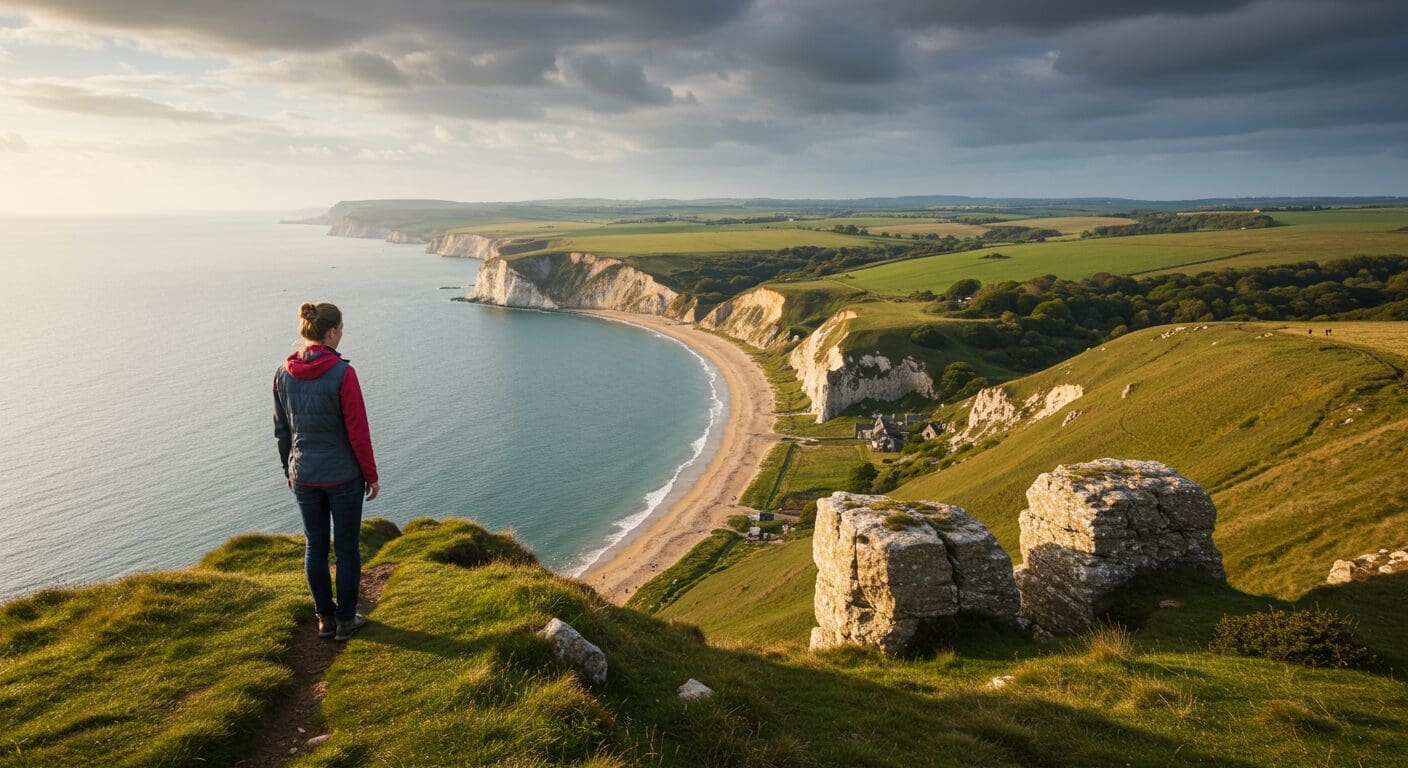
The Jurassic Coast – the stretch of coastline running from Exmouth in Devon to Swanage in Dorset – was the first natural site in England to achieve UNESCO World Heritage status. The reason is geological rather than aesthetic, though the aesthetics are, it must be said, extremely persuasive. 185 million years of Earth’s history are exposed in these cliffs, laid down in sequence like the world’s most patient filing system. At Durdle Door, a natural limestone arch of architectural improbability stands in the sea as if someone placed it there for effect. At Lulworth Cove, a near-perfect circular bay of turquoise water sits behind a narrow entrance in the cliffs with the smugness of somewhere that knows exactly how it looks. Studland Bay, further east, offers four miles of National Trust beach with some of the cleanest water on the south coast.
Inland, the county’s market towns deserve considerably more attention than they typically receive. Dorchester – Hardy’s Casterbridge – is a proper Roman town with proper Roman remains and a high street that operates with the deliberate pace of somewhere not trying to impress anyone. Shaftesbury, perched on its spur of greensand with views across the Blackmore Vale that seem to go on indefinitely, is best known for the impossibly steep cobbled Gold Hill, which achieved a strange immortality in a 1973 bread advertisement and has been photographed by every visitor since. Beaminster, Sherborne, Wareham: each has its own distinct character, its own microclimate of local loyalties and independent shops and pubs that have been in the same families for three generations.
The New Forest presses against Dorset’s eastern boundary, and the two landscapes bleed into each other in ways that make county borders feel faintly theoretical. To the west, the border with Devon is marked approximately by Lyme Regis, a town so entirely itself – Regency architecture stacked above a working harbour, fossils on the beach, rain at any given moment – that it functions as its own argument for the southwest.
Things to Do in Dorset: The List That Actually Has Something for Everyone
Fossil hunting on the Jurassic Coast is one of those activities that sounds like a children’s party entertainer has been involved in its naming, and then you find an ammonite in twenty minutes and become immediately evangelical about the whole enterprise. The beach between Lyme Regis and Charmouth is the primary hunting ground: the cliffs here shed material after every decent rainfall, and the fossils that emerge range from small ammonites you can pocket to – if you are very lucky and happen to be a palaeontologist on sabbatical – ichthyosaur remains of genuine scientific significance. The Charmouth Heritage Coast Centre runs guided walks led by people who know exactly what they’re looking at. This is not a passive activity. You will end up on your hands and knees in the shingle. Your back will complain. You will not care.
Sailing from Poole Harbour – one of the world’s largest natural harbours – is a Dorset institution. The harbour covers about 36 square kilometres and contains Brownsea Island, where Baden-Powell held his first scout camp in 1907 and red squirrels still exist in numbers sufficient to constitute a serious population. Charter sailing from Poole operates at every level from introductory tasters to fully crewed week-long coastal passages. The Solent, just to the east, is one of the great sailing grounds in northern Europe – technically demanding, endlessly varied and, on a clear autumn morning, entirely magnificent.
Walking the South West Coast Path in Dorset – or sections of it – is perhaps the most democratic of the county’s pleasures. The path runs the full length of the Jurassic Coast, and even short sections between Swanage and Worth Matravers, or the circular walk out to St Aldhelm’s Head, deliver the kind of views that make you understand why people move here and never leave. The going can be strenuous in places, the signposting occasionally optimistic, and you should always carry more water than you think you need. But the reward – cliff-top walking above a genuinely ancient sea, buzzards overhead, wildflowers in the turf – is not something you can reliably replicate elsewhere.
Brownsea Island itself is worth the short ferry from Poole Quay for the wildlife alone: peacocks wander freely, herons fish the lagoon with professional detachment, and the landscape has the quality of somewhere time has declined to update. Castle tours, National Trust walking trails and the simply excellent act of sitting on the south beach looking back at the harbour make for a genuinely restorative day.
Adventure in Dorset: The County Has More Edge Than It Lets On
Dorset maintains a convincing pastoral exterior while concealing, for those who know where to look, a surprisingly vigorous adventure sports scene. The coastline is the engine of most of it.
Coasteering – the practice of traversing sea cliffs at water level by swimming, climbing, jumping and general controlled recklessness – originated in nearby Pembrokeshire but has found an enthusiastic home along the Purbeck coast. The sea caves, rock arches and deep-water jumping points between St Aldhelm’s Head and Kimmeridge Bay provide ideal conditions, and several Dorset-based operators run half and full-day sessions for everyone from tentative first-timers to people who clearly should have been born with gills.
Kitesurfing and windsurfing are well established at Poole and Studland, where the combination of reliable southwesterly winds, flat water in the harbour and swell on the seaward side of the sandbanks creates conditions that attract serious practitioners from across the south of England. Lessons are available through several BKSA-accredited schools, and the standard of instruction is high.
Cycling in Dorset divides into two distinct traditions: the leisurely and the genuinely punishing. The Hardy Monuments Trail – a 140-mile circular route taking in much of the county’s interior – is one of the great road cycling routes in the south of England, passing through villages and landscape that feel in places barely altered from Hardy’s own time. The chalk ridgeway routes offer superb off-road riding on clear, fast tracks above the valleys, with views in each direction that justify the climb. The hills in this county are not kind to optimism. They are, however, extremely good for fitness.
Open water swimming has found its most committed practitioners in Dorset’s coves and harbours. Chapman’s Pool, reached on foot via a steep path through rolling farmland, is a deep, sheltered bowl of remarkably clear water that the open-water swimming community regards with something approaching reverence. Kimmeridge Bay, with its unusual flat rock ledges and rich marine life, doubles as an exceptional snorkelling site when the visibility cooperates – which, in summer and early autumn, it does with pleasing frequency.
Dorset for Families: Proper Childhood, Temporarily Restored
There is a strong argument that Dorset is the finest county in England for a family holiday, and the argument rests primarily on this: Dorset provides children with genuinely interesting things to do outdoors that don’t require a lanyard, a queue or an app. This is rarer than it should be.
The fossil beaches at Charmouth and Lyme Regis create the conditions for a specific kind of child – focused, suddenly expert, determined to find the ichthyosaur before lunch – to emerge from the most apparently uninterested offspring. There is something in the combination of fresh air, actual discovery and the possibility of finding something 185 million years old that produces a quality of concentration school has been unable to achieve since September. Guided fossil-hunting tours are available and well worth taking; the guides are genuinely knowledgeable and have developed impressive techniques for sustaining eight-year-old attention spans.
Brownsea Island is a near-perfect family day: short ferry crossing, wildlife that obliges by being visible, walking trails scaled for small legs, and the sort of manageable adventure that ends with tired children and relaxed adults. The Tank Museum at Bovington is one of the finest military museums in the world and operates with a level of engagement – live tank demonstrations, interactive displays, vehicles from virtually every nation and era of armoured warfare – that tends to produce an effect in children aged roughly seven to fifteen that can only be described as ecstatic.
For families choosing luxury villas in Dorset, the private pool is not an optional extra – it is the difference between a holiday that requires constant negotiation and one that runs itself. Children who have their own pool, their own garden, their own space to be loud without apologising to adjacent hotel guests, are fundamentally different creatures from those confined to a corridor and a breakfast buffet. The logic is simple and the effect is immediate.
History, Culture and the Long Memory of Dorset
Dorset has been inhabited, farmed, fought over and written about for so long that its history has become inseparable from its landscape. The chalk uplands are stitched with Iron Age hill forts – Maiden Castle, just south of Dorchester, is among the largest in Europe, a vast earthwork of extraordinary ambition that covers 47 acres and whose ramparts are so well preserved they remain genuinely vertiginous to walk. The Romans used it as a cemetery. Before that, it was a town. The layering of occupation in this landscape is sometimes difficult to hold in mind; Dorset has simply been continuously significant for too long to process in a single visit.
Thomas Hardy dominates the county’s literary identity in the way very few writers dominate any landscape – not as a museum exhibit but as a genuine presence, the quality of his observation so accurate that the villages and heathlands he described feel familiar to anyone who has read him even casually. Hardy’s Cottage in Higher Bockhampton, where he was born in 1840 and wrote Far From the Madding Crowd in longhand, is a National Trust property of quiet intensity. Max Gate, the house he designed and built himself on the edge of Dorchester, where he lived for the last 43 years of his life, is a more formal but genuinely affecting place – particularly given that he removed his own heart from the property after his death, for burial in Stinsford churchyard, while the rest of him went to Westminster Abbey. Hardy contained multitudes.
Corfe Castle – a Norman fortification dramatically ruined in the Civil War and sitting on its conical hill above the village like something from an illuminated manuscript – is the county’s most photographed monument and, remarkably, earns the attention. The village below it has the good grace to be genuinely attractive rather than merely photogenic. Lawrence of Arabia lived at Cloud’s Hill, a tiny cottage near Bovington, in the years before his death in 1935; the cottage is preserved essentially as he left it, and the scale of his ambition contrasted with the deliberate smallness of his chosen life creates one of the county’s most unexpectedly moving cultural experiences.
Sherborne, in the north of the county, has two castles – the ruined medieval one and the Elizabethan one Sir Walter Raleigh built and subsequently lost when he fell out of favour with James I, which is the sort of thing that happened regularly in the sixteenth century – and an abbey church of such architectural grandeur it would dominate a city three times Sherborne’s size.
Shopping in Dorset: Small, Independent, Occasionally Brilliant
Dorset’s shopping operates on the assumption that you are here to buy things you can’t find everywhere else. This assumption is largely correct. The county has not yet been fully colonised by the national chains that have made so many English high streets interchangeable, though it is putting up less of a fight in Bournemouth than one might wish.
The independent shops in Bridport – a town that has a mild habit of attracting creative types who have moved down from London and brought their taste with them – include a number of genuinely excellent galleries, bookshops and makers selling ceramics, textiles and jewellery produced locally. The Saturday market in Bridport is one of the best in the west of England: organic produce, artisan bread, specialist cheeses and the general atmosphere of a community that takes food seriously.
Sherborne’s collection of antique shops is serious enough to attract dealers from across the country on a regular basis. If you are in the market for Georgian furniture, silverware, maps or books, you will find the browsing rewarding and the prices rather more negotiable than they appear. Wareham, on the edge of the Purbeck heathlands, has developed a small but excellent collection of independent retailers operating from the sort of market town high street that hasn’t changed its bones since the Saxons laid them down.
For provisions – and Dorset provisions are genuinely worth the attention – the county’s farm shops and delis are the correct destination. Denhay near Bridport, known primarily for its bacon and charcuterie, operates a farm shop that functions as a reliable reminder of what British food can be when it’s given room to be itself. Local cheeses, including Dorset Blue Vinny – a crumbly, intensely flavoured blue cheese with a history stretching back to the seventeenth century – are widely available and make excellent travelling companions in any well-equipped villa kitchen.
Practical Matters: What You Actually Need to Know
Dorset operates in British pounds sterling. Tipping is appreciated in restaurants – typically ten to fifteen percent for good service – though it is nowhere near the obligation it constitutes in, say, the United States. Card payments are accepted almost universally, though a small number of rural pubs and farm stalls maintain a charming commitment to cash that is either delightfully principled or slightly inconvenient depending on your preparedness.
The best time to visit Dorset depends considerably on what you’re after. June to September delivers the warmest weather, the longest days and the fullest beaches – along with the fullest car parks, the fullest restaurants and the fullest sense that several hundred thousand other people have had exactly the same idea at the same time. July and August are, meteorologically, the most reliable months and, socially, the most demanding. May and early June offer something close to ideal conditions: the countryside is at its most vivid, the weather is frequently excellent, and the county is still largely populated by people who live there. September and October are genuinely wonderful – warm enough for swimming in early September, golden and clear in October, and blessed with a quality of quiet that the summer months withhold entirely.
Winter in Dorset is not the hardship it sounds. The coast path walks are dramatic and bracing in a way that builds rather than breaks character. The pubs are warm and unhurried. The restaurants are easier to book. The landscape – stripped of leaf cover, the chalk hills starkly pale against grey skies – has a beauty that requires no apology. A well-chosen luxury villa in Dorset in January, with underfloor heating and an open fire and a kitchen stocked with local provisions, constitutes a specific and underrated pleasure.
A note on roads: Dorset’s lane network was designed for pack horses and has never been entirely updated. Allow more time than the map suggests for any rural journey. This is not a complaint, merely an observation. The lanes enforce a pace that the county’s pleasures reward.
Luxury Villas in Dorset: Why You Won’t Consider a Hotel Once You’ve Tried This
There is a particular kind of Dorset holiday that a hotel, however excellent, simply cannot provide – and it begins with the moment you close the gate behind you, hear the complete absence of other guests, and realise that the next several days belong entirely to your own agenda. This is the essential proposition of a luxury villa in Dorset, and it is a compelling one.
The county’s villa stock ranges from converted farmhouses on working estates in the Blackmore Vale to coastal retreats above the Jurassic Coast cliffs, from Georgian manor houses with walled kitchen gardens to modern builds in the Purbeck hills with floor-to-ceiling views of the sea. What they share is scale – the scale to accommodate families properly, to give a group of friends genuine space without requiring negotiation over shared facilities, to give couples the kind of privacy that honeymoons actually require. A private pool in a Dorset garden, on a clear September morning, is not a luxury in the resort-brochure sense of the word. It is simply the best possible place to be.
For families, the villa format changes the entire arithmetic of a holiday. Children contained within their own private grounds are fundamentally less complicated than children navigating hotel lobbies, restaurant dress codes and the general requirement to be quieter than they naturally are. The space to spread out – bikes in the garden, toys on the lawn, meals at your own pace in your own kitchen with produce from the farm shop you visited that morning – constitutes a form of freedom that no amount of hotel service can replicate.
Groups of friends – the kind of reunion trip where six or eight people are recalibrating friendships around the changed circumstances of careers and children and geography – work best in spaces where everyone can be together without being on top of each other. A villa with multiple living spaces, a large dining table and a garden of sufficient size to accommodate a long Sunday lunch works in ways that two adjacent hotel rooms simply don’t. The evenings particularly: cooking together, or bringing in a private chef who knows exactly what to do with the lobsters from the fishmonger in Weymouth, constitute memories of a specific and lasting kind.
Remote workers have discovered, with the enthusiasm of a generation that spent two years working from kitchen tables, that a well-equipped Dorset villa with fast, reliable broadband is a considerably more effective working environment than most offices. Several properties now offer Starlink connectivity where rural location makes conventional broadband insufficient, and the combination of professional connectivity with the complete absence of commute, open-plan noise and motivational wall art is, by all accounts, transformative. The coast path at lunchtime. The tasting menu in the evening. The inbox managed from a desk with a view of the chalk hills. This, quietly, is what a luxury holiday in Dorset can look like for the working traveller.
Wellness-focused guests find in Dorset something that no spa menu can manufacture: an environment that is inherently restorative. The coast path walks, the cold-water swimming at Chapman’s Pool or Kimmeridge, the farm-to-table food, the pace of a county that has no particular interest in performing for your benefit – these things work on the nervous system in ways that are difficult to quantify and easy to feel. Several luxury villas come with private gyms, outdoor hot tubs and treatment rooms where therapists can be arranged for in-villa massage, yoga or reflexology. Others are positioned within easy reach of excellent day spas. But the primary wellness amenity in Dorset is the county itself – the light, the quiet, the air and the sea.
With over 27,000 properties worldwide, Excellence Luxury Villas can help you find exactly the right base for your Dorset stay – whether that’s a coastal retreat for two, a manor house for twenty, or something in between. Browse our collection of private villa rentals in Dorset and find the one that makes your particular version of this holiday possible.
More Dorset Travel Guides
- Best Restaurants in Dorset: Fine Dining, Local Gems & Where to Eat
- Dorset Food & Wine Guide: Local Cuisine, Markets & Wine Estates
- Dorset with Kids: The Ultimate Family Holiday Guide
- Best Time to Visit Dorset: Month by Month Weather, Crowds & Tips
- Dorset Luxury Itinerary: The Perfect 7-Day Guide
- Romantic Dorset: The Ultimate Couples & Honeymoon Guide
What is the best time to visit Dorset?
May, June and September represent the sweet spot for most visitors. You get reliable weather and long days without the peak-summer crowds that descend in July and August. September is particularly good: the sea is still warm from the summer, the light is extraordinary on the chalk downs and coast path, and the county returns to something approaching its normal, unhurried self. October offers brisk, clear walking weather and dramatically reduced prices. Winter is underrated for those who enjoy wild coastal landscapes and very good pub fires.
How do I get to Dorset?
Bournemouth International Airport is the closest major airport, with domestic and European routes. Southampton Airport, around 45 minutes east, offers broader connections. From London, both road (A31 via the M3) and rail (London Waterloo to Dorchester South, approximately two hours fifteen minutes) are practical options. Once in Dorset, a hire car is essential – the county’s best places are not on bus routes, and the lanes between them are best navigated at your own pace.
Is Dorset good for families?
Exceptionally so. The fossil beaches at Charmouth and Lyme Regis alone will occupy children for days. Brownsea Island, the Tank Museum at Bovington, the coast path, sailing in Poole Harbour and the sheer quality of outdoor space make Dorset one of the best family destinations in England. A private villa with its own pool and garden adds a layer of ease – and genuine privacy – that hotel-based family holidays simply can’t match.
Why rent a luxury villa in Dorset?
Because the way to experience Dorset properly is slowly, privately and at your own pace – none of which a hotel naturally facilitates. A luxury villa gives you a private kitchen stocked with local produce, a garden or grounds to wake up in, a pool that belongs to your party alone, and the freedom to structure each day without reference to check-out times or restaurant sittings. For families, groups of friends and couples on special occasions, the space-to-experience ratio of a private villa is simply unmatched. Staff and concierge services can be arranged through Excellence Luxury Villas to add whatever level of support you require.
Are there private villas in Dorset suitable for large groups or multi-generational families?
Yes – Dorset has a good range of larger properties capable of accommodating ten to twenty guests, including converted manor houses, farmhouse complexes with separate cottages and estate properties with multiple wings. These work particularly well for multi-generational holidays where grandparents, parents and children need

