
Eixample Travel Guide: Best Restaurants, Culture & Luxury Villas
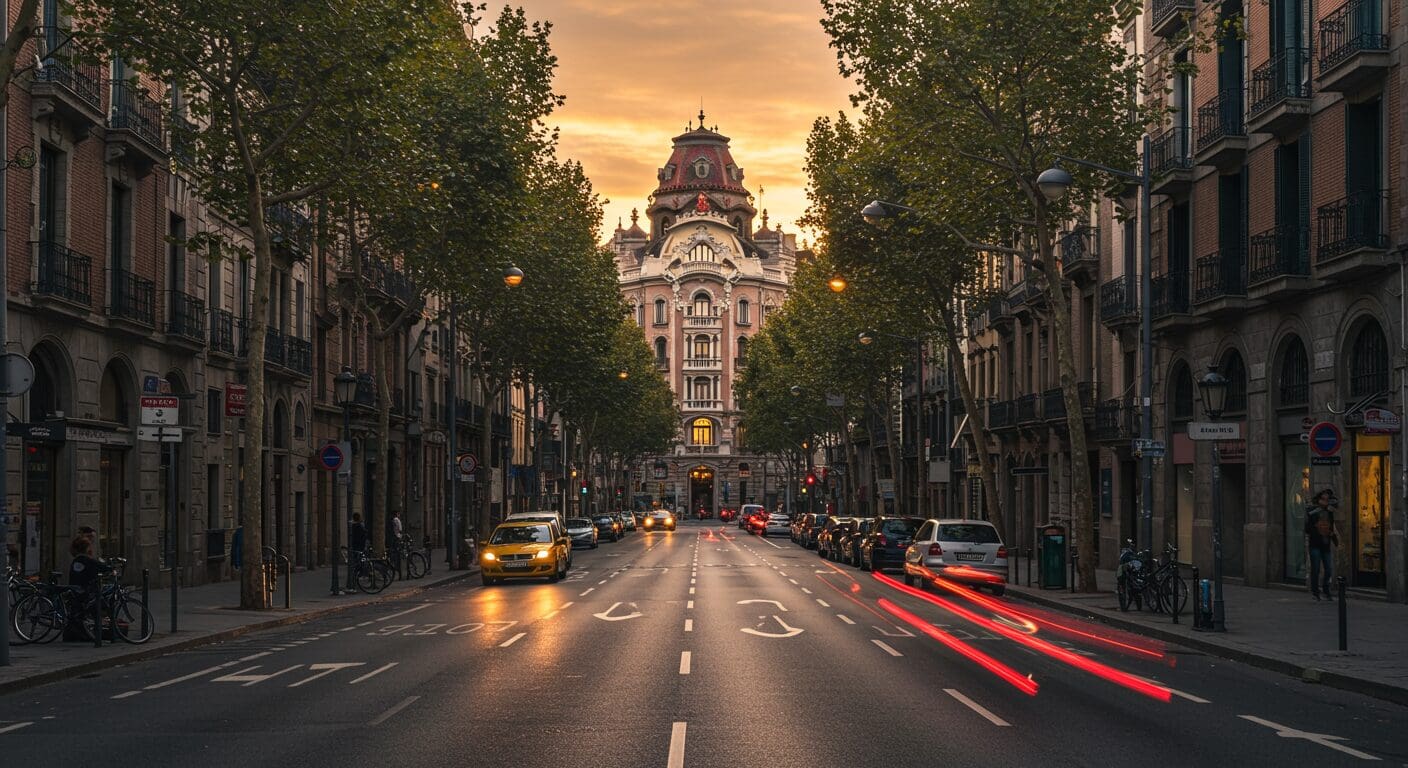
In May, something shifts in Eixample. The jacaranda trees that line the wide boulevards come into riotous purple bloom, and the neighbourhood – Barcelona’s grand, grid-planned heartland – suddenly looks like a Gaudí fever dream made botanical. The terraces fill. The light turns gold by seven in the evening and stays that way for what feels like an implausibly long time. The city has been beautiful all winter, of course, but in late spring it becomes theatrical about it. This is when Eixample reveals itself not merely as a place to visit but as a place to inhabit – and the distinction matters enormously once you’ve experienced it.
Eixample is, depending on who you ask, either the most liveable neighbourhood in Europe or proof that city planning can occasionally produce something genuinely extraordinary. Designed in 1860 by Ildefons Cerdà with an almost utopian insistence on order, light and equal access to green space, its characteristic octagonal blocks and wide pavements give it a human scale that many great cities have spent the last century trying to retrofit. It draws couples celebrating significant birthdays or anniversaries who want culture, Michelin-starred dining and architecture at genuinely world-class level without the chaos of the Gothic Quarter. It draws groups of friends with particular interests – art, food, design – who know that a well-appointed apartment on Passeig de Gràcia puts them in the centre of everything. Families seeking a private base with space to breathe find that luxury villas and apartments in Eixample offer something hotels categorically cannot: a kitchen table large enough for everyone, a second sitting room when the children need to be in two places at once, and the rare gift of a morning that belongs entirely to you. Remote workers with serious connectivity requirements arrive and find themselves extending their stays by a week. Wellness-focused travellers discover that a neighbourhood built for walking, with spa options, cycling infrastructure and Mediterranean light as a baseline amenity, is rather good for the soul.
Getting to Eixample: Closer Than You Think, Easier Than It Should Be
Barcelona-El Prat Airport (BCN) is the gateway, and it handles the job efficiently. It sits roughly 14 kilometres southwest of Eixample, which in practice means 20 to 30 minutes by taxi, private transfer or the Aerobus express coach service, depending on traffic and your appetite for drama on the C-32. Private transfers are the sensible choice for anyone arriving with luggage, children or a reasonable expectation of comfort – they can be arranged in advance and will typically deposit you directly at your villa or apartment door without the minor adventure of navigating Barcelona’s one-way system yourself.
Within Eixample itself, the question of getting around has a pleasing answer: you mostly don’t need to. The neighbourhood is designed for walking. Cerdà’s wide pavements were almost certainly wider than he needed them to be in 1860, but they have aged beautifully into the age of the outdoor terrace. The L2, L3 and L5 metro lines cut through the neighbourhood and connect to everywhere else with admirable frequency. Taxis are abundant. The city’s Bicing bike-share scheme covers the area comprehensively, and cycling along the Superilla – Barcelona’s expanding network of car-reduced streets – is genuinely pleasant rather than merely virtuous. For day trips to the coast or further into Catalonia, rental cars make sense, though anyone attempting to park in central Eixample without a private garage deserves sympathy rather than advice.
Eating in Eixample: From Elbulli Alumni to Lebanese-Catalan Fusion You Didn’t Know You Needed
Fine Dining
Disfrutar occupies a particular category in the world of fine dining: the kind of place that appears on every list of the world’s best restaurants and yet somehow still surprises you when you arrive. Opened in 2014 by three former head chefs from elBulli – a restaurant so mythologised that its alumni now operate like a small culinary dynasty scattered across the globe – Disfrutar has built something remarkable on that foundation. The cooking is technically extraordinary, the creativity is genuine rather than performative, and the room is notably free of the particular atmosphere that sometimes descends on restaurants that know they’re famous. This is not a place where you eat in reverent silence. Book well in advance. Months, not weeks.
La Dama takes a different approach to ambition. Set inside the Gaudí-influenced Casa Sayrach – all organic forms and architectural flourish – the restaurant looks like the kind of apartment that a well-travelled socialite heiress might have decorated on a very good year. Mirrored doorways, crimson velvet banquettes, vintage floral wallpaper: the room alone justifies a reservation. The Mediterranean-French menu keeps pace, with dishes like calamari carbonara where the squid is sliced like tagliatelle – an act of culinary confidence that either works brilliantly or falls flat, and here it works brilliantly.
Bardeni has established itself as Barcelona’s preeminent address for meat – a claim that carries real weight in a city that takes its carnivorous credentials seriously. The quality of the sourcing is exceptional, and the approach is direct in the best possible way.
Where the Locals Eat
Cervecería Catalana, just off Passeig de Gràcia, is one of those places that should by rights have been ruined by its own reputation but hasn’t. It is perpetually busy, perpetually good, and the tapas are the kind that remind you why the format exists. Steak with foie gras. Grilled shrimp with enough char to mean something. A plate of patatas bravas that arrives and is immediately eaten before anyone planned to eat it. There will be a queue, particularly in the evening. Join it without resentment. It moves.
The Mercat de l’Abaceria in the upper reaches of the neighbourhood offers a slightly different register – a covered market with a certain lived-in character, where local shopping and coffee coexist naturally. The Eixample branch of the Mercat de la Llibertat is equally worthwhile for anyone who wants to understand what Catalan produce actually looks like before it reaches a restaurant plate.
Hidden Gems Worth Seeking Out
Albé is genuinely one of those finds that people return from trips brandishing like evidence. A Lebanese restaurateur, a move to Barcelona, a falling-in-love with Catalan produce, and the result is a restaurant that serves Lebanese dishes in tapas-sized portions using local ingredients – a combination that sounds like a concept and tastes like a revelation. The vegetarian options are particularly excellent, which is worth noting in a city where “vegetarian option” occasionally means a sad arrangement of grilled vegetables. Albé takes the format seriously. The sourcing is meticulous. The portions encourage ordering several of everything, which is, it turns out, exactly the right approach.
Eixample Neighbourhood by Neighbourhood: A Grid That Rewards the Curious
Eixample divides neatly – though the locals would say it divides naturally – into two halves. Esquerra de l’Eixample sits to the left of Passeig de Gràcia when you’re facing the sea, and Dreta de l’Eixample to the right. The Dreta is where most visitors orient themselves, drawn by the density of Modernista architecture along the Manzana de la Discordia – the block containing Casa Batlló, Casa Amatller and Casa Lleó Morera, three Modernista buildings by three different architects all within twenty metres of each other. They were not trying to outdo one another. Probably.
The Esquerra, particularly the stretch between Carrer del Consell de Cent and Carrer de Muntaner, has acquired a distinct character over the decades as the heart of Barcelona’s LGBTQ+ community – the Gayxample, as it’s locally known – and with it has come a density of excellent bars, independent restaurants and a general atmosphere of good-natured social ease that makes the whole area particularly welcoming. The Esquerra also contains the Sant Antoni neighbourhood, technically its own barrio but bleeding seamlessly into Eixample’s grid. Sant Antoni has been Barcelona’s most talked-about neighbourhood for a decade – fashionable without having quite surrendered to being a theme park version of itself. The Mercat de Sant Antoni, magnificently restored and opened in 2015, anchors the whole area.
Passeig de Gràcia itself requires a separate paragraph because it operates on a different scale. This is Barcelona’s great boulevard – the one that gets compared to the Champs-Élysées, though it is considerably more pleasant to walk along and has substantially better architecture on either side. The luxury retail is concentrated here: the flagship stores, the jewellers, the hotel lobbies you can walk through simply for the pleasure of the air conditioning and the marble. It is also where the most photographed buildings in the city live, side by side and entirely unbothered by the attention.
Things to Do in Eixample: Architecture, Art and the Occasional Intentional Indulgence
The best things to do in Eixample begin with accepting that you will spend time looking at buildings in a way that you do not normally look at buildings. This is not tourism. This is an involuntary response to being in close proximity to some of the most extraordinary architecture produced in the last two centuries.
Casa Batlló rises 32 metres above Passeig de Gràcia with the confidence of something that knows it’s being watched. The jaw-shaped balconies, the glazed coloured tiles, the dragon’s-back roof – Antoni Gaudí designed every element down to the doorknobs, and it shows. The interior tour, available with augmented reality enhancements that range from genuinely revelatory to slightly bewildering, is worth doing in the evening when the crowds thin and the building acquires a different quality of light. Over 700,000 people visit annually, which means that arriving with a timed booking is not optional – it is the minimum reasonable precaution.
A few blocks north, Casa Milà – known as La Pedrera – offers a different encounter with Gaudí’s universe. Where Casa Batlló dazzles with colour and ornament, La Pedrera seduces with form: those undulating stone facades, the surrealist rooftop of twisted chimneys and warrior-like ventilation towers that reads like a landscape from another planet. The interior apartments, preserved in their early twentieth-century configuration, offer a surprisingly intimate window into how the bourgeoisie of Modernista Barcelona actually lived.
And then there is La Sagrada Família, which requires its own category entirely. Spain’s most visited monument has been under construction since 1882 and will, apparently, be complete by 2026 – a completion date that has been revised enough times that the wise traveller holds it loosely. What can be said with certainty is that the building defies every expectation you bring to it. The eighteen spires. The Nativity Facade, dense with symbolic carving, stopping pedestrians mid-stride. The interior, where Gaudí’s branching columns create the sensation of standing inside a stone forest flooded with coloured light. Even people who are entirely indifferent to churches find themselves standing in the nave in a state that is difficult to name but resembles awe. Book timed entry in advance. Consider the morning visit before the worst of the crowds. Do not, under any circumstances, try to simply turn up.
Beyond the architectural canon, Eixample rewards more leisurely pleasures. The Fundació Antoni Tàpies, housed in a Modernista publisher’s building on Carrer d’Aragó, offers an excellent alternative to the constant Gaudí orbit – Tàpies was Barcelona’s great post-war artist, and the permanent collection is exceptional. The Museu del Modernisme Català, less visited than it deserves, fills in the broader picture of the artistic movement that defined the neighbourhood’s character.
Active Eixample: Walking, Cycling and the Art of the Intentional Stroll
Eixample is not, to state the obvious, a destination for skiing or surfing. But anyone who dismisses it as an inactive destination has never spent a morning cycling its expanding network of protected lanes, or walked the full length of Passeig de Gràcia from the Arc de Triomf to Diagonal and back in the long evening light. The physical experience of the neighbourhood is central to understanding it.
The city’s Superilla programme – which has been progressively converting interior streets within Cerdà’s blocks into car-free spaces with greenery and seating – has transformed cycling and walking into genuinely enjoyable pursuits rather than exercises in urban negotiation. Hire a bike from Bicing or any number of private rental shops, and the connections to the wider cycling network become apparent quickly. The seafront is forty minutes away by bike. The Collserola hills – the forested ridge above the city where Barcelona residents escape on weekends – are accessible from the northern edge of Eixample.
For swimming, the beaches of Barceloneta are within easy reach, though the summer crowds make the sea an act of faith more than a guaranteed pleasure. The municipal pools, including the Piscines Bernat Picornell up on Montjuïc – built for the 1992 Olympics – offer a more composed alternative, with outdoor lanes and views over the city that make the modest entry fee feel like a genuine bargain. Tennis, padel and running routes through the Ciutadella Park all add to the picture of a neighbourhood that takes physical wellbeing seriously without making a fuss about it.
Eixample with Children: Architecture That Actually Captures Young Attention
Bringing children to Eixample involves one extraordinary advantage and one persistent challenge. The advantage is La Sagrada Família, which – unlike almost every other cathedral on the European tourist circuit – exerts a genuine grip on young imaginations. The building is simply too strange, too large and too visually overwhelming to be dismissed as another church. Gaudí designed a forest made of stone, lit by stained glass, with towers that look like they were imagined by someone who had read too much science fiction. Children generally find this interesting. The audio guides designed for younger visitors help considerably.
Casa Batlló, with its dragon roof and fairy-tale excess, similarly lands well with children who have been dragged past enough Baroque facades to have developed opinions. The augmented reality elements of the tour were, it must be said, designed with a younger audience partly in mind.
The challenge is pace. Eixample is fundamentally an adult neighbourhood – a place of long lunches, slow meanders, late dinners and the kind of urban exploration that benefits from not having a deadline. Families who stay in a private villa or spacious apartment find this significantly more manageable than those in hotel rooms, because the question of where children decompress, eat at irregular hours and watch something loud on a screen has a ready answer. A kitchen matters. A second bedroom matters. A dining table that accommodates everyone without elbows colliding matters rather more than any hotel “family room” category ever quite acknowledges. Luxury holiday Eixample planning is, for families, essentially an argument for the villa format.
The parks of Eixample – including the interior courtyard gardens that Cerdà originally intended to remain green, some of which have been beautifully restored – provide breathing space. The Parc de l’Estació del Nord is pleasant for younger children. The Ciutadella Park, a short taxi ride away, has a boating lake, a zoo, and enough space for an entire afternoon.
The History Behind the Grid: Why Eixample Looks the Way It Does
To understand Eixample, you need to understand one act of deliberate demolition. In 1854, the medieval walls that had surrounded Barcelona for centuries were torn down – not because they were crumbling but because the city had become unliveable. Packed into an area a fraction of its modern size, Barcelona had one of the highest mortality rates in Europe. The walls came down, and the question of what came next was answered, after considerable political argument, by a civil engineer named Ildefons Cerdà.
Cerdà’s plan – the Pla Cerdà – was radical in its egalitarianism. A perfect grid of identical blocks, each with chamfered corners to improve sight lines at intersections, each intended to have internal gardens at its centre. Wide streets. Equal access to light and air for all residents regardless of class. It was, by the standards of nineteenth-century urban planning, essentially utopian. The internal gardens were mostly lost to development pressure within a few decades. The chamfered corners survived. The grid survived. And the result – walkable, legible, human in scale – is one of the great pieces of city planning in European history, even if history required a few compromises along the way.
The Modernisme movement that erupted across Eixample’s facades between 1880 and 1920 layered another stratum of meaning onto the grid. This was Catalan nationalism expressed through architecture – a deliberate cultivation of a distinctive aesthetic identity that drew on Gothic and Moorish sources while inventing something entirely its own. Gaudí is the name everyone knows, but Lluís Domènech i Montaner and Josep Puig i Cadafalch were his contemporaries, and their work lines these streets with equal ambition if occasionally less celebrity. The Ruta del Modernisme maps over 120 buildings across Barcelona; a substantial portion of them are in Eixample, and walking between them constitutes one of the finest free cultural experiences available anywhere in Europe.
The neighbourhood has its own festival calendar. La Mercè in late September is Barcelona’s great popular fiesta – human towers, fire-running, free concerts in the streets – and Eixample participates fully. Sant Jordi, on April 23rd, sees the streets fill with book and rose stalls in honour of Catalonia’s patron saint and an entirely charming tradition of giving books and flowers to people you love. It is one of the most genuinely appealing public celebrations in Europe. It also happens to coincide with the jacaranda bloom. The timing is not accidental, or perhaps it is, but either way the effect is considerable.
Shopping in Eixample: From Passeig de Gràcia Flagships to the Finds on Carrer del Consell de Cent
The shopping in Eixample operates across three distinct registers, and understanding them saves time and prevents the faint disappointment of expecting one thing and encountering another. Passeig de Gràcia is luxury retail at its most concentrated: Loewe, whose original Barcelona store occupies a ground floor decorated by Domènech i Montaner, is the obvious anchor. Hermès, Chanel, the usual international names – all present, all occupying spectacular buildings, the architecture doing more than the merchandise to justify the visit.
The streets perpendicular to Passeig de Gràcia – particularly Carrer del Consell de Cent, Carrer de Provença and Carrer de Mallorca in the Dreta – contain a more interesting stratum of independent boutiques, local designers and the kind of shops that exist because someone decided they wanted to sell exactly this thing in exactly this neighbourhood. Catalan ceramics, jewellery using local semi-precious stones, textile work drawing on the region’s long weaving tradition – these are the things to look for and the things to bring home. Barcelona’s design culture is sophisticated and distinct, and shopping in Eixample is one of the better ways to access it.
The Mercat de Sant Antoni, on Sunday mornings, hosts an outdoor book and coin market around the perimeter of the building that draws an agreeably mixed crowd of serious collectors and casual browsers. It is also an excellent reason to be in the Sant Antoni neighbourhood at a time when the coffee is fresh and the city is at its most relaxed.
Practical Eixample: What to Know Before You Arrive
The currency is the euro. The language is officially Catalan first, Spanish second, though English is spoken widely enough in tourist-facing contexts that language is rarely a barrier. Making any effort with Catalan – gràcies, bon dia, si us plau – will be received with genuine warmth. Using Spanish is entirely fine. Beginning any interaction in English without acknowledgement is not specifically frowned upon, but the raised eyebrow is real and occasionally deserved.
Tipping is not the mandatory ritual it is in North America. In restaurants, rounding up the bill or leaving a few euros on a good meal is appreciated; ten percent on a significant dinner is generous. Bar staff do not expect tips. Taxi drivers will not be offended if you round to the nearest convenient number.
Safety in Eixample is a reasonable concern rather than an unreasonable fear. Pickpocketing exists, particularly on Passeig de Gràcia and around La Sagrada Família in high season. The usual precautions apply: front pockets, zipped bags, not engaging with anyone who seems particularly interested in your attention for reasons that are unclear. The neighbourhood itself is safe to walk at any hour.
For the best things to do in Eixample by season: spring (April-June) delivers the jacaranda bloom, comfortable temperatures and the first outdoor terrace evenings. Autumn (September-November) is arguably the finest season of all – warm, less crowded than August, culturally rich with La Mercè in September. July and August are hot, busy and entirely manageable if you approach the middle of the day with appropriate ambition levels. Winter is mild by northern European standards, cool and quiet, and offers the buildings without the queues. An Eixample travel guide should be honest: there is no bad time to visit. There are just different versions of it.
Why a Luxury Villa in Eixample Changes the Entire Experience
There is a version of a Barcelona trip that begins and ends with a hotel room – a perfectly adequate room, efficiently serviced, with a breakfast that is either excellent or institutional depending on the price point. And there is a version that begins with your own keys, your own kitchen, a table large enough to spread out on, and an address that is indistinguishable from the address of someone who actually lives here. These two versions of the same city are notably different.
Luxury villas and apartments in Eixample offer something that the hotel sector has spent considerable energy pretending it can replicate but cannot: genuine privacy, genuine space, and the experience of belonging to a place rather than visiting it. For couples on milestone trips, the difference between a hotel suite and a beautifully designed Eixample apartment – the private terrace, the kitchen for a late night cheese and wine that costs nothing and costs nothing in the morning, the ability to arrive at midnight without a lobby – is the difference between a holiday and a memory. For families, the practical case is overwhelming: children sleep in their own rooms, adults remain sane, and no one eats a compulsory breakfast at the hour decreed by the hotel.
For groups of friends, a large villa or multi-floor apartment in Eixample becomes a base of operations that no hotel can match – a kitchen for the morning, a terrace for the evening, and enough space that six people can occupy the same address without feeling like they’re rehearsing for a reality television programme. For remote workers, the connectivity in premium Eixample properties is fast, reliable and – in a growing number of cases – supported by high-speed fibre infrastructure that handles video calls, large file transfers and the general demands of a working day without drama. The view from the desk is an additional benefit the office cannot claim.
Wellness-focused guests find that a luxury villa with access to a pool, a building with a gym, and a neighbourhood designed for walking represents a fundamentally different proposition from a hotel spa experience: it is simply woven into the texture of the day rather than scheduled as a separately bookable amenity. Concierge services, private chefs available on request, housekeeping that operates around your schedule rather than the other way around – these are the details that accumulate into something that feels less like a holiday product and more like an elevated way of living in a city you have temporarily, delightfully, claimed as your own.
Excellence Luxury Villas has an outstanding portfolio of luxury villas and apartments in Eixample – curated properties that put you in the centre of one of Europe’s great neighbourhoods with the space, privacy and quality that the destination genuinely deserves.
More Eixample Travel Guides
What is the best time to visit Eixample?
Spring (April to June) and autumn (September to November) are the finest seasons. Spring brings the extraordinary jacaranda bloom along the boulevards, comfortable temperatures and the first long evenings on outdoor terraces. Autumn offers warm days, thinner crowds than August, and a rich cultural calendar including the La Mercè festival in late September. Winter is mild, quiet and architecturally uncrowded – an underrated choice. Summer is hot and busy, but entirely manageable if you approach the midday heat with appropriate respect.
How do I get to Eixample?
The nearest airport is Barcelona-El Prat (BCN), approximately 14 kilometres from Eixample. Private transfers take 20 to 30 minutes depending on traffic and are the most comfortable option for families or anyone with significant luggage. The Aerobus express coach service connects the airport to Plaça de Catalunya, at the top of Eixample, with good frequency and at modest cost. Taxis are readily available at the airport. Within Eixample, the L2, L3 and L5 metro lines provide excellent connectivity across the neighbourhood and into the wider city.
Is Eixample good for families?
Yes, with some planning. The neighbourhood’s wide pavements, walkable layout and density of extraordinary attractions – La Sagrada Família and Casa Batlló in particular genuinely captivate children – make it a strong choice. The practical advantage for families lies in choosing a private villa or spacious apartment over a hotel: children have their own rooms, there is a kitchen for flexible mealtimes, and adults retain a degree of sanity that hotel family rooms cannot reliably guarantee. Parks, cycling routes and the beaches of Barceloneta are all accessible from Eixample within a comfortable distance.
Why rent a luxury villa in Eixample?
A private villa or luxury apartment in Eixample gives you something no hotel can: space, privacy and the experience of genuinely inhabiting the neighbourhood rather than visiting it. For couples, it means a private terrace and a kitchen without the constraints of hotel hours. For families, it means separate rooms, flexible mealtimes and space to decompress. For groups, it means a shared base with enough room that six people remain friends by the end of the week. Staff and concierge services are available on request at premium properties, and the ratio of personalised attention to guests is simply incomparable to a hotel of any star rating.
Are there private villas in Eixample suitable for large groups or multi-generational families?
Yes. The Excellence Luxury Villas portfolio includes multi-bedroom apartments and duplex properties in Eixample with sufficient space for larger groups or multi-generational families. Many properties span entire floors of Modernista buildings, offering multiple bedrooms with private bathrooms, large living and dining areas, and rooftop terraces or private gardens. Some premium properties include dedicated staff such as housekeepers and private chefs available on request, making them well-suited to families where different generations have different requirements and different ideas about when breakfast should be served.
Can I find a luxury villa in Eixample with good internet for remote working?
Yes. Premium villas and apartments in Eixample are generally equipped with high-speed fibre broadband – Barcelona’s urban connectivity infrastructure is excellent, and properties at the luxury end of the market treat reliable internet as a baseline rather than an optional extra. Many properties include designated workspace or desk areas. If seamless connectivity is a priority, it is worth specifying your requirements when booking; the Excellence Luxury Villas team can confirm speeds and workspace provision for individual properties.
What makes Eixample a good destination for a wellness retreat?
Eixample was designed, at its foundations, for human wellbeing – wide pavements, light, greenery and walkability are built into its DNA. For wellness-focused travellers, this translates practically into a neighbourhood that supports a healthy daily rhythm without effort: walking is the natural mode of transport, cycling infrastructure is extensive, and the Mediterranean diet is available at its finest on every block. Several premium spa facilities operate within and close to the neighbourhood. Luxury villas with private pools, building gyms and outdoor terraces allow wellness to become part of the daily routine rather than a scheduled activity. The pace of Barcelona – unhurried in the mornings, alive in the evenings – has its own restorative logic.

