
Grad Split Travel Guide: Where to Stay, Eat & Explore in Luxury
What if the most rewarding place in Croatia wasn’t the place everyone argues about? Dubrovnik gets the Instagram posts. Hvar gets the yachts. But Grad Split – the historic city district at the heart of Split, built quite literally inside the walls of a Roman emperor’s retirement palace – quietly gets on with being one of the most extraordinary urban environments in Europe, largely unbothered by its own magnificence. That, if you’re paying attention, is a very good sign.
Grad Split rewards a particular kind of traveller – and rather a wide range of them, as it happens. Couples marking a milestone anniversary will find that the ancient stone alleyways and harbourfront restaurants do the romantic heavy lifting without any effort required. Families seeking genuine privacy discover that a luxury villa in Grad Split gives them the space, the pool and the independence that no hotel ever quite manages. Groups of friends who’ve graduated from party destinations find something rarer here: a place with genuine culture, exceptional food and a pace that allows actual conversation. Remote workers – and there are more of them every season – are discovering that the Dalmatian coast offers surprisingly reliable connectivity alongside the kind of light that makes even a video call feel civilised. And for the wellness-focused traveller, the combination of Adriatic sea swimming, mountain air within reach and the Mediterranean way of simply slowing down is, frankly, therapeutic in a way that no spa menu could adequately describe.
The Journey In: Closer Than You Think, Better Than You Expect
Split Airport – officially Zračna Luka Split, for anyone who enjoys navigating foreign signage – sits roughly 25 kilometres northwest of the city centre, near the town of Kaštela. It handles direct flights from across Europe throughout the summer season, with London, Amsterdam, Frankfurt, Vienna and a growing number of other cities all offering direct routes. Flying time from the United Kingdom is around two and a half hours, which is genuinely convenient, though the airport’s relative modesty in size means arrivals can feel brisk in peak July and August. Book your transfer in advance and this becomes a minor footnote rather than an experience.
Private transfers from the airport to Grad Split take around 30 to 40 minutes depending on traffic – and in high summer, traffic on the approach to Split does have opinions about schedules. A pre-arranged luxury transfer is the obvious choice for arriving in any kind of composure. Once in the city, the historic Grad Split area is largely pedestrianised, which is precisely why it feels so human. The old town’s car-free lanes reward walking above all else. For wider exploration of the region – the islands, the hinterland, the wine villages inland – renting a car or arranging a private driver makes sense. Ferries to the islands of Brač, Hvar, Vis and Šolta depart regularly from Split’s busy harbour, and the schedule is reliable enough that spontaneous island days are entirely possible with only moderate planning.
Eating in Grad Split: From Adriatic Seafood to the Table Everyone’s Fighting Over
Fine Dining
The fine dining scene in Split has matured considerably over the past decade, moving well beyond the tourist-menu seafood platters of earlier years into something genuinely sophisticated. The city’s best restaurants now champion Dalmatian ingredients with ambition – locally caught fish prepared with care and restraint, aged sheep’s cheese from the islands, black risotto that earns its blackness, lamb slow-cooked in the peka style under an ember-covered bell. The standard is high, the portions generous, and the wine lists increasingly well-curated with Dalmatian varieties – Plavac Mali in particular – that deserve far more international attention than they currently receive. Dress codes are relaxed by Mediterranean standards, but the cooking at the upper end is not. Reserve well in advance for the restaurants that matter, especially in July and August when competition for tables becomes spirited.
Where the Locals Eat
Step even slightly back from the harbour promenade and prices shift meaningfully while quality holds. The covered market – Pazar, just outside the Golden Gate of Diocletian’s Palace – is where mornings should begin: fresh produce, local honey, sheep’s cheese wrapped in cloth, fish so recently caught that the vendor will tell you exactly which boat brought it in. Konobas – the family-run restaurants that are Croatia’s answer to the French bistro, only with better olive oil – dot the streets of Varoš, the old fishermen’s quarter to the west of the palace walls. These are the places where the wine arrives in a ceramic jug, the bread is homemade and the octopus salad is prepared with the quiet confidence of people who’ve been doing this for three generations. Lunch here is an extended philosophical position, not just a meal.
Hidden Gems Worth Seeking Out
The most satisfying discoveries in Grad Split tend to come from wandering without a map and then following the smell of grilling fish through a passageway that appears to lead nowhere. Wine bars tucked into palace basement vaults – and there are genuine bars occupying what were once Roman basement chambers, which is a sentence that still takes a moment to process – offer local natural wines and small plates of prosciutto and olives. The Meštrović Gallery café, west of the centre, attracts a more local crowd than the tourist restaurants and serves coffee with appropriate seriousness. And for pastry, the Croatian concept of fritule – small fried dough balls dusted with powdered sugar and laced with lemon and rum – is the kind of street food that justifies an entire morning of walking.
The Lay of the Land: A City Built Inside an Emperor’s House
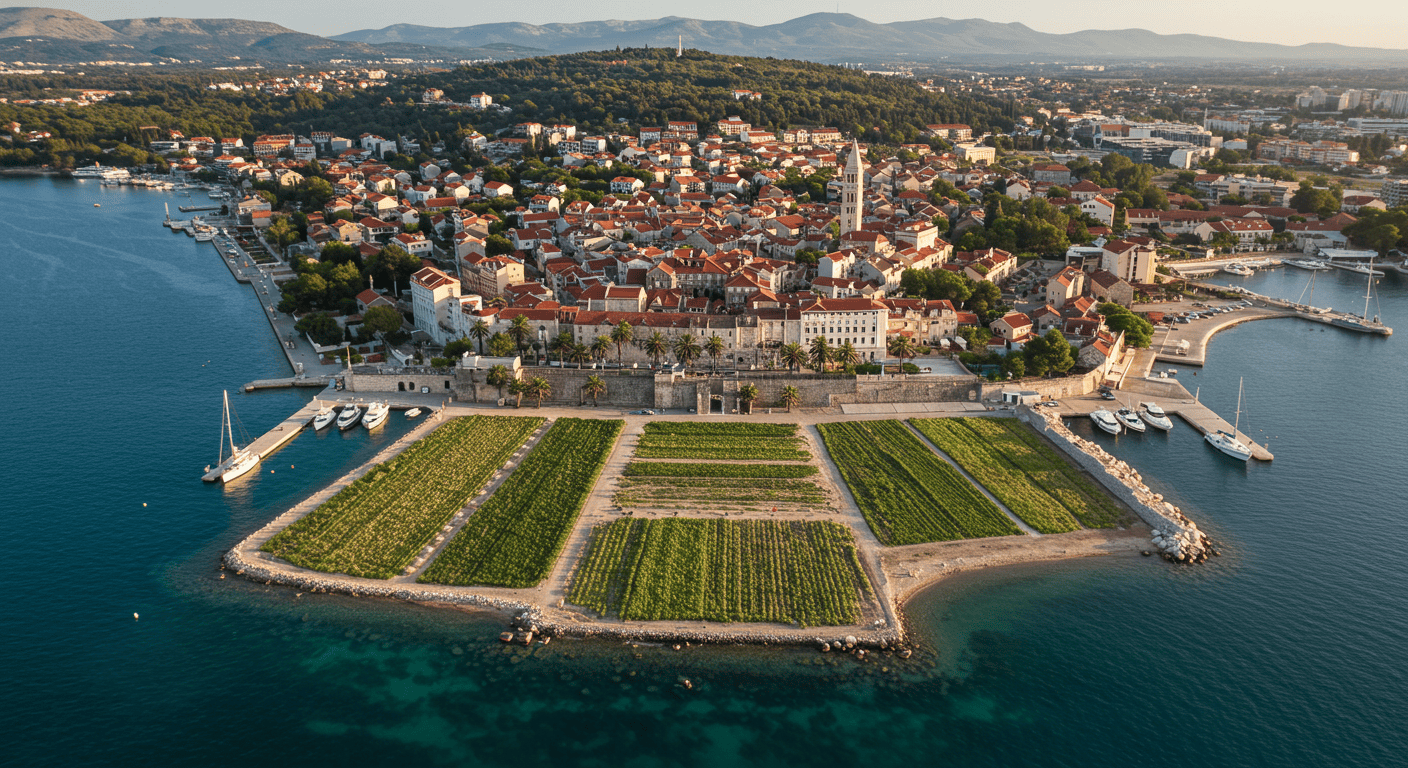
Grad Split sits on a peninsula jutting into the Adriatic, with the Dalmatian mountains rising dramatically to the north and the island-scattered sea stretching south. The city is the second largest in Croatia, but the part that matters most – the historic Grad Split, the old town within and immediately around the walls of Diocletian’s Palace – is compact enough to walk across in fifteen minutes, yet complex enough to spend days exploring without fully mapping it.
The palace itself, built by the Roman Emperor Diocletian as his retirement residence around the third and fourth century AD, is not a museum piece in the conventional sense. People live in it. Apartments occupy towers. Cafés fill the peristyle courtyard. Laundry occasionally hangs from windows between ancient stonework. This layering of civilisations – Roman, medieval Venetian, Ottoman-influenced, Yugoslav modernist, twenty-first century Croatian – gives Grad Split a texture that no amount of heritage tourism management could artificially produce. Beyond the palace walls, the Meštrović Gallery houses the magnificent work of Croatia’s greatest sculptor in a purpose-built villa that is itself worth the visit. The waterfront Riva promenade runs along the southern face of the palace, offering the kind of evening passeggiata atmosphere that the Italians like to claim as exclusively theirs.
Inland from the city, the Dalmatian hinterland opens into a landscape of karst limestone hills, vineyards and villages where the pace of life suggests that urgency has never really taken hold. The Cetina river gorge, the Sinj plateau and the Mosor mountain range all lie within easy driving distance and offer a counterpoint to the coast that many visitors completely miss.
Things to Do: Culture, Islands and the Inevitable Sunset That Changes Your Plans
The Roman remains alone would justify a visit. Diocletian’s Palace is a UNESCO World Heritage Site, but the phrase doesn’t quite prepare you for the experience of standing in a third-century vestibule while a busker plays a cover version of something contemporary in the echoing space above. The Cathedral of Saint Domnius – converted from Diocletian’s own mausoleum, which is either ironic or poetically just, depending on your view of Roman emperors – contains a remarkable collection of medieval art and a bell tower worth climbing for the views.
Day trips from Grad Split are, in the most literal sense, outstanding. The island of Brač, twenty minutes by fast ferry, is home to the famous Zlatni Rat beach – a shingle spit that shifts shape with the current – and the white limestone quarried for, among other things, parts of the White House in Washington. Hvar, an hour by catamaran, offers the full range from lavender fields and medieval forts to cocktail bars where the clientele wear sunglasses after dark. Vis – further out, less visited, notably more itself – rewards those willing to make the longer crossing with unspoiled coves, exceptional wine and a kind of quietness that feels increasingly rare on the Adriatic. Closer to home, the Krka National Park, roughly an hour’s drive north, offers a series of waterfalls in a karst river canyon that justify every photograph taken of them.
Adventure on the Water and the Mountain: The Active Side of the Dalmatian Coast
The Adriatic around Split is warm, clear and entirely suited to anyone who believes that water sports are best enjoyed with visibility measured in metres rather than centimetres. Sea kayaking from the city’s beaches out to the smaller islands is genuinely accessible for mixed-ability groups, with guided half-day trips operating throughout the season. Scuba diving in the waters around the islands reveals Roman amphora fields, submerged walls and a marine life that has benefitted from Croatia’s relatively responsible fishing regulations.
Sailing, naturally, is the great tradition. Charter a skippered yacht from Split’s ACI Marina and the entire Dalmatian archipelago becomes negotiable – a week of island hopping with a professional at the helm who knows where the anchorages are that don’t appear in the guidebooks. For the less nautically inclined, kite surfing conditions are excellent in certain parts of the coast, particularly where the Bura wind creates the technical conditions that enthusiasts travel across Europe to find.
On land, the mountains provide. Mosor, rising directly behind the city to over 1,300 metres, offers hiking trails with views that require no embellishment. Mountain biking routes through the karst hinterland are increasingly well-marked and range from the leisurely to the genuinely demanding. Rock climbing on the limestone outcrops around Omiš, a small town south of Split at the mouth of the Cetina river gorge, is a specialist pursuit that’s developed a committed following among European climbers who appreciate the quality of the routes and the temperature of the sea at the end of the day.
Grad Split with Children: Why This Ancient City Works for Modern Families
It is one of those pleasant surprises that a city built inside a Roman emperor’s palace turns out to be exceptionally good for children. The car-free alleyways create a natural safety net. The abundance of ice cream – sladoled, consumed without apology at any hour – provides motivation for cultural engagement. The palace becomes, with minimal adult narration, an extremely convincing ancient fortress. The beaches are accessible, the sea is calm within most of the sheltered coves, and the general Croatian attitude toward children in restaurants is warm in a way that feels genuine rather than performed.
The logistical advantage of a luxury villa with a private pool in Grad Split cannot be overstated for families. The ability to return from a morning of sightseeing to a private outdoor space – a pool, shaded terrace, dining area that belongs entirely to your group – removes the negotiation and compromise that hotel living imposes on family dynamics. Younger children can nap on their own schedule. Teenagers can decompress from family togetherness in their own wing. Parents can have a glass of wine in something approaching silence while the sun sets over the Adriatic. Extraordinary how much easier everything is when you have space.
History and Culture: Living Inside 1,700 Years of Civilisation
The history of Grad Split is not something that has to be sought out and explained by a guide – it is simply present, in the fabric of every building, the curve of every alley, the mismatched layers of stonework that reveal three or four different centuries in a single wall. Diocletian’s Palace was begun around 293 AD and completed around 305 AD, when the emperor retired here from Rome with what appears to have been a genuine preference for cabbage gardening over imperial politics. The palace complex covered some 30,000 square metres and housed not just the emperor but his court, his guards and the infrastructure of late imperial life.
When Diocletian died, the palace was used intermittently before medieval refugees, fleeing Slavic invasions elsewhere in Dalmatia, moved in permanently and simply never left. The cathedral was converted from the emperor’s tomb – which even by medieval standards was a bold repurposing decision. Venetian rule from the fifteenth century added Gothic windows and loggia to the Roman substructure. The twentieth century added concrete apartment blocks immediately outside the walls, which are best appreciated as context rather than architecture.
The Split Summer Festival, held annually from mid-July through mid-August, brings opera, theatre and classical concerts into the palace spaces with an atmosphere that is genuinely unlike any other festival setting in Europe. Ivan Meštrović, Croatia’s great sculptor of the early twentieth century, left a remarkable concentration of his work in the city – the gallery in his former villa and the Kaštelet chapel, which contains his extraordinary wooden reliefs of the life of Christ, are among the finest artistic experiences Croatia offers.
Shopping in Split: Beyond the Lavender Sachets (Though the Lavender Is Very Good)
The souvenir economy of any Adriatic destination runs heavily on lavender – and to be fair, the lavender from Hvar in particular is genuinely excellent, pressed into oils, sachets and soaps with legitimate quality control. But Grad Split’s shopping scene has more texture than the harbour stalls suggest. The Pazar market is the obvious starting point for edible discoveries: local olive oil, fig jam, artisanal honey, Dalmatian pršut (the air-dried ham that competes with Italian prosciutto with rather more confidence than the Croatians publicly admit).
Within the palace walls and in the streets of the old town, independent boutiques have emerged alongside the inevitable souvenir shops selling the same ceramic tiles with the same Dalmatian checker pattern. Croatian lace – particularly from the island of Pag, where it is a UNESCO-recognised craft tradition – is the kind of acquisition that rewards attention. Tie-lovers should know that the necktie has documented Croatian origins, a historical detail that Croatian menswear boutiques have been appropriately capitalising on for years. Wine, inevitably, is among the best things to bring home: Plavac Mali from the Pelješac peninsula or Pošip white from Korčula will survive the journey and improve any dinner party well beyond what a box of Croatian chocolates would achieve.
The Practicalities: What to Know Before You Go
Croatia adopted the Euro in January 2023, which simplifies things considerably for travellers from the Eurozone and removes the mental arithmetic burden for everyone else. Credit cards are widely accepted in Split’s restaurants, shops and hotels, though smaller konobas and market stalls prefer cash, and it’s worth carrying some for exactly these moments. Croatia joined the Schengen Area at the same time as the Euro adoption, streamlining border crossings from other Schengen member states.
The official language is Croatian – a South Slavic language that is beautiful to listen to and genuinely difficult to learn, though English is spoken with impressive fluency throughout the tourist-facing hospitality industry. Making even a minimal effort with Croatian greetings (dobar dan for good day, hvala for thank you) is received with visible warmth. Tipping is not obligatory but is appreciated; rounding up a restaurant bill or leaving ten percent for good service is the general practice and is never expected to the degree it is in the United States.
The best time to visit Grad Split for a luxury holiday depends on your tolerance for crowds and heat. July and August are peak season – brilliant weather, full animation, and the sense that roughly half of Northern Europe has had the same idea simultaneously. June and September are often considered the optimal months: the sea is warm, the restaurants have availability, the light in early autumn is extraordinary and the crowds have thinned to a manageable level. May and October are worth serious consideration for cultural visits, hiking and food-focused travel, though some island services run reduced schedules outside high season.
Safety is not a significant concern. Split is a well-functioning European city with a low serious crime rate. The usual precautions around pickpockets in crowded tourist areas apply. The main practical challenge in summer is heat – midday temperatures in July and August regularly exceed 35 degrees Celsius, and the limestone of the palace complex retains warmth in a way that makes afternoon sightseeing optimistic rather than wise. Mornings and evenings are when the city belongs to itself.
Why a Private Villa in Grad Split Changes the Entire Holiday
There is a version of Split that involves a hotel room on a busy street, dinner at a restaurant table jammed between two other parties, and the particular morning experience of fighting for a sun lounger before 8am. This guide is not about that version. The private luxury villa approach to Grad Split – which encompasses properties both within the wider Split area and in the hills and coastal villages immediately surrounding the city – represents something fundamentally different, and the difference is not merely one of budget.
Space is the first thing. A villa that sleeps eight or ten people gives each guest a relationship to the property that no hotel room replicates – a private terrace, a shared pool that belongs only to your group, a kitchen for the mornings when breakfast is a leisurely domestic pleasure rather than a buffet negotiation. Families find that this space resolves the friction points of shared holidays in a way that proximity in a hotel never does. Groups of friends discover that having a home base – with a long outdoor table, a grill, wine from the local market cooling in the fridge – gives the holiday a centre of gravity around which everything else organises itself.
The privacy is particularly significant for wellness-focused travellers. A villa with a private pool, a garden, perhaps a sauna or an outdoor shower with a sea view, allows a genuinely restorative rhythm: a morning swim, a slow breakfast, a day that you structure entirely according to your own preferences. No check-out time pressuring departure. No common areas requiring the social performance that hotels demand.
For remote workers, the better villa properties in the Split area now offer reliable high-speed connectivity – fibre broadband has reached even many rural Croatian properties, and some premium villas offer Starlink backup for clients who genuinely cannot afford a dropped connection. The combination of a dedicated workspace with that view of the Adriatic and the knowledge that the pool is waiting after the afternoon call ends is, objectively, a superior working environment to any office.
Many villa properties in the area come with concierge services – pre-stocking the fridge before arrival, arranging private boats, booking the restaurants that require forward planning, organising guided excursions tailored to the group. The staff-to-guest ratio in a good villa frequently exceeds what a five-star hotel provides, delivered with the warmth that comes from a smaller, more personal arrangement.
Explore our collection of luxury villas in Grad Split with private pool and find the property that fits how you actually want to spend your time here.
More Grad Split Travel Guides
What is the best time to visit Grad Split?
June and September represent the sweet spot for most travellers – the Adriatic is warm enough for swimming, the restaurants and beaches are lively without being overwhelmed, and the quality of light in early and late summer is exceptional. July and August offer the fullest programme of events, including the Split Summer Festival, but come with peak-season crowds and temperatures that regularly exceed 35°C. May and October suit cultural and hiking-focused visits well, with quieter streets and mild temperatures, though some island ferry services run reduced schedules outside the main season.
How do I get to Grad Split?
Split Airport (SPU) is the main entry point, located around 25 kilometres northwest of the city near Kaštela. It operates direct flights from many European cities throughout the summer season, including London, Amsterdam, Frankfurt and Vienna, with flight times from the UK of approximately two and a half hours. A pre-booked private transfer from the airport to the city takes 30 to 40 minutes. Travellers from elsewhere in Croatia can also reach Split by coastal ferry, with services from Dubrovnik and Zadar, or by bus from Zagreb. Once in Grad Split, the historic old town is pedestrianised and best explored on foot.
Is Grad Split good for families?
Genuinely well-suited, yes. The car-free alleyways of the old town create an environment where children can explore without constant traffic anxiety. The beaches are accessible and the sea generally calm within sheltered coves. Croatian restaurants are relaxed and welcoming toward children in a way that feels authentic rather than performative. The practical advantage of renting a private villa with a pool rather than a hotel is significant for families – the space, privacy and independence resolve many of the friction points of travelling with children across different ages. Day trips to the islands, particularly Brač and its beaches, are manageable with younger children and rewarding for older ones.
Why rent a luxury villa in Grad Split?
The private villa model solves problems that hotels create. You get genuine space – your own pool, your own terrace, your own kitchen for the mornings you don’t want to go out – without the compromises of shared facilities and stranger-adjacent schedules. The staff-to-guest ratio in a premium villa often exceeds what a five-star hotel provides, but with the warmth and attention of a more personal arrangement. Pre-arrival concierge services can stock the villa, book restaurants and arrange boats before you arrive, so your holiday begins the moment you walk through the door. For families and groups especially, the economics of a villa frequently compare favourably with booking multiple hotel rooms of equivalent quality.
Are there private villas in Grad Split suitable for large groups or multi-generational families?
Yes – the villa inventory in the wider Split area includes properties sleeping anywhere from six to sixteen or more guests, with configurations suited to multi-generational travel: separate wings or annexes for privacy between generations, multiple bedroom suites with en-suite bathrooms, large open-plan living and dining spaces for shared meals, and private pools large enough to accommodate the whole group without anyone negotiating for space. Some premium properties offer additional staff – a chef, housekeeper and private driver – which transforms the logistics of a large family holiday considerably. Booking well in advance for peak summer dates is strongly recommended for the larger properties.
Can I find a luxury villa in Grad Split with good internet for remote working?
Increasingly yes. Fibre broadband has reached a significant proportion of Croatian properties, including many villa rentals in the Split area, and connectivity standards have improved markedly in recent years. Premium villas often specify download speeds and some offer Starlink satellite backup for guests who require consistently reliable connectivity regardless of local infrastructure. When enquiring about a specific property, it’s worth asking directly about internet speed and whether a dedicated workspace or study is available. Many guests find that the combination of reliable connectivity and a private pool within reach of the Adriatic makes for a working environment that raises no complaints whatsoever.
What makes Grad Split a good destination for a wellness retreat?
The Dalmatian coast offers the building blocks of genuine restoration: warm, clean sea swimming from the villa or a short drive away, mountain hiking on Mosor with views that provide immediate perspective, a Mediterranean diet built on olive oil, fresh fish and vegetables that is therapeutic without requiring any announcement. The pace of life in Split moves by its own logic, and that logic is not urgent. A private villa with a pool, shaded terrace and perhaps an outdoor sauna or gym area allows a wellness-focused programme to be built entirely around your own preferences and schedule. Local day spas in Split offer massage and treatment services, and many villa concierges can arrange in-villa therapists for guests who prefer to keep wellness within the property.

