Megève Travel Guide: Where to Stay, Eat & Explore in Luxury
It is half past eight on a Tuesday morning in February. The village square is dusted with last night’s snow, the horse-drawn carriage is making its first loop of the day, and a woman in an impeccably cut ski jacket is drinking a café crème outside a bakery with the unhurried air of someone who has nowhere to be until eleven. She probably does have somewhere to be at eleven. She simply doesn’t look it. This is Megève’s particular trick: a resort that has been quietly glamorous since the 1920s, that has hosted the Rothschilds, the film stars and half of Geneva’s private banking sector, and yet somehow wears all of that history with the ease of a cashmere turtleneck. Nothing is shouted. Everything is felt.
Megève is not the Alps for everyone, and it knows it. It is the Alps for families who want privacy and space – a chalet the size of a small hotel, a hot tub steaming above the treeline, children building snowmen in their own garden rather than dodging strangers on a hotel terrace. It is the Alps for couples marking a significant anniversary, for whom the idea of room service and a shared spa pool is fine but a private cinema room and a personal chef is considerably better. It is the Alps for groups of friends in their late thirties who have graduated beyond hostel bunks and lift queues and would now like someone else to handle the fondue. And increasingly, it is the Alps for those who work remotely and have concluded, sensibly, that fast Wi-Fi tastes better with a view of Mont Blanc. Whether you are here for powder, peace, or a table at a three-Michelin-starred restaurant – and ideally all three – Megève has a very specific, very considered answer to what a luxury holiday Megève-style actually means.
Getting Here Is Part of the Experience (If You Do It Right)
The nearest major airport is Geneva, which sits approximately 80 kilometres from Megève and on a clear run takes around an hour by road. Geneva has direct flights from virtually every significant city in Europe, and the transfer corridor between the airport and the resort is, in high season, something of a procession – chauffeur-driven SUVs threading through the Arve valley with skis loaded and passengers enjoying what is frequently described as the world’s most scenic airport transfer. It is a fair description. The moment the road begins to climb and the valley falls away behind you, something in the nervous system adjusts.
Lyon Saint-Exupéry is the alternative for those arriving from further south or connecting from certain international routes – it is roughly 150 kilometres and closer to two hours by road, though helicopter transfers from Lyon are available for those who have reached the point in their lives where sitting in traffic feels like a personal affront. Grenoble Alpes-Isère is a third option, popular with private jet travellers given its runway capacity and proximity to the mountain resorts.
Within Megève itself, the village is compact and largely pedestrianised in its historic core. Most luxury villa rentals come with access to concierge services who will arrange everything from ski hire delivery to restaurant reservations, meaning a car is often unnecessary for the resort itself. If you are exploring beyond the village – the Aravis range, the Contamines valley, the lac de la Girotte – then a rental car or private driver makes life considerably more fluid. Taxis are available but best booked in advance during peak season, when demand has a habit of outrunning supply with the kind of timing that always seems personal.
Where to Eat in Megève: From Tasting Menus to Table d’Hôte
Fine Dining
The most serious restaurant in Megève – and by most measures one of the most serious restaurants in France – is Flocons de Sel, Emmanuel and Kristine Renaut’s three-Michelin-star Relais & Châteaux address on the Route du Leutaz. Renaut’s cooking is a precise and deeply felt interpretation of the mountain larder: lake fish, wild mushrooms, high-altitude herbs, berries from the surrounding Haute-Savoie terrain – ingredients that most chefs would consider supporting cast elevated here to lead roles. The restaurant is reopening in December 2025 following a year-long renovation, which means the 2025-26 ski season will be the first chance to experience whatever Renaut has been quietly perfecting during the hiatus. Book early. Book very early. This is where private bankers from Geneva entertain clients over tasting menus that run to multiple courses and leave you wondering why you have been eating anywhere else.
La Table de l’Alpaga, housed within the five-star L’Alpaga hotel, holds its own Michelin star and deserves its own paragraph. Chef Alexandre Baule’s kitchen celebrates vegetables and alpine botanicals with a rigour and creativity that makes it feel less like a hotel restaurant and more like a destination in its own right. The six- and eight-course tasting menus unfold beneath warm wood beams with views of the Mont Blanc massif as backdrop – a combination that ought to be clichéd and somehow is not.
At the Four Seasons Hotel Megève, La Dame de Pic – Le 1920 brings Anne-Sophie Pic’s formidable reputation to the mountains. The world’s most decorated Michelin-starred female chef has built a menu around Savoyard produce shot through with her signature unexpected flavour combinations – the kind of pairings that read oddly on the menu and make complete sense on the palate. Lunch on the terrace, with the panorama doing what panoramas in Megève tend to do, is one of the resort’s genuine pleasures.
Where the Locals Eat
Not every meal in Megève needs to be a production. The Beef Lodge at Lodge Park Hotel occupies a different register entirely – and a rather magnificent one. The room is all deep hues, patinated leather, majestic trophies and subdued lighting, warmed by a large fireplace that makes the concept of outside feel theoretical. Chef Christophe Côte selects his cuts with what can only be described as devotion: T-bone, tomahawk, picanha flambéed in whisky, matured fillets from the best farms in Finland, Scotland, Denmark and France. Each piece of meat arrives having spent time on an Argentine barbecue and the results are exactly what you want from a steak restaurant in the Alps – unapologetic, impeccably sourced, and deeply satisfying.
For something more village-woven, Le Vieux Megève in the centre of town has been a local institution for over 45 years. The Friday evening atmosphere in particular is the kind of thing guidebooks mean when they say “authentic” – which is to say it actually is, rather than having been constructed to appear so. Arrive without a reservation on a Friday in peak season and you will learn something about optimism.
Hidden Gems Worth Seeking Out
The mountain restaurants – the refuges and ferme-auberges accessible only on skis or on foot – are where Megève reveals a less polished but equally rewarding face. A long lunch at altitude, with the slopes emptying around you and a carafe of Savoie white on the table, is one of those experiences that doesn’t photograph especially well but lives in the memory with unusual persistence. Ask your villa concierge which refuge currently has the best reputation for tartiflette – this intelligence changes seasonally and is worth having. The village also has a covered market where local producers sell cheeses, charcuterie and honey of the kind that makes you briefly consider whether life in the Haute-Savoie might actually be the answer to several unrelated problems.
The Lay of the Land: Megève and Its Surroundings
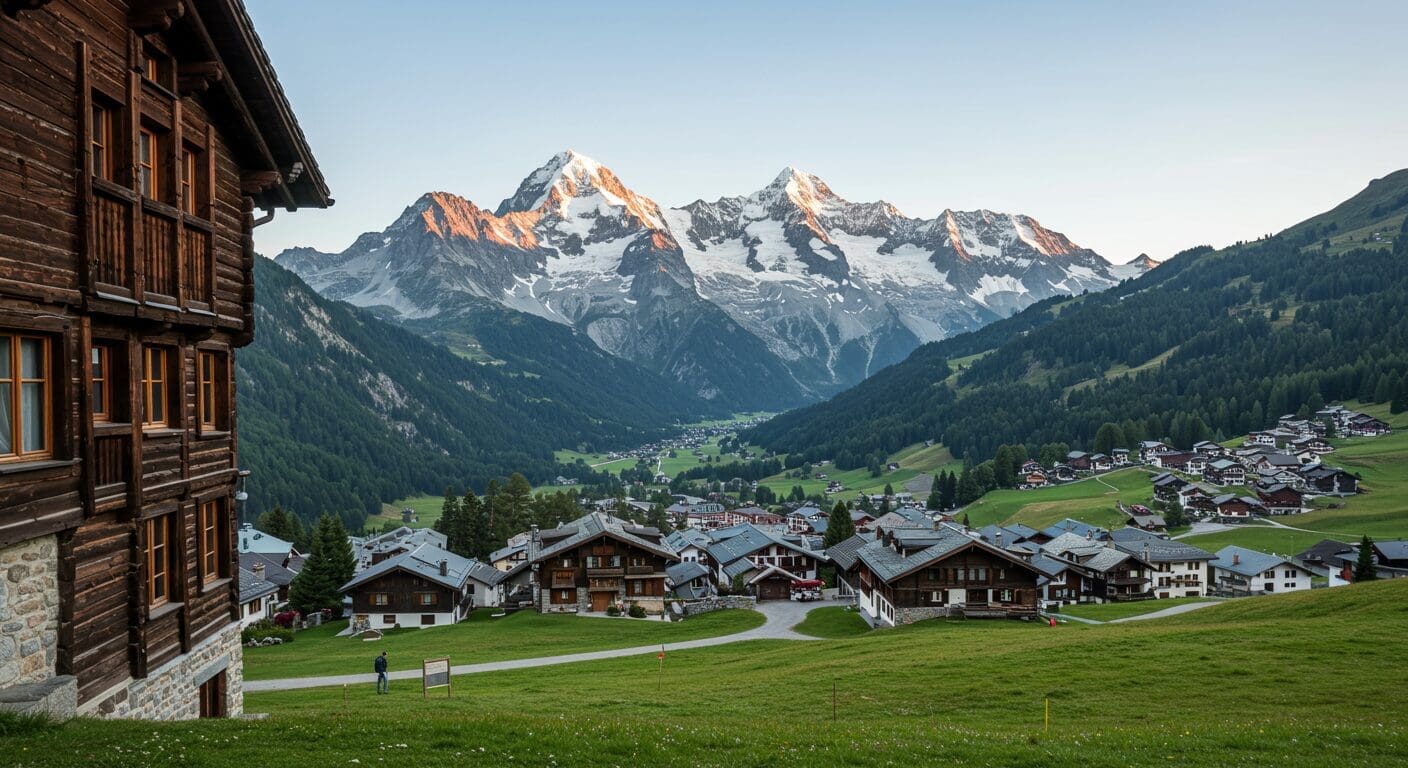
Megève sits at 1,113 metres in the Haute-Savoie department of the Auvergne-Rhône-Alpes region, cradled by three massifs – Rochebrune, Mont d’Arbois and Le Jaillet – that together form the Évasion Mont Blanc ski area, one of the largest interconnected ski domains in the Alps. The village itself occupies a wide, sun-facing plateau that gives it a quality of light unusual among mountain resorts – brighter, warmer, more generous than the deep-shadowed valleys you find elsewhere in the French Alps. In winter this means excellent snow conditions combined with reliable sunshine. In summer it means something else entirely.
The geography here is gentler than Chamonix’s dramatic severity, more varied than Val d’Isère’s relentlessly high terrain. The landscape is a patchwork of forest, open pasture and traditional chalets – the kind of scenery that makes sense at all speeds, whether you are navigating it on skis, on foot, or from the window of a gondola. The valley below connects to the broader Arve river system, and the proximity to the Italian border gives the surrounding region a culinary and cultural complexity that rewards exploration beyond the resort itself.
The Contamines-Montjoie valley to the south is worth a day trip for its relative tranquillity and the long hiking trails that reach into the Mont Blanc massif. The lac de la Girotte, accessible by cable car and on foot, is one of the more spectacular high-altitude lakes in the region. And the town of Sallanches in the valley below offers a useful dose of unvarnished local life for anyone who has been in the resort long enough to start finding the horse-drawn carriages a touch theatrical.
What to Do in Megève: The Full Picture
Skiing is the obvious answer and the dominant one for half the year. The Évasion Mont Blanc domain covers around 445 kilometres of marked runs across five resorts – Megève, Saint-Gervais, Combloux, La Giettaz and Les Contamines – a spread that offers something for every level of skier without the punishing uplift queues of larger, more crowded domains. The terrain suits intermediate skiers particularly well, which is one reason Megève has always been popular with families and mixed-ability groups. Advanced skiers will find steeper challenges on the Rochebrune and Mont d’Arbois sectors, and there is off-piste terrain for those with a guide and a reasonable sense of self-preservation.
Ice skating on the outdoor rink in the village centre is one of those activities that sounds minor and turns out to be genuinely charming – particularly on a clear evening when the mountains are lit and the village is doing its thing. There are snowshoe trails for those who prefer their winter exercise without the commitment of ski boots. Dog sledding is available for families who have run out of other ways to delight their children. Hot air balloon flights over the valley offer a perspective on the landscape that no gondola can match.
In summer, Megève transforms into a walking and cycling destination of genuine quality. The trail network extends across all three massifs, ranging from gentle valley walks to serious multi-day routes. Mountain biking – including electric-assisted options for those who are sensible about their limitations – has developed substantially over the past decade, with dedicated trails and hire facilities in the village. Golf courses occupy the sunlit plateau below the village. Tennis, horse riding, paragliding and a swimming lake complete a summer programme that makes the question of whether Megève is worth visiting without snow a very easy one to answer.
Adventure Sports: Where the Mountain Bares Its Teeth
For those who find groomed pistes a little too civilised, Megève and its surrounding mountains offer a full spectrum of alternatives. Off-piste skiing and ski touring are the natural entry points – the backcountry terrain around the Mont d’Arbois and the Aravis range provides serious challenge for experienced alpinists, and a number of specialist guides operate out of the resort offering everything from half-day powder experiences to multi-day ski touring itineraries. The Haute Route – the classic ski mountaineering traverse between Chamonix and Zermatt – can be accessed from the broader region for those with the fitness and ambition.
Ice climbing is possible at several frozen waterfalls in the surrounding valleys during deep winter, and the nearby Gorges de l’Arly provide a dramatic setting for canyon walking in the shoulder seasons. Via ferrata routes on the Aravis range offer a summer adrenaline option that requires no specialist training – just a head for heights and a willingness to trust a fixed steel cable over a void that your brain will insist is larger than it is.
Paragliding from the upper slopes, with the Mont Blanc massif as backdrop and the valley 1,000 metres below your dangling feet, is the kind of experience that rearranges your relationship with everyday problems. Tandem flights are available for beginners. River kayaking and white-water rafting on the Arve and its tributaries fill out the summer adventure calendar for those who have already exhausted the hiking trails and are looking for something with more velocity.
Megève with Children: Better Than You’d Expect, and You Expected It to Be Good
Megève has been attracting families for decades and shows it. The ski school system here is extensive and well-regarded – the ESF (École du Ski Français) and several independent alternatives operate children’s programmes from age three upwards, with dedicated beginner areas away from the main pistes that make the early learning process considerably less traumatic for children and parents alike. The resort’s relatively gentle terrain means that young skiers progress quickly without the intimidation factor of steeper resorts.
Beyond skiing, the resort has child-focused activities that go beyond the token gesture. There are sledging tracks, snowshoeing routes designed for small legs, and a skating rink that tends to become an informal social hub for families by mid-morning. In summer the range expands further: the swimming lake at the foot of the gondola, forest adventure courses, donkey trekking (which is exactly as delightful as it sounds), and nature discovery trails that give older children something to actually look at rather than just walk past.
The villa advantage for families is not a small thing. Travelling with children in a luxury hotel requires a level of constant vigilance about noise levels and shared spaces that is frankly exhausting. A private chalet with its own garden, hot tub and living space returns something important to family holidays: the freedom to be completely yourselves. Dinner at whatever time suits the children. Breakfast in ski boots. Wet gloves drying on every available surface without anyone minding. There is no front desk experience that replicates this.
Megève’s History: The Resort That Aristocracy Built
Most Alpine resorts grew organically from farming communities over centuries. Megève was, to a large degree, invented – and the inventor was the Baroness Noémie de Rothschild, who in 1916 set out to create a French alternative to the fashionable Swiss resorts where her family had been holidaying. She wanted something that felt unmistakably French, something with character and style, something that would attract the right sort of people. She succeeded rather comprehensively.
The resort that grew up around her ambitions – the Palace de Megève, the timber-framed chalets, the cobbled village centre – set the template for Alpine luxury that still holds today. By the 1930s Megève was a fixture in the social calendar of European aristocracy and the international wealthy. Coco Chanel was a regular. The Duke and Duchess of Windsor came. The film stars followed. What is remarkable is how much of the original atmosphere survives – the village has expanded, modernised and adapted, but the core remains intact: a medieval church at its centre, a square designed for lingering, chalets built in the Savoyard vernacular that have aged with considerable grace.
The annual calendar includes a summer jazz festival, equestrian events on the plateau, and a series of cultural exhibitions that make use of the various gallery and museum spaces in the village. The Musée du Vieux Megève offers a thoughtful account of the resort’s history and the mountain communities that predated it – worth an hour of anyone’s afternoon, particularly on the kind of grey mid-week day that the mountains occasionally produce to remind you that they remain in charge.
Shopping in Megève: Purposeful Extravagance
Megève’s shopping is not aggressive. It does not perform. The boutiques along the Rue du Général Miribel and the surrounding pedestrian streets house the kind of names you expect at this altitude – Hermès, Gucci, Cartier have all maintained presences here – alongside independent specialists in ski equipment, Alpine fashion and local produce who carry genuine expertise and no particular interest in selling you something you don’t need.
The local food shopping is worth taking seriously. Fromageries stocking Beaufort, Abondance and Reblochon in various stages of maturity are the natural first stop for anyone provisioning a chalet. The Beaufort in particular – the great hard mountain cheese made from the milk of Tarentaise and Tarine cows grazed at altitude – is one of the finest things produced in this part of France, and buying it here, where it was made, from someone who can tell you which valley and which altitude, is a different experience from buying it elsewhere.
Savoyard wines are an underrated souvenir. The whites from Chignin-Bergeron, the sparkling Ayze, the light Gamay-based reds from Chautagne – none of them travel extensively beyond the region, which makes them worth bringing home in quantities that test the airline’s baggage policy. Local charcuterie, particularly the diots (pork sausages traditionally cooked in white wine) and the various cured meats of the region, complete what is essentially a very serious picnic shopping list.
Practical Matters: What to Know Before You Arrive
France uses the euro. Credit cards are accepted almost everywhere, though smaller producers at the village market will occasionally remind you that cash remains a valid and respected form of currency. Tipping is not mandatory in French restaurants – service is included in the bill by law – but leaving something for genuinely excellent service is appropriate and appreciated. The standard is around five to ten percent for exceptional meals; rounding up the bill at casual restaurants is sufficient.
The language is French, and Megève’s staff are well-accustomed to English-speaking guests, meaning the linguistic barrier is minimal in the resort itself. A few words of French go a long way in terms of warmth, however – the “bonjour” on entering a shop, the “merci” at the end of a transaction – these small courtesies are not optional in French culture in the way they might be elsewhere, and skipping them is the kind of thing that is noticed even when nothing is said.
The best time to visit for skiing is mid-January through mid-March, when the snowpack is typically at its deepest and the resort is operating at full capacity without the holiday crowds of the Christmas and February half-term periods. Early December and late March can offer excellent value and uncrowded conditions respectively – the skiing is less reliable at the margins of the season, but the resort’s relatively low altitude means the groomers work harder here to compensate. Summer visits peak in July and August, when the hiking and cycling conditions are at their best and the village has an unhurried quality that winter cannot quite replicate. The shoulder seasons – June and October – are quiet to the point of closed, and best avoided unless solitude is the explicit aim.
Why a Private Luxury Villa in Megève Is Simply the Better Choice
Hotels in Megève are, in the main, excellent. The Four Seasons and L’Alpaga are doing what they do with considerable skill, and nobody will have a bad stay at either. But the hotel model – however well executed – involves a series of negotiations with shared space that becomes, after a few days, quietly wearing. The lobby that is never entirely empty. The spa booking that requires planning two days in advance. The breakfast room where you make eye contact with strangers over your croissant.
A private villa in Megève removes all of this. The space is yours. The hot tub on the terrace is yours. The kitchen is yours – or if you have arranged a private chef, the kitchen belongs to someone who is using it entirely on your behalf. For families, this represents the difference between a holiday you managed and a holiday you actually took. For groups of friends, it means the long table, the shared bottles, the late night conversations by a wood fire that define the best kind of group travel. For couples, it means privacy of the particular kind that five-star hotels – for all their merits – cannot fully manufacture.
The practicalities matter too. Premium villas in Megève now typically come with fast fibre broadband or Starlink connectivity, meaning remote workers can be genuinely productive during the morning hours before heading to the slopes. Wellness-focused guests will find that the better properties include sauna and steam facilities, home gyms, treatment rooms and in some cases outdoor heated pools – which, in the context of a snow-covered mountain, is an experience that earns its own separate conversation. Concierge services can arrange ski instructors, mountain guides, restaurant bookings, helicopter transfers and grocery deliveries before arrival, meaning the administrative burden of a complex trip largely evaporates.
Megève rewards those who do it properly. Find your luxury holiday villas in Megève at Excellence Luxury Villas and let the mountain do the rest.
More Megève Travel Guides
What is the best time to visit Megève?
For skiing, mid-January through mid-March offers the best snow conditions and the fullest resort operation. The Christmas period and February half-term are busy and expensive – book well in advance or consider the slightly quieter weeks around them. Early December and late March can offer good skiing with fewer crowds. Summer peaks in July and August for hiking and cycling. The shoulder months of June and October are largely quiet and some facilities will be closed.
How do I get to Megève?
Geneva Airport is the closest international hub, approximately 80 kilometres from Megève and around one hour by road in normal conditions. Direct flights to Geneva serve most major European cities and many long-haul routes. Lyon Saint-Exupéry Airport is a secondary option, approximately 150 kilometres away. Grenoble Alpes-Isère Airport is popular for private jet arrivals. Helicopter transfers from Geneva and Lyon are available for those who prefer not to spend the journey looking at the back of a motorway.
Is Megève good for families?
Megève is exceptionally well-suited to families. The ski terrain is gentler than many comparable resorts, making it ideal for children learning to ski and for mixed-ability groups. The ESF and independent ski schools run children’s programmes from age three. Beyond skiing, the resort offers sledging, skating, dog sledding, snowshoeing and summer activities including a swimming lake, adventure courses and donkey trekking. A private villa rental – with its own outdoor space, hot tub and shared living areas – transforms the experience for families by removing the constraints of hotel life entirely.
Why rent a luxury villa in Megève?
A private villa gives you complete freedom from the shared-space compromises of hotel life – your own outdoor areas, your own schedule, your own kitchen or private chef, and a staff-to-guest ratio that no hotel can match. For families it means space for children without the constant management of noise and public areas. For groups it means the kind of communal living – long dinners, late evenings, shared routines – that makes group travel genuinely memorable. For couples it means real privacy. Many properties also include saunas, hot tubs, home gyms and high-speed connectivity, making them suitable for both deep relaxation and productive remote working.
Are there private villas in Megève suitable for large groups or multi-generational families?
Yes – the villa stock in Megève includes a significant number of large properties designed with exactly this use in mind. Many chalet-style villas accommodate eight to sixteen guests across multiple bedrooms and separate living areas, with private hot tubs, cinema rooms and outdoor terraces that allow different generations or friend groups to have their own space within the same property. Dedicated concierge and chalet staff services can be arranged to manage catering, ski equipment hire and childcare, making large group stays logistically straightforward.
Can I find a luxury villa in Megève with good internet for remote working?
Increasingly yes. Premium villa rentals in Megève now routinely specify high-speed fibre broadband, and Starlink satellite connectivity is available in a number of properties where traditional infrastructure is less reliable. If reliable connectivity for video calls and large file transfers is a priority, confirm the specific provision with the property before booking – Excellence Luxury Villas can advise on which properties offer verified high-speed connections suitable for professional remote working.
What makes Megève a good destination for a wellness retreat?
The combination of clean mountain air, extensive outdoor activity and the particular quality of Megève’s light makes it a natural environment for physical and mental reset. The hiking and ski touring networks provide serious cardiovascular exercise at altitude. Several hotels and independent practitioners offer spa treatments, massage therapy and guided wellness programmes. Private villa rentals with saunas, steam rooms, outdoor heated pools and home gyms allow guests to build a personalised wellness routine without sharing facilities. The pace of the village itself – unhurried, beautiful, with excellent food – does much of the heavy lifting without any intervention required.