
Sesimbra Travel Guide: Where to Stay, Eat & Explore in Luxury
Most people who visit Sesimbra spend their first morning photographing the castle and their last morning buying dried fish at the market and assume they’ve covered it. They haven’t. The thing almost every travel piece misses about this small fishing town on Portugal’s Arrábida coast is that it operates on two distinct registers simultaneously: there’s the version the day-trippers from Lisbon see – cheerful, photogenic, pleasantly fishy – and then there’s the slower, stranger, more rewarding version that reveals itself only when you stay. The evening light on the castle walls at around seven o’clock, when the coach parties have gone and the fishermen are mending nets below, and the whole place exhales. That version. That’s the one worth coming for.
Sesimbra suits a particular kind of traveller rather well – and a surprisingly wide range of them. Couples who’ve outgrown the package holiday but haven’t yet surrendered to organised tours find exactly the right balance here: enough to do, enough to ignore. Families seeking genuine privacy away from the hotel-corridor chaos of the Algarve discover that the combination of calm, clear Atlantic water and unhurried Portuguese village life is precisely what they’d been hoping for but couldn’t quite articulate when booking. Groups of friends – the kind who want to cook together one night and eat out the next – find the villa-and-village format almost suspiciously well-suited to their requirements. Remote workers who’ve learned that reliable connectivity and extraordinary surroundings are not mutually exclusive have started arriving with laptops and staying considerably longer than planned. And for the wellness-focused traveller, there is something about the air quality, the hiking trails above the Arrábida cliffs, and the general pace of life here that makes the concept of a digital detox feel less like deprivation and more like common sense.
Closer Than You Think: Getting to Sesimbra Without the Suffering
Sesimbra sits on the Setúbal Peninsula, roughly 40 kilometres south of Lisbon – which in practical terms means you can be stepping off a transatlantic or European flight at Lisbon Humberto Delgado Airport and, with a pre-arranged private transfer, pulling up outside your villa in under an hour. That’s not a boast, that’s just geography doing you a favour for once. The drive itself – across the Tagus via the Vasco da Gama bridge, or through the southern suburbs via the 25 de Abril suspension bridge – is not unpleasant. The bridge crossing at dusk, with the Tagus turning copper below you, is the kind of arrival moment that makes people reach for their phones before they’ve even arrived.
Private transfers from Lisbon are the obvious choice for villa guests and can be arranged door-to-door without drama; expect to pay in the region of €80-120 for a saloon, more for a people carrier or minibus for larger groups. Taxis and Uber work well from the airport but become less reliable as you head south toward Sesimbra specifically – the town sits in a slight hollow behind the Arrábida hills and is not on any major road network, which is, of course, a large part of its appeal. Rental cars are genuinely useful here: Sesimbra itself is walkable, but the surrounding peninsula – the Arrábida Natural Park, the beaches that don’t appear on Instagram yet, the villages slightly further afield – rewards having your own wheels. Parking within the town in high summer requires patience and a certain philosophical outlook. Plan accordingly.
Eating in Sesimbra: Where the Fish Is the Point and the Wine Isn’t an Afterthought
Fine Dining
Sesimbra is not a Michelin-star destination in the conventional sense, and the town doesn’t especially seem to want to be one. What it offers instead is something arguably rarer: an exceptionally high standard of honest, ingredient-led cooking in which the quality of the raw material does most of the heavy lifting. The seafood arrives at restaurants having been very recently alive in the water visible from the dining room, which tends to concentrate the mind of any chef who might otherwise be tempted toward unnecessary complexity. Several restaurants along the harbour front – particularly those that have been operating under the same families for decades – serve grilled fish of a quality that makes the concept of a sauce feel almost impertinent. Look for fresh local species like cherne (wreckfish), robalo (sea bass) and linguado (sole), prepared with olive oil, garlic, lemon, and the confidence of people who understand that nothing else is needed. The wine lists lean heavily and correctly toward the Setúbal Peninsula’s own production – the region’s whites, particularly those made from Fernão Pires and Moscatel de Setúbal, are underrated in the way that excellent things near great cities often are, perpetually overshadowed by their more famous neighbours.
Where the Locals Eat
The morning fish market – the Lota – is where you understand the town’s real personality. It operates on the harbour in the early hours, mostly visible to civilians only in its aftermath: the arrival of the boats, the offloading of the catch, the subsequent appearance of that same fish on restaurant menus by lunchtime. The loop is satisfyingly short. For breakfast, the local pastelarias open early and serve pastéis de nata alongside bifanas (pork rolls) and the kind of very strong espresso that recalibrates your entire morning. For lunch, tascas – the small, unfussy restaurants that make up the backbone of Portuguese eating – serve the dish of the day on paper tablecloths without ceremony or apology. The portions are large. The price is remarkably low by northern European standards. You will feel simultaneously fed and slightly guilty about how little you paid.
Hidden Gems Worth Seeking Out
The beaches slightly outside Sesimbra town – accessible by car along the Arrábida coast – come with small seasonal bars and beach restaurants that appear each summer and vanish again in September with the reliability of migratory birds. These are not marketed, not reviewed, not particularly discoverable by anyone who hasn’t been told where to look. Your villa concierge, if engaged properly, will know exactly which ones are worth the drive this season. The general rule of thumb in Sesimbra: the further from the main harbour square, the less the menu has been translated into English, and the more interesting the meal is likely to be. This correlation holds with unusual consistency.
The Arrábida Coast and Beyond: A Landscape That Earns Its Reputation
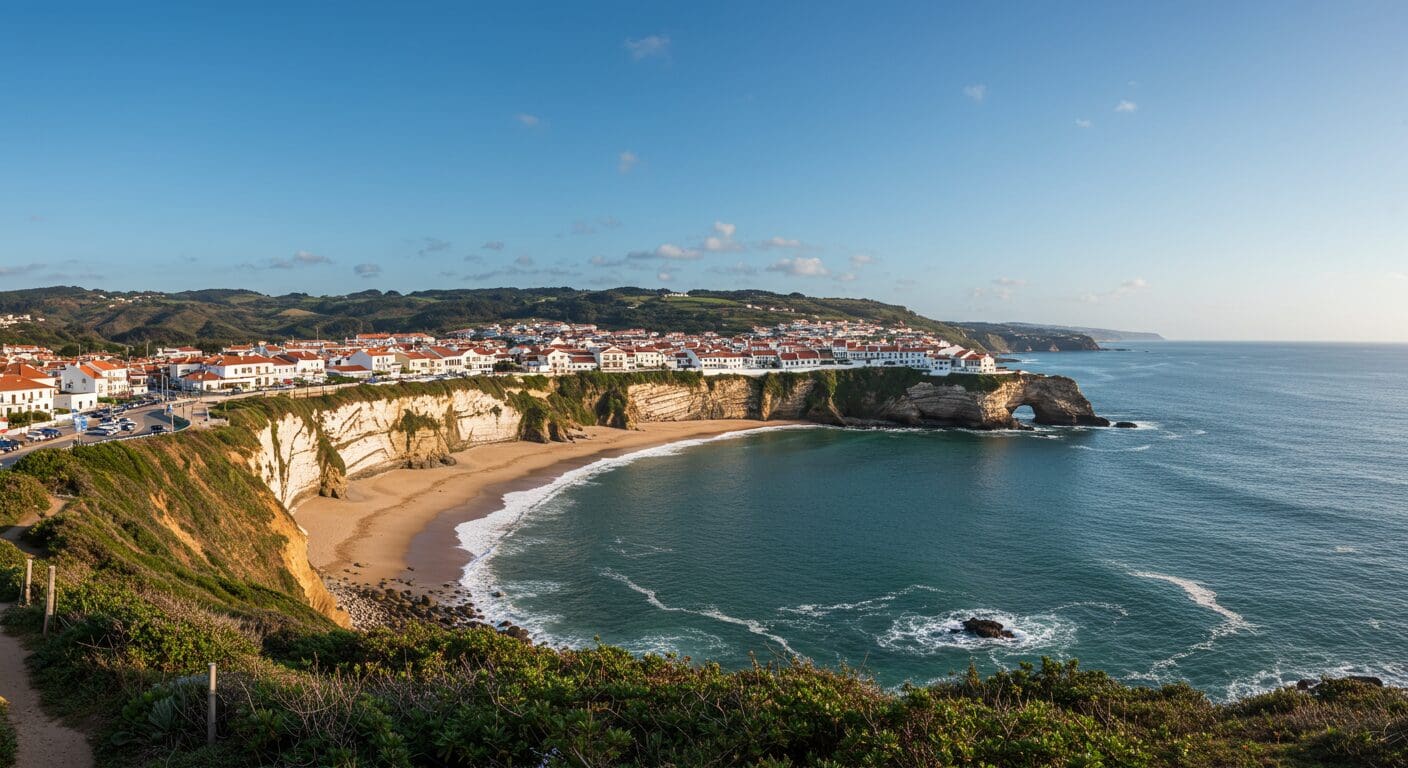
The Parque Natural da Arrábida extends along the peninsula’s southern coast in a way that makes it difficult to believe you’re within an hour of a European capital. The cliffs here – limestone, dramatic, falling steeply to water of an improbable Mediterranean blue – form the northern edge of a protected natural park that covers roughly 10,800 hectares of coastline, hillside, and Atlantic scrubland. The water transparency in the sheltered coves below is the kind that makes even experienced divers stop and recalibrate their expectations. On calm summer days, it can exceed 15 metres visibility, which in Atlantic terms is extraordinary.
Sesimbra itself sits at the western end of this coast, sheltered in a natural bay that catches the morning sun and holds it. The castle on the hill behind the town – Moorish in origin, substantially remodelled by the Portuguese after the Reconquista – watches over everything with a slightly proprietorial air. The town’s historic centre is compact and navigable on foot: narrow lanes, whitewashed walls, azulejo panels on unexpected corners, cats on warm steps. It is, in other words, what Portugal keeps doing better than almost anywhere else – the beautiful ordinary.
A short drive east brings you to Setúbal, the region’s main city, which functions as a useful counterpoint: noisier, more working-class, home to the ferry crossing to the Tróia Peninsula and its long Atlantic beach that stretches almost 20 kilometres with barely an interruption. Further inland, the Arrábida hills are threaded with hiking trails that reward the effort with views that manage to contain, simultaneously, the Atlantic, the Tagus estuary, and on very clear days, the distant outline of Lisbon. The geography here is unusually generous with its vistas.
Things to Do in Sesimbra: Earning Your Afternoon by the Pool
Swimming is the obvious activity and one that deserves more credit than it usually gets in travel writing. The beach at Sesimbra town – Praia de Sesimbra – is a proper arc of sand sheltered by the headlands and generally calmer than the exposed Atlantic beaches further north. The water temperature from June through September is, by Atlantic standards, inviting. By Mediterranean standards, it’s cold. By any standards, it’s clean, clear, and extremely pleasant once you’ve committed to it.
Boat trips along the Arrábida coastline are among the region’s genuinely great experiences: small operators run everything from morning snorkelling excursions to half-day kayaking routes that hug the cliffs and access beaches unreachable by road. The kayak routes in particular are a revelation – you see the coastline from the water as the fishing community has always seen it, which is entirely different from seeing it from the road above. Day trips to Lisbon are straightforward and genuinely worthwhile; the city is close enough to do in a day and interesting enough to justify several. The Sintra hills – palaces, forests, a UNESCO World Heritage designation it absolutely deserves – are also within easy range, as is Setúbal and the Tróia crossing for a wilder Atlantic beach day.
For those with an interest in birdwatching, the Arrábida is a surprisingly productive spot: Bonelli’s eagles nest in the cliffs, and the scrubland supports populations of birds that have retreated from more intensively farmed parts of Europe. Nobody leads with this in the brochures, but it’s the kind of thing that turns an afternoon walk into something quietly extraordinary.
Under the Water and Over the Hills: Adventure in the Arrábida
Sesimbra has a legitimate claim to being one of the best diving locations on the Iberian Peninsula, and it makes this claim quietly, without the marketing apparatus that louder destinations deploy. The waters off the Arrábida coast are part of a protected marine reserve, which means the fish populations are healthy, the ecosystems are intact, and the experience of diving here is materially different from diving in waters that haven’t been protected. Several local dive centres operate out of Sesimbra, offering everything from beginner courses to guided dives on the underwater rock formations and the wrecks that lie in deeper water offshore. The visibility, as noted, is exceptional by Atlantic standards.
Above the waterline, the Arrábida hills offer hiking of genuine quality. The GR11 long-distance path crosses the peninsula, but it’s the shorter, locally waymarked routes through the park’s limestone terrain that most reward casual walkers – particularly the trails that trace the ridge line and offer simultaneous views of both coastlines. Mountain biking is possible on forest tracks, though the terrain is technical in places and suited more to confident riders than anxious ones. Road cyclists will find the peninsula’s quieter roads, particularly early in the morning before the summer traffic, excellent: the climbs are real, the descents are rewarding, and the pastelaria at the bottom is always there when you need it. Stand-up paddleboarding and kayaking in the sheltered coves are available through local operators and require no particular skill level to enjoy. Surfing, by contrast, is better sought on the Atlantic-facing beaches further west, where the swell has more to work with.
Why Families Who Discover Sesimbra Tend to Come Back
Families with children who have outgrown the bucket-and-spade holiday but aren’t quite ready for the culture-heavy city break find Sesimbra occupying a very useful middle ground. The beach is genuinely child-friendly: the bay is sheltered, the waves are manageable, the water is clear enough that you can see exactly where your children are, which is a specific comfort that parents of small swimmers will appreciate. The town itself is compact and walkable without being crowded in the way that, say, Lisbon’s tourist quarters become in August.
The Arrábida’s snorkelling, even for beginners, is memorable. Rocky coves with calm water and abundant marine life make for the kind of afternoon that ends with children voluntarily reading about fish species at dinner, which is the benchmark for a successful activity. Boat trips are popular with families and generally well-operated; teenagers who would otherwise be horizontal in a hotel room tend to revive dramatically when introduced to the idea of jumping off a boat into deep clear water.
The private villa format solves, almost entirely, the logistical complexity of travelling with children of different ages and requirements. Multiple bedrooms, a private pool that operates on your family’s schedule rather than the hotel’s, a kitchen for the meals that are easier made than negotiated, outdoor space for the evening wind-down – these are not luxuries in the abstract sense so much as practical solutions to practical problems. The families who try it and go back to hotels are, in our experience, vanishingly rare. A luxury villa in Sesimbra, particularly one with its own pool and garden, removes the friction that accumulates imperceptibly when you’re sharing space with strangers and waiting for your turn at the breakfast buffet.
Castles, Fishermen and the Long Memory of the Coast
Sesimbra’s history is rather older and more layered than the postcard version suggests. The castle on the hill above the town is largely Moorish in its original construction – the Moors held this coastline from the 8th century until the Portuguese Reconquista pushed south in the 12th century, and the fortifications reflect that long strategic importance. The town below developed gradually around the fishing trade, and there is a continuity to that identity that persists: Sesimbra remains, functionally and culturally, a fishing town, and makes no particular effort to pretend otherwise. This is worth respecting and exploring.
The Church of Santiago, in the town centre, dates from the 16th century and contains azulejo tilework of considerable beauty – the kind that rewards the willingness to step inside even on a hot afternoon when every instinct is pointing toward the beach. The Forte de Santiago, a 17th-century fortress on the seafront, has been repurposed over the centuries but remains an architectural landmark that frames the harbour in photographs with a regularity that suggests the Portuguese understood framing before they invented the camera.
Local festivals are worth timing around if possible. The Festas do Mar in August are Sesimbra’s main popular celebration – a blend of religious procession, live music, fireworks over the harbour, and the kind of collective goodwill that large communities sometimes generate when they’ve been celebrating the same thing for several hundred years. The atmosphere is genuinely warm and inclusive in the way that local festivals tend to be before they’ve been fully discovered by tourism, which Sesimbra’s, by some miracle, hasn’t yet.
Shopping in Sesimbra: Small, Local, Worth the Browse
Sesimbra is not a shopping destination in the way that Lisbon or Porto are shopping destinations, and this is not a criticism. What it offers instead is the particular pleasure of the small, independent, occasionally eccentric local shop – the kind that sells three different things and has been doing so since the 1980s without any apparent desire for expansion. The market, held regularly in the town, is the best place to acquire what you should actually be acquiring: local wine from the Setúbal Peninsula, tinned fish of a quality that bears no resemblance to the tinned fish you buy at home, dried goods, local ceramics, handmade textiles.
Portuguese tinned fish – sardinhas, atum, lulas – has undergone something of a global reappraisal in recent years and rightly so; the stuff produced in this region is excellent, makes an exceptional and lightweight gift, and travels home in your luggage without complaint. Local olive oil is similarly worth seeking out. Cork products – Portugal produces roughly half the world’s cork, and the Setúbal region is part of that story – range from the genuinely beautiful to the aggressively kitsch. The former are worth buying; the latter are, of course, entirely your own business.
The Practical Business of Being Here: What You Actually Need to Know
Portugal uses the euro, accepts cards almost universally, and has a tipping culture that operates at around 5-10% in restaurants rather than the more demanding scales of some other European countries. Nobody will make you feel bad for not leaving anything; nobody will make you feel good for leaving 25%. The register is more relaxed than that, which suits the destination well.
The language is Portuguese, which is not Spanish despite the geographical proximity to Spain. Portuguese speakers will gently point this out if you assume otherwise. English is widely spoken in the hospitality sector throughout Sesimbra, less universally in older tascas and market stalls, where a phrase or two of Portuguese and some goodwill will take you considerably further than raising your voice in English. This applies globally, but bears repeating.
The best time to visit depends somewhat on what you want from the trip. July and August are the warmest months and the most crowded – the beaches fill with Lisboëtas on weekends, the restaurants are busy, and accommodation requires advance booking. June and September are, by fairly wide consensus among people who know the area well, the optimal months: the sea has warmed, the crowds have thinned, the light in September in particular achieves a quality that photographers come specifically to photograph. May and October are beautiful for walking, cycling, and cultural exploration, with water temperatures that suit braver swimmers. The winter is mild by northern European standards – temperatures rarely drop below 10°C even in January – and the Arrábida on a clear February morning, with the light low and the trails empty, has a quality entirely its own.
Safety is not a meaningful concern in Sesimbra. Portugal consistently ranks among the safest countries in the world on global peace indices, and Sesimbra specifically is the kind of place where the primary hazard is overindulgence in the local wine. Petty theft around very busy beach areas in high summer is not unknown, as in all tourist destinations, but requires only the usual application of common sense rather than anxiety.
Why a Luxury Villa in Sesimbra Is the Only Sensible Way to Do This
The argument for a private villa over a hotel in Sesimbra is not primarily about luxury in the conventional sense – it’s about proportion. What the destination offers – privacy, space, the ability to move between your own pool and a beautiful coastline on your own terms, the pleasure of a proper kitchen when you’ve bought something exceptional at the market – maps almost perfectly onto what a well-chosen villa provides. A hotel, however good, mediates the experience. A villa simply puts you inside it.
For families, the calculus is straightforward: private pool, multiple bedrooms, space for children to exist without performing quietness, a kitchen for the meals that make more sense made at home, a garden for the evenings. For couples on significant trips – the anniversary, the honeymoon, the milestone birthday that deserves better than a superior room with a partial sea view – the seclusion of a private villa with its own pool and terrace turns a good holiday into a memory with a specific address. For groups of friends, the shared kitchen, the long dinners under the stars, the absence of any checkout time that forces the holiday to end before it wants to – these are the things you talk about afterwards.
Remote workers who’ve discovered that Portugal’s time zone suits collaboration with teams in both the United Kingdom and the east coast of the United States will find that Sesimbra villas increasingly come with fibre broadband or Starlink connectivity – genuinely fast, genuinely reliable, and genuinely strange to have in a house with views like that. The laptop-by-the-pool fantasy is, in Sesimbra at least, not a fantasy.
Wellness-focused guests will find that the combination of the Arrábida’s trails, the quality of the local food, the sleep quality that comes with sea air and no noise, and the various in-villa amenities – pools, outdoor showers, hot tubs, yoga terraces in better-equipped properties – makes the concept of a restorative holiday feel not just possible but almost automatic. The place seems to understand what restoration means before you’ve explained what you’re looking for.
Excellence Luxury Villas has a carefully curated collection of private villa rentals in Sesimbra – from intimate retreats for couples to expansive properties capable of hosting multi-generational family gatherings in the kind of style that Sesimbra, quietly, completely deserves.
More Sesimbra Travel Guides
What is the best time to visit Sesimbra?
June and September are widely considered the sweet spot – the sea is warm from the summer, the crowds are thinner than in peak July and August, and the light is extraordinary. July and August are the liveliest months if atmosphere and warm evenings are your priority, but book well in advance. May and October suit walkers, cyclists, and anyone whose idea of a good beach day involves having the beach largely to themselves. Winter is mild and quiet, with temperatures rarely falling below 10°C – excellent for the Arrábida trails and the slower pleasures of the town.
How do I get to Sesimbra?
The nearest airport is Lisbon Humberto Delgado Airport, approximately 40-50 kilometres north of Sesimbra. With a private transfer – the most comfortable option for villa guests, particularly those arriving with luggage and children – the journey takes around 45-60 minutes depending on traffic and route. Rental cars are available at the airport and recommended for exploring the wider peninsula. Uber operates from Lisbon but is less reliable for the final stretch to Sesimbra specifically. There is no direct rail connection; the town’s relative inaccessibility by public transport is, from one perspective, a significant part of what has kept it from being overrun.
Is Sesimbra good for families?
Genuinely excellent. The sheltered bay means calmer water than the exposed Atlantic beaches further north, the town is compact and safe for children to explore, and the Arrábida’s snorkelling and boat trips provide the kind of activities that children actually talk about afterwards. The private villa format – private pool, flexible mealtimes, space for different ages to coexist without performance – removes most of the friction associated with travelling with families of mixed ages and requirements. Sesimbra has none of the manufactured entertainment infrastructure of larger resort destinations, which is either a concern or an asset depending entirely on your family.
Why rent a luxury villa in Sesimbra?
Because the destination suits the format almost perfectly. Sesimbra rewards the kind of unhurried, self-directed holiday that a private villa enables: cooking with market fish one evening, eating out the next, swimming at nine in the morning before anyone else arrives, having dinner on your own terrace with a bottle of Setúbal white and a view that cost you nothing extra. The staff-to-guest ratio in a private villa is incomparably better than any hotel; the privacy is total; the pool is yours. For families and groups in particular, the economics also start to look considerably more sensible once you’re comparing against multiple hotel rooms.
Are there private villas in Sesimbra suitable for large groups or multi-generational families?
Yes. The villa rental market in and around Sesimbra includes properties ranging from two-bedroom retreats for couples to large-format villas sleeping twelve or more, often with multiple living spaces, separate guest wings, private pools large enough to be genuinely shared, and outdoor dining areas designed for the kind of extended-family dinners that made you want a holiday like this in the first place. Properties suited to multi-generational groups typically offer ground-floor accessibility, multiple lounge and dining areas so different age groups can occupy different parts of the property, and staff options including private chefs and concierge services for groups who don’t want to self-cater entirely.
Can I find a luxury villa in Sesimbra with good internet for remote working?
Increasingly, yes. Portugal has invested substantially in broadband infrastructure, and many villa properties in the Sesimbra area now offer fibre connections or Starlink satellite internet, delivering speeds that are entirely adequate for video conferencing, large file transfers, and the general demands of a working day. Portugal’s time zone (WET/WEST) is particularly well suited to remote workers collaborating with teams in both the United Kingdom and the east coast of the United States – roughly the same as the UK in winter, one hour behind in summer. It’s worth confirming connectivity specifics with our team when booking if reliable internet is non-negotiable.
What makes Sesimbra a good destination for a wellness retreat?
Several things operating simultaneously. The air quality in the Arrábida Natural Park is measurably cleaner than most European urban environments. The hiking trails above the limestone cliffs offer the kind of physical engagement that recalibrates the body more effectively than a gym ever quite manages. The local food – fresh fish, local olive oil, excellent regional wine consumed with the moderate Mediterranean sensibility – is nourishing in a way that feels entirely natural rather than prescribed. Sleep quality tends to improve dramatically here, attributed variously to the sea air, the absence of noise pollution, and the general slowing of pace. Private villas with pools, outdoor yoga terraces, hot tubs, and access to in-villa wellness services complete the picture for those who want structured wellness alongside natural restoration.