Zakynthos with Kids: The Ultimate Family Holiday Guide
Zakynthos with Kids: The Ultimate Family Holiday Guide
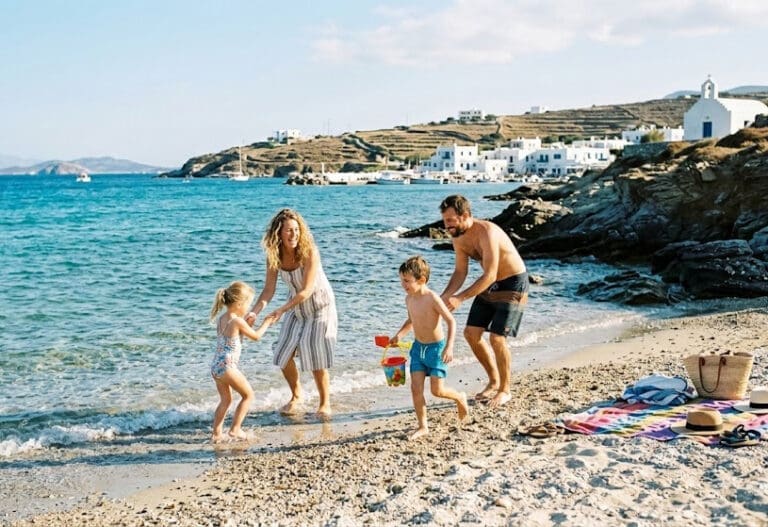
There are Greek islands that do beauty, and Greek islands that do beaches, and Greek islands that do a reasonable impression of a place you might actually want to bring children. Zakynthos does something rarer: it manages all three without sacrificing any of them. The water here is the kind of blue that makes children stop mid-sentence – genuinely stop, mid-sentence – because they’ve never seen anything quite like it outside of a screen. The sea caves glow. The turtles are real. The taverna owner will almost certainly give your child a piece of bread they didn’t ask for, and everyone will be better for it. This is not an island that merely tolerates families. It welcomes them with the particular warmth of somewhere that has been doing exactly this for generations, and hasn’t yet confused hospitality with a wellness programme.
Why Zakynthos Works So Well for Families
The honest answer is geography. Zakynthos is compact enough to feel manageable – you are never more than an hour from most things worth seeing – but varied enough that a two-week stay reveals a completely different island to the one you thought you’d arrived at. The east and south coasts offer calm, shallow-entry beaches ideal for toddlers and anxious parents alike. The west coast serves up dramatic cliff scenery and the famous Shipwreck Beach for families with older children and a sense of adventure. The north is quieter, greener, and blissfully uncrowded.
Beyond geography, there is something in the pace of Greek island life that suits children in ways that more aggressively organised destinations simply don’t. Nobody is rushing. Lunch can take two hours. The beach is five minutes away. The expectation that small humans must be constantly entertained dissolves somewhere around day two, and everyone is rather happier for it. Zakynthos also benefits from reliable summer weather, flat calm seas on most mornings, and a local food culture that does not require children to be adventurous eaters – though they often become so by accident.
For a broader overview of what the island offers, our Zakynthos Travel Guide covers the island in full – the kind of context that makes a family holiday feel genuinely considered rather than hastily assembled.
The Best Beaches for Families in Zakynthos
Not all beaches are created equal when you are travelling with children, and Zakynthos is usefully honest about this. Some of its most famous beaches – spectacular to photograph, less straightforward to access – are better suited to the child-free. Others are practically purpose-built for family days.
Gerakas Beach, on the Vasilikos peninsula in the south-east, is widely considered one of the finest family beaches on the island. The sand is soft, the water enters gently with no sudden drop, and the bay is naturally sheltered. It is also a protected loggerhead sea turtle nesting site – which means no umbrellas or sunbeds on the lower section of the beach, which sounds like an inconvenience and turns out to be a revelation. Children who have been staring at devices for the better part of a year will spend hours watching the waterline for turtle fins. This is worth noting in advance: if you time your visit to an early morning guided beach walk during nesting season, the experience has a way of lodging itself permanently in a child’s memory.
Porto Zoro, also on the Vasilikos peninsula, is a strong alternative – clearer water, slightly more facilities, and a beach length that gives teenagers room to wander without actually disappearing. Tsilivi Beach on the east coast is the most family-oriented resort beach on the island: organised, well-equipped, and lined with tavernas at which children are clearly expected. It lacks the wild beauty of Gerakas but compensates with practicality. On mornings when logistics matter more than poetry, Tsilivi earns its place.
Banana Beach – so named for its curved shape rather than any culinary offering, which is a disappointment to children everywhere – provides excellent shallow swimming with water sports for older children and teenagers. The dual beaches (Big Banana and Little Banana) allow different age groups to coexist at a useful distance.
Family Activities and Experiences Worth Having
A boat trip to the Blue Caves and Shipwreck Beach is one of those experiences that cuts across age groups with unusual efficiency. Toddlers are mesmerised by the colour of the water inside the caves. Juniors are fascinated by the rusting hull of the Panagiotis, stranded on its famous strip of white sand since 1980. Teenagers, who have decided they are too old to be impressed by things, are impressed. The trips run from various points on the island but those departing from Porto Vromi on the west coast offer the most direct and dramatic approach to the Shipwreck – shorter sailing time, longer at the destination. A private boat charter removes the group-tour element entirely and is, frankly, a different experience.
The loggerhead sea turtle – Caretta caretta – is the island’s most celebrated resident. Zakynthos hosts one of the Mediterranean’s most important nesting populations in the Bay of Laganas, which is now a protected National Marine Park. Taking an evening boat trip through the bay with a licensed operator offers a genuine chance of close encounters. The rule is strict: watching only, no approaching, no flash photography. Children tend to follow these rules with remarkable seriousness when the animal in question is an actual sea turtle.
For days when the beach feels sampled rather than savoured, the island’s interior offers something genuinely different. The villages of Keri and Macherado are quiet, real, and unequipped with gift shops, which is either their great strength or their great weakness depending on your travelling companions. The church at Macherado – dedicated to Agia Mavra – is worth a visit for older children with any interest in Byzantine art, and the drive through olive groves and vineyards is the kind of thing that retrospectively becomes a favourite memory.
Olive oil tastings and small-scale winery visits work surprisingly well with children, particularly in estates that understand their audience and provide juice, bread, and something to look at while the adults get on with things. The local variety, Verdea, is one of Greece’s oldest white wines and worth seeking out – the adults can confirm this while the children chase something around the courtyard.
Eating Out with Children in Zakynthos
Greek taverna culture is, by its nature, child-friendly – not in the branded, high-chair-and-colouring-sheet sense, but in the deeper way of places where families have always eaten together and nobody finds this remarkable. The question on Zakynthos is less whether children are welcome and more which of the island’s many excellent options to choose from.
The waterfront tavernas in Zakynthos Town – particularly along Strani Hill and the old harbour area – offer the combination of atmosphere, straightforward food, and enough visual interest (boats, passing pedestrians, the odd cat) to keep children occupied between courses. Greek cuisine at its best does not require adventurous eating: grilled fish, bread, chips cooked in olive oil, tzatziki, and the unmistakable local bread are all things that children reliably eat without the negotiation phase that characterises meals in more challenging culinary territories.
Along the Vasilikos peninsula, small family-run tavernas serve fresh seafood in the kind of setting – plastic chairs, paper tablecloths, direct view of the water – that is worth a hundred more elaborately designed restaurants. The cooking is simple and honest. The portions are generous. The wine comes in a small carafe and costs almost nothing. It is the sort of dinner that families describe differently every year but always remember fondly.
For longer-stay families based in private villas, the island’s local markets and supermarkets in Zakynthos Town provide excellent fresh produce, local honey, cured meats, and the island’s famous mandolato nougat – the last of which children tend to discover independently and rapidly. Self-catered breakfasts and lunches around the pool, with taverna evenings as a counterpoint, is the rhythm that suits villa holidays best. It requires remarkably little planning and produces remarkably high satisfaction rates.
Age by Age: What Works for Different Children
Families are not monolithic, and the same island can be very different experiences for a two-year-old and a fourteen-year-old – sometimes on the same day, in the same direction.
Toddlers and young children thrive in Zakynthos precisely because the pressure is low. The sheltered beaches with gentle entry points are ideal – Gerakas and Porto Zoro require no special equipment or nerve. Nap times happen, meals run late without consequence, and the general temperament of the island means that a small person having a complicated morning in a taverna is met with patience rather than performance. A private pool at a villa changes the entire architecture of a day with toddlers: the beach becomes a choice rather than an obligation, and the afternoon heat can be enjoyed rather than fled.
Children aged roughly six to twelve are perhaps the ideal Zakynthos travellers. Old enough to snorkel, old enough to remember the turtle sighting, old enough to understand why the rusting ship on the beach is extraordinary, young enough to be genuinely enchanted by it. This age group is served by the boat trips, the beach days, the occasional hike in the hills, and the freedom that comes from being in a place where the main risks are sunburn and eating too much bread. Snorkelling equipment is widely available for hire; bringing your own is better. The waters around Gerakas and at the small rocky coves of the Vasilikos peninsula reward time spent underwater.
Teenagers are, as any honest travel writer will acknowledge, a specific challenge. Zakynthos handles them reasonably well. The water sports at Banana Beach and Tsilivi – jet skis, paddleboarding, banana boats – provide the adrenaline requirement. A private boat charter gives them the feeling of freedom without the actuality of it, which is usually sufficient. The Blue Caves boat trip lands reliably. The evening energy of Tsilivi and Laganas suits older teens who want proximity to nightlife without parental involvement, though the choice of base matters enormously here: a villa in the quieter Vasilikos peninsula keeps everyone sane while remaining within reach of the livelier parts of the island when occasion demands.
Why a Private Villa with Pool is Transformative for Family Holidays
The argument for a private villa with pool on a family holiday is almost embarrassingly straightforward once you have experienced one. Hotel rooms, however luxurious, are fundamentally designed around the needs of couples. The geometry is wrong: not enough space, not enough bathrooms, not enough separation between bedtime and adult time. The poolside is shared. The breakfast hour is negotiated against other guests. The logistics of getting children from room to beach require the strategic planning of a minor military operation.
A private villa inverts all of this. The pool is yours – which means the two-year-old can be in it at seven in the morning without disturbing anyone, and the twelve-year-old can be in it until nine at night without anyone raising an eyebrow. Multiple bedrooms with separate spaces means children and adults both get the thing they actually want, which is occasional privacy. A private kitchen allows for the kind of flexible meal timing that children require and restaurant booking systems don’t accommodate. The garden or terrace becomes an outdoor living room – the place where holiday evenings actually happen rather than being managed.
In Zakynthos specifically, villas with private pools are frequently positioned to take advantage of the island’s views and coastline in ways that hotels, often grouped in resort zones, simply cannot match. A villa on the Vasilikos peninsula with sea views from the pool terrace is not a holiday that requires constant activity to be worth the journey. It is a holiday that is worth the journey while you are sitting still. For families who have been operating at full operational capacity for most of the year, the value of this particular quality is difficult to overstate. The children swim. The parents have a drink. Everyone is, briefly and collectively, exactly where they should be.
Browse our collection of family luxury villas in Zakynthos and find the right base for your own version of all of the above.
What is the best time of year to visit Zakynthos with children?
June and September are the sweet spots for families. The weather is reliably warm and the sea is swimmable, but the island is noticeably less crowded than July and August – which means shorter queues for boat trips, easier taverna bookings, and a calmer experience all round. July and August are perfectly manageable but represent peak season in full effect. For families with children who are of school age, the first two weeks of September offer near-perfect conditions: warm, calm seas, reduced crowds, and prices that are beginning to ease. Those travelling with very young children may also consider late May, when the island is green, quiet, and at its most unhurried.
Are the beaches in Zakynthos safe for young children?
Many of them, yes – but it depends which beaches you choose. Zakynthos has a range of beach types, from dramatic cliff-backed strips accessible only by boat to wide, shallow-entry sandy bays that are ideal for young children. Gerakas and Porto Zoro on the Vasilikos peninsula, and Tsilivi on the east coast, offer calm, sheltered water with gentle gradients – well suited to toddlers and young swimmers. The more famous west coast beaches, including Shipwreck Beach, are boat-access only and better visited on a day trip rather than as a swimming base for families with small children. Always check sea conditions on the day, particularly on exposed west-facing beaches where winds can pick up in the afternoon.
Is it possible to see sea turtles in Zakynthos with children?
Yes, and it is one of the genuinely memorable wildlife experiences available to families travelling in Europe. The Bay of Laganas in the south of the island is a protected National Marine Park and home to one of the Mediterranean’s largest populations of loggerhead sea turtles. Licensed boat operators run evening turtle-spotting trips from Laganas and the surrounding area, and sightings – while never guaranteed – are relatively frequent during the summer nesting and hatching season. Children are typically asked to observe quietly and avoid flash photography, rules they tend to follow with unusual diligence once an actual turtle appears. Gerakas Beach is also a key nesting site and offers early morning guided walks during nesting season with the local turtle conservation organisation, which is well worth arranging in advance.