Zakynthos Travel Guide: Best Beaches, Restaurants & Luxury Villas
The ferry from the mainland slides into Zakynthos Town just as the light turns amber, and for a moment the whole harbour looks like someone has applied a filter too generously – except they haven’t. The campanile of Agios Dionysios catches the last hour of sun. Fishing boats knock gently against their moorings. A cat, with the proprietorial confidence common to all Greek island cats, surveys the quayside from a bollard. This is the moment you understand why people keep coming back to Zakynthos – not because it’s undiscovered (it emphatically isn’t), but because it somehow still feels like it belongs to itself. The Ionian Islands have a different quality to the Greek Islands of the Aegean – greener, softer, the water an almost aggressive shade of turquoise that you keep photographing even though you know no photograph will ever quite get it right.
Zakynthos rewards the discerning traveller who knows how to find the right corner of it. It works beautifully for couples marking a significant anniversary – the kind of trip where the hotel option feels somehow insufficient for the occasion. It is genuinely excellent for families seeking privacy, a private pool, and the ability to have lunch at 2pm in their swimwear without anyone minding. Groups of friends in their late thirties and forties tend to discover it and wonder why they spent their twenties in Mykonos. Remote workers who need reliable connectivity and a view that makes the nine o’clock call bearable have increasingly found that a well-equipped private villa here delivers both. And for those whose idea of wellness extends beyond a spa treatment to include daily swims in clear water, long walks through olive groves, and eating extraordinarily well – Zakynthos, approached correctly, is something close to ideal. The key phrase being: approached correctly. This guide will help with that.
Getting to Zakynthos: Easier Than You’d Think, Better Than You Remember
Zakynthos International Airport – officially named Dionysios Solomos, after the island’s most celebrated poet – sits so close to the sea that on approach you will briefly wonder whether the pilot has the right destination. Direct flights operate from most major UK airports throughout the summer season, with British Airways, easyJet and Jet2 all serving the route. From mainland Europe, connections are equally straightforward, with the journey from London taking around three and a half hours. Shoulder season – May, June, and September – sees fewer direct options, but Athens is an easy hub, with Olympic Air and Aegean operating regular forty-five-minute hops from the capital.
If you’re arriving via Athens, there’s also the ferry option from Kyllini on the Peloponnese, a crossing of roughly an hour and a half. It sounds romantic. It occasionally is. Hire a car at the port or airport – this is non-negotiable if you intend to see anything beyond your immediate neighbourhood, and the island is compact enough that driving from the northern tip to the southern coast takes well under an hour. The roads vary, diplomatically speaking, but nothing here requires a four-wheel drive. A comfortable saloon will see you through. The bigger challenge is parking in Zakynthos Town on a Saturday evening, but that is a universal Mediterranean problem and not unique to this island.
Eating in Zakynthos: Where the Kitchen Takes Things Seriously
Fine Dining
The fine dining scene on Zakynthos has matured considerably in recent years, which will surprise anyone who last visited a decade ago and remembers an undifferentiated parade of tourist tavernas. The island now has several restaurants that would hold their own in any European city.
Prosilio in Zakynthos Town is the name that serious food travellers tend to mention first – and with good reason. Chef Kristy Karageorgou and sommelier Yiorgos Kampitsis have built something genuinely distinctive here: a menu that plays with unexpected ingredients and original combinations without ever tipping into the kind of self-conscious experimentation that mistakes confusion for creativity. The lamb with potatoes and pasta with truffle are standout dishes – refined, precise, and of a quality that makes the bill feel entirely justified. The service is flawless, the atmosphere sophisticated without being stiff.
On the Akrotiri peninsula, Bassia occupies a setting that does a great deal of the work before the food has even arrived. The views from its raised position are the kind that make conversation briefly impossible – the sea stretches out below and the light in the evening is quite extraordinary. The menu leans into what the surrounding waters provide: sea bass handled with proper care, lobster pasta that earns its place on the menu, steamed mussels that taste of the actual sea rather than a distant memory of it. The Zakynthian rabbit brings things gently back to land and is among the best things on the menu. Bassia is the kind of place you book for a milestone evening and find yourself thinking about for weeks afterwards.
For a luxury holiday in Zakynthos with culinary ambition at its centre, these two restaurants alone would justify the trip. But there is more.
Where the Locals Eat
Botanic Garden in Zakynthos Town is one of those places that requires a small act of faith to find – the entrance sits discreetly between two bars and offers little indication of what lies beyond. What lies beyond is a courtyard terrace of considerable charm, where the kitchen produces Greek-fusion dishes with real confidence. Share the fresh burrata salad, the grilled octopus and the arancini, order from a wine list that was clearly assembled by someone who knows what they’re doing, and note that the cocktails are excellent. The fact that it’s hidden means it fills up with people who sought it out – which makes for a particular kind of atmosphere.
Aperitto Resto Bar in Agios Sostis offers something different again: a waterfront setting, Mediterranean and Greek cuisine executed with modern flair, and an ambiance occasionally enhanced by soft jazz that somehow doesn’t feel like a cliché in this context. It caters thoughtfully to vegetarian, vegan and gluten-free guests without making a production of it – the menu simply works for everyone. The sea views are the sort that make it difficult to keep one’s attention on the wine list, which is carefully curated and well worth the attention.
Hidden Gems Worth Seeking Out
Drive inland to Lagopodo and you’ll find Ktima Grampsa, a rural estate surrounded by olive groves that offers one of the most genuinely farm-to-table experiences on the island. The menu is built around locally sourced ingredients and traditional recipes treated with a light modern hand – the kind of cooking that doesn’t announce its ambition loudly but leaves you understanding exactly what the fuss is about. There is a peacefulness to eating here, surrounded by groves and open sky, that a harbour-front restaurant simply cannot replicate. Book ahead and go at lunch.
For beach club dining done well, Hamsa Beach Club at Laganas offers a more glamorous coastal experience – the kind of place where a long lunch slides imperceptibly into the afternoon with the Ionian Sea doing most of the heavy lifting scenically. The food keeps pace with the setting, which is more than can be said for many beach clubs of similar ambition.
The Coastline: What the Photographs Don’t Prepare You For
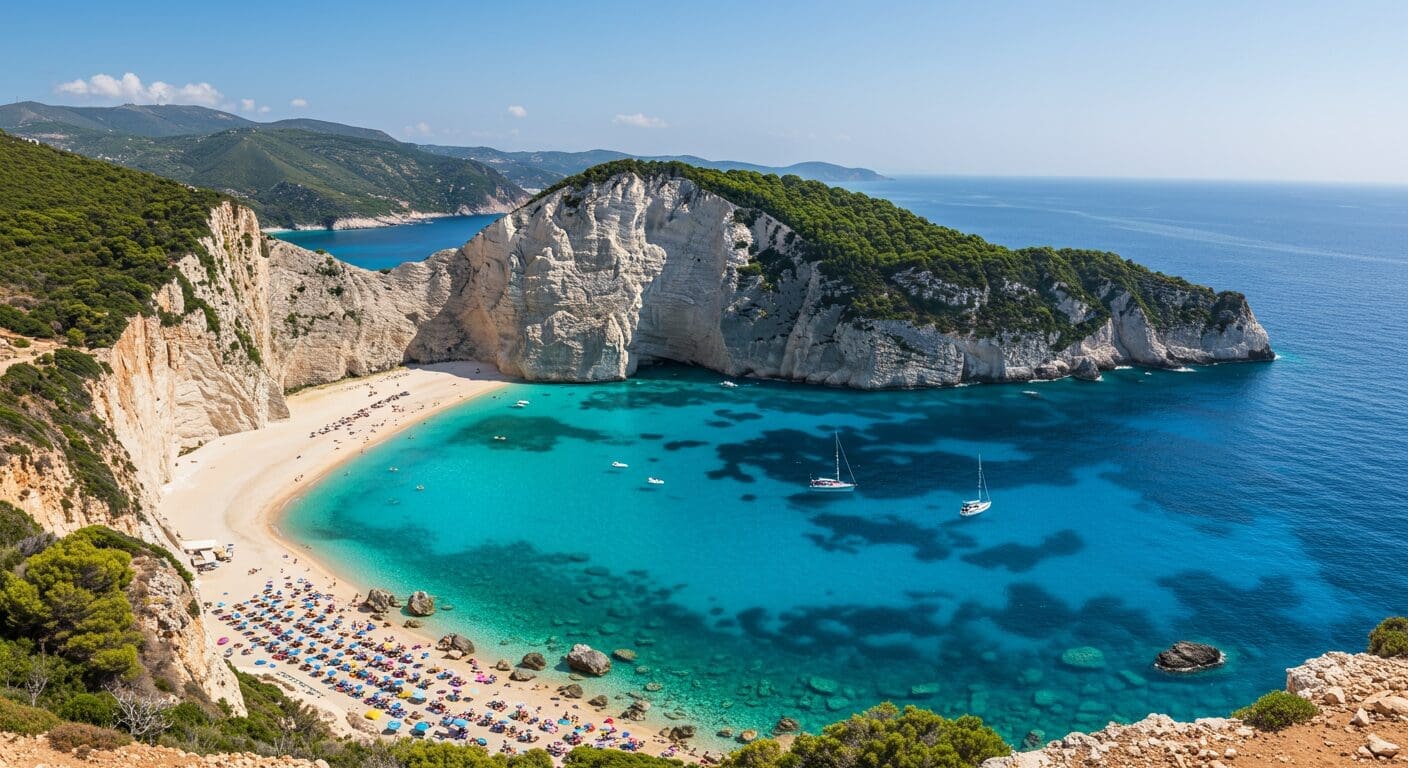
Navagio Beach – the so-called Shipwreck Beach – is one of the most photographed coves in the Mediterranean, which means it also hosts what may be the most photographed crowd in the Mediterranean. Go anyway, ideally by private boat from Porto Vromi or Agios Nikolaos, and arrive early before the tour boats arrive. Seen from the clifftop at sunrise, with the rusted hull of the Panagiotis below and the limestone cliffs glowing white, it is – and there is no more accurate word – extraordinary. The received wisdom that it’s overrated has become its own form of snobbery.
The Blue Caves at Cape Skinari in the north are best explored by small motorboat or kayak in the morning, when the angle of light creates the electric blue reflections that give them their name. The water clarity here is remarkable – you can see the seabed in detail from a boat several metres above it.
Gerakas Beach in the south is quieter, longer, and backed by impressive sandstone cliffs. It also serves as a nesting ground for loggerhead sea turtles (Caretta caretta), and the whole southern coast is protected as part of a national marine park. Swimming here in the early morning, before anyone else arrives, with the possibility of a turtle surfacing nearby, is one of those travel experiences that sounds implausible until it actually happens to you.
For those who prefer their beaches with a side of civilisation, Porto Zoro and Banana Beach on the east coast offer calmer water, reliable sun loungers, and enough facilities to make a full day comfortable. The west coast beaches – Korakonissi, Dafni, Sekania – are wilder, more dramatic, and require more effort to reach. They are worth the effort.
Things to Do in Zakynthos Beyond the Obvious
The best things to do in Zakynthos involve, for the most part, moving slowly and being outside. That said, there is enough variety to fill a fortnight without repetition.
A private boat charter – either a day trip or a longer circumnavigation of the island – is the most effective way to access the coastline properly. The combination of sea caves, remote beaches and open water that only a boat can reach makes this a genuine highlight rather than a tourist box-tick. Several operators offer fully crewed charters with a skipper who knows which coves are crowd-free on which days. This information is worth having.
Zakynthos Town itself deserves more time than most visitors give it. The town was almost entirely destroyed by the 1953 earthquake and rebuilt in a style that echoes its pre-war Venetian elegance – the arcaded streets, the neoclassical facades, the central Plateia Solomou – all of it reconstructed with a care and coherence that makes walking here genuinely pleasurable. The Byzantine Museum on the main square houses a significant collection of post-Byzantine religious art salvaged from churches after the earthquake. It is not to be skimped on.
Wine tourism is quietly flourishing here. The Verdea grape is indigenous to Zakynthos and produces a white wine of some character – dry, oxidative, unlike anything you’ll drink elsewhere. Several local wineries offer tastings, and the experience of sitting on a hillside vineyard in the late afternoon with a glass of something local and interesting is one that pairs well with the general philosophy of a luxury holiday in Zakynthos.
The mountain villages of the interior – Keri, Machairado, Agios Nikolaos – are undervisited by most tourists and are all the better for it. The drive through olive and currant groves, past stone-built churches and working farms, gives the island a depth that the beach alone cannot provide.
Adventure and Water Sports: The Ionian as Playground
The waters around Zakynthos are among the clearest in the Mediterranean, which makes them particularly well-suited to diving. Several reputable dive centres operate on the island, catering to everything from first-time snorkellers to experienced divers seeking wall dives and cave systems. The marine park in the south adds an element – the possibility of diving alongside loggerhead turtles – that is difficult to replicate elsewhere. Operators work within strict guidelines to protect the turtles, which is both ecologically responsible and, from an experience perspective, makes the encounters feel more meaningful rather than less.
Kayaking the coastline independently or with a guided tour is an excellent way to access sea caves and small coves that are inaccessible by larger vessel. The northern coast around Cape Skinari is particularly well-suited to this – calm water, dramatic cliffs, and the Blue Caves accessible at low tide by kayak in a way that feels genuinely exploratory.
Windsurfing and kitesurfing conditions vary by location – the sheltered eastern coast is good for beginners, while the more exposed western bays can deliver serious wind for experienced riders. Stand-up paddleboarding has established itself across most beaches, predictably, but on a calm morning in one of the quieter coves it earns its place as a way of moving slowly across water that deserves to be looked into.
For those who prefer their adventure on land, mountain biking through the interior is increasingly well-catered for, with hire available in Zakynthos Town. The terrain is hilly enough to be interesting and varied enough that a day’s riding takes you through landscapes most visitors never see. Hiking trails are less formally marked than in some destinations, which means that the best approach is either a local guide or a proper paper map and some tolerance for improvisation.
Zakynthos with Children: The Private Villa Advantage
Zakynthos is, with the right approach, an excellent destination for families. The sea is warm from June through October, the beaches largely safe and shallow at their edges, and the pace of Greek island life is tolerant of children in a way that some more fashionable European destinations are not. Greek culture, it should be said, actively welcomes children in restaurants at hours that would raise eyebrows in Paris. This is not a minor detail when you have a seven-year-old who has decided that 9pm is dinner time.
The private villa context transforms a family holiday in Zakynthos. A villa with a private pool eliminates the daily negotiation over sunbeds, removes the need to apply sunscreen to a child while simultaneously balancing two towels and a beach bag, and provides the kind of space – both physical and psychological – that a hotel room, however luxurious, simply cannot offer. Children can be loud. Children can eat at irregular hours. Children can spend forty-five minutes doing something inexplicable with pool noodles. In a private villa, this is their prerogative. In a five-star hotel, it is someone else’s concern.
Families with younger children will find the calmer, east-coast beaches – Tsilivi, Planos, Alykanas – ideal, with shallow water, beach facilities, and reliable ice cream availability. Older children tend to take enthusiastically to snorkelling, kayaking, and boat trips – the sea turtle encounters at Gerakas being, in the experience of many parents, the thing their children remember and talk about long after the trip.
Multi-generational groups – the kind where grandparents and teenagers are somehow required to coexist for a fortnight – find that a villa with sufficient space and separate sleeping arrangements makes this considerably more achievable. The pool serves as neutral territory.
History, Culture and the Earthquake That Built a Town Twice
Zakynthos has been called the Flower of the Levant, a name given by the Venetians who controlled the island for more than three centuries and left behind an architectural and cultural legacy that still shapes it. The Venetian period (1484-1797) brought olive cultivation, the currant industry, and a tradition of choral music called the kantade – harmonised singing that evolved from Italian opera and still surfaces at festivals and in certain tavernas late enough in the evening.
The 1953 earthquake that devastated most of the island was a cultural catastrophe of enormous scale – churches, palaces, archives, art – much of it lost. The rebuilding of Zakynthos Town was undertaken with unusual care for its historical character, and the result is a town that feels coherent and genuinely beautiful rather than merely functional. The Byzantine Museum on Plateia Solomou is the most important repository of what was salvaged from the churches – icon paintings of real quality and historical significance, housed in a building worth the visit on its own terms.
The Church of Agios Dionysios in Zakynthos Town – dedicated to the island’s patron saint – survived the earthquake, was rebuilt, and remains the spiritual heart of the island. The feast of Agios Dionysios on 24th August brings the whole island to Zakynthos Town in a procession that manages to be both deeply devout and enormously convivial. If you happen to be there, don’t miss it.
The poet Dionysios Solomos, who wrote the Greek national anthem, was born here. The island takes this seriously. His house, his statue, and the museum dedicated to him and to Andreas Kalvos – another Zakynthian poet of national significance – are all worth visiting, and the context they provide for understanding the island’s sense of itself is genuinely illuminating.
Shopping: What to Bring Home That Isn’t a Fridge Magnet
The honest truth about shopping in Zakynthos is that the genuinely worthwhile purchases are mostly edible. Zakynthian olive oil is excellent – the island’s centuries-old groves produce oil of real quality, and bottles from small local producers make for gifts that will be both used and appreciated. Mandolato – a local nougat made with honey, almonds and egg white – is a traditional sweet that travels well and tastes significantly better than it sounds. The local honey is exceptional and widely available.
Verdea wine, as mentioned, is an indigenous variety worth bringing home in quantity. The local grocery shops in Zakynthos Town stock it alongside a range of locally produced preserves, herbs and spirits – the liqueur made from the island’s mastic and citrus is acquired taste that some people acquire very quickly.
For non-edible souvenirs, the leather goods workshops in the old town produce quality sandals and bags at prices that feel reasonable by comparison with the tourist-facing shops in the main plateia. Ceramics in the local blue-and-white tradition are widely available – quality varies, but the better pieces are distinctive and travel well. The weekly market at Zakynthos Town is a better bet for authentic local craft than the central tourist shopping strip, which is as it should be.
Practical Things Worth Knowing Before You Go
The best time to visit Zakynthos is May, June or September. This is not a controversial position – it is simply correct. July and August are hot, crowded, and expensive, in an order that varies by temperament. The sea is warm from late May, the light is extraordinary throughout, and the shoulder months offer the island at something closer to its natural pace. October is still viable for the weather-tolerant – warm enough to swim, quiet enough to hear yourself think, and remarkably good value.
Greece uses the euro. Cash is still expected in smaller tavernas and village shops, though larger restaurants and shops now accept cards reliably. Tipping around ten percent is standard and appreciated but not aggressively expected. The official language is Greek – a few words of which will be received with disproportionate warmth, as is universally the case.
The island is extremely safe by any reasonable measure. The primary hazards are sunburn, sea urchins in rocky shallows (wear water shoes or look carefully), and the mild chaos of August traffic in the main resort towns. The latter is best avoided by choosing where you stay carefully, which brings us neatly to the final point.
The national marine park regulations in the south of the island restrict boat speeds, prohibit certain activities near nesting beaches, and require that visitors treat the turtle habitat with care. This is not bureaucratic inconvenience – the turtles are genuinely important to the island’s ecology and identity, and the regulations are enforced.
Why a Luxury Villa in Zakynthos Makes the Whole Trip Different
There is a version of a Zakynthos holiday that takes place in a hotel with a shared pool, a buffet breakfast, and neighbours on the other side of a wall that turns out to be less substantial than it appeared in the photographs. It is a perfectly respectable version. It is not, however, the version that most people describe when they come back and say that Zakynthos changed something in them.
The luxury villa experience in Zakynthos operates at a different register entirely. Privacy is the first thing – not the manufactured privacy of a hotel suite, but the actual privacy of a property where the terrace, the pool, the garden and the view are yours alone. You eat when you want. You swim at midnight if the mood takes you. You arrive at the kitchen at seven in the morning in whatever state the morning finds you, and nobody is evaluating this.
Space matters too, particularly for families and groups. A well-chosen villa gives different generations and personalities room to coexist and, more importantly, room to separate. The children have the pool. The adults have the terrace and the wine. There is a room somewhere with a door that closes. Everyone is happier.
The best luxury villas in Zakynthos come with private pools positioned to catch the Ionian light at its most flattering – which is to say, most of the day – along with outdoor dining areas, fully equipped kitchens for the days when you don’t want to go anywhere, and staff options ranging from a housekeeper to a full concierge service that can arrange boat charters, restaurant reservations and private wine tastings before you’ve finished your first coffee.
For remote workers, the quality of connectivity at premium villas has improved dramatically – Starlink availability is increasing across the island, and a reliable high-speed connection combined with a view of the Ionian Sea makes the daily schedule feel considerably more manageable. The time zone works reasonably for UK and European business hours, and the ability to close the laptop, walk fifteen seconds and be in the pool represents a work-life balance that no office-based arrangement can match.
Wellness guests find that the combination of private pool, clean sea air, excellent local food and the general unhurriedness of island life does more for the nervous system than most formal retreats manage in twice the time. Add a villa with a gym or outdoor yoga space – both available in the right properties – and the infrastructure for a genuine reset is complete.
Excellence Luxury Villas offers an extensive collection of carefully selected properties across the island, from intimate two-bedroom villas above quiet coves to expansive estates suited to large groups or multi-generational families. Browse our full selection of luxury villas in Zakynthos with private pool and find the property that makes this the trip you’ve been meaning to take.
More Zakynthos Travel Guides
What is the best time to visit Zakynthos?
May, June and September are the sweet spot – warm enough to swim comfortably, far less crowded than the peak summer months, and noticeably better value across accommodation and dining. July and August are at full intensity: hot, busy, and expensive. October remains viable for those happy to accept slightly cooler evenings in exchange for quiet beaches and a much more relaxed pace. If you’re primarily motivated by privacy and a genuine sense of the island rather than peak-season energy, shoulder season is categorically the better choice.
How do I get to Zakynthos?
Zakynthos International Airport (ZTH) receives direct flights from most major UK airports throughout the summer season, operated by British Airways, easyJet and Jet2 among others. The flight from London takes approximately three and a half hours. For travel outside the direct-flight season, Athens serves as the main hub with Olympic Air and Aegean running frequent forty-five-minute connections to Zakynthos. There is also a ferry service from Kyllini on the Peloponnese, taking around ninety minutes – a practical option if you’re travelling overland through Greece. Hiring a car on arrival is strongly recommended.
Is Zakynthos good for families?
Yes, and genuinely so rather than in the vague, everything-is-family-friendly way that travel writing often deploys. The sea is warm and calm along the east coast from June through October, and beaches like Tsilivi and Alykanas offer safe, shallow water for younger children. Greek culture is actively welcoming towards children in restaurants and public spaces. The sea turtle encounters at Gerakas Beach in the national marine park tend to be the thing that children remember most vividly. The strongest case for Zakynthos as a family destination, however, is a private villa with pool – the space, privacy and flexibility it offers make the logistics of a family holiday significantly more manageable than any hotel arrangement.
Why rent a luxury villa in Zakynthos?
The case for a villa rather than a hotel in Zakynthos comes down to privacy, space and the quality of the day-to-day experience. A private villa gives you sole use of a pool, a terrace and a kitchen – meaning you eat when you want, swim when you want, and live at your own pace rather than the hotel’s. For families, the additional space is genuinely transformative. For couples, the seclusion and intimacy of a private property is difficult to replicate in any hotel context, however excellent the hotel. Many villas come with housekeeping, concierge services and chef options, giving the staff ratio and attentiveness of a luxury hotel with none of the compromises on privacy. The better villas in Zakynthos also position you away from the busier resort areas, which gives you a fundamentally different relationship with the island.
Are there private villas in Zakynthos suitable for large groups or multi-generational families?
There are, and the range is considerable. Properties sleeping eight to fourteen guests are well represented in the portfolio, with the best larger villas offering separate wings or sleeping pavilions that give different family groups genuine independence within the same property. Private pools at this scale tend to be generously sized. Larger villas typically come with full housekeeping and can be arranged with additional services including private chefs, childcare and dedicated concierge support. The key is booking early – properties at this size and quality level, particularly those with the best sea views and most secluded settings, are in significant demand during the peak season and tend to go to returning guests if not secured well in advance.
Can I find a luxury villa in Zakynthos with good internet for remote working?
Increasingly, yes. Connectivity at premium villa properties on Zakynthos has improved considerably, and Starlink satellite internet is now available at a growing number of properties, delivering reliable high-speed connection even in more remote hillside or coastal locations. When browsing villas, connectivity specifications are listed and can be confirmed with our concierge team before booking. The time zone (Eastern European Time, UTC+3 in summer) works well for UK and most European working hours. It should also be said that a desk overlooking the Ionian Sea is a material improvement on most office environments, and the commute is considerably shorter.
What makes Zakynthos a good destination for a wellness retreat?
The combination of factors that makes Zakynthos effective for wellness is not one that any single spa or retreat can manufacture: clean air, warm clear water you can swim in every morning, excellent local food built around olive oil, fresh fish and seasonal vegetables, and a pace of life that gently discourages urgency. The outdoor activity options – kayaking, diving, hiking the interior, long walks along coastal paths – provide movement that feels purposeful rather than exercised. Private villas with pools, outdoor yoga spaces and gym facilities provide the infrastructure for a structured wellness routine, while the island’s general character does the deeper work. It is, in short, a place where it becomes relatively easy to eat well, sleep well, move daily and spend significant time outside – which is, in most frameworks, most of what wellness actually requires.