
Maspalomas Travel Guide: Where to Stay, Eat & Explore in Luxury
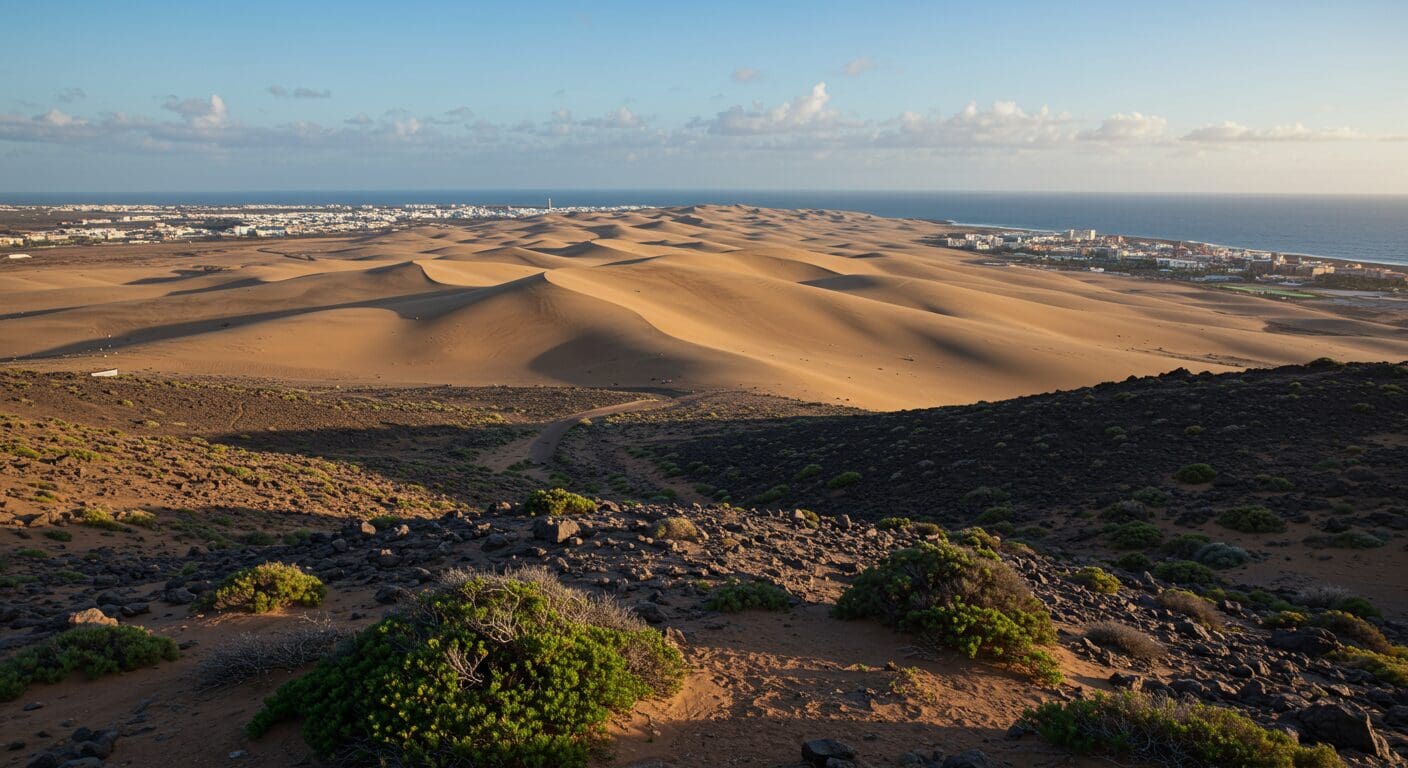
There is a particular quality to the light at Maspalomas in the early morning – before the beach fills, before the parasols go up, before anyone has thought about sunscreen. It arrives sideways across the dunes, gold and almost theatrical, turning the sand into something that resembles a film set for a Lawrence of Arabia sequel. The air smells of salt and warm earth. Somewhere a dog is barking. The Atlantic, improbably blue, makes no noise at all. This is the moment that explains why people come to the southern tip of Gran Canaria and then, somehow, keep coming back.
Maspalomas rewards specificity. It is not simply a beach resort – though the beach is extraordinary – nor simply a nature destination, though the 404-hectare dune reserve is unlike anything else in Europe. It is a place of genuine range: couples celebrating anniversaries who want nothing more than a private pool, excellent wine and a view that makes them feel slightly smug; families who need space, safety and something to keep teenagers from looking at their phones for more than forty minutes; groups of friends arriving from the United Kingdom in February, hollowed out by grey skies, requiring immediate sunshine rehabilitation. It suits remote workers who have discovered that a villa with reliable connectivity and a desk beside a private pool is, in fact, a perfectly rational working arrangement. It suits wellness-focused travellers who come for the year-round warmth, the walking trails, the outdoor living, and the particular kind of mental reset that only happens when you spend three consecutive days doing absolutely nothing that matters. Maspalomas is all of these things without being confused about it. That is a genuinely rare quality in a destination.
The Journey South: Getting to the Bottom of Gran Canaria
Gran Canaria’s Las Palmas Airport – officially Aeropuerto de Gran Canaria, though nobody calls it that with any urgency – sits conveniently in the centre of the island, roughly 25 kilometres north of Maspalomas. Direct flights arrive from across the United Kingdom, most of Europe, and connecting through Madrid or Barcelona if you are coming from further afield. The flight time from London is approximately four hours, which is long enough to finish a decent novel and short enough that you feel no particular guilt about not sleeping.
Transfers to Maspalomas take between 25 and 40 minutes depending on traffic and which particular corner of the resort you are heading to. Pre-arranged private transfers are the sensible option if you have luggage, children, or any interest in arriving without incident – taxi queues at the airport have their own particular character, especially on Saturday afternoons in high season. Rental cars are readily available and genuinely useful if you plan to explore the rest of the island; the road network is better than you might expect, the signs are clear, and Gran Canaria is compact enough that almost anywhere is reachable within an hour. Within Maspalomas itself, the resort is walkable between its main areas – Playa del Inglés, the Dunes, the Faro neighbourhood around the lighthouse – though the distances are longer than they first appear on a map, as distances always are.
Getting around Gran Canaria more widely, Global buses cover the island reliably and cheaply. But if your plan involves a private villa and a refrigerator stocked with Canarian wine, you will probably find that a hire car, collected on arrival and returned on departure, covers all eventualities neatly.
At the Table: Eating in Maspalomas with Appropriate Seriousness
Fine Dining
Maspalomas has quietly developed a dining scene that would surprise anyone operating on assumptions formed fifteen years ago. Restaurante LoLa is the current benchmark for elevated dining in the southern resort area – a relaxed but genuinely sophisticated room drawing inspiration from Mexico, Japan, Peru and Italy in the particular way that only works when the kitchen actually knows what it is doing. The locally sourced seafood is exceptional; the nine-course tasting menu is the kind of thing that starts a table conversation and then, somewhere around course six, renders everyone temporarily speechless. The ceviche is playful, the risotto serious, and the staff have mastered the difficult art of being extremely friendly without hovering.
For those whose idea of a fine evening involves magnificent cuts of meat, Las Brasas makes a compelling case. The high loin steak with peppercorn sauce has been cooked with sufficient confidence that you suspect the kitchen has been doing this for some time. The interior is traditional Spanish rather than resort-glossy – which is precisely the point. Around sixty euros for two steaks and drinks represents the kind of value that makes you pause, recalculate, and then quietly order another glass.
Restaurante Allende 22° deserves mention in the same breath – part of a small chain with roots in Las Palmas de Gran Canaria, it offers something close to 100% Spanish cuisine: broken eggs, salmorejo, croquettes and cachopo executed with the kind of care that makes Spanish classics feel revelatory rather than familiar. The atmosphere is relaxed without being sloppy, which is a harder balance than it sounds.
Where the Locals Eat
Wapa Tapa occupies a quietly important position in the Maspalomas dining landscape – not because it is flashy, but because it solves a genuine problem with considerable skill. The chef is himself gluten-free, which means the kitchen’s approach to allergen management is personal rather than procedural. Around 90% of the menu qualifies, and the preparation is careful enough that coeliac guests tend to eat here repeatedly rather than nervously. The hake fillet with smoky sauce is the kind of dish that makes you wonder why more restaurants bother with anything else, and the Uruguayan prime beef medallion suggests a kitchen thinking beyond the obvious. Book ahead. The locals have already found it.
The resort’s beach clubs occupy a slightly different register – more scene than substance in some cases, though the better ones have evolved into serious lunch destinations. The Faro area around the lighthouse tends to attract a slightly older, quieter crowd than the Playa del Inglés end of the resort, and the bars and cafes clustered there reflect this. Ice-cold local beer and a plate of Canarian potatoes with mojo sauce eaten in the shade of a terrace in the early afternoon is, arguably, the most honest meal Maspalomas offers.
Hidden Gems Worth Seeking Out
The most counterintuitive dining discovery in Maspalomas requires you to walk into the Cita shopping mall – which is not an instruction that typically precedes a restaurant recommendation of any quality. Persevere. Kilómetro 00 sits inside this unlikely setting and operates as a proper Italian gourmet pasta bar, with the kind of ingredient sourcing and wine list that suggests someone made a deliberate decision not to coast. The truffle carbonara is the headline act, but the tasting menu – multiple starters, multiple pastas, arrive hungry and without appointments for the following two hours – is where the kitchen shows its full hand. The pannacotta with red wine reduction is one of those desserts that makes the question of whether to order pudding feel briefly philosophical. Come on a quiet weeknight if you can. It would be a shame to rush it.
A Landscape That Doesn’t Behave Like a European Island Should
Gran Canaria’s geography is the first thing that confuses and then delights. The island is roughly circular, approximately 50 kilometres across, and rises dramatically from the coast to a mountainous interior that peaks above 1,900 metres. The southern coast – where Maspalomas sits – is dry, warm and almost desert-like. The north is lush and green. The interior, bisected by deep ravines called barrancos, looks like a small piece of the Andes has been misplaced in the Atlantic. This all happens within a forty-five-minute drive in any direction, which takes some getting used to.
Maspalomas itself sits at the island’s southernmost point, anchored by the lighthouse – the Faro de Maspalomas – which has been warning ships about the headland since 1890 and now presides over an area that has changed rather more dramatically than it anticipated. To its east lies Playa del Inglés, the larger, busier resort with a character best described as democratic: all ages, all nationalities, all levels of commitment to the concept of sunbathing. To the west, the dunes extend inland in a sweep of pale sand that remains one of the most genuinely surprising natural landscapes in southern Europe. Behind the dunes, the Charca de Maspalomas – a salt lagoon and bird sanctuary – provides a moment of unexpected stillness.
The residential areas of Campo Internacional and Meloneras sit quietly to the west of the lighthouse, with a more local, less touristic character – wider streets, private villas rather than apartment blocks, and a pace that moves at a noticeably different speed. These are the neighbourhoods where people come when they have decided they are done with resorts but not done with Maspalomas.
Things to Actually Do: An Honest Assessment
The Maspalomas Dunes are, without question, the defining experience of the area, and no amount of enthusiasm in a travel guide can quite prepare you for them. Walk into the dunes twenty minutes from the beach road and the resort disappears entirely. There is silence – actual silence – and sand ridges carved by wind into shapes that no garden designer could improve upon. Walking barefoot at dawn or dusk, when the light does what it does, is one of those experiences that feels slightly unfair on everywhere else you have ever been.
The dromedary safari across the dunes is, depending on your temperament, either a genuinely memorable way to experience the landscape or an objectively absurd thing to be doing in Spain. Both things can be simultaneously true. The camel rides operate from the edge of the dune reserve and take around 30 minutes; children find them unforgettable, and adults are surprised by how much they enjoy something they thought they had outgrown. The dunes are a protected natural reserve, which means visitor numbers are regulated and the experience retains a genuine quality.
Sioux City, the Wild West theme park just inland from the resort, occupies a particular nostalgic position for generations of British visitors who came here as children and now bring their own. It is exactly what it sounds like, which is to say it is either wonderful or bewildering, and the gap between those two responses tracks fairly closely with age. Maspalomas also offers day trips to the interior villages – Fataga, San Bartolomé de Tirajana, the craft markets at Mundo Aborigen – that provide genuine contrast to the coast and a reminder that Gran Canaria existed long before the resort developments.
The Palmitos Park, a botanical garden and wildlife park a short drive inland, is considerably better than its marketing suggests – the tropical bird shows and butterfly house in particular. Holiday World, with its fairground rides and entertainment, caters to the family evening-out requirement with reasonable efficiency. And the resort’s shopping centres – Faro 2, Cita, La Cantera – cover everything from supermarket runs to souvenir collection, open late in the manner of a Mediterranean resort that has grasped that its visitors keep different hours than the mainland.
Adventure for Those Who Find Lying Still Philosophically Difficult
The Atlantic off the southern coast of Gran Canaria is a serious body of water, and the activities it supports reflect this. Kitesurfing is perhaps the sport most associated with the area – the trade winds that give the Canaries their year-round warmth also provide conditions that attract serious riders from across Europe. Pozo Izquierdo on the eastern coast is a world-class kitesurfing destination, but beginners can take lessons closer to the resort at Playa del Inglés. The wind is honest here. It will tell you very quickly what level you are at.
Surfing and windsurfing operate alongside kitesurfing, with rental and instruction available through the beach clubs along the main strand. The waves are consistent if not dramatic – better suited to improving than to showing off. Scuba diving around the southern coast reveals a seafloor of volcanic rock formations, moray eels, rays, and the occasional octopus operating with a degree of self-possession that suggests it has seen tourists before. Several operators run PADI certification courses and guided dives for experienced divers, including wreck dives at sites a short boat ride offshore.
Cycling deserves particular mention. Gran Canaria has become a legitimate cycling destination – the combination of warm winters, varied terrain and good roads has attracted training camps from professional teams, and the infrastructure for recreational cyclists has followed. Routes from the coast into the mountains provide a physical challenge calibrated to however much suffering you are in the mood for, from gentle coastal paths to ascents that professional riders use for serious training. E-bikes have widened the audience considerably, which is either an excellent development or a matter for internal reflection, depending on your views.
Hiking the interior ravines – the barrancos – is slower, quieter, and rewards a different kind of attention. The Fataga gorge, reachable by car from the resort, opens into walking trails through palm-filled valleys that are completely unlike the coast. For those who want to walk without a car, guided hiking excursions leave from the resort regularly.
Maspalomas with Children: A Realistic Guide
Let us be direct: Maspalomas was built, at least in part, for families. The beach is long, broad, gently shelving at its calmer western end, and reliably warm. The resort infrastructure – supermarkets, pharmacies, restaurants with children’s menus, parks, playgrounds – is extensive. The weather is as close to guaranteed sunshine as anywhere in Europe can honestly claim. Flights from the UK are short enough not to require sedation planning. These are not small advantages.
The dunes function as a free activity that entertains children for the precise amount of time you need – which is to say, quite a long time. The camel rides are genuinely exciting for anyone under twelve. Palmitos Park and Sioux City fill rainy-afternoon slots, though rainy afternoons are rare enough that their occurrence becomes a family story for years. Holiday World covers evening entertainment with rides calibrated to the full age range.
Where the luxury villa proposition becomes particularly relevant for families is in the question of space and privacy. A private villa with its own pool removes the negotiation – with sunbeds, with timing, with whether small children can splash near the adult quiet zone – that hotel life requires of families who do not actually want to spend their holiday managing the feelings of strangers. A kitchen means breakfast happens when it should, not when the buffet opens. Multiple bedrooms mean that when everyone goes to bed at different times because they are different ages and have different requirements, this is simply fine. The private pool means swimming on a whim at 7pm when the communal pools have closed and someone has remembered they love swimming. These are quiet, cumulative pleasures that add up to a holiday that feels genuinely restorative rather than logistically heroic.
History, Culture and a Landscape That Shaped Everything
Gran Canaria was inhabited by the Guanches – the indigenous Berber people who arrived, probably from North Africa, before recorded history and developed a sophisticated culture adapted to the island’s varied environments – for thousands of years before Spain completed its conquest in 1496. The Maspalomas area was the site of some of the final Guanche resistance, a detail that the lighthouse and hotel strips do not particularly advertise. The Cueva Pintada in Gáldar, in the north of the island, preserves Guanche cave paintings of remarkable geometric sophistication – worth the forty-five minute drive for anyone who wants the island’s history to be more than ambient decoration.
The Mundo Aborigen archaeological park, closer to Maspalomas in the mountains above Fataga, reconstructs Guanche village life with genuine seriousness. It is not a theme park version of archaeology – the site makes a genuine effort to communicate what is actually understood about the indigenous culture, and the mountain setting above the barranco is itself worth the journey.
Las Palmas de Gran Canaria, the island capital to the north, is one of the genuinely underrated cities in southern Europe – a proper Atlantic city with a remarkable old quarter (Vegueta), a cathedral of genuine architectural ambition, the house where Christopher Columbus almost certainly stayed before his 1492 Atlantic crossing, and a local art scene concentrated around the Elder Museum and the Atlantic Centre for Modern Art. The city has absorbed influences from Africa, Latin America and the Iberian mainland into something that feels distinctly Canarian rather than simply Spanish. The half-day trip from Maspalomas is one of those decisions that guests consistently report as a holiday highlight, having initially considered skipping it.
The Canary Islands carnival season – centred on Las Palmas in February and March – is one of the great unsung festivals in Europe, second in scale only to Rio and Trinidad according to its own enthusiastic participants, which is a claim worth investigating in person.
Shopping in Maspalomas: Knowing What You Are Looking For
Maspalomas is not a shopping destination in the way that some cities earn that description, and no reasonable travel guide should pretend otherwise. What it is, is a place where you can buy everything you forgot to pack, several things you did not need, and a small number of things genuinely worth bringing home. The resort’s main shopping centres – Faro 2 and La Cantera among them – cover the practical range efficiently: supermarkets, pharmacies, clothing chains, electronics, and the kind of tourist souvenir shops that require no further description.
Canarian mojo sauce – both the red (mojo rojo) and the green herb version (mojo verde) – travels well and tastes nothing like the jarred version available at home. Artisan versions, sold at the craft markets in the mountain villages, are considerably better than the supermarket alternatives and make useful gifts for people who actually cook. Canarian rum (ron miel, honey rum, is the local speciality) is worth investigating seriously rather than buying at the airport in panic. Aloe vera products, grown on the islands, are sold everywhere and range from genuinely good to thoroughly ordinary – the better producers are clearly labelled.
The Saturday market at San Fernando, just inland from the resort, draws a local crowd and offers a more authentic mix of produce, craft goods and second-hand items than the purpose-built tourist markets. For serious shopping – fashion, design, galleries – Las Palmas rewards a dedicated half-day and has a genuinely interesting retail scene in the Triana neighbourhood.
Practical Intelligence: What You Actually Need to Know
Currency: The euro. Gran Canaria is a Spanish territory and part of the EU, and card payment is universally accepted everywhere except very small local bars and market stalls, where cash remains sensible. ATMs are plentiful throughout the resort.
Language: Spanish, with Canarian inflection – the accent is softer and faster than Castilian, closer to Latin American Spanish. English is spoken throughout the resort with varying degrees of enthusiasm. Even minimal Spanish – please, thank you, two of those – is appreciated and occasionally rewarded with improved service or additional information.
Tipping: Not compulsory in Spain, but rounding up the bill or leaving five to ten percent in better restaurants is normal and appreciated. At bars, leaving the small change is fine. At taxis, rounding to the nearest euro is conventional.
Best Time to Visit: The honest answer is: whenever you need it. Maspalomas averages 320 days of sunshine per year and winter temperatures in the high teens to low twenties Celsius – which is why its February visitors tend to look so specifically satisfied. Summer is hotter (mid to high twenties), occasionally humid, and the resort is busier. Spring and autumn represent the classic combination of warm weather, good availability and manageable crowds. December, while logistically complicated for travel, rewards those who make the effort with near-empty dunes and extraordinary light.
Safety: The resort is generally safe, with the standard cautions applicable to any busy tourist area: be aware of pickpockets in crowded beach areas, secure valuables, and do not leave anything visible in hire cars. The dunes have their own codes of conduct worth reading before you walk in – it is a protected natural reserve and the rules exist for reasons.
Local etiquette: Lunch is taken seriously and served late by northern European standards – rarely before 1:30pm, with 2pm to 4pm the practical peak. Dinner before 8pm tends to result in restaurants that are essentially empty and slightly puzzled by your presence. The Spanish pace of eating is an adjustment that almost everyone comes to appreciate within two or three days.
Why a Luxury Villa in Maspalomas Simply Makes More Sense
There is a version of a Maspalomas holiday that involves a hotel room, a shared pool, breakfast at a set hour and the mild competitive diplomacy of claiming a sunbed before 8am. It is a perfectly valid way to visit. It is also not what most people, given genuine alternatives, would choose.
The case for luxury villas in Maspalomas rests on something simpler than luxury for its own sake – it rests on the quality of experience that private space creates. A villa with its own pool means the pool is yours: at 7am when you want to swim before the day starts, at midnight when the evening calls for one more swim, at 3pm when the youngest child has decided they absolutely cannot wait any longer. There is no negotiation with strangers about this. It simply happens.
For families, the advantages compound: a kitchen means dietary requirements, fussy eaters, early breakfasts and late dinners are all manageable without consultation with anyone other than the people you actually came with. Multiple bedrooms across a private villa mean that different generations sleep and wake on their own schedules. A garden means children can exist outside without being immediately adjacent to strangers. These things sound minor until you have spent a week in a hotel with people of varying ages and needs, at which point they sound essential.
For couples on milestone trips – anniversaries, honeymoons, landmark birthdays – a private villa in Maspalomas delivers a quality of privacy and intimacy that even the best hotel rooms cannot replicate. The combination of a private pool, a terrace built for eating and drinking at leisure, and a bedroom from which you can hear nothing but the wind and the distant Atlantic produces a specific quality of restoration that cities and crowded resorts specifically cannot.
Groups of friends benefit from the economics as much as the experience – a well-appointed villa divided among eight or twelve people often costs less per person than a comparable hotel room, while delivering considerably more: a private dining table large enough for everyone, space to decompress from each other without anyone actually leaving, and the particular pleasure of cooking together when the mood takes you.
Remote workers have discovered Maspalomas for the same reason they discover anywhere with reliable broadband, excellent weather and a private outdoor space from which to take video calls without questions about the background. The best luxury villas in the area come equipped with fibre connectivity or Starlink, dedicated workspace, and the kind of climate that makes the distinction between work hours and leisure hours feel pleasantly negotiable.
Wellness-focused guests find that the combination of a private pool, outdoor yoga decks, warm mornings ideal for hiking before the heat builds, and complete control over diet and schedule creates conditions for the kind of reset that requires a week minimum in a hotel and happens in three days in a villa. The pace of the place does the rest.
Excellence Luxury Villas holds an extensive portfolio of private villa rentals in Maspalomas – from intimate retreats for couples to sprawling multi-generational estates with every amenity. If Maspalomas has been on your list and you have been considering how best to experience it, the answer is probably simpler than you think.
More Maspalomas Travel Guides
- Best Restaurants in Maspalomas: Fine Dining, Local Gems & Where to Eat
- Maspalomas Food & Wine Guide: Local Cuisine, Markets & Wine Estates
- Maspalomas with Kids: The Ultimate Family Holiday Guide
- Best Time to Visit Maspalomas: Month by Month Weather, Crowds & Tips
- Maspalomas Luxury Itinerary: The Perfect 7-Day Guide
- Romantic Maspalomas: The Ultimate Couples & Honeymoon Guide
What is the best time to visit Maspalomas?
Maspalomas is genuinely a year-round destination, which is not something every resort can honestly claim. Winter – November through February – is when the resort earns its reputation as a sunshine refuge: temperatures in the high teens to low twenties Celsius, low rainfall, and a certain quiet satisfaction among visitors who have left grey northern winters behind. Spring and autumn offer warm temperatures with slightly smaller crowds and good villa availability. Summer is the hottest period – mid to high twenties, occasionally humid – and the resort is at its busiest. December and January are excellent for those who can make the dates work: the dunes are quieter, the light is extraordinary, and the sense of having discovered a secret that most of Europe has overlooked is particularly acute.
How do I get to Maspalomas?
Gran Canaria is served by Las Palmas Airport (LPA), located in the centre of the island approximately 25 to 30 kilometres from Maspalomas. Direct flights operate year-round from airports across the United Kingdom and mainland Europe, with journey times of around four hours from London. Transfers from the airport to Maspalomas take between 25 and 45 minutes by private taxi or pre-arranged transfer. Rental cars are available at the airport and are recommended for anyone planning to explore the island beyond the resort. The southern motorway connects the airport directly to Maspalomas with minimal complexity.
Is Maspalomas good for families?
Genuinely, yes. The beach is wide, long and gently shelving – accessible for small children and reassuring for parents. The dunes provide hours of free entertainment for children of all ages. The resort’s infrastructure is extensive: supermarkets, pharmacies, children’s restaurants, parks and entertainment venues are all well-established. Flight times from the UK are short enough not to require significant pre-travel management. The private villa option amplifies all of this considerably – a villa with its own pool, kitchen and garden removes the logistical compromises that hotel family holidays require, and the Maspalomas villa market offers excellent properties across the full range of family sizes and budgets.
Why rent a luxury villa in Maspalomas?
The private pool alone changes the character of a Maspalomas holiday significantly – available at any hour, with no sunbed politics and no waiting. Beyond that, a luxury villa delivers space that hotel rooms cannot: separate bedrooms, a private kitchen, outdoor dining on your own terrace, and the freedom to eat, sleep and swim entirely on your own schedule. For families, the advantages are practical as much as experiential. For couples, the privacy is the point. The staff-to-guest ratio at a well-serviced villa – with concierge, housekeeping and optional private chef – matches or exceeds what a hotel provides, with the considerable advantage that all of it is exclusively yours.
Are there private villas in Maspalomas suitable for large groups or multi-generational families?
Yes – and this is one of the strongest arguments for the villa format in Maspalomas. The villa portfolio in the area includes properties ranging from two-bedroom retreats to large estates accommodating twelve or more guests across multiple bedrooms and, in some cases, separate wings or annexes that allow different generations to share a property without actually sharing all of the same space all of the time. Private pools, generous outdoor areas, multiple living rooms and full kitchen facilities make large-group stays genuinely comfortable rather than merely manageable. Excellence Luxury Villas can assist in matching group size and specific requirements to the right property.
Can I find a luxury villa in Maspalomas with good internet for remote working?
Increasingly, yes. The better luxury villas in the Maspalomas area are equipped with high-speed fibre broadband or, in more recently upgraded properties, Starlink satellite connectivity – which provides reliable high-bandwidth internet that holds up under video conferencing demand. When enquiring about a villa for remote working, it is worth specifying your requirements clearly: connection speed, dedicated workspace, and quiet areas away from the pool during working hours. Gran Canaria’s time zone (GMT in winter, GMT+1 in summer) aligns closely enough with the UK and central Europe to make working hours straightforward, and the climate means that the workspace can, in many cases, be outdoors.
What makes Maspalomas a good destination for a wellness retreat?
Several things converge usefully. The year-round warmth and sunshine make outdoor activity – morning walks in the dunes, coastal hiking, cycling into the mountains – possible on any day of any month. The pace of the resort, particularly in the quieter western areas around Meloneras and the Faro, is genuinely unhurried. A private luxury villa with a pool, outdoor spaces and full kitchen control creates conditions for restorative eating, regular swimming and the kind of unstructured time that urban life rarely permits. Several villa properties in the area include dedicated wellness amenities: private gyms, outdoor yoga terraces and hot tubs. Combined with the dune landscape, the quality of the light and the proximity of the Atlantic, Maspalomas offers a wellness environment that works as well for serious retreat guests as it does for those who simply need to stop for a week.


