
Best Restaurants in Perugia: Fine Dining, Local Gems & Where to Eat
What does it actually mean to eat well in Perugia? Not just adequately, not just authentically in the vague, Instagram-caption sense of the word – but properly, memorably, in a way that makes you rearrange your afternoon plans because the carafe is still half full and the truffle pasta arrived looking like something a Renaissance painter would have wept over. It means understanding that Umbria is not Tuscany’s quieter neighbour so much as its more interesting one: less performed, less photographed, and considerably more focused on what ends up on the plate. Perugia sits at the heart of all of this – a medieval hilltop city that takes its food with the same seriousness it takes its art, its chocolate, and its remarkably steep streets. This guide is your answer to that question.
The Fine Dining Scene in Perugia
Perugia does not play the Michelin star game with quite the same intensity as Rome or Florence, which is either a problem or a relief depending on your relationship with tasting menus that arrive in seventeen courses and finish at midnight. What the city does offer is something arguably more interesting: a fine dining scene rooted in genuine regionality, where the luxury lies not in architectural foam or edible gold leaf but in ingredients that are, frankly, exceptional. Umbrian black truffle – the tartufo nero di Norcia – is not a garnish here. It is a philosophy.
The city’s better restaurants approach Umbrian cuisine with real intelligence, pairing heritage produce with considered technique. Expect handmade pasta in formats you may not recognise from any menu you have seen before, slow-braised meats, wild boar prepared with the kind of patience that has no place in a rushed kitchen, and an approach to local cheese and cured meats that treats them as the opening statement rather than an afterthought. Reservations at the top tables are worth making well in advance, particularly through summer and during October’s Eurochocolate festival, when Perugia receives more visitors than its medieval streets were ever designed to accommodate.
Those looking for a more formal evening should note that dress codes, while rarely posted on doors, are quietly enforced by the atmosphere itself. You will not feel underdressed in smart casual, but you will feel the room.
La Taverna – The Benchmark Umbrian Experience
If you ask a well-travelled local where to take someone visiting Perugia for the first time and wanting the full picture, a significant number of them will say La Taverna without pausing for breath. This is not the reflexive recommendation of someone who stopped updating their mental restaurant list in 2015. La Taverna genuinely earns its top billing.
Consistently ranked among the best restaurants in Perugia across review platforms, it delivers what so many places claim and few achieve: an authentic Umbrian meal, from beginning to end, without concession to the tourist gaze. The welcome Prosecco arrives as a statement of intent. The service is attentive without hovering – the European ideal that so many restaurants discuss in their training manuals and so few actually manage in practice. The food is precise, the prices are, by the standards of what is on the plate, genuinely reasonable. Order the truffle dishes. Order whatever the kitchen is running as a special. Trust them.
Book ahead. This is not a walk-in kind of evening.
Osteria a Priori – A True Hidden Gem
There is a category of restaurant that exists in every great food city – one that guidebooks occasionally mention but never quite do justice to, that word of mouth consistently elevates above anything with a polished website. In Perugia, Osteria a Priori occupies that space with considerable confidence.
Set within historic wine cellars in the heart of the city, it is the kind of place where the atmosphere does a significant portion of the work before a single dish arrives – stone walls, warm light, the quiet hum of people who have found exactly the table they were looking for. The menu is not large. This is by design. Every dish is thoughtfully selected, every ingredient traceable to Umbrian producers the kitchen clearly knows personally. The flavour is concentrated and honest in the way that only comes from not trying to please everyone.
The wine shop attached to the osteria is worth browsing seriously. The staff are knowledgeable and friendly without being performatively so. Prices, for the quality delivered, are remarkably fair. If you only have one lunch in Perugia that isn’t eaten standing up with something chocolate-adjacent from a market stall, make it this one.
Ristorante del Sole – Dining With a View
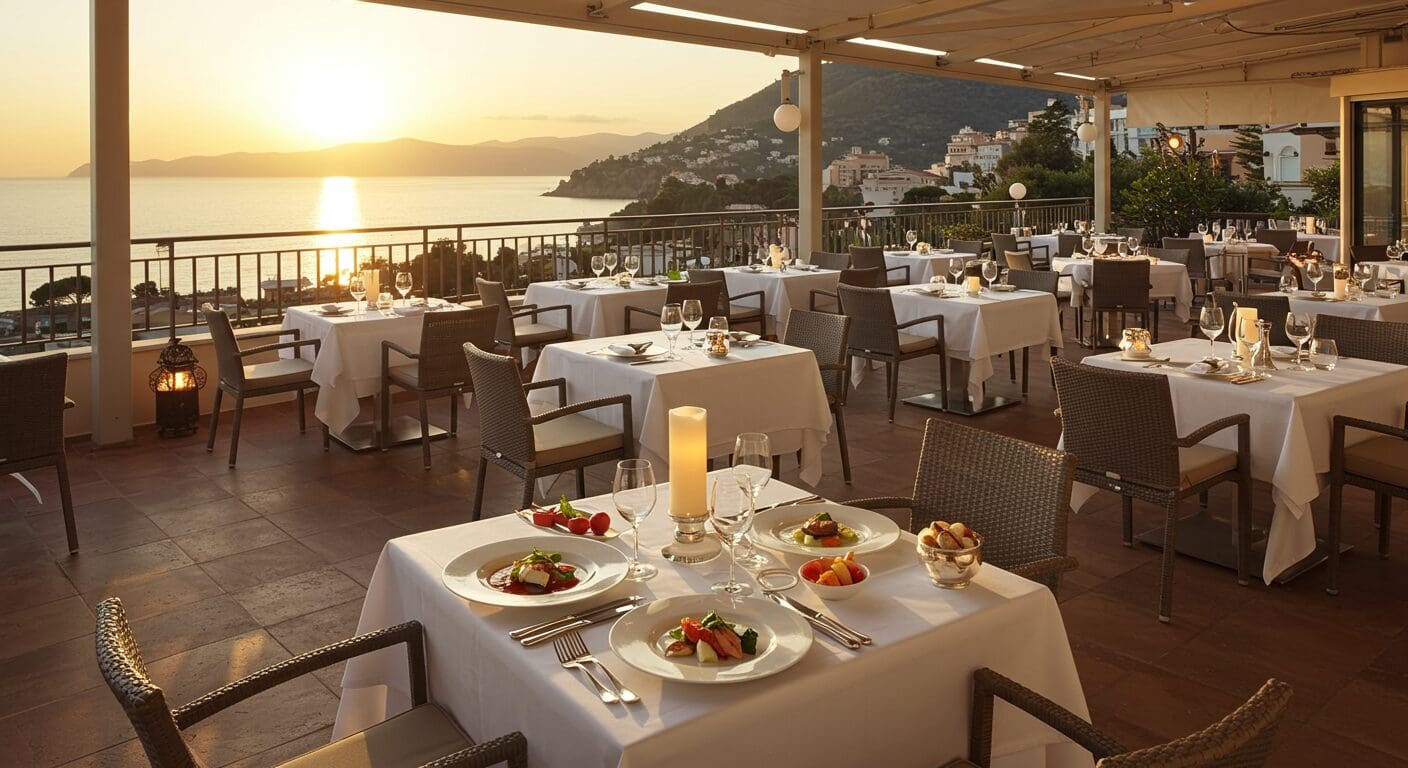
Perugia is a city built on a hill, which means that views are, in theory, available from almost any elevated terrace. In practice, the difference between a view that is pleasant and one that makes you briefly reconsider your life choices is significant, and Ristorante del Sole sits firmly in the second category. Reviewers consistently describe the panorama here as among the finest in the entire city – and given that Perugia’s skyline involves medieval towers, rolling Umbrian countryside, and light that turns amber in a way that makes everyone reach for their phone, that is not faint praise.
The food stands independently of the setting, which is the mark of a kitchen that knows it could coast on the view but has chosen not to. Come for dinner when the light is falling and the valley below begins to soften into dusk. Order the local wine. Resist the urge to narrate the experience in real time to anyone following you on social media. Some things are better absorbed quietly.
Civico 25 – Worth Tracking Down
The best review Civico 25 appears to have received, and one that captures it rather well, is simply: “just…awesome.” Not an elaborate critique. Not a structured analysis of flavour profiles. Just someone, somewhere, who ate there and came away slightly disarmed. Located in the centro storico, it is one of those places that rewards the kind of traveller who does not mind consulting a map twice and turning around once, because finding it is part of the experience and arriving is the payoff.
In a city where centro storico can sometimes mean tourist-adjacent mediocrity with atmospheric stone ceilings, Civico 25 represents the genuine article. The cooking is careful, the atmosphere is warm without being contrived, and the overall experience sits comfortably above the category it might initially appear to inhabit. It is, in short, the kind of restaurant Perugia does very well and that takes a little effort to find – which, in fairness, describes most things worth finding.
Casual Dining, Pizza & Where to Eat Without Ceremony
Not every meal in Perugia needs to be an occasion. Sometimes you want something exceptional without the preamble, the amuse-bouche, or the sommelier’s considered pause before the wine arrives. For those moments, Tankard Pizza & Food Perugia steps forward with a 9.3 rating on TheFork – one of the highest scores across the entire city’s restaurant listing on the platform – and the kind of consistently excellent pizza that makes you slightly irritated you spent your first afternoon wandering the Galleria Nazionale dell’Umbria instead of eating here sooner.
Pizza in Umbria does not always receive the attention it deserves precisely because the region’s pasta and truffle dishes are so dominant in conversation. Tankard is a useful corrective. It is popular, it is well-priced, and it delivers with the kind of reliability that earns a 9.3 in a city full of strong competition.
Beyond pizza, casual eating in Perugia means aperitivo culture taken seriously – bars along the Corso Vannucci that put out proper small plates rather than a bowl of industrial peanuts, and neighbourhood spots in the quieter quartieri where a glass of Sagrantino and a board of local salumi constitutes a perfectly respectable dinner if you have spent the morning walking.
Food Markets & Where to Shop Like a Local
The Mercato Coperto di Perugia – the covered market near Piazza Matteotti – is the kind of place that justifies arriving slightly hungry and leaving considerably less so. Vendors here deal in the produce that ends up on the better restaurant tables: fresh truffles when in season, aged pecorino from the surrounding hills, locally cured meats, fresh pasta, and olive oil pressed in the Umbrian countryside that surrounds the city like a very well-dressed frame.
For the luxury traveller staying in a villa with kitchen access, this is where a morning’s shopping becomes a genuinely pleasurable exercise rather than a logistical one. Buy the truffle. Buy more of the truffle than you think you need. You will use all of it. If you are staying somewhere with a private chef – and in Perugia, several of the finest villas offer exactly this arrangement – a market visit together before lunch is the kind of experience that sounds planned but feels entirely spontaneous.
The market also operates as an unofficial social institution. Perugians do not shop here quickly. Factor that into your morning.
What to Order: The Dishes You Should Not Leave Without Eating
Umbrian cuisine has a character that rewards those who pay attention. The region is landlocked, which means the kitchen has always looked inward – to the forests, the farms, and the wild edges of the landscape – for its defining ingredients. Several dishes appear on enough serious menus to constitute a non-negotiable list.
Strangozzi al tartufo nero – thick, hand-rolled pasta with black truffle sauce – is the dish Perugia is perhaps most widely associated with, and for good reason. When the truffle is fresh and the pasta is properly made, it achieves the rare quality of tasting exactly like itself, with nothing extraneous distracting from it. Order this.
Piccione – roasted pigeon – appears on the menus of most serious Umbrian restaurants and is treated here with far more respect than the bird’s urban reputation might suggest. Porchetta, cooked low and slow with wild fennel and herbs, is found at markets and some trattorias and is not to be bypassed on grounds of informality. And lenticchie di Castelluccio – tiny lentils from the high plain above Norcia – appear as a side dish or base that manages to be both humble and genuinely memorable. This is a trick Umbrian cooking pulls off more often than it has any right to.
Wine, Sagrantino & What to Drink
Umbria produces wine that has been somewhat undervalued in international markets for years, which is good news for the traveller because it means bottles of serious quality are still available at prices that would be unthinkable for equivalent Tuscan labels. The regional star is Sagrantino di Montefalco – a big, tannic red with extraordinary depth that pairs with the region’s meat-forward cooking as though the two were always meant to find each other, which they were, because they grew up in the same landscape.
Orvieto Classico, the white, is elegant and crisp – better with fish and lighter antipasti, or simply as an aperitivo on a warm evening when the city is settling into its post-passeggiata calm. Osteria a Priori’s wine shop is an excellent place to learn more about both categories from people who clearly consider this important.
Locally, Perugians also take their coffee with considerable seriousness. The bars along Corso Vannucci produce espresso that makes a case for never leaving. Midmorning, standing at the bar rather than seated: this is the correct approach, and it costs approximately the same as a deep breath of fresh air.
Reservation Tips & When to Go
The best restaurants in Perugia fill during peak season – July and August bring the heat and the tourists simultaneously, while October’s Eurochocolate festival makes the centro storico extraordinarily busy for ten days. If you are visiting during either period, reservations at La Taverna, Osteria a Priori, and Ristorante del Sole should be made at least a week ahead, and longer for weekend evenings.
TheFork (also known as La Fourchette in Italy) is the most widely used reservation platform for mid-range and upper-mid restaurants in the city, while the finest tables often prefer direct contact by phone or email – sometimes because they like to know who is coming, which is very Italian and entirely reasonable. A villa concierge, if your accommodation includes one, can often secure tables that appear fully booked online.
Spring – April to early June – and autumn, particularly September into October, offer the best combination of manageable crowds and exceptional seasonal ingredients. Truffle season runs from roughly November through March for the prized black truffle, which is as good a reason as any to visit in winter when the city’s medieval streets feel properly medieval rather than festively congested.
The Finest Way to Experience It All
Perugia’s food culture is not something you can extract from its context. The truffle pasta tastes better because you walked the Via dell’Acquedotto beforehand. The Sagrantino means more when you can see the Umbrian hills from where you are sitting. And the morning market makes considerably more sense when you have a kitchen – or a private chef – to bring it home to.
For those who want the full experience without compromise, staying in a luxury villa in Perugia with a private chef option transforms the entire relationship with the local food scene. Rather than simply eating Umbrian food, you participate in it – market in the morning, exceptional cooking in the evening, and the particular pleasure of a table that is entirely your own. It is, in the best possible sense, a different category of visit entirely.
For everything else you need to plan your time in the city – from the Galleria Nazionale dell’Umbria to the Casa del Cioccolato at the Perugina factory – the full Perugia Travel Guide has you comprehensively covered.


